

605 ·GitHub
What is this?
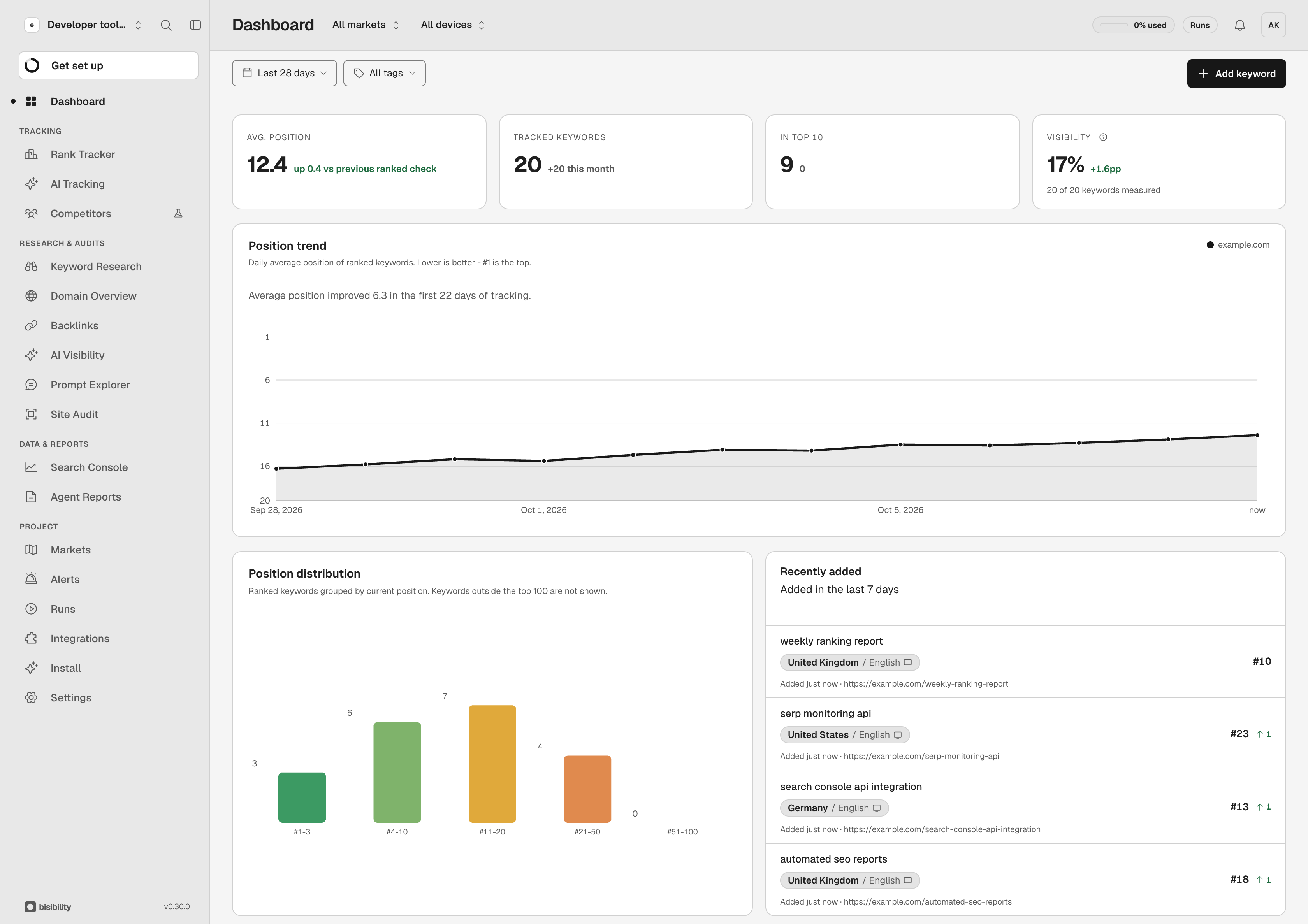
 bisibility is an open-source SEO platform for researching keywords, inspecting backlinks, and tracking Google search rankings, with all the data stored in a PostgreSQL database you control.
bisibility is an open-source SEO platform for researching keywords, inspecting backlinks, and tracking Google search rankings, with all the data stored in a PostgreSQL database you control.Is this a hosted SaaS or something I run myself?It is a self-hostable web application (Next.js dashboard plus REST API) that you deploy on your own PostgreSQL/Redis stack, or you can use the open hosted beta if you do not want to operate the infrastructure yourself.
It is a self-hostable web application (Next.js dashboard plus REST API) that you deploy on your own PostgreSQL/Redis stack, or you can use the open hosted beta if you do not want to operate the infrastructure yourself.How do I get it running?Follow the self-hosting guide to deploy the full stack, or spin up the local demo with synthetic data for a quick look; the local demo quickstart documents the exact bootstrap steps and how to clean up afterward.
Follow the self-hosting guide to deploy the full stack, or spin up the local demo with synthetic data for a quick look; the local demo quickstart documents the exact bootstrap steps and how to clean up afterward.What do I need to self-host it for real use?Production deployments need PostgreSQL, a Redis-compatible store (Valkey by default), and a DataForSEO or SerpAPI account for rank/keyword/backlink data; recurring scheduled checks additionally require the Temporal worker.
Production deployments need PostgreSQL, a Redis-compatible store (Valkey by default), and a DataForSEO or SerpAPI account for rank/keyword/backlink data; recurring scheduled checks additionally require the Temporal worker.Is this stable enough to run in production right now?Not fully - it is an early release before 1.0, so breaking changes and rough edges are expected, and the local demo intentionally uses a fixed, insecure OTP that must never be treated as production-ready.
Not fully - it is an early release before 1.0, so breaking changes and rough edges are expected, and the local demo intentionally uses a fixed, insecure OTP that must never be treated as production-ready.What happens to my SERP provider credentials?If you self-host, your DataForSEO or SerpAPI credentials stay inside your own instance; on the hosted beta they are instead stored encrypted by the managed service, with provider billing staying directly between you and the provider.
If you self-host, your DataForSEO or SerpAPI credentials stay inside your own instance; on the hosted beta they are instead stored encrypted by the managed service, with provider billing staying directly between you and the provider.Can AI agents work with bisibility directly?Yes - it exposes a Model Context Protocol endpoint at /api/mcp alongside its REST API, so agents like Codex can create projects, run keyword checks, and read history using a personal access token or project API key.
Yes - it exposes a Model Context Protocol endpoint at /api/mcp alongside its REST API, so agents like Codex can create projects, run keyword checks, and read history using a personal access token or project API key.What SDKs or CLI tools are available?Official TypeScript, Python, and Go SDKs and a CLI sit on top of REST API v1 and its OpenAPI schema, so you can script rank checks and exports without touching the dashboard.
Official TypeScript, Python, and Go SDKs and a CLI sit on top of REST API v1 and its OpenAPI schema, so you can script rank checks and exports without touching the dashboard.Does self-hosting cost anything beyond my own servers?No application subscription or per-keyword fee - you only pay for your own infrastructure and for SERP requests made through your own DataForSEO or SerpAPI account.
No application subscription or per-keyword fee - you only pay for your own infrastructure and for SERP requests made through your own DataForSEO or SerpAPI account.How does competitor benchmarking work?bisibility tracks Share of Voice against competitors and can optionally pull in Google Search Console and GA4 metrics to line ranking movement up with deploys and CMS changes.
bisibility tracks Share of Voice against competitors and can optionally pull in Google Search Console and GA4 metrics to line ranking movement up with deploys and CMS changes.What are similar projects?rankme.fast, open-seo-mcp-skills, anythingmcp, searchmirror, QuantDinger, goshen-email, clevis, seo-monster
rankme.fast, open-seo-mcp-skills, anythingmcp, searchmirror, QuantDinger, goshen-email, clevis, seo-monster