





What is this?
 opengrok lets you run other LLMs (Claude, GLM, Qwen, Gemini, DeepSeek, local models) inside an existing Grok Bot desktop install, with evidence-based wire maps so each model gets the correct request shape instead of a generic prompt.
opengrok lets you run other LLMs (Claude, GLM, Qwen, Gemini, DeepSeek, local models) inside an existing Grok Bot desktop install, with evidence-based wire maps so each model gets the correct request shape instead of a generic prompt.Is this its own app, or does it plug into Grok Bot?It is a config sidecar, not a standalone app: it writes model bindings and wire maps next to your existing Grok Bot install and tells it which model to talk to, without hosting or emulating Grok Bot itself.
It is a config sidecar, not a standalone app: it writes model bindings and wire maps next to your existing Grok Bot install and tells it which model to talk to, without hosting or emulating Grok Bot itself.How do I get it running?Run the installer: it detects your Grok Bot install and live services, adopts existing bindings or asks three setup questions, writes its config and a machine baseline, then opens the model picker so you can pick, test live, and save a model per agent.
Run the installer: it detects your Grok Bot install and live services, adopts existing bindings or asks three setup questions, writes its config and a machine baseline, then opens the model picker so you can pick, test live, and save a model per agent.What do I need before installing this?A working Grok Bot desktop install, Python 3.9+, Node 18+ for the picker and maps, and API keys for whichever model providers you plan to bind.
A working Grok Bot desktop install, Python 3.9+, Node 18+ for the picker and maps, and API keys for whichever model providers you plan to bind.Does model binding work the same on cloud Grok Bot hosts?No — stock cloud Grok Bot hosts ignore saved bindings until you run the box-patch tool to install the binding consumer into the host; the local → push → patch → bounce → verify flow is required there.
No — stock cloud Grok Bot hosts ignore saved bindings until you run the box-patch tool to install the binding consumer into the host; the local → push → patch → bounce → verify flow is required there.Where do my provider API keys go?They stay local to your machine; opengrok never ships your keys off-box or into committed config.
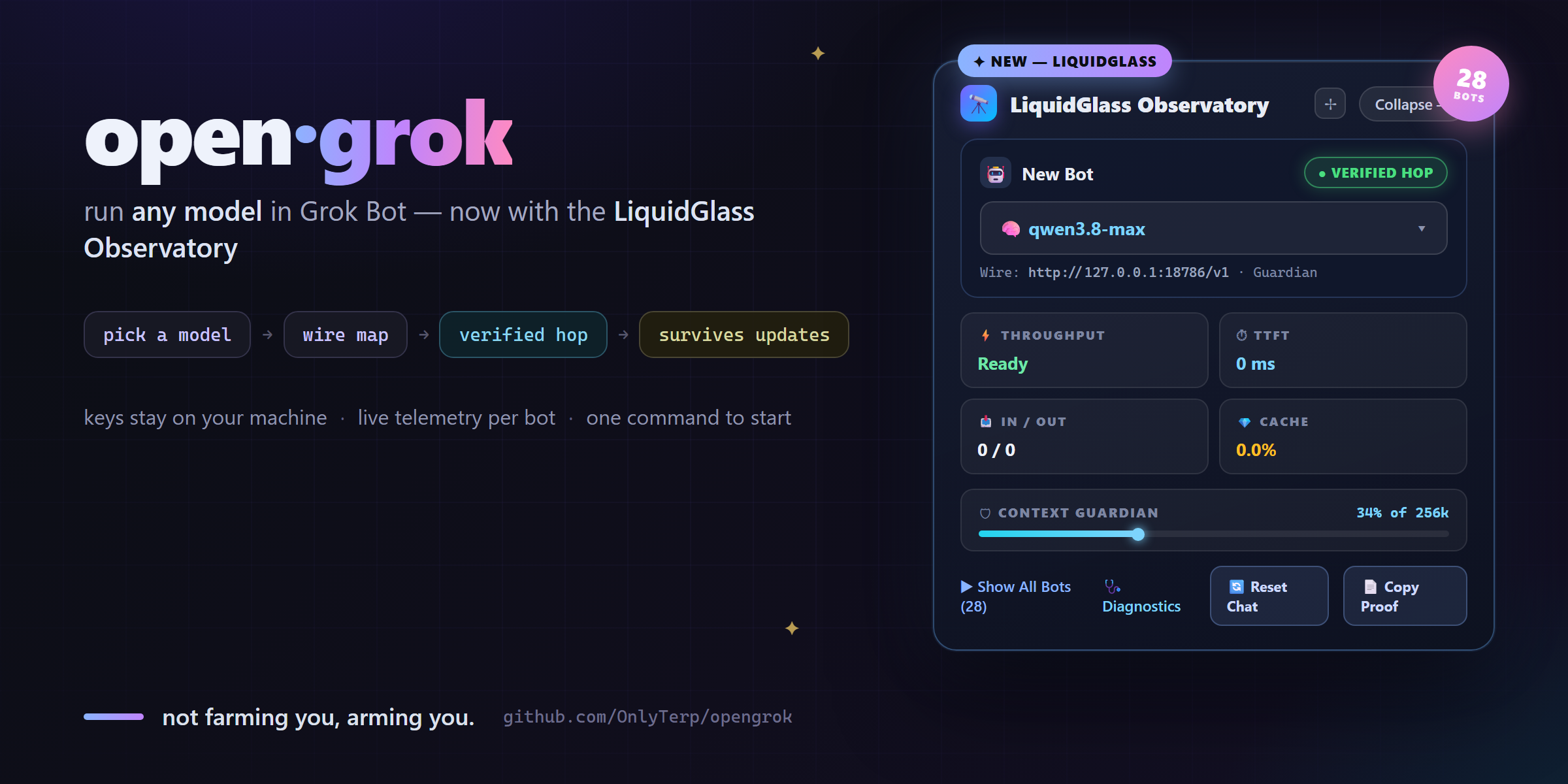
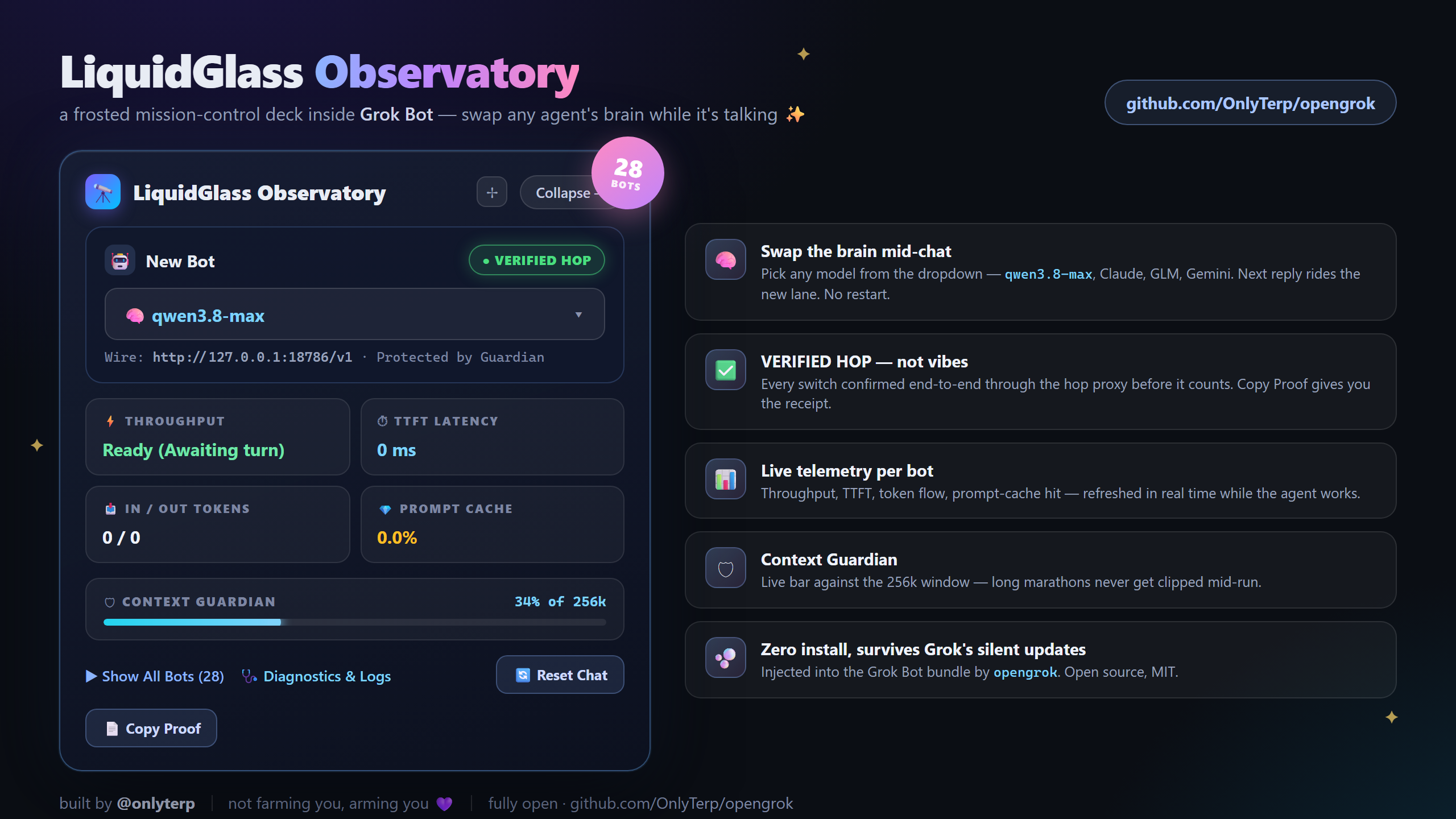
They stay local to your machine; opengrok never ships your keys off-box or into committed config.What is the LiquidGlass Observatory?It's the in-app frosted-glass control panel inside Grok Bot that lets you swap a model mid-chat with no restart, see verified-hop proof per switch, watch per-bot telemetry (throughput, TTFT, token flow, cache hit rate), and track a context-window guardian bar across 28 bots.
It's the in-app frosted-glass control panel inside Grok Bot that lets you swap a model mid-chat with no restart, see verified-hop proof per switch, watch per-bot telemetry (throughput, TTFT, token flow, cache hit rate), and track a context-window guardian bar across 28 bots.Why can't I just point a model's API at Grok Bot directly?Each model family was RL-trained on its own harness's wire shape (reasoning-effort fields, thinking toggles, model-slug conventions). Dropping it in raw causes harness mismatch — it 'works' but runs slower and dumber. opengrok's provider maps fix the exact wire fields per model family, backed by captured probe evidence.
Each model family was RL-trained on its own harness's wire shape (reasoning-effort fields, thinking toggles, model-slug conventions). Dropping it in raw causes harness mismatch — it 'works' but runs slower and dumber. opengrok's provider maps fix the exact wire fields per model family, backed by captured probe evidence.Does it include a voice assistant?Yes — the voice/ folder has a local, localhost-only realtime voice stack: streaming speech-to-text, an OpenAI realtime brain, and ElevenLabs text-to-speech with barge-in support, set up via a guided walkthrough.
Yes — the voice/ folder has a local, localhost-only realtime voice stack: streaming speech-to-text, an OpenAI realtime brain, and ElevenLabs text-to-speech with barge-in support, set up via a guided walkthrough.How does it survive Grok Bot's silent updates?doctor.py baselines your machine on first setup and re-checks files, services, and caches after updates, reporting exactly what drifted; a --quiet mode stays silent when nothing changed, which is cron-friendly.
doctor.py baselines your machine on first setup and re-checks files, services, and caches after updates, reporting exactly what drifted; a --quiet mode stays silent when nothing changed, which is cron-friendly.What are similar projects?casbin-gateway, aichat, router, openclaw-zero-token, opencodex, 9router, ccx, ThinkWatch-Lite
casbin-gateway, aichat, router, openclaw-zero-token, opencodex, 9router, ccx, ThinkWatch-LiteWhich topics is it in?model-router, llm-gateway, voice-assistant, byok, grok, configuration, speech-recognition, tts, qwen, openai-compatible, local-llm, deepseek
model-router, llm-gateway, voice-assistant, byok, grok, configuration, speech-recognition, tts, qwen, openai-compatible, local-llm, deepseek