
23.8K ·GitHub
What is this?
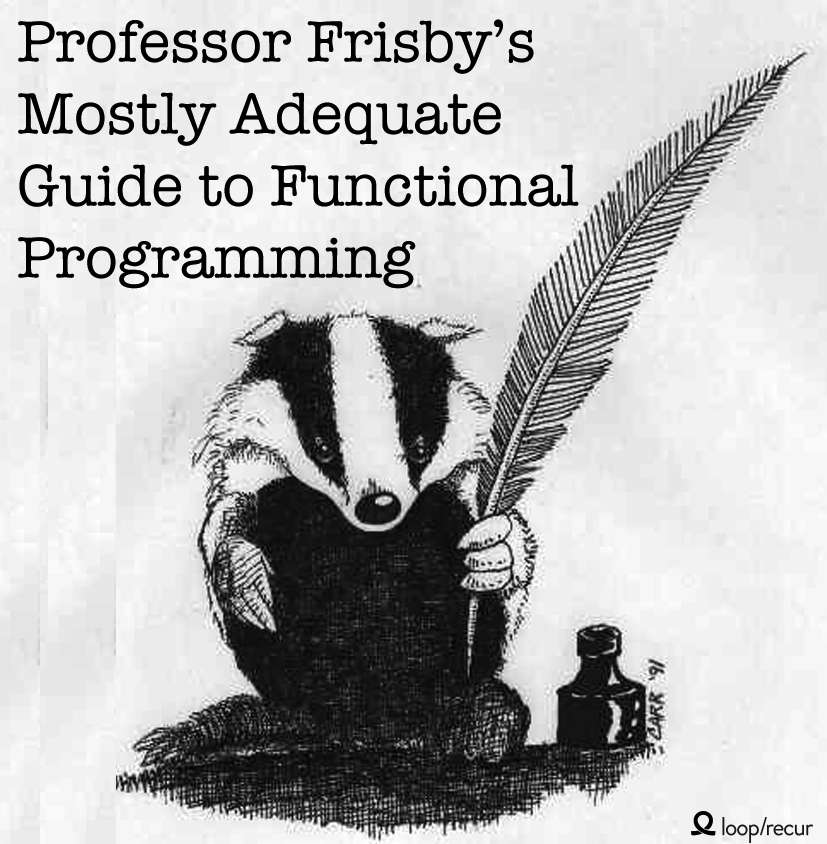
 'Mostly Adequate Guide to FP' is a free book that teaches functional programming concepts using JavaScript, going from pure functions and composition up through functors, monads and other categorical ideas.
'Mostly Adequate Guide to FP' is a free book that teaches functional programming concepts using JavaScript, going from pure functions and composition up through functors, monads and other categorical ideas.Is this a coding library or just a book I read?It's primarily a book you read chapter by chapter online, as PDF or as EPUB, but the code snippets are also packaged as an npm module, and each chapter has a runnable exercise.js file you can solve in your own editor.
It's primarily a book you read chapter by chapter online, as PDF or as EPUB, but the code snippets are also packaged as an npm module, and each chapter has a runnable exercise.js file you can solve in your own editor.How do I start reading it?The easiest path is reading it online via GitBook, which adds a sidebar, in-browser exercises and examples; if you want an offline copy, pre-built PDF and EPUB files are attached to the latest GitHub release.
The easiest path is reading it online via GitBook, which adds a sidebar, in-browser exercises and examples; if you want an offline copy, pre-built PDF and EPUB files are attached to the latest GitHub release.Is building the book locally painless?Not really — the build setup is outdated, so you're likely to hit issues unless you install the specific old Node version and have Calibre's ebook-convert tool ready.
Not really — the build setup is outdated, so you're likely to hit issues unless you install the specific old Node version and have Calibre's ebook-convert tool ready.How is the book structured?It has three parts: Part 1 (chapters 1-7) covers basics like pure functions, currying and composition; Part 2 (chapters 8-13) covers type classes such as functors and monads through to traversable; Part 3 (chapter 14+) tackles comonads, f-algebras, free monads and other categorical constructs.
It has three parts: Part 1 (chapters 1-7) covers basics like pure functions, currying and composition; Part 2 (chapters 8-13) covers type classes such as functors and monads through to traversable; Part 3 (chapter 14+) tackles comonads, f-algebras, free monads and other categorical constructs.Why did the author use JavaScript instead of a purer FP language like Haskell?Because most readers already use JS daily, so they can practice FP on real-world code instead of toy projects, while JS is flexible enough to let beginners fall back on familiar imperative habits while they learn.
Because most readers already use JS daily, so they can practice FP on real-world code instead of toy projects, while JS is flexible enough to let beginners fall back on familiar imperative habits while they learn.Can I actually practice along as I read?Yes — every chapter has a runnable exercise.js file (e.g. exercises/ch04) you complete in your own editor and then run to check your work.
Yes — every chapter has a runnable exercise.js file (e.g. exercises/ch04) you complete in your own editor and then run to check your work.Is the content finished or still evolving?Part 1 is described as an initial draft still being corrected, and Parts 2 and 3 are listed as future plans, so the book keeps growing and changing over time.
Part 1 is described as an initial draft still being corrected, and Parts 2 and 3 are listed as future plans, so the book keeps growing and changing over time.What are similar projects?the-way-to-go_ZH_CN, wtfpython-cn, typescript-book, build-web-application-with-golang, zh.javascript.info, up, Functional-Light-JS, typescript-book
the-way-to-go_ZH_CN, wtfpython-cn, typescript-book, build-web-application-with-golang, zh.javascript.info, up, Functional-Light-JS, typescript-bookWhich topics is it in?reactive-programming, epub, functional-programming, npm-package, ebook, translation, programming, book, pdf, beginner-friendly, guide, learning-resources
reactive-programming, epub, functional-programming, npm-package, ebook, translation, programming, book, pdf, beginner-friendly, guide, learning-resources