Prism is an open-source contract litigation management system for drafting, reviewing, sharing, and managing legal work. Luna is the AI assistant inside Prism. The browser application uses React and Vite. The API uses Express, Better Auth, PostgreSQL, and Drizzle ORM.
Legal work is still too fragmented. Teams draft documents, review contracts, compare versions, check compliance, and manage negotiations across different tools. Prism brings that work together in one connected workspace.
Review documents, work together, and keep every clause in context.
Prism AI
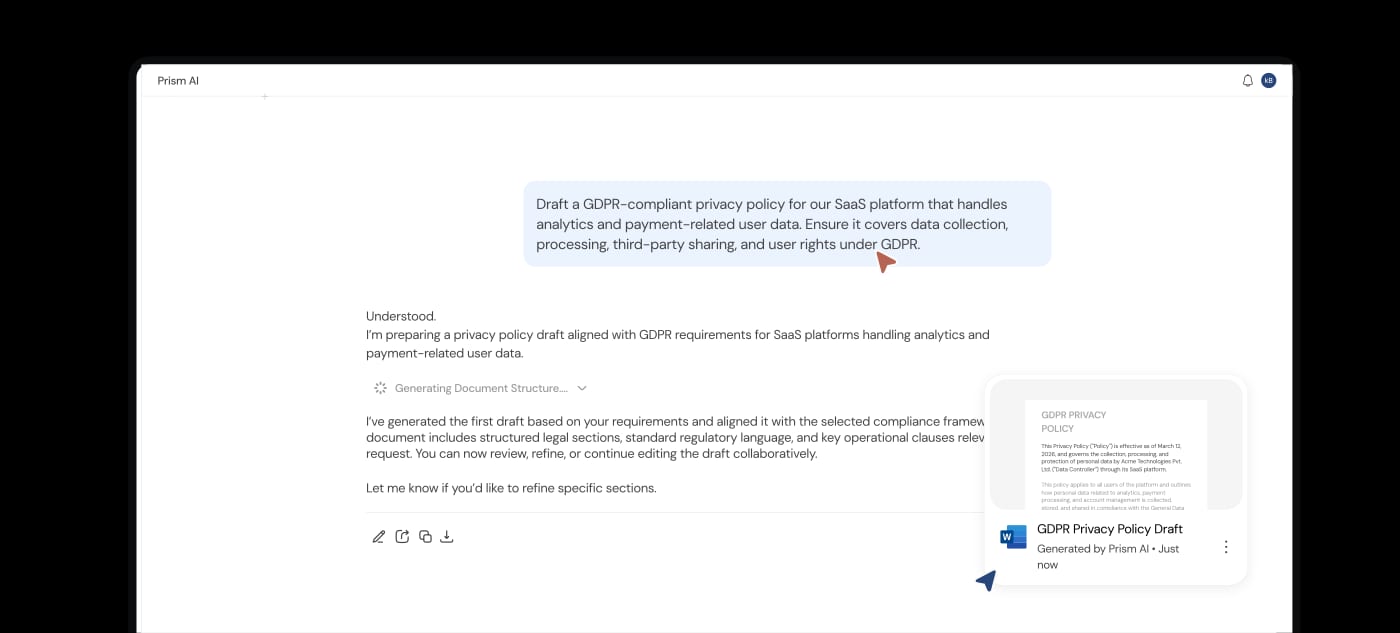
Research, draft, and refine legal documents with your AI assistant.
Contract Intelligence
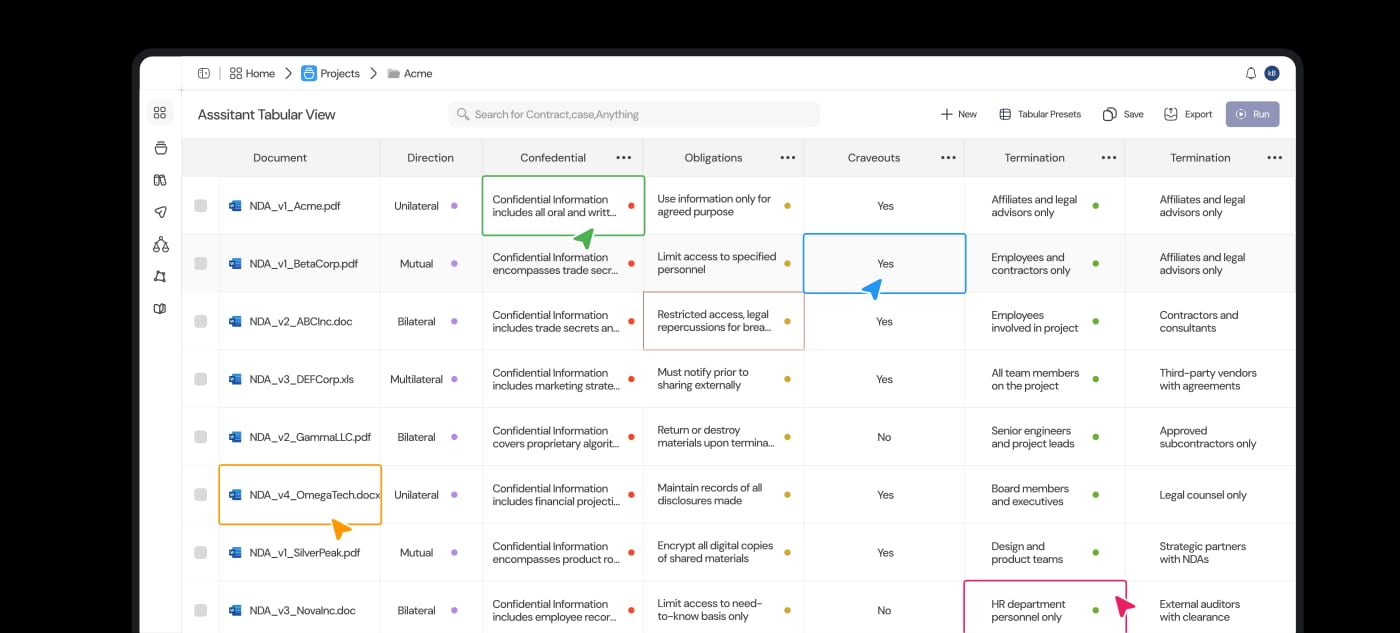
Compare documents side by side and bring the details that matter into view.
Document Intelligence
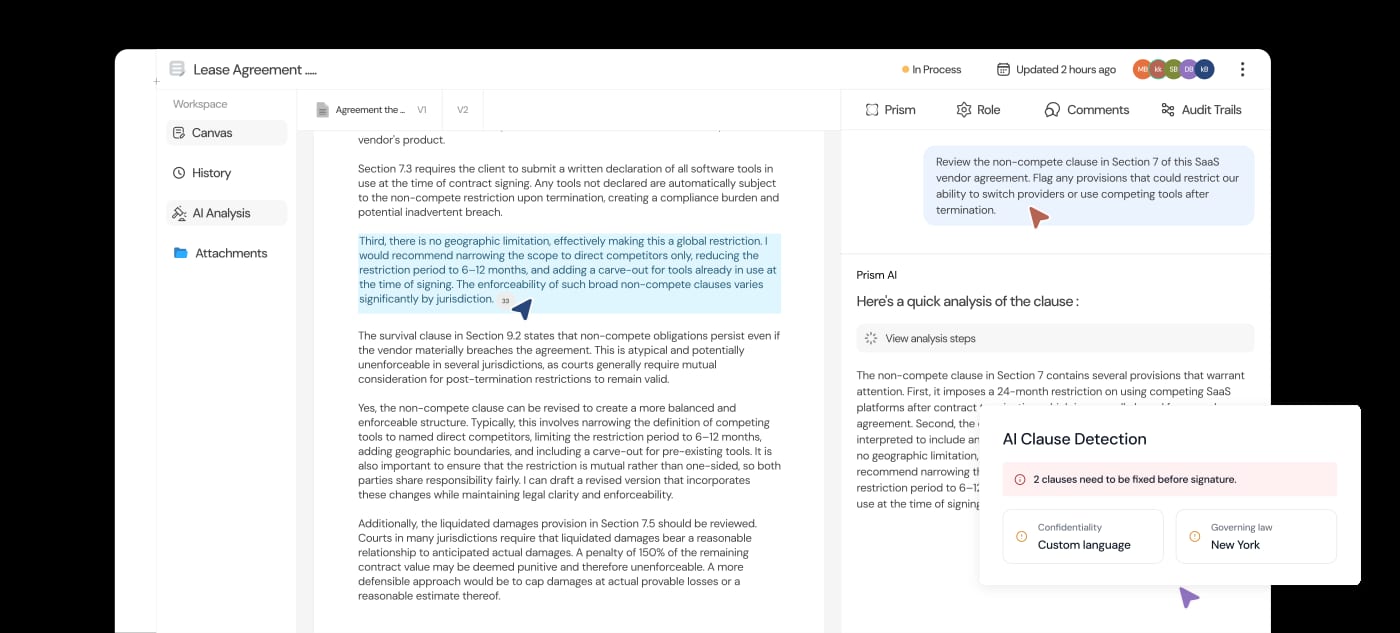
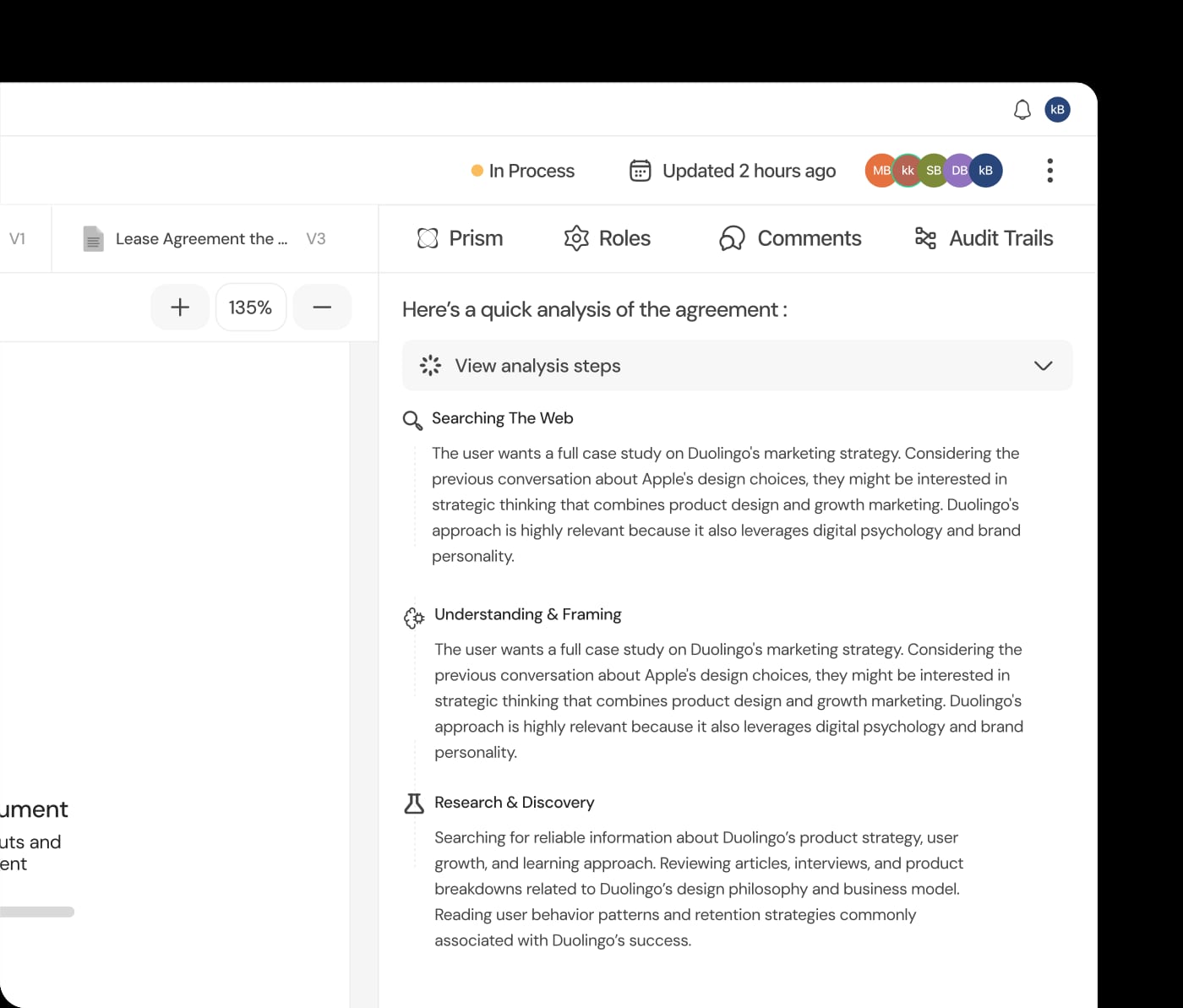
Analyze legal documents with speed and precision. Extract clauses, obligations, risks, key entities, and critical information from contracts, policies, and legal documents in seconds.
Features
Draft faster. Check smarter. Work better. Start with a template or a request to Luna, bring your documents into a shared workspace, and move drafts through review and approval. Explore the feature guide for workflows, examples, and setup requirements.
Identify legal risks before they become problems. Spot missing clauses, compliance gaps, conflicting terms, and potential risks with supporting context.
Bring the whole team into the conversation. Discuss clauses, share feedback, resolve comments, and approve or reject drafts with activity history.
Legal workflow
All your legal work, one connected workspace:
Organize. Bring primary and supporting documents into a shared legal workspace.
Research. Explore your sources with AI-assisted answers and supporting references.
Draft. Start with a legal template and refine your draft with Luna.
Analyze. Extract and compare key terms across multiple documents.
Review. Check contracts against your team's review playbooks.
Refine. Edit clauses, resolve comments, and keep a history of every version.
Approve. Bring your team together to review and approve the final draft.
Export. Export your document in Word or PDF, ready for the next step.
AI features require a configured provider. Indexed source retrieval also requires Qdrant and an OpenAI key, and background analysis requires the worker. Each feature guide explains its prerequisites. AI output and templates need qualified legal review before use.
[!IMPORTANT]
Deploy on your terms
Self-hosted: your infrastructure, your control. Get the source, customize Prism, and run it wherever you choose.
Managed by FuturixAI: we deploy, maintain, and run Prism for your team. You focus on legal work.
For private infrastructure, custom integrations, migration support, or managed rollouts, contact [email protected].
What runs
The repository has three application processes and two data services:
frontend/ contains the React 19 and Vite 8 single-page application.
The shared event contract lives in packages/protocol/. Uploaded and generated files live in an S3-compatible object store. Compose runs MinIO for it, and host development can use local files.
Quick start
Install Docker Engine with Docker Compose. You need a Resend API key for sign-in email. An OpenAI API key enables Luna and document search.
Run the remaining commands from the new Prism directory.
cp .env.example .env
Set RESEND_API_KEY and OPENAI_API_KEY in .env, then start Prism.
docker compose up -d
Open http://localhost:8080 and sign in with your email address. The six-digit sign-in code arrives by email through Resend.
The default sender, [email protected], delivers only to the email address of your Resend account. To invite other people, set MAIL_FROM in .env to an address on a domain you have verified in Resend, then run docker compose up -d again.
Compose starts PostgreSQL, Qdrant, MinIO, the API, the worker, and the frontend. MinIO stores uploaded and generated files in the prism bucket, which Compose creates on first start. The backend container runs migrations automatically before it starts the API. It also seeds approval policies, workflows, the AI model catalog, and all 61 bundled templates. Prism generates its application secrets on first start and keeps them in the prism_secrets volume.
The API listens on http://localhost:8003, with API documentation at http://localhost:8003/api-docs. To grant an existing account the global administrator role, run:
Adding -v deletes the database, stored files, search index, and generated secrets.
Develop Prism on the host
Install Node.js 22.x, npm 11.19.0, and Docker Engine with Docker Compose. Install LibreOffice if you need DOC or DOCX to PDF conversion. Puppeteer installs its Chromium build with the normal dependency install.
Complete the .env step from the quick start, then run:
npm ci
docker compose up -d postgres qdrant
cp backend/.env.example backend/.env
npm run setup --workspace @prism/backend
npm run dev
setup builds the backend, applies migrations, and runs every seed. Rerun it after you pull new migrations. The backend generates its secrets into backend/.secrets.env on first start.
Open http://localhost:5173. The API listens on http://localhost:3001. The worker does not open a network port.
Luna uses the server OpenAI connection when OPENAI_API_KEY is set. Users can add their own Anthropic, Google, OpenAI, and OpenAI-compatible connections under Settings > AI settings.
Document search needs Qdrant and OPENAI_API_KEY. Compose runs Qdrant for you. Without both, uploads still work, but source indexing and source-backed search do not.
Storage uses MinIO under Compose and the local filesystem for host development. Production requires S3-compatible storage and rejects local storage.
Without RESEND_API_KEY, mail records delivery as suppressed and does not expose email contents or sign-in codes.
DOC and DOCX conversion uses LibreOffice. HTML to PDF conversion uses Puppeteer Chromium.
The worker handles document indexing, compliance runs, tabular generation, email delivery, health checks, and storage reconciliation.
The full sequence verifies the publication rules, authentication migration guard, database baseline, seed data, formatting, lint, types, unit and security tests, production dependency audit, builds, and mocked browser journeys.
Prism is licensed under GNU Affero General Public License version 3 only. If you modify Prism and let users interact with that modified version over a network, section 13 requires you to offer those users the Corresponding Source of the running version at no charge through a standard method. Sections 4 through 6 also contain notice and source requirements for distribution.
The application does not add a source-code link for an operator. A host of a modified version must provide an appropriate source offer that matches the deployed version. Keep the license and notices with redistributed copies.
This paragraph summarizes repository obligations. It is not legal advice. Read the license and ask qualified counsel how it applies to your deployment.
What is this?Prism is an open-source legal OS for contract drafting, review, legal research, and litigation management, with an AI assistant called Luna built in.
Is this a SaaS product or something I run myself?It is a self-hosted web application you run with Docker Compose (React/Vite frontend, Express API), though FuturixAI also offers to run it for you as a managed service.
How do I get Prism running?Install Docker Engine with Docker Compose, set RESENDAPIKEY and OPENAIAPIKEY in .env, then run docker compose up -d, which starts PostgreSQL, Qdrant, MinIO, the API, the worker, and the frontend.
Do I need a Resend or OpenAI key before I start?You need a Resend API key for the email sign-in code, and an OpenAI API key to enable Luna and document search; users can later add their own Anthropic, Google, OpenAI, or OpenAI-compatible connections.
What happens if I skip the OpenAI key or Qdrant?Uploads still work, but source indexing and AI-backed search require both Qdrant and the OpenAI key; without a Resend key, sign-in emails are just suppressed rather than sent.
Who is Prism built for?It is aimed at legal teams who need one shared workspace to draft, review, research, and approve contracts instead of juggling separate tools.
What does the AGPL license mean if I host a modified Prism?Prism is AGPLv3-only, so if you modify it and let users interact with that version over a network, you must offer them the Corresponding Source of the running version at no charge.
What exactly does Luna do?Luna is the AI assistant inside Prism that helps research, draft, and refine legal documents, answering questions about uploaded files with supporting source references.
Does Prism come with ready-made contract templates?Yes, it bundles 61 contract and legal-document templates (54 Word and 7 HTML) with guided fields that you can refine with Luna.
What formats can I export finished documents in?Edited drafts can be exported as Word or PDF documents, ready for the next step in the legal workflow.
Where does Prism store uploaded files and search data?PostgreSQL stores application data and job queues, Qdrant stores the document search index, and uploaded/generated files go to an S3-compatible store (MinIO under Docker Compose).













 Prism is an open-source legal OS for contract drafting, review, legal research, and litigation management, with an AI assistant called Luna built in.