Official code and pretrained checkpoints for
PrismQuant: Optimal Null-Space Rotations for Grouped Quantizers
(arXiv:2609.32429), by Yanlong Chen, Yining Chen, Song Zhang, Amirhossein Habibian,
and Yawei Li. See the released models for all Hugging Face checkpoints.
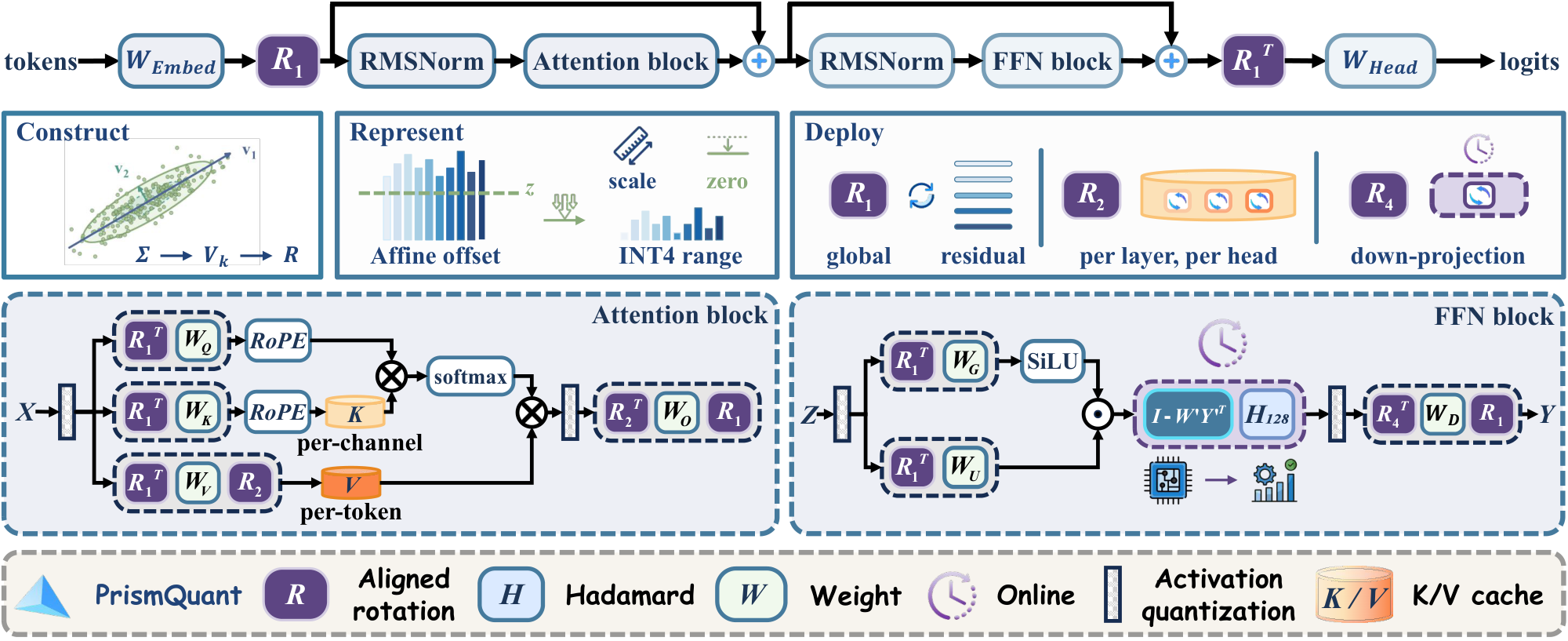
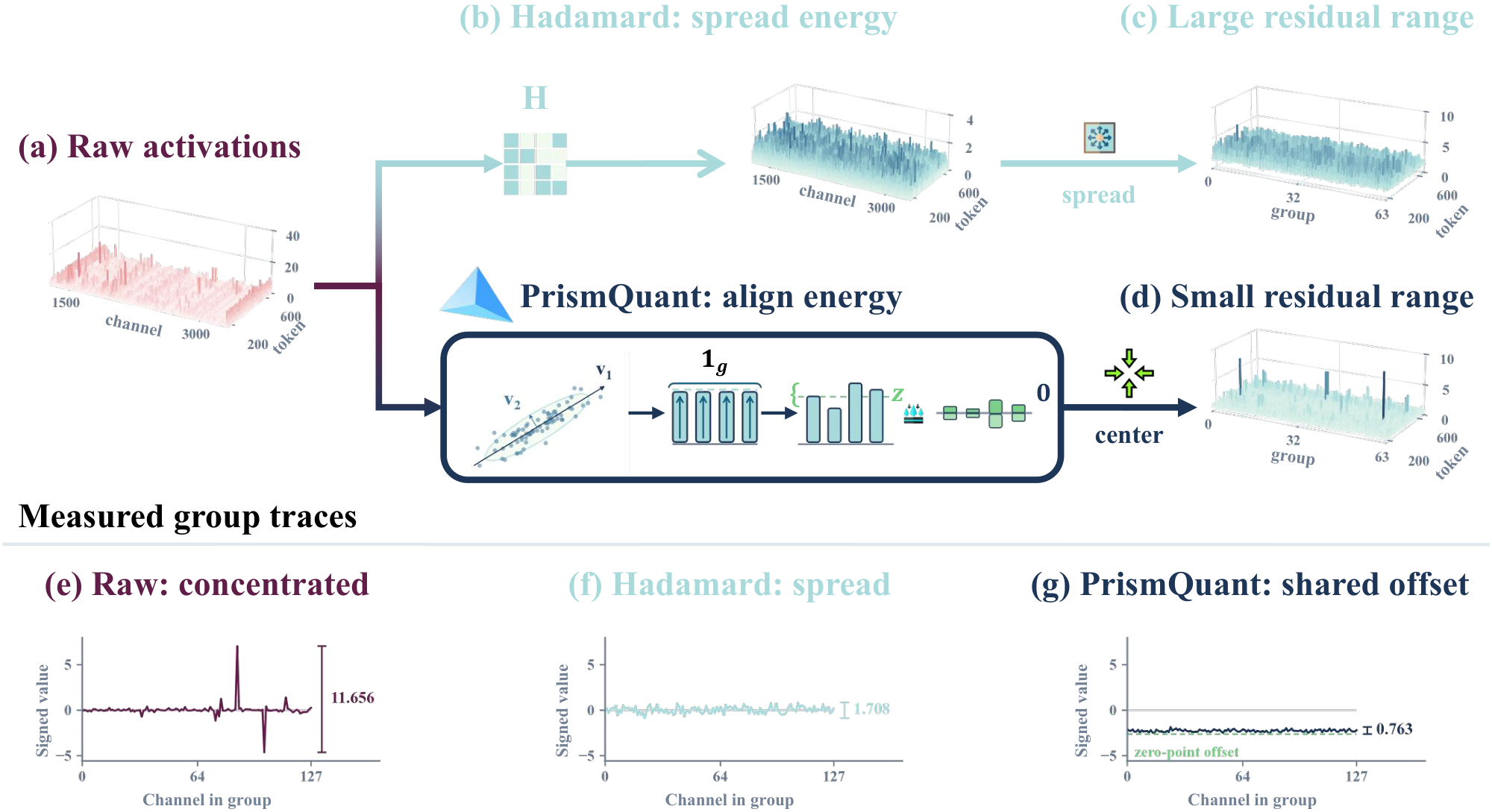
PrismQuant aligns high-energy activation directions with the constant directions
of quantization groups. It combines calibrated orthogonal rotations, compact-WY
representations and groupwise asymmetric INT4 quantization. This repository
contains the core implementation, released model checkpoints and paper figures.
Quick start
Use Python 3.10+ and a PyTorch installation appropriate for your CUDA version.
git clone --depth 1 https://github.com/ForeverBlue816/PrismQuant.git
cd PrismQuant
pip install -e .
prismquant models
Start with the smallest released model:
from prismquant import load_model

model = load_model("qwen3_0.6b_base")
print(model.generate("The key idea behind quantization is", max_new_tokens=64))
Or use the command line:
prismquant generate --model qwen3_0.6b_base \
  --prompt "The key idea behind quantization is" --max-new-tokens 64
The loader downloads only the selected checkpoint and its required rotation
factors, then obtains the matching base model and tokenizer. The default
PrismQuant configuration is selected automatically. These are base-model completions, not chat-tuned
assistants. See model selection, memory and loading options.
Checkpoint format. The released GPTQ weights are dequantized INT4 values in
floating-point tensors. The reference runtime simulates activation and KV
quantization while retaining floating-point storage; it is not a packed INT4
serving engine. Use this package's loader, rather than passing the artifact repo
to AutoModelForCausalLM.from_pretrained. The separate fused R4 kernels are
provided for implementation work.
Released models
The model catalog pins the model artifacts and base
models to exact revisions. The MoE release includes all expert weights and
per-expert rotations. Upstream model licenses apply.
Method
- Construct: estimate dominant uncentered activation directions and map them
to group anchors with Householder reflectors and a balanced permutation.
- Represent: apply block Hadamard transforms so aligned directions become
constant within groups; store the group scale and real affine offset in fp16.
- Deploy: fold static transforms into weights and use compact-WY factors for
the remaining online rotations.
The core rotation can also be used independently of a language model:
import torch
from prismquant import fit_rotation, dynamic_asym_int4

calibration = torch.randn(512, 256)  # replace with your calibration activations
rotation = fit_rotation(calibration, rank=2, group_size=128)
signs = torch.ones(256)
rotated = rotation.apply(calibration, signs)
quantized, scale, offset, codes = dynamic_asym_int4(rotated, 128)
reconstructed = rotation.transpose(quantized, signs)
This example fits a rotation from user-provided activation samples using exact
second moments. See the technical guide for conventions and
the kernel guide for the fused path.

Seven paper results are indexed on Papers with Code.
As checked on 2026-10-14, PrismQuant on Llama-3.1-70B, W4A4KV4, k=8
has 3.85 WikiText-2 perplexity and ranks first among that site's indexed
WikiText-2 results. This rank is specific to the indexed comparison set;
base models, tokenizers, precision budgets and evaluation protocols differ.
The badge shows the published score, not a live rank.
All seven scores are unchanged, and the catalog now includes the checkpoint
links and clarified evaluation protocols. See verified evaluation metadata
for evaluation settings and reproduction guidance. Catalog verification is
not an independent experimental replication.
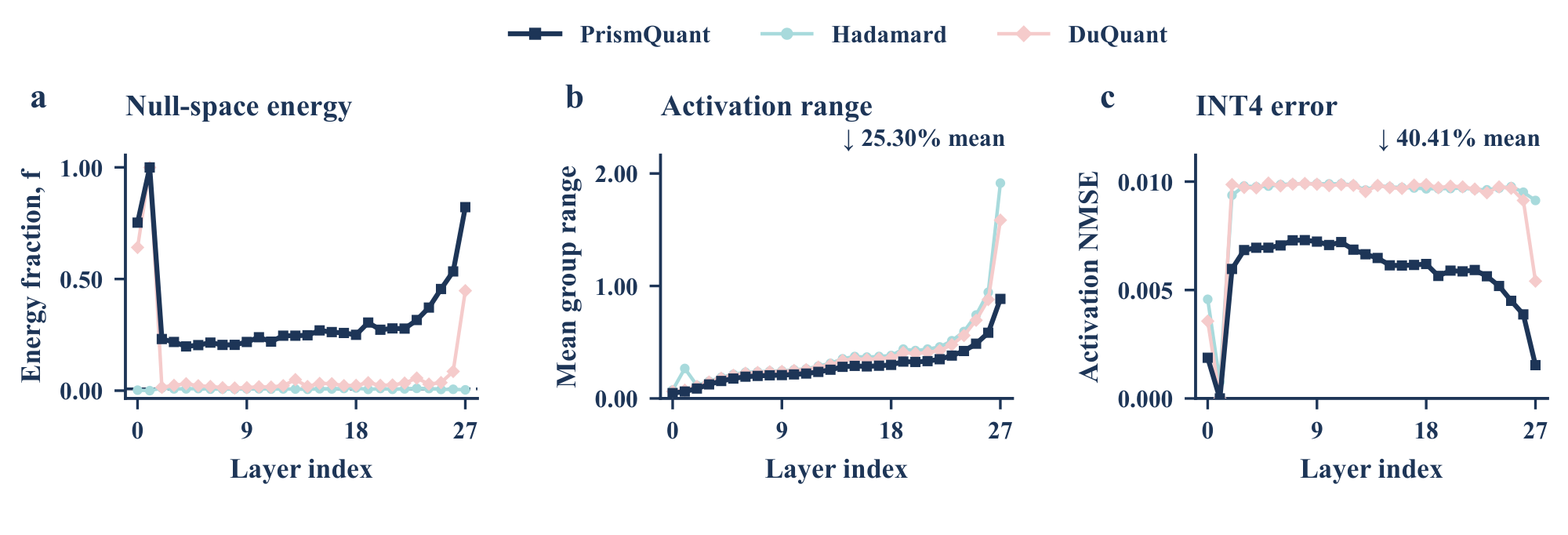
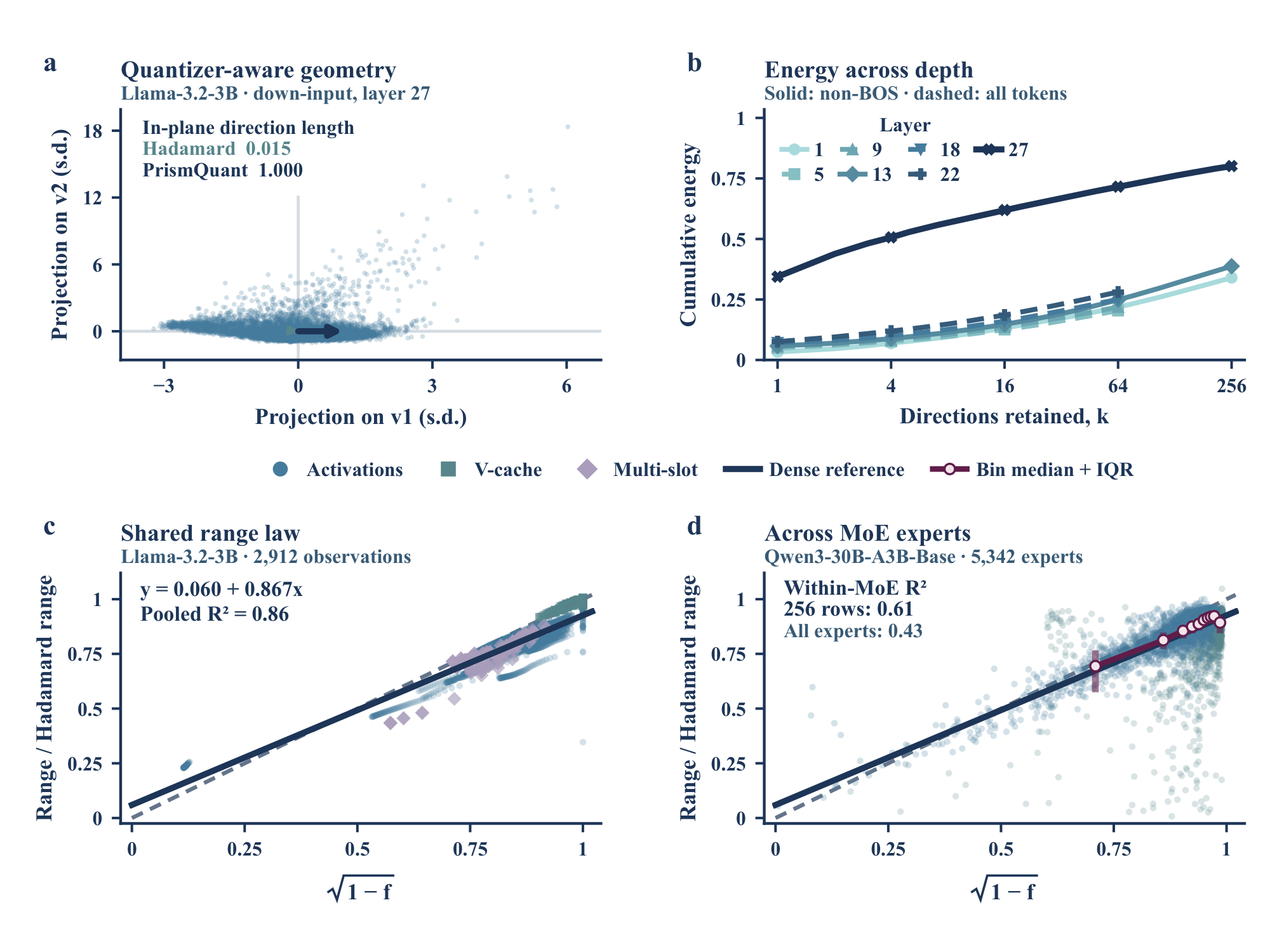
The figure gallery includes the author's final Figure 1–6,
method overview and activation matrices, with PDF originals and PNG/SVG previews.
Figure 5 reports the dedicated deployment implementation; its throughput should
not be attributed to the floating-point reference loader above.
Repository layout
prismquant/       Rotation, quantization, GPTQ, folding, loading and CUDA kernels
examples/         Text completion and standalone rotation examples
Figures/          Author-provided paper figures and shareable previews
docs/             Model format, technical guide and reproduction pointers
tests/            Algebra, metadata, loading and generation checks
This repository provides the reference implementation, released model catalog,
tests and paper figures. See reproduction guidance for
model revisions, evaluation settings and the scope of the public package.
Development
pip install -e '.[dev]'
pytest -q
See release validation for the test scope and numerical checks.
Paper and citation
PrismQuant: Optimal Null-Space Rotations for Grouped Quantizers
Yanlong Chen, Yining Chen, Song Zhang, Amirhossein Habibian, and Yawei Li.
@article{chen2026prismquant,
  title={PrismQuant: Optimal Null-Space Rotations for Grouped Quantizers},
  author={Chen, Yanlong and Chen, Yining and Zhang, Song and Habibian, Amirhossein and Li, Yawei},
  journal={arXiv preprint arXiv:2609.32429},
  year={2026},
  doi={10.48550/arXiv.2609.32429},
  url={https://arxiv.org/abs/2609.32429}
}
License and acknowledgments
Code: Apache-2.0. Model weights retain their respective upstream
licenses. Built with Llama for the Llama-derived checkpoints. The GPTQ core is
adapted from QuaRot; see
third-party notices.



 PrismQuant 是一篇关于大语言模型 INT4 量化研究论文的官方代码和预训练检查点。它利用校准后的正交旋转,将高能量的激活方向与量化分组的常量方向对齐。