




ponytail README

The project's README from github.com/DietrichGebert/ponytail. As one markdown file: README.md.

Ponytail, the lazy senior dev

Ponytail

He says nothing. He writes one line. It works.

DietrichGebert%2Fponytail | Trendshift

Stars Release npm Works with 20 agents MIT license

Using Ponytail at work? Tell us your story

DietrichGebert/ponytail | Trendshift DietrichGebert/ponytail | Trendshift DietrichGebert%2Fponytail | Trendshift monthly ranking

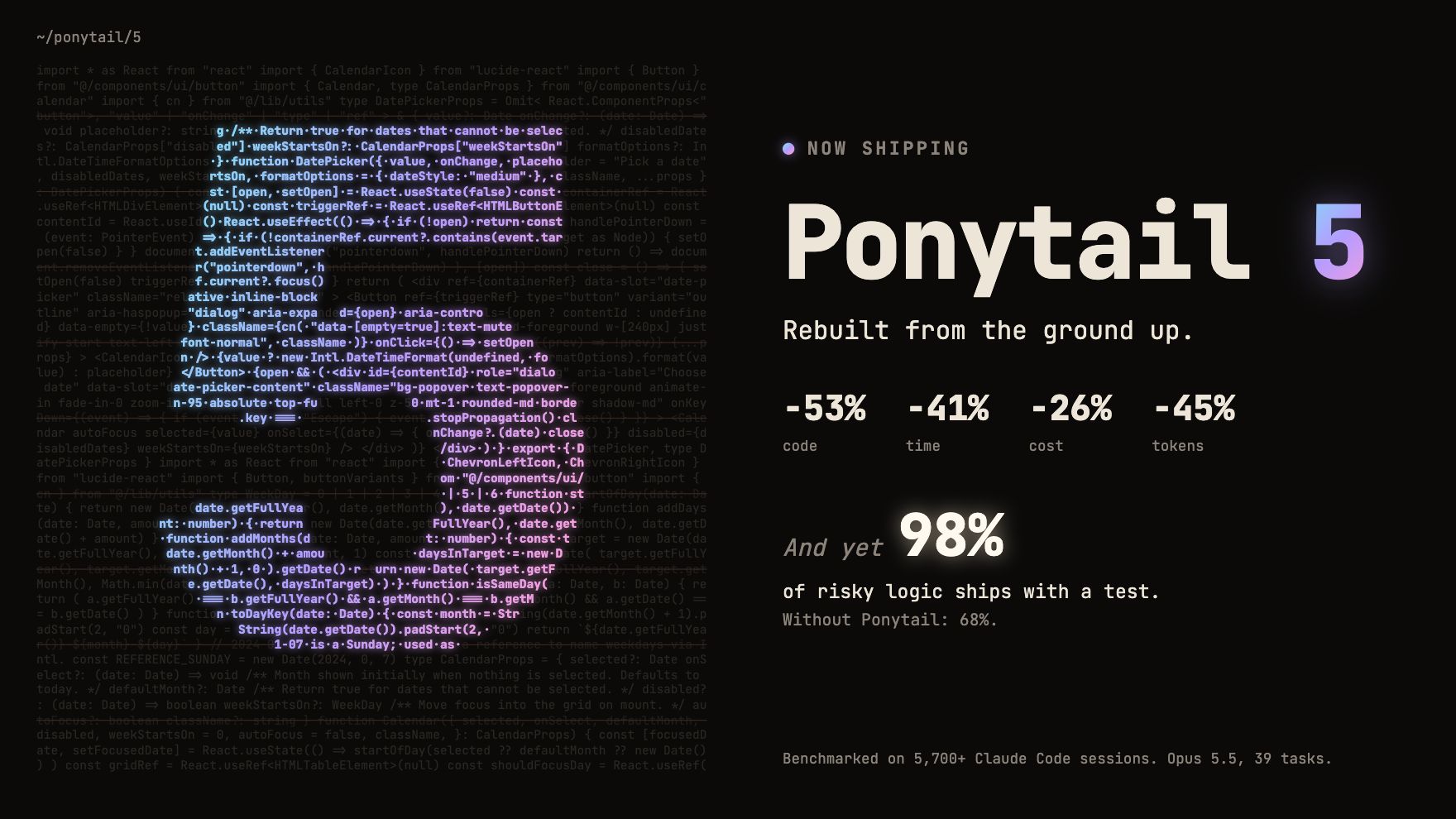
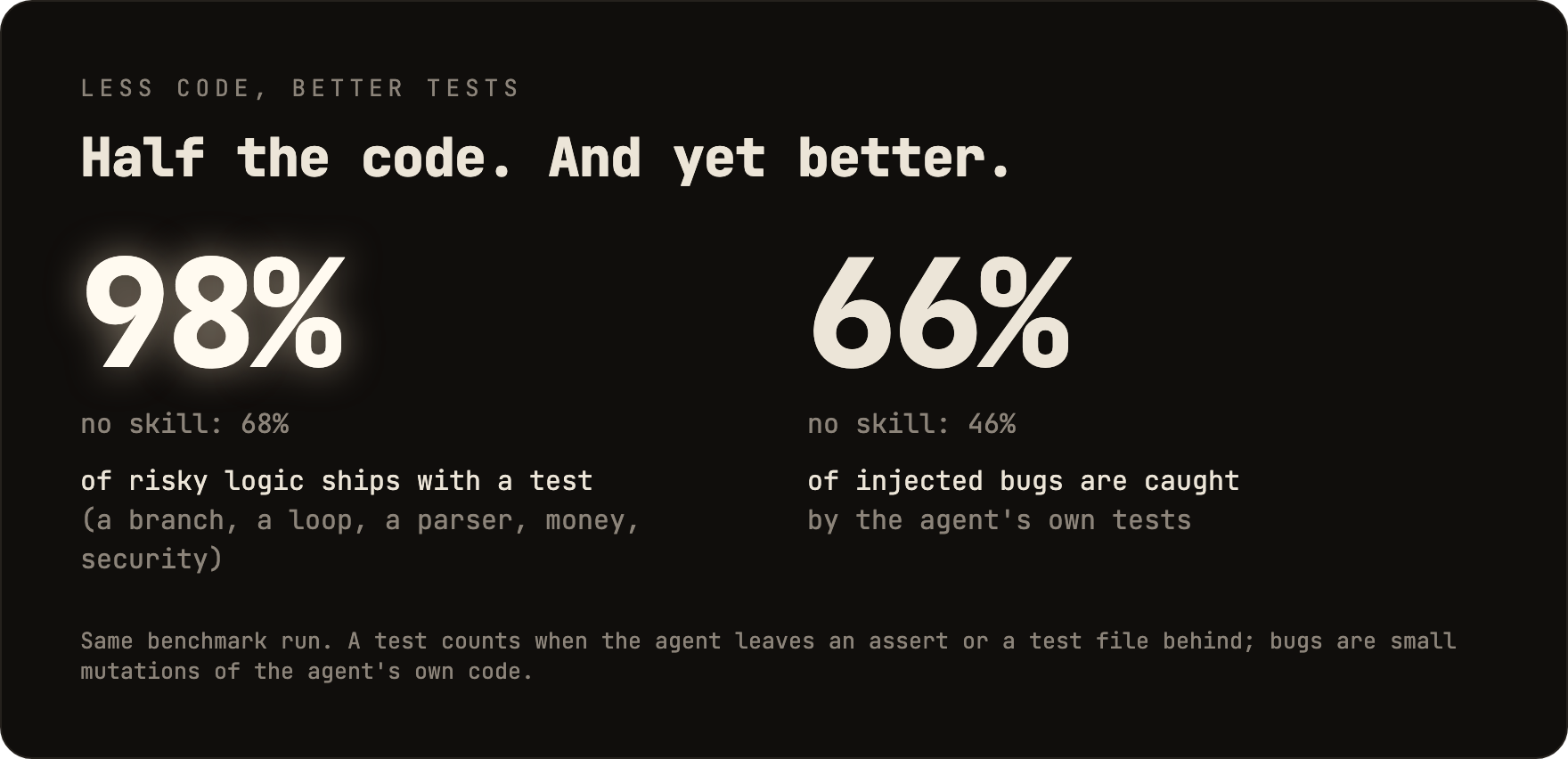
Ponytail 5, rebuilt from the ground up: -53% code, -41% time, -26% cost, -45% tokens. And yet 98% of risky logic ships with a test, without Ponytail 68%.

Ponytail 5: rebuilt from the ground up.
-53% code · -41% time · -26% cost · -45% tokens
And yet: 98% of risky logic ships with a test. Without Ponytail: 68%.
Benchmarked in Claude Code, the same agent with and without the skill: 39 tasks including a real FastAPI + React repo, Opus 5.5, 5 runs each. Details.

Español · 한국어 · 简体中文 · 日本語


Something's coming, join the waitlist

Already built with Ponytail

Retriever

You know him. Long ponytail. Oval glasses. Has been at the company longer than the version control. You show him fifty lines; he looks at them, says nothing, and replaces them with one.

Ponytail puts him inside your AI agent.

Numbers

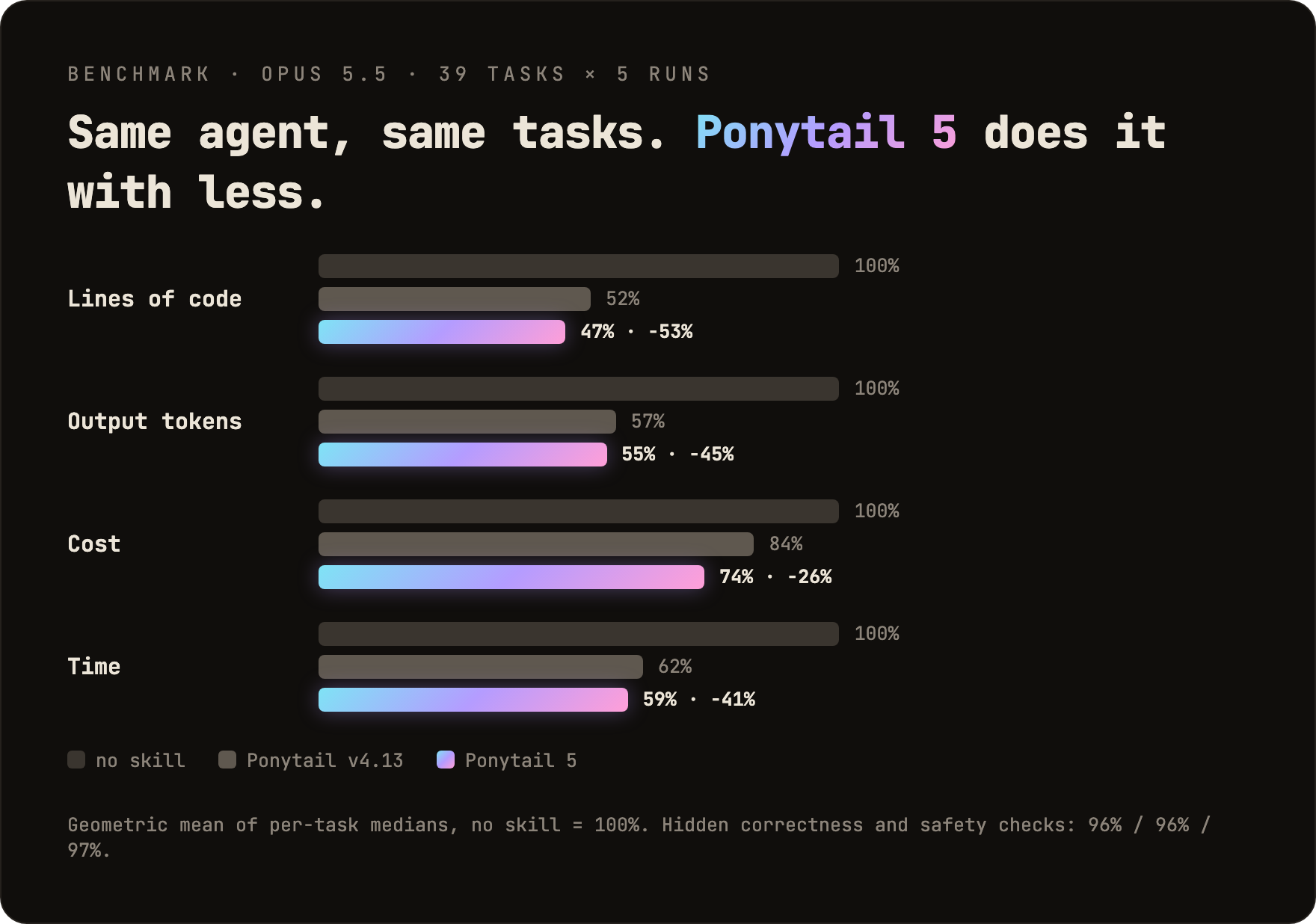
Share of the no-skill baseline. Lines of code: Ponytail v4.13 52%, Ponytail 5 47%. Output tokens: 57% and 55%. Cost: 84% and 74%. Time: 62% and 59%.

Half the code, and yet better: 98% of risky logic ships with a test (no skill 68%); the agent's own tests catch 66% of injected bugs (no skill 46%).

Two things the chart does not show: in a blind comparison, Ponytail 5's replies beat the previous Ponytail's 110 to 67. And on the six security tasks (SQL injection, path traversal, forged tokens, rate limiting, malformed CSV rows, caching) it passed all 30 runs: less code, no less safe. Method, per-task tables and limits: benchmarks/results/2026-10-07-agentic.md.

The rule was never "fewest tokens." It is: write only what the task needs, and never cut validation, error handling, security, or accessibility. The code ends up small because it is necessary, not golfed. Lower cost and latency are a side effect.

Before / after

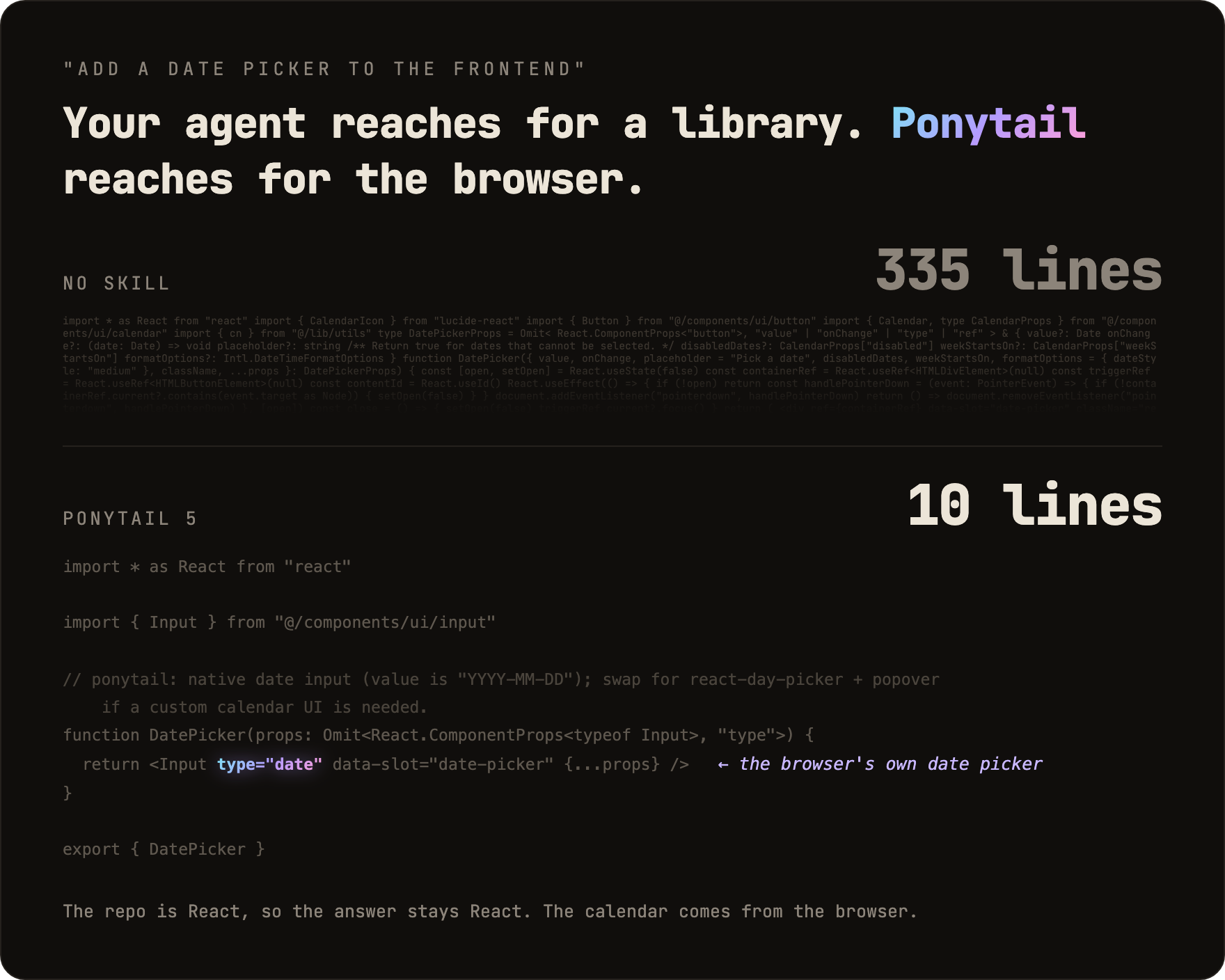
Add a date picker to the frontend. No skill: 335 lines, a calendar and a date picker built by hand. Ponytail 5: one 10-line file that reuses the repo's Input with type date, so the browser brings the calendar.

You ask for a date picker. Without Ponytail, the agent installs a date picker library or builds a whole calendar by hand: 335 lines. Ponytail 5 first looks at what is already there: the repo has an Input component, and every browser has a date picker. It puts the two together. 10 lines.

More survivors in examples/.

The review, rebuilt

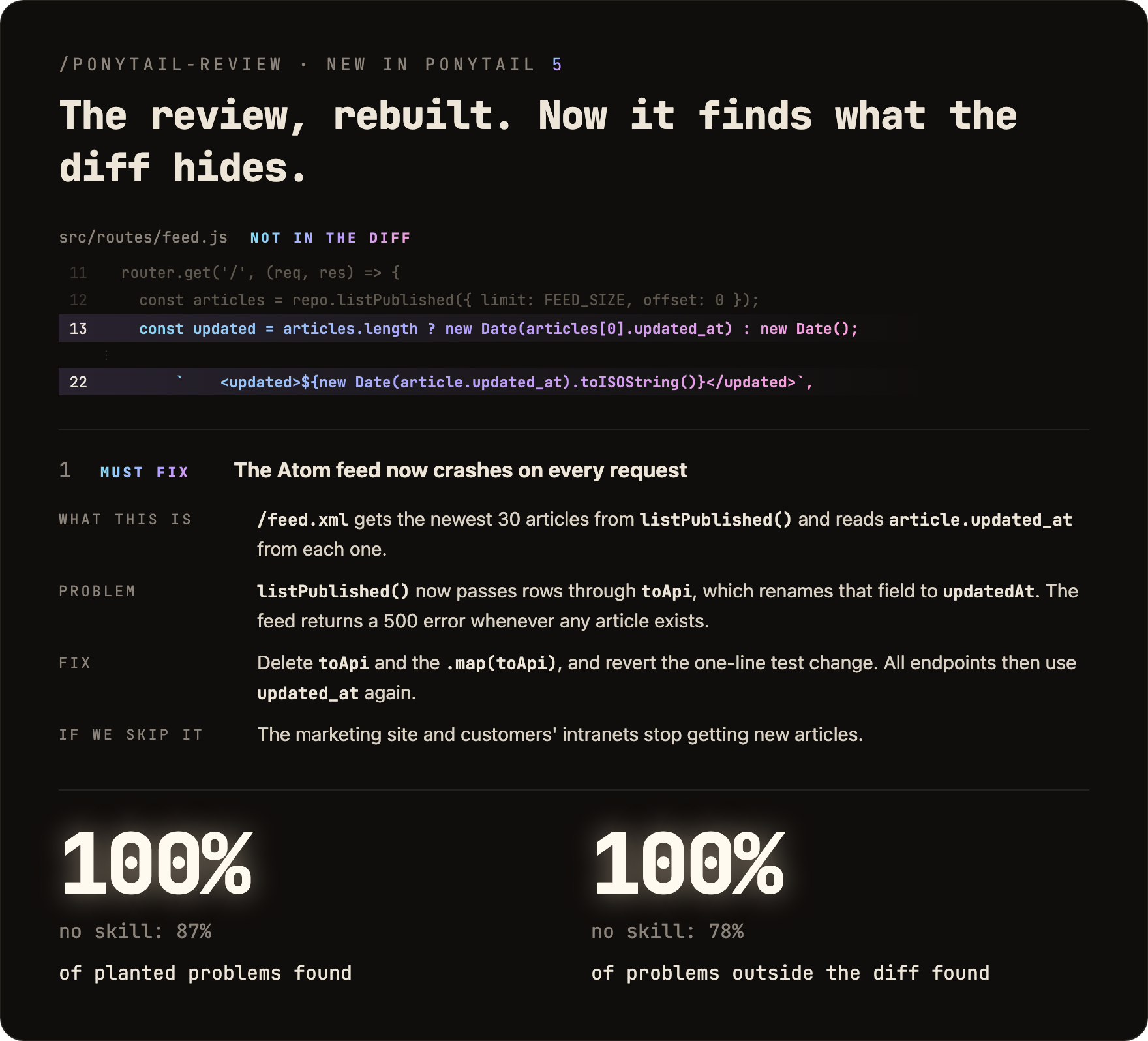
The review, rebuilt. A real /ponytail-review finding from the benchmark: the change renamed a field, and an untouched file, src/routes/feed.js, now crashes. Must fix: the Atom feed now crashes on every request, with what this is, the problem, the fix, and what happens if we skip it. 100% of planted problems found, no skill 87%. 100% of problems outside the diff found, no skill 78%.

/ponytail-review used to look only for code to cut. Now it reviews like the senior dev who gets paged when it breaks: it reads the code your change touches, not just the diff, and checks bugs, security, real load, missing tests, speed, and what to cut. Each finding says what the code does, what goes wrong, how to fix it, and what happens if you don't.

The audit, rebuilt

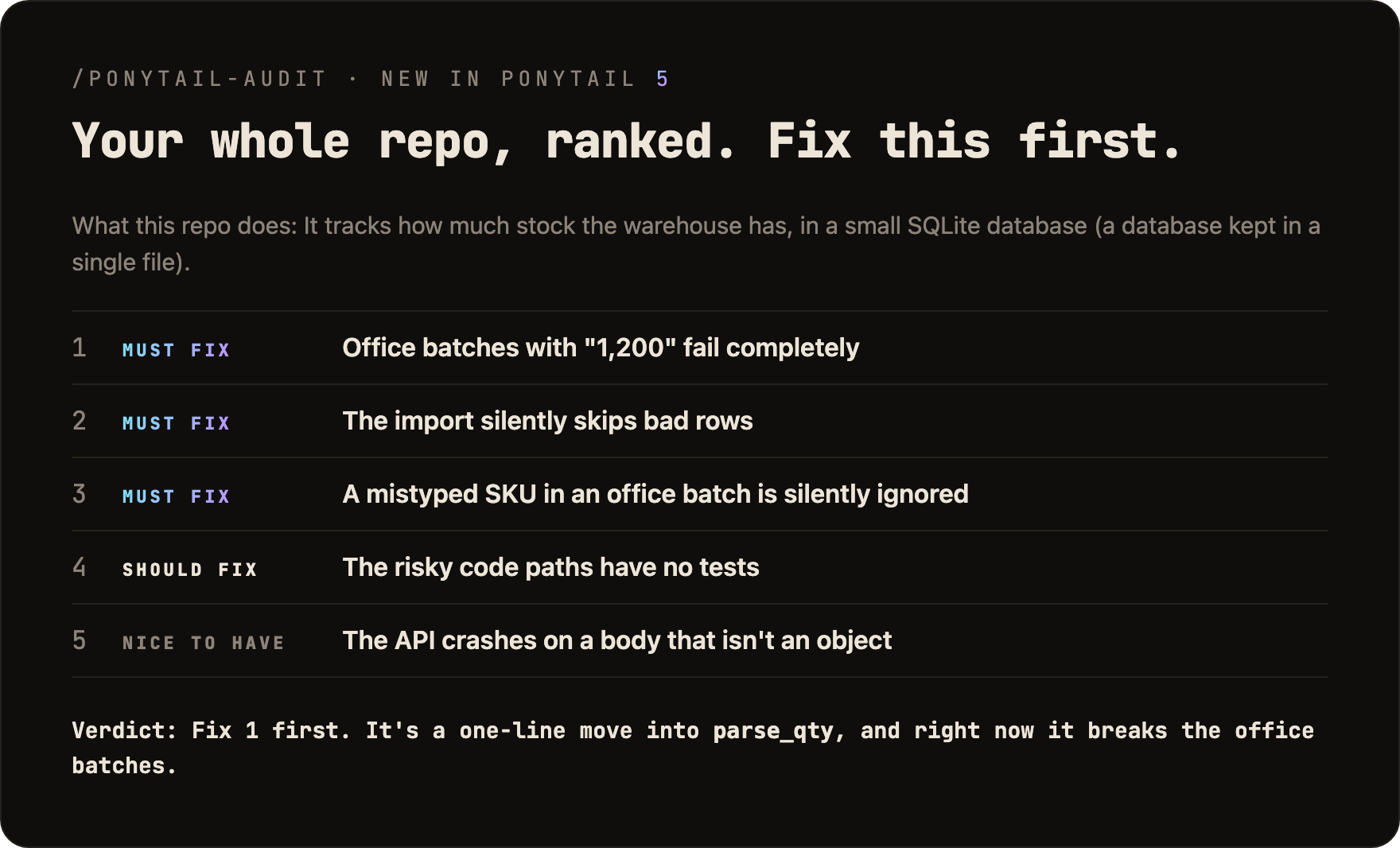
Your whole repo, ranked. Fix this first. A real /ponytail-audit from the benchmark on a warehouse stock repo: 1 must fix, office batches with 1,200 fail completely; 2 must fix, the import silently skips bad rows; 3 must fix, a mistyped SKU in an office batch is silently ignored; 4 should fix, the risky code paths have no tests; 5 nice to have, the API crashes on a body that isn't an object. Verdict: fix 1 first.

/ponytail-audit runs the same checks on the whole repo. It maps the code first: entry points, how data moves, what load the project expects. Then it ranks what it finds and tells you what to fix first. The old audit only listed what to delete.

How it works

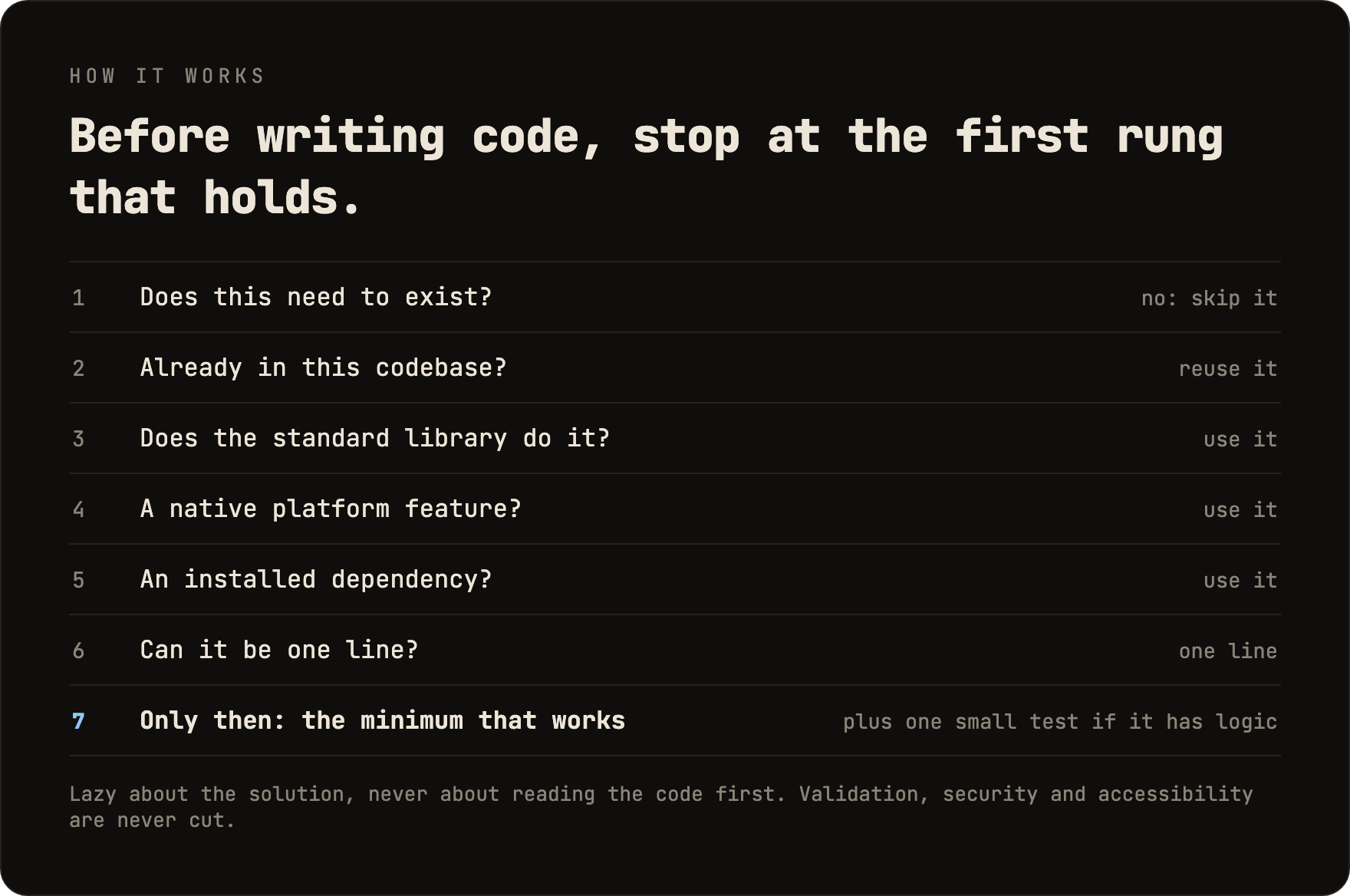
Before writing code, stop at the first rung that holds: 1 does this need to exist, 2 already in this codebase, 3 does the standard library do it, 4 a native platform feature, 5 an installed dependency, 6 can it be one line, 7 only then the minimum that works, plus one small test if it has logic.

The ladder runs after it understands the problem, not instead of it: it reads the code the change touches and traces the real flow before picking a rung. Lazy about the solution, never about reading.

Lazy, not negligent: trust-boundary validation, data-loss handling, security, and accessibility are never on the chopping block.

Logic with a branch, a loop, a parser, money or security leaves one small test behind. Every reply ends with what was skipped or not checked and any risk you should know.

The prompt

Ponytail is one prompt: skills/ponytail/SKILL.md. The compact version, for agents that read a rules file, is AGENTS.md. Everything else in this repo loads that prompt into different agents.

Install

Claude Code, as two separate prompts:

/plugin marketplace add DietrichGebert/ponytail
/plugin install ponytail@ponytail

Codex:

codex plugin marketplace add DietrichGebert/ponytail
codex plugin add ponytail@ponytail

Then open /hooks in Codex, trust its two lifecycle hooks, and start a new thread.

Any other agent: copy AGENTS.md into your project, or ask your agent to install skills/ponytail/SKILL.md as a skill. Step by step for Copilot, Cursor, OpenCode, Gemini and the rest: INSTALL.md.

That was it. He'd be proud. He won't say it.

Active every session, with a handful of commands (see Commands). /ponytail ultra exists for when the codebase has wronged you personally. Startup and mode-change text shows the current mode.

Only install ponytail from DietrichGebert/ponytail on GitHub or @dietrichgebert/ponytail on npm. It never ships .exe or .dll files; a copy that does is not mine.

Commands

Command What it does
/ponytail [lite | full | ultra | off] Set the intensity, or turn it off. No argument switches ponytail on at the default level if it is off, and otherwise reports the current level.
/ponytail-review Review the current diff like the senior dev who gets paged when it breaks: bugs, security, real load, risky code without a test, slow paths, and what to cut. Each finding says what the code does, what goes wrong, how to fix it, and what happens if you don't. Name a target in plain words to narrow or widen it: uncommitted, staged, branch, or a PR link.
/ponytail-audit The same check for the whole repo, most important first.
/ponytail-debt Harvest the shortcut: comments you've deferred into a ledger, so "later" doesn't become "never".
/ponytail-gain Show the measured impact scoreboard (less code, less cost, more speed) from the benchmark.
/ponytail-help Quick reference for the commands above.

Commands need a skill-capable host (Claude Code, Codex, Devin CLI, OpenCode, Gemini, pi, Hermes Agent, Qoder, Grok Build). In Codex CLI and the IDE extension they're skills under the plugin's namespace; invoke with $ponytail:ponytail-review. Cursor with the hooks gets /ponytail level switching only, typed as a plain message. The instruction-only adapters (Cursor's rule file, Windsurf, Cline, Copilot, Kiro, Antigravity) load the always-on ruleset without the commands.

FAQ

Does it need a config file? No. An optional ~/.config/ponytail/config.json or PONYTAIL_DEFAULT_MODE env var can set the default level, but nothing is required.

Why does it write shortcut: comments? They mark a deliberate shortcut and when to revisit it, and /ponytail-debt collects them into a ledger. Want another word, or none? Say so in your project's CLAUDE.md or AGENTS.md, then run /ponytail-debt <your word>.

What if I really need the 120-line cache class? You don't. Insist anyway and he'll build it. Slowly. Correctly. While looking at you.

Does it scale? The code you never wrote scales infinitely. Zero bugs, zero CVEs, 100% uptime since forever.

Why "ponytail"? You know exactly why.

Sponsors

GreenPT

License

MIT. The shortest license that works.

Star History

Star History Chart

ponytail (DietrichGebert/ponytail)

Searching Database…

165.2K ·GitHub
这是什么?Ponytail 是一个给 AI 编程智能体用的技能,它让智能体像团队里最懒得动手的资深开发一样干活:只写任务真正需要的代码,因为最好的代码就是你从来没写出来的那段代码。
它是一个独立的软件,还是我的编程智能体加载的东西?是你的智能体加载的东西:一个提示词文件 skills/ponytail/SKILL.md,外加一份精简的 AGENTS.md 给使用规则文件的智能体;仓库里的其他内容只是把这个提示词打包适配给不同的智能体而已。
把它接进我的智能体要做哪些事?在 Claude Code 里它作为两个独立的提示词安装;在 Codex 里你打开 /hooks 并信任它的两个生命周期钩子;其他智能体则是把 AGENTS.md 复制到项目里,或者把 skills/ponytail/SKILL.md 作为技能安装。
它需要配置文件吗?不需要。可选的 ~/.config/ponytail/config.json 或环境变量 PONYTAILDEFAULTMODE 可以设置默认等级,但都不是必需的。
不管我用哪个智能体,斜杠命令都能用吗?不能——这些命令需要支持技能的宿主,比如 Claude Code、Codex、Devin CLI、OpenCode 或 Gemini;只支持指令文件的适配方式(比如 Cursor 的规则文件、Windsurf、Cline 或 Copilot)只能拿到规则集,没有这些命令。
我用的是 Mac、Windows 还是 Linux 有影响吗?基本没有——它只是你的智能体加载的一个提示词,没有任何依赖操作系统的东西。提醒一下:只从 GitHub 上的 DietrichGebert/ponytail 或 npm 上的 @dietrichgebert/ponytail 安装;凡是附带 .exe 或 .dll 文件的副本都是假的。
这种「懒」实际用起来是什么样子?比如你要一个日期选择器,智能体会先看看项目里已经有什么:它找到仓库里的 Input 组件,配合浏览器自带的日期选择器,最后只写了 10 行代码,而不是一个 335 行的日历。
少写代码是不是意味着在安全或测试上偷工减料?不是——规则是只写任务需要的东西,但绝不省略校验、错误处理、安全和无障碍。98% 的有风险逻辑都带测试交付,而没有 Ponytail 时只有 68%,并且在 6 个安全任务的全部 30 次运行中它都通过了。
除了写新代码,它也能审查已有的代码吗?能——/ponytail-review 会读你的改动涉及到的代码,而不只是看 diff,检查 bug、安全、真实负载、缺失的测试和性能;/ponytail-audit 会对整个仓库运行同样的检查,并排出修复优先级。
这些效果有实测数据吗,还是只是感觉而已?有实测:在 Claude Code 里做了基准测试,同一个智能体带和不带这个技能各跑一遍——39 个任务,其中包括一个真实的 FastAPI + React 仓库,用的是 Opus 5.5,每个任务跑 5 次。核心数据:代码量 -53%,耗时 -41%,成本 -26%,token -45%。
Size
12.4 MB
Stars
165.2K
Age
4mo
Commits · 90 Days