Independent open-source project. Not affiliated with or endorsed by Anthropic. Claude and Claude Code are trademarks of Anthropic.
What You Get
- 50 ToS-friendly providers. 1.3B+ free tokens every month. Use free, paid, subscription, and local models from one searchable UI without putting your account at risk. FCC follows provider terms and removes integrations if they stop being allowed.
- 10 coding agents. One model catalog. Run Claude Code, Codex, Pi, OpenCode, Cline, Hermes, DeepSeek Harness, Grok Build, Muse Code, or Aider with your FCC models.
- Keep coding through provider outages. After retries are exhausted, FCC automatically tries your next configured model without making you restart the turn—across every client.
- Up to 90% fewer terminal-output tokens. Optional RTK filters common command output, while five FCC optimizations handle quota probes, command-prefix detection, titles, suggestions, and filepaths without calling a provider.
- Native Code sessions in your browser. Choose a folder and run Codex in the browser with real-time and background support. Freely switch providers/models in the same session. Support for switching harnesses in the same session coming soon!
- Terminal, desktop, IDE, or phone. Work through native launchers, VS Code, Codex App, JetBrains, Discord, or Telegram.
- Voice notes in. Code out. Talk to your agent using local Whisper or NVIDIA NIM transcription.
- Agent capabilities stay intact. Stream responses, use tools, preserve native interleaved thinking for maximum performance, send images, and route Fable, Opus, Sonnet, and Haiku independently with compatible models.
Free-tier availability and limits are controlled by each provider and may change.
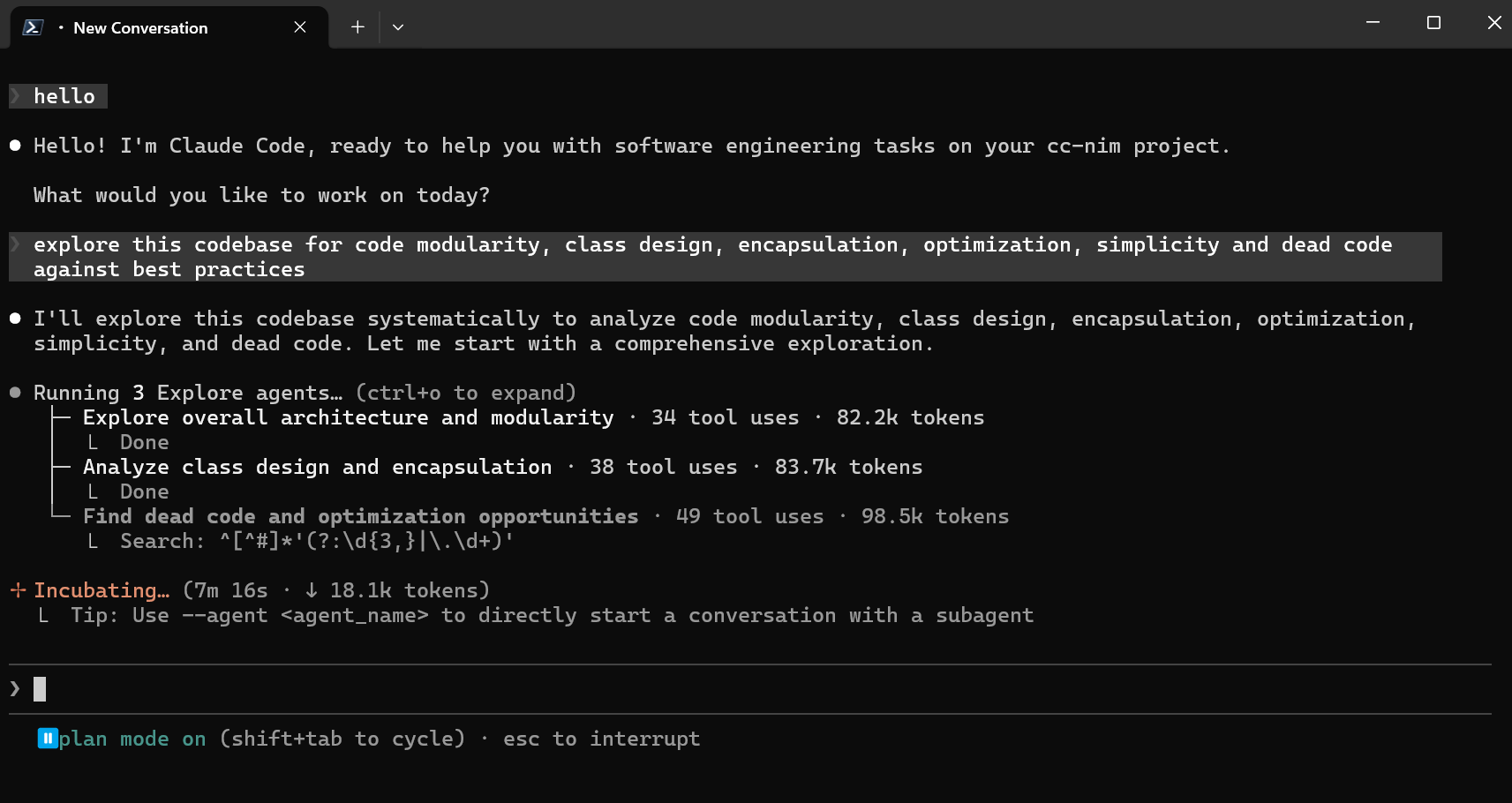
Claude Code running with FCC.
Quick Start
1. Install Or Update
macOS/Linux:
curl -fsSL "https://raw.githubusercontent.com/Alishahryar1/free-claude-code/main/scripts/install.sh" | sh
Windows PowerShell:
& ([scriptblock]::Create((irm "https://raw.githubusercontent.com/Alishahryar1/free-claude-code/main/scripts/install.ps1")))
Re-run the same command to update. When prompted, choose at least one coding agent and optionally RTK. You can review the installers before running them: install.sh and install.ps1.
2. Start FCC
Windows
Open Free Claude Code from your desktop or Start menu.
macOS
Open Free Claude Code from your desktop or Applications folder.
Linux
Run:
fcc-server
FCC opens the Admin UI after starting. On Windows and macOS, use the tray or
menu-bar icon to open Admin, restart, or quit. When using fcc-server, keep its
terminal open.
- Create an API key at build.nvidia.com/settings/api-keys.
- Open the Admin UI URL from the server log.
- Paste the key into
NVIDIA_NIM_API_KEY.
- Leave
MODEL on the default nvidia_nim/nvidia/nemotron-3-super-120b-a12b, or search the model dropdown and select another model.
- Click Apply.
To protect the local proxy with a bearer token, enable Proxy Authentication
in Admin.
4. Run Your Coding Agent
Claude Code:
fcc-claude
Codex:
fcc-codex
Pi:
fcc-pi
OpenCode:
fcc-opencode
Cline:
fcc-cline
Hermes:
fcc-hermes
DeepSeek Harness Web:
fcc-dsh
Grok Build:
fcc-grok
Muse Code:
fcc-muse
Aider:
fcc-aider
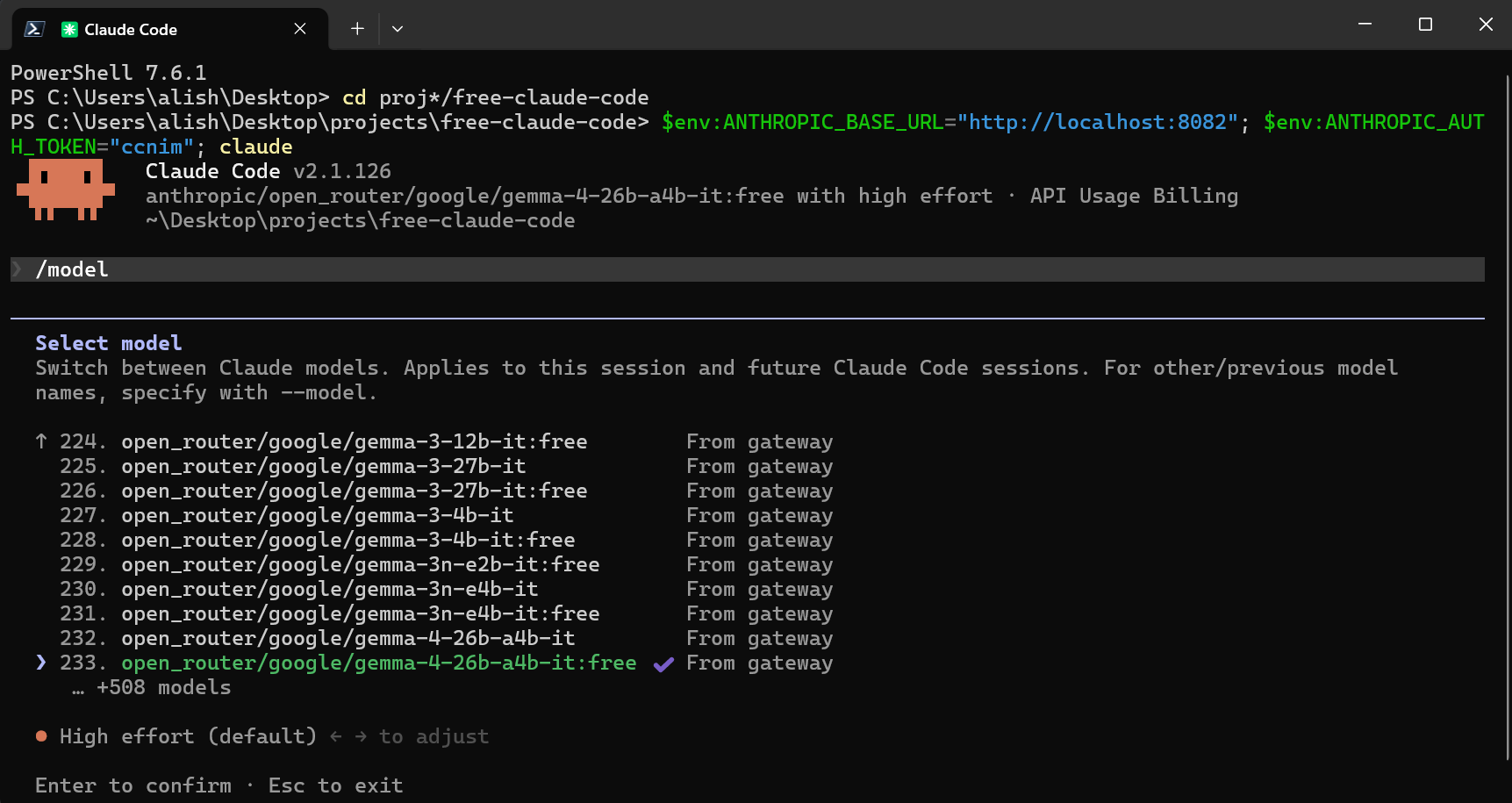
Select an FCC model from Claude Code's native /model picker.
Choose A Provider
- Open a provider link below for its key, models, or setup instructions.
- In the Admin UI, configure the listed setting. For OpenAI, use
Providers → Connected accounts instead.
- Search the
MODEL dropdown and select a model. If the provider cannot list
models, enter <provider-id>/<exact-provider-model-id> manually.
- Click Apply.
Optional: add an ordered Fallback Models list under Model Config. It
applies to every connected client. A failed request may reach and consume usage
from more than one provider before succeeding.
Provider catalog
Provider-specific setup
- OpenAI uses your ChatGPT subscription rather than an API key. Connect from
Providers → Connected accounts in the Admin UI. Use device code on
headless systems. Restart an already-running agent after connecting.
- GitHub Copilot uses your signed-in GitHub account and subscription. Install
Copilot CLI 1.0.83
on PATH, then choose Providers → Connected accounts → GitHub Copilot → Connect.
FCC reuses the native profile or shows a GitHub device code when sign-in is needed.
You can also sign in first with
copilot login --device-code. Select a concrete
github_copilot/<model-id> from the discovered list; available models and quotas
depend on your subscription and organization policies. Restart an already-running
agent after connecting. Disconnect stops FCC use and leaves the native login intact.
FCC pins its SDK and CLI compatibility because direct endpoint access is experimental.
- Azure OpenAI uses the deployment names from your resource. Set
AZURE_OPENAI_BASE_URL to its complete v1 endpoint, such as
https://YOUR-RESOURCE-NAME.openai.azure.com/openai/v1/, and select a
deployment that supports Chat Completions. Enter the deployment name as a
custom model slug if it does not appear in the model dropdown.
- Mistral Codestral uses a separate key from Mistral La Plateforme.
- Kimi Code subscription keys use
kimi_code/; Kimi API credit keys use
kimi/. Kimi Code plans are for personal interactive coding-agent use under
Kimi's community guidelines.
- QwenCloud Coding Plan keys use
qwencloud_coding/; QwenCloud Token Plan keys
use qwencloud/. The keys and endpoints are not interchangeable. Coding Plan
is for local, personal, interactive coding-agent use under the
Coding Plan terms.
- OpenCode Zen and OpenCode Go share
OPENCODE_API_KEY but use the explicit
opencode_zen/ and opencode_go/ model prefixes.
- For Amazon Bedrock, set
BEDROCK_BASE_URL to the URL for the same region as
the API key and select one of the listed models.
- Vertex AI uses Google Application Default Credentials instead of an API key.
Locally, run
gcloud auth application-default login once; service-account
files and attached service accounts also work. Set VERTEX_PROJECT_ID, and
optionally change VERTEX_LOCATION from its global default.
- Cloudflare requires both its API token and account ID.
- For Ollama Cloud, use the exact model IDs shown in the model picker. Local
Ollama uses the separate
ollama/ prefix.
- Prefer tool-capable models for coding agents. Local models also need enough context for the agent's system prompt and tool definitions.
Local provider setup
LM Studio
Start LM Studio's local server, load a tool-capable model, and use the model identifier shown by LM Studio with the lmstudio/ prefix. The default URL is http://localhost:1234/v1.
llama.cpp
Start llama-server with its OpenAI-compatible Chat Completions API and enough context for the model. Use the local model ID with the llamacpp/ prefix. LLAMACPP_BASE_URL defaults to http://localhost:8080/v1; FCC accepts either the server root or an explicit /v1 suffix.
Ollama
ollama pull llama3.1
ollama serve
Use the tag shown by ollama list with the ollama/ prefix. OLLAMA_BASE_URL defaults to http://localhost:11434; FCC accepts either the root URL or an explicit /v1 suffix.
Optional model-tier routing
MODEL is the fallback for every request. Select a model for MODEL_FABLE, MODEL_OPUS, MODEL_SONNET, or MODEL_HAIKU to override an individual Claude Code tier; select None to use MODEL.
For example, route Opus to nvidia_nim/nvidia/nemotron-3-super-120b-a12b, Sonnet to open_router/openrouter/free, Haiku to lmstudio/qwen3.5-coder, and keep MODEL on zai/glm-5.2.
Reasoning control
Open Admin UI → Model Config → Reasoning and select the behavior you want.
| Selection |
Behavior |
| From client (default) |
Use the effort sent by Claude Code, Codex, Pi, OpenCode, Cline, Hermes, DeepSeek Harness, Grok Build, Muse Code, or Aider. If none is sent, keep the provider default. |
| Off |
Request reasoning to be disabled. |
| Low, Medium, High, X-High, or Max |
Override the client with the selected reasoning level. |
| Inherit (Fable, Opus, Sonnet, and Haiku only) |
Use the root Reasoning selection. |
Providers that do not support a selected control retain their own behavior.
Connect Your Client
For terminal use, start fcc-server, then run fcc-claude, fcc-codex,
fcc-pi, fcc-opencode, fcc-cline, fcc-hermes, fcc-dsh, fcc-grok,
fcc-muse, or fcc-aider.
Use the guides below for editor integrations.
Claude Code in VS Code
Install the Claude Code extension. Open VS Code's user settings as JSON and add:
"claudeCode.disableLoginPrompt": true,
"claudeCode.environmentVariables": [
  { "name": "ANTHROPIC_BASE_URL", "value": "http://localhost:8082" },
  { "name": "ANTHROPIC_AUTH_TOKEN", "value": "freecc" },
  { "name": "CLAUDE_CODE_ENABLE_GATEWAY_MODEL_DISCOVERY", "value": "1" },
  { "name": "CLAUDE_CODE_AUTO_COMPACT_WINDOW", "value": "190000" },
  { "name": "DISABLE_AUTOUPDATER", "value": "1" },
  { "name": "DISABLE_FEEDBACK_COMMAND", "value": "1" },
  { "name": "DISABLE_ERROR_REPORTING", "value": "1" }
]
Match the port and authentication token to the Admin UI, then reload the extension.
Codex App
Start FCC, then edit your Codex configuration:
- Windows:
%USERPROFILE%\.codex\config.toml
- macOS:
~/.codex/config.toml
Add the matching model-catalog path and replace YOUR_USERNAME.
Windows:
model_catalog_json = "C:/Users/YOUR_USERNAME/.fcc/codex-model-catalog.json"
macOS:
model_catalog_json = "/Users/YOUR_USERNAME/.fcc/codex-model-catalog.json"
Then add the shared FCC settings:
model_provider = "fcc"
model = "nvidia_nim/nvidia/nemotron-3-super-120b-a12b"

[model_providers.fcc]
name = "Free Claude Code"
base_url = "http://127.0.0.1:8082/v1"
wire_api = "responses"

[model_providers.fcc.auth]
command = "fcc-codex"
args = ["--print-proxy-auth-token"]
Match the model and port to the Admin UI. The auth command reads FCC's current
proxy token automatically. Restart the Codex App after setup or model changes,
then select an FCC model from its model picker.
Codex in VS Code








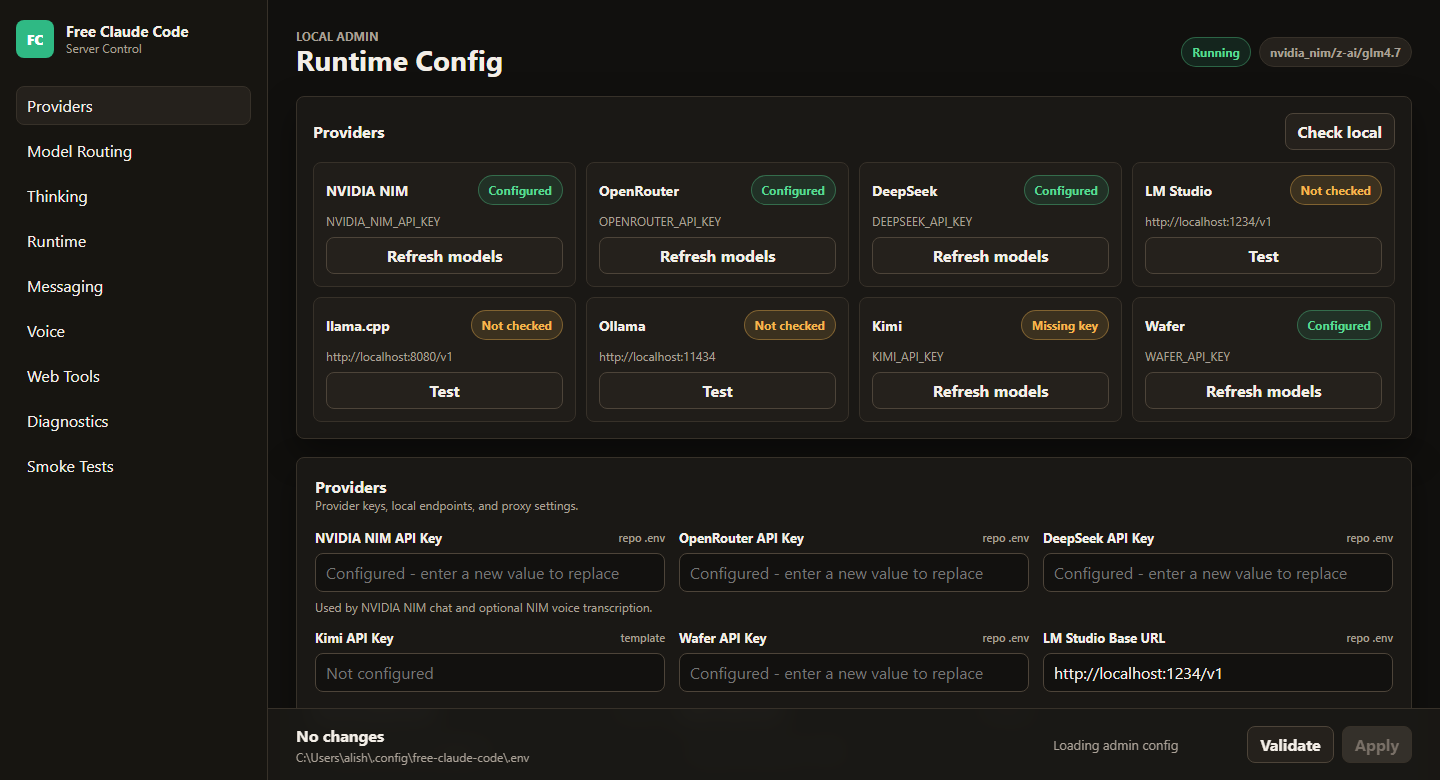

 FCC (Free Claude Code) routes coding agents like Claude Code, Codex, and OpenCode to 50 ToS-friendly providers, giving you 1.3B+ free tokens every month.