





Что это такое?
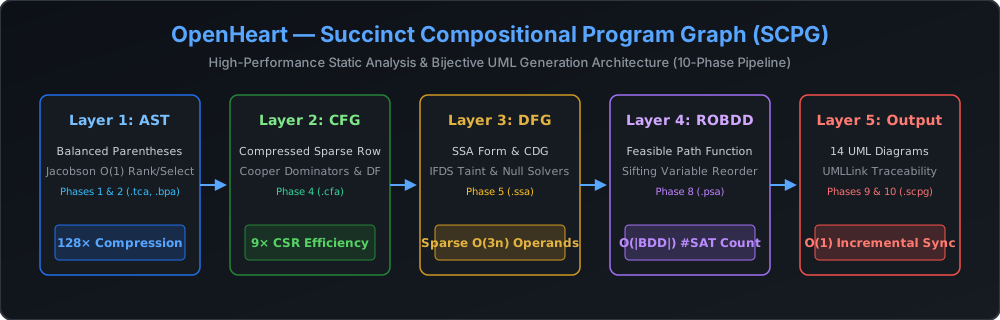
 OpenHeart — это компилятор статического анализа, написанный на Rust. Он разбирает исходный код и преобразует его в формальное графовое представление под названием SCPG (Succinct Compositional Program Graph), а затем проецирует его в 19 различных диаграмм: 14 стандартных представлений UML 2.5 и 5 промежуточных представлений (IR) конвейера компилятора.
Это приложение для браузера или инструмент командной строки?И то, и другое: есть Web Studio без серверной части, которая клонирует и анализирует репозитории GitHub полностью на стороне клиента, без сервера, а также движок на Rust, который можно собрать и запустить локально из командной строки для анализа одной кодовой базы или интеграционных тестов.
И то, и другое: есть Web Studio без серверной части, которая клонирует и анализирует репозитории GitHub полностью на стороне клиента, без сервера, а также движок на Rust, который можно собрать и запустить локально из командной строки для анализа одной кодовой базы или интеграционных тестов.Как это запустить?Откройте действующую OpenHeart Web Studio на GitHub Pages для анализа без установки или клонируйте репозиторий и пройдите шаги сборки движка, запуска анализа и запуска веб-сервера, чтобы пользоваться им локально.
Откройте действующую OpenHeart Web Studio на GitHub Pages для анализа без установки или клонируйте репозиторий и пройдите шаги сборки движка, запуска анализа и запуска веб-сервера, чтобы пользоваться им локально.Что нужно, чтобы собрать и запустить это локально?Поскольку это проект на Rust, для сборки движка нужен инструментарий Rust (cargo); размещённой Web Studio достаточно обычного браузера, так как разбор выполняется на стороне клиента.
Поскольку это проект на Rust, для сборки движка нужен инструментарий Rust (cargo); размещённой Web Studio достаточно обычного браузера, так как разбор выполняется на стороне клиента.Какие языки оно действительно умеет анализировать?Проверка проводилась на кодовых базах на Java, Kotlin, Python, Rust, TypeScript и C++ с идеальной точностью F1=1.0000, поэтому поддержка сосредоточена именно на этих языках.
Проверка проводилась на кодовых базах на Java, Kotlin, Python, Rust, TypeScript и C++ с идеальной точностью F1=1.0000, поэтому поддержка сосредоточена именно на этих языках.Что собой представляет модель графа SCPG?SCPG — это формальное представление графа в виде кортежа из 7 элементов, которое объединяет компактные сбалансированные деревья скобок (Balanced Parentheses), графы потока управления на основе CSR, представления потока данных в форме SSA и сводки путей ROBDD вместо традиционного AST или IR, построенного на указателях.
SCPG — это формальное представление графа в виде кортежа из 7 элементов, которое объединяет компактные сбалансированные деревья скобок (Balanced Parentheses), графы потока управления на основе CSR, представления потока данных в форме SSA и сводки путей ROBDD вместо традиционного AST или IR, построенного на указателях.Как достигается сжатие памяти в 128 раз?Узлы AST/IR, в которых на каждом шаге переходят по указателям, заменяются компактными битовыми строками (Balanced Parentheses) с индексами Jacobson Rank/Select за время O(1). Всё сериализуется в бинарные артефакты с проверкой CRC-64, которые отображаются в память, а не десериализуются.
Узлы AST/IR, в которых на каждом шаге переходят по указателям, заменяются компактными битовыми строками (Balanced Parentheses) с индексами Jacobson Rank/Select за время O(1). Всё сериализуется в бинарные артефакты с проверкой CRC-64, которые отображаются в память, а не десериализуются.Что могут показать 19 сгенерированных диаграмм?Семь структурных диаграмм UML (классов, пакетов, компонентов, составной структуры, объектов, развертывания, профилей), семь поведенческих диаграмм (последовательности, состояний, деятельности, использования, коммуникации, обзора взаимодействий, временных) и пять IR компилятора (CFG, DFG, CDG, граф вызовов, насыщение ROBDD).
Семь структурных диаграмм UML (классов, пакетов, компонентов, составной структуры, объектов, развертывания, профилей), семь поведенческих диаграмм (последовательности, состояний, деятельности, использования, коммуникации, обзора взаимодействий, временных) и пять IR компилятора (CFG, DFG, CDG, граф вызовов, насыщение ROBDD).Какие есть похожие проекты?graphify, difftastic, rataflow, graphicle, spinel, CoDiver, ast-grep, GitNexus
graphify, difftastic, rataflow, graphicle, spinel, CoDiver, ast-grep, GitNexusВ каких он темах?ast, diagram, tree-sitter, github-pages, code-analysis, graph, software-engineering, data-structures, computer-science, static-analysis, visualization, compiler
ast, diagram, tree-sitter, github-pages, code-analysis, graph, software-engineering, data-structures, computer-science, static-analysis, visualization, compiler