Structured multi-perspective deliberation for decisions that deserve more than one reasoning path.
Claude Code · Codex · Gemini CLI · OpenCode
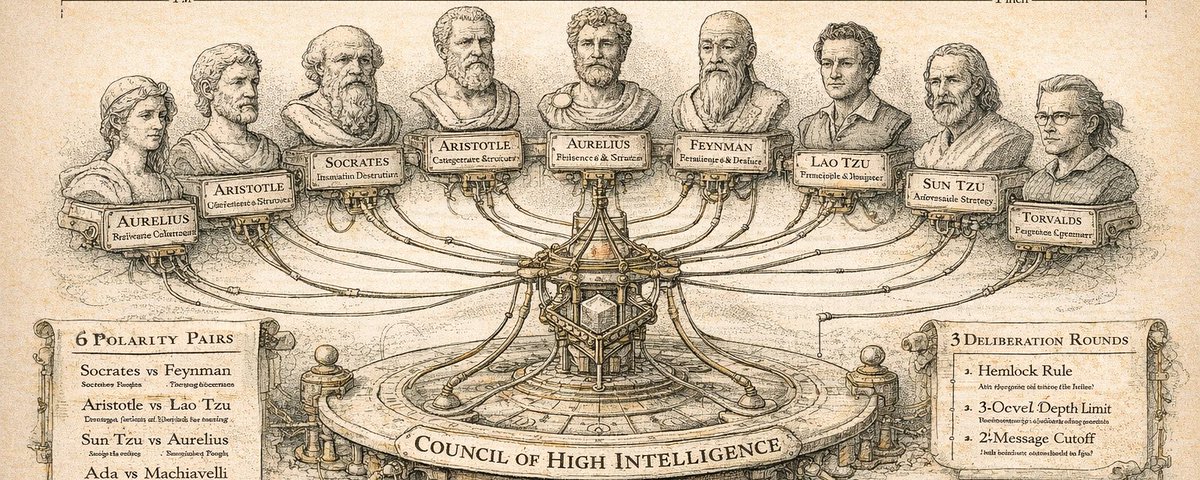
The council assigns a hard question to deliberately different analytical personas, keeps
their first positions independent, forces direct disagreement, and returns a verdict that
preserves unresolved questions, dissent, kill criteria, and the next concrete action.
Try a council
Claude Code users can install the plugin directly:
Then convene the full council, a faster panel, or a two-member dialectic:
/council Should we open-source our agent framework?
/council --quick Should we add caching here?
/council --duo Should we use microservices or a monolith?
For Codex, Gemini CLI, or OpenCode, clone once and use the matching installer flag:
Restart the target client after installation. The command remains /council on every
supported host.
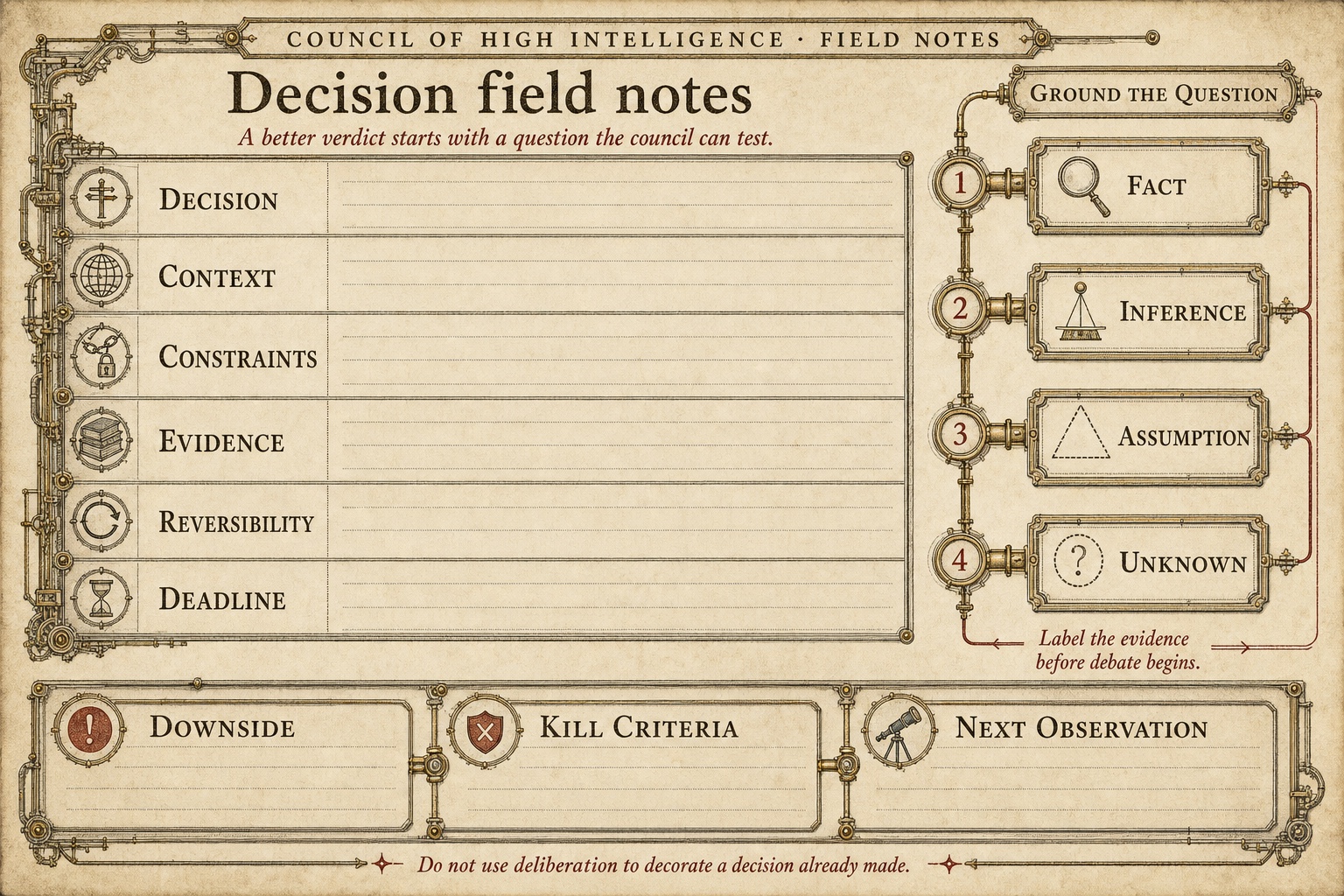
Use it for the decision boundary
Good council questions have material downside, competing values, incomplete evidence, or
an irreversible choice. Write down the decision, constraints, evidence, reversibility, and
deadline before adding personas.
The field notes distinguish facts from inference, assumptions, and unknowns. They also make
it harder to use a long deliberation as decoration for a decision already made.
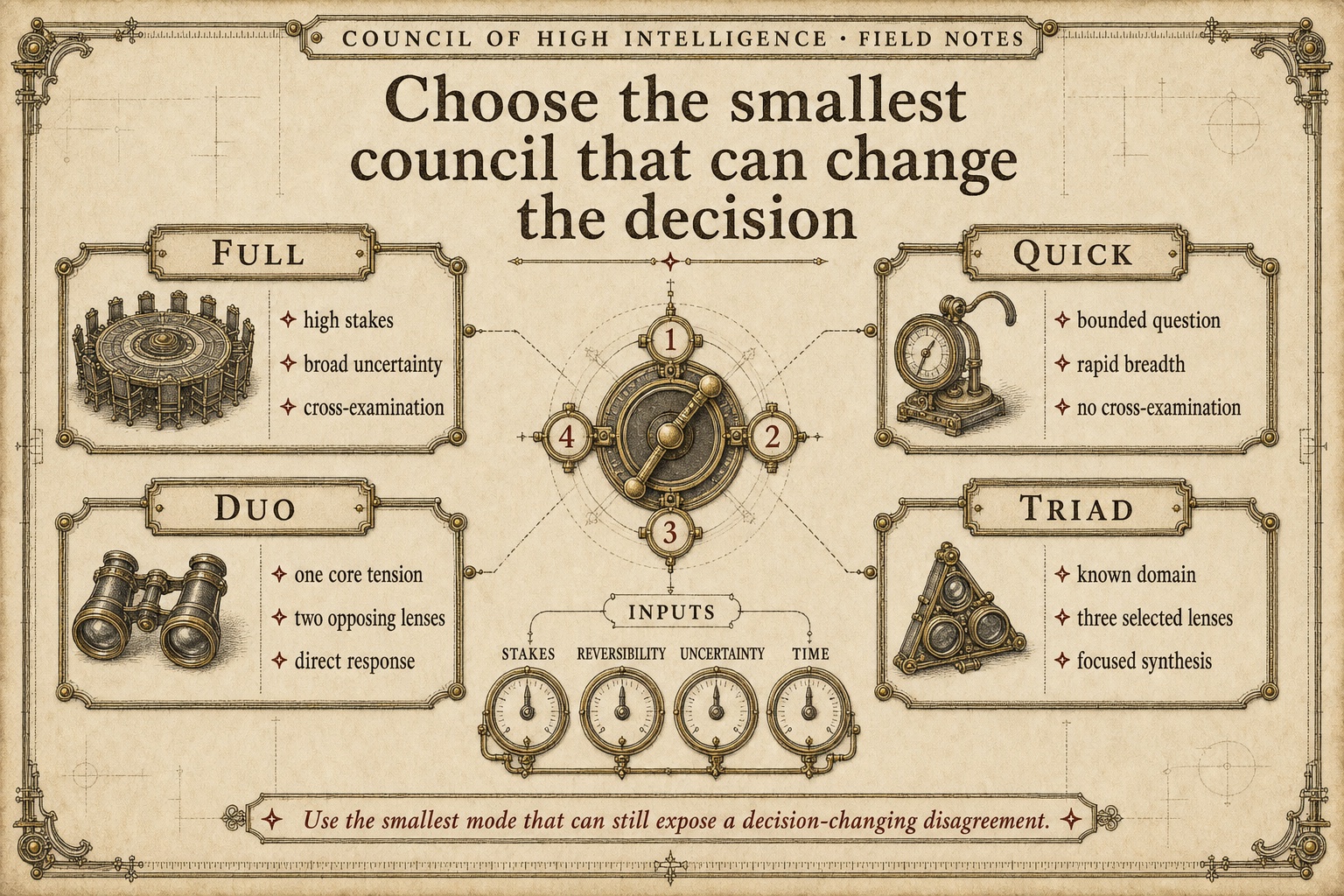
When to use something smaller
Use a direct answer or primary documentation for factual lookups.
Run an experiment when the choice is cheap and reversible.
Use --quick when cross-examination will not change the outcome.
Use --duo when one tension matters more than broad coverage.
Do not convene a council to manufacture support for a preferred answer.
Choose a mode
Mode
Shape
Use it when
Full
Independent analysis, cross-examination, final stance, synthesis
Stakes are high and competing frames need contact
Quick
Restate, rapid analysis, final positions
The decision needs breadth but not a full adversarial round
Duo
Opening positions, direct response, final statements
One polarity defines the decision
/council --full What is the right pricing model?
/council --quick --triad shipping Should we release today?
/council --duo --members torvalds,ada Is this abstraction worth it?
Named triads select three relevant lenses without assembling the whole council:
/council --triad strategy Where is our defensible advantage?
/council --triad risk What could make this launch irreversible?
/council --triad ai-product Which capability belongs in the product?
Available domains include architecture, strategy, ethics, debugging, risk,
shipping, product, founder, ai, ai-product, ai-safety, decision, systems,
uncertainty, design, economics, and bias. The canonical routing table lives in
SKILL.md.
What the protocol protects
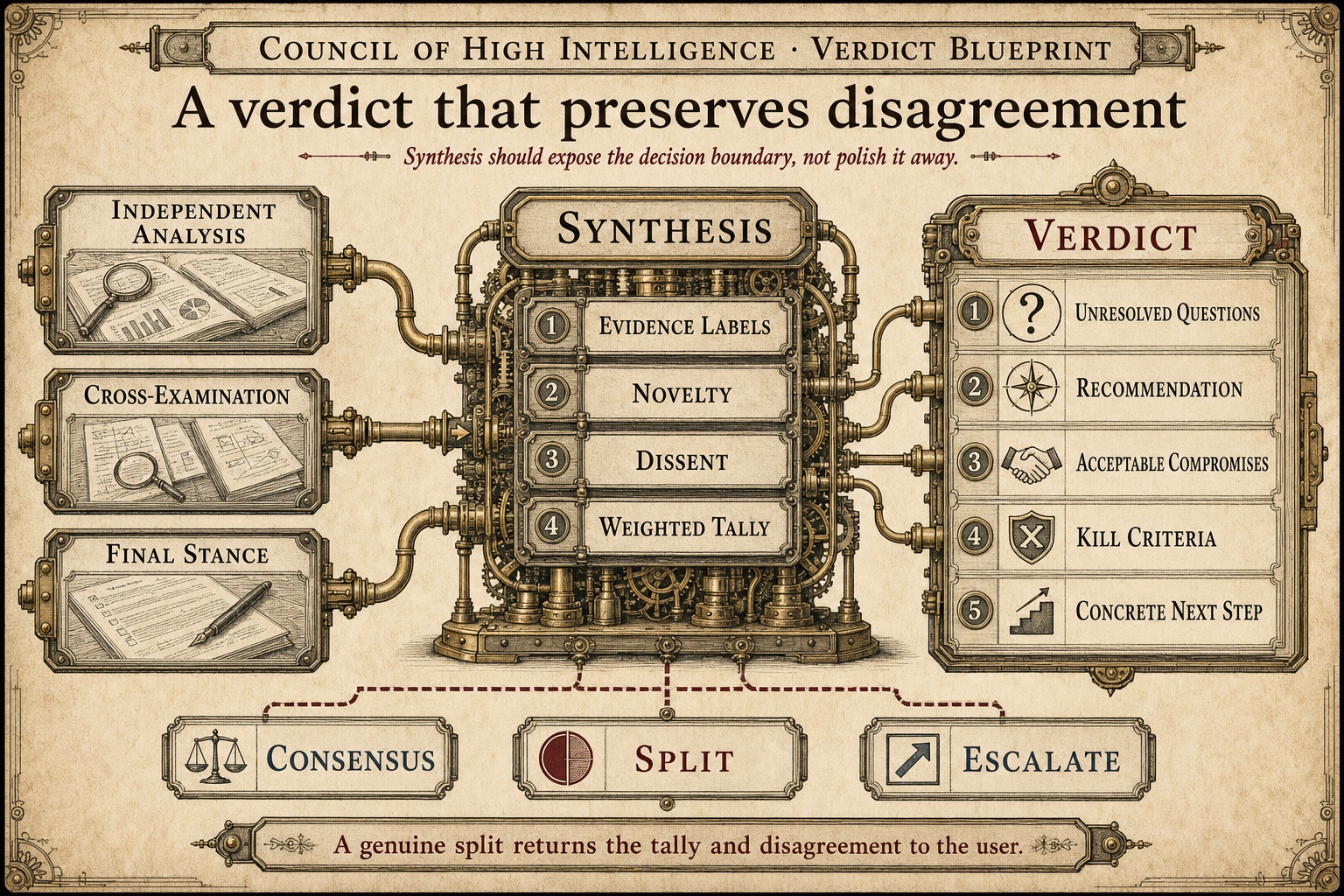
The full protocol has a fixed round budget. Members first restate the problem, analyze
blind, cross-examine other positions, declare a final stance, and then enter synthesis.
Enforcement checks look for premature agreement, repeated claims, missing dissent, and
unsupported confidence.
Verdicts lead with what remains unresolved. A recommendation is paired with acceptable
compromises, kill criteria, and one concrete next step. When the weighted tally remains
split, the result returns that split to the user instead of turning it into prose consensus.
Evidence labels separate:
FACT: directly supported by supplied or retrieved evidence;
INFERENCE: follows from evidence but is not directly observed;
ASSUMPTION: required for the argument and still unverified;
UNKNOWN: missing information that could change the decision.
Track the outcome
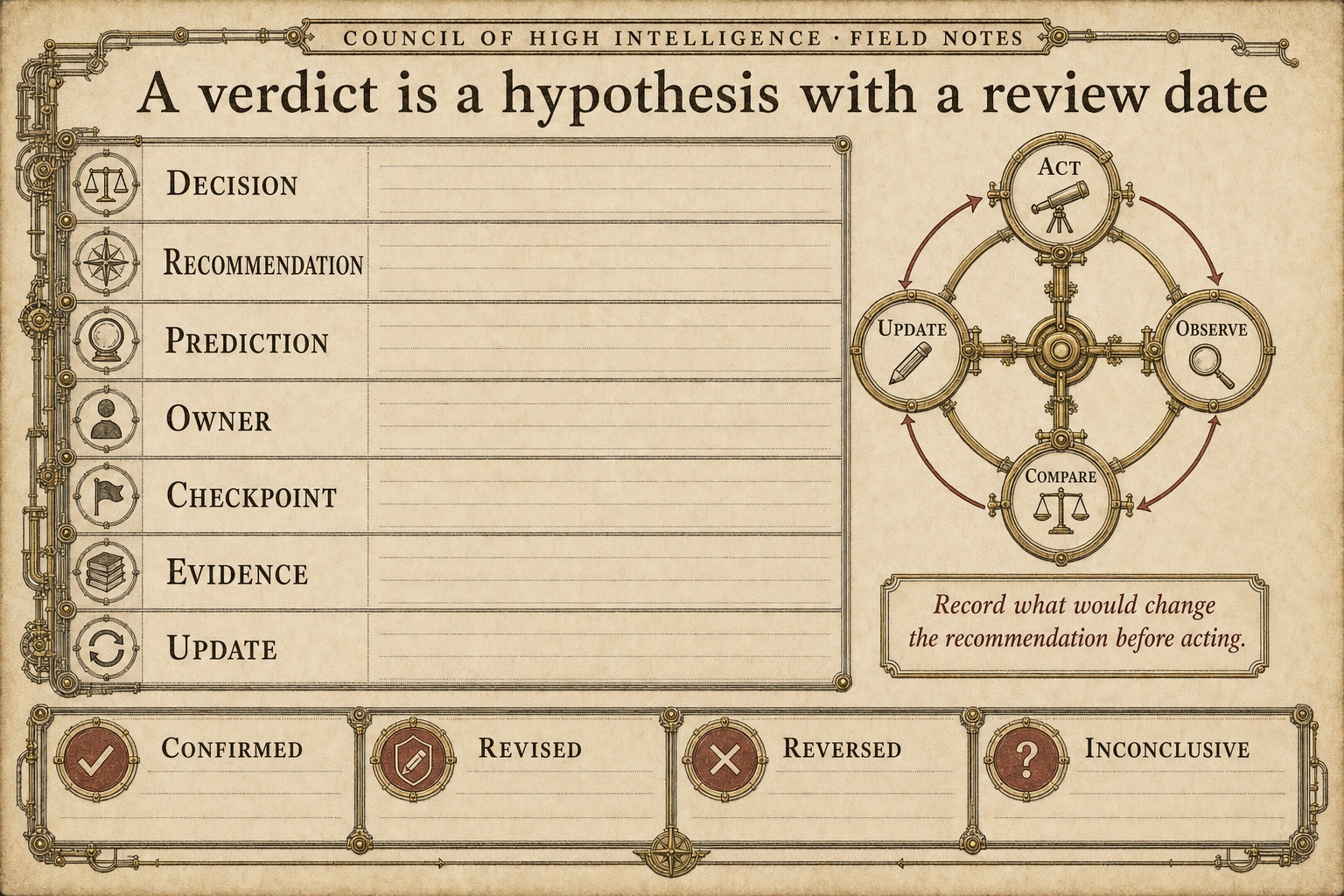
A verdict is useful only if it can be checked later. Before acting, record the prediction,
owner, review date, and evidence that would change the recommendation. At the checkpoint,
mark the result confirmed, revised, reversed, or inconclusive instead of rewriting the
original rationale.
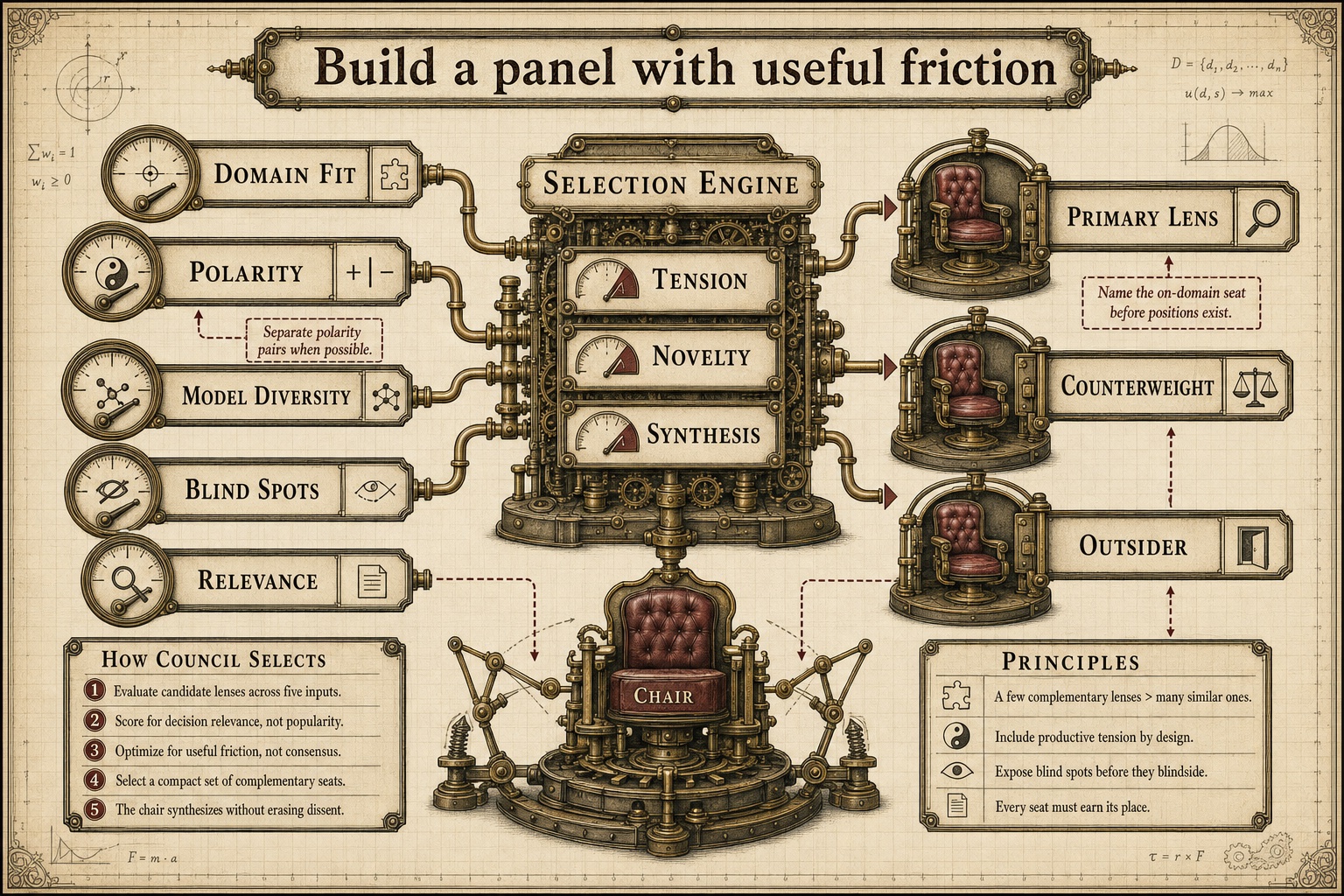
The 18 lenses
Members are analytical instruments, not impersonation claims. Each persona has a grounding
protocol, a method, known blind spots, and a structured response contract.
Member
Primary lens
Useful counterweight
Aristotle
Categories and structure
Lao Tzu on emergence and excess structure
Socrates
Assumption destruction
Feynman on reconstruction from first principles
Sun Tzu
Terrain and adversarial strategy
Aurelius on internal control and moral cost
Ada Lovelace
Formal systems and abstraction
Machiavelli on incentives and informal power
Marcus Aurelius
Resilience and moral clarity
Sun Tzu on external competition
Machiavelli
Power and incentives
Ada on formal consistency
Lao Tzu
Non-action and emergence
Aristotle on explicit categories
Richard Feynman
Explanation and empirical debugging
Socrates on the premise itself
Linus Torvalds
Shipping and maintainability
Meadows on system-level consequences
Miyamoto Musashi
Timing and decisive action
Torvalds on acting before the ideal moment
Alan Watts
Reframing and false problems
Torvalds on concrete implementation
Andrej Karpathy
Empirical ML behavior
Sutskever on frontier risk
Ilya Sutskever
Scaling and AI safety
Karpathy on observation and iteration
Daniel Kahneman
Cognitive bias
Feynman on explicit causal reasoning
Donella Meadows
Feedback loops and high-impact interventions
Torvalds on local fixes
Charlie Munger
Inversion and model lattices
Aristotle on single-system classification
Nassim Taleb
Tail risk and fragility
Karpathy on smooth empirical trends
Dieter Rams
User clarity and restraint
Ada on what can be formalized
The repository stores each member contract under agents/. Custom panels can
use --members, named triads, or the classic, exploration-orthogonal, and
execution-lean profiles documented in SKILL.md.
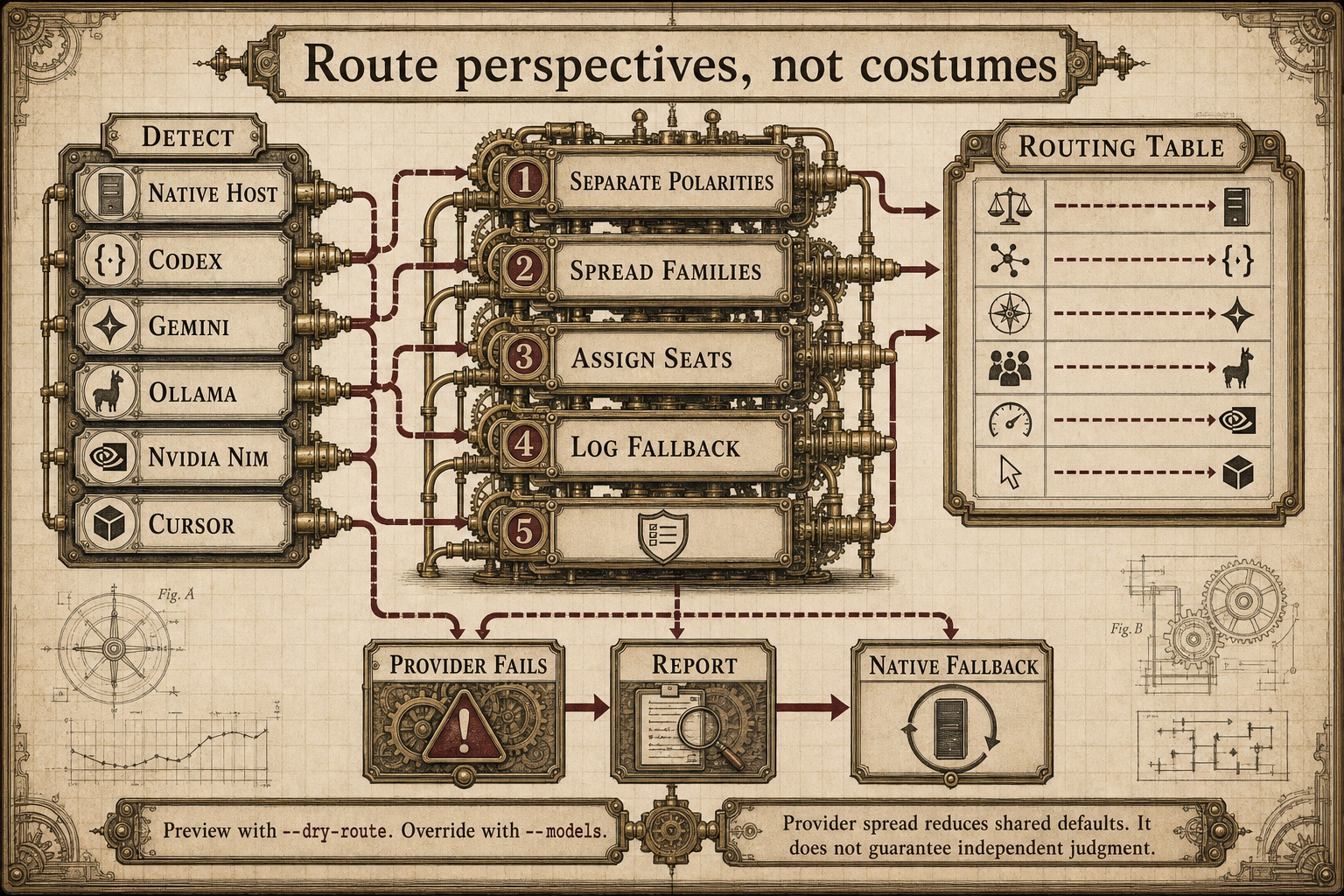
Multi-provider routing
The detection script checks which supported providers are available, then the coordinator
distributes seats across them. Polarity pairs are separated when possible so a single model
family does not play both sides of a disagreement.
Provider path
Detection
Native host subagents
Available through the active supported client
OpenAI
codex executable
Google
gemini executable
Ollama
ollama executable
NVIDIA NIM
NVIDIA_API_KEY
Cursor
cursor-agent executable or configured login
Preview routing without running a council:
/council --dry-route --triad decision Should we accept this acquisition offer?
Use --no-auto-route to keep native-host defaults. Use --models <path> with a copy of
configs/provider-model-slots.example.yaml
for an explicit seat map. Provider failure is reported before the seat falls back to the
native host.
Installation reference
./install.sh                         # Claude Code
./install.sh --codex                 # Claude Code + Codex
./install.sh --codex-only            # Codex only
./install.sh --gemini                # Claude Code + Gemini CLI
./install.sh --gemini-only           # Gemini CLI only
./install.sh --opencode              # Claude Code + OpenCode
./install.sh --opencode-only         # OpenCode only
./install.sh --copy-configs          # Include provider-routing templates
./install.sh --dry-run               # Preview writes
Custom target directories are supported through --claude-dir, --codex-dir,
--gemini-dir, and --opencode-dir. Run ./install.sh --help for the current contract.
The checklist validates persona structure, host-protocol parity, routing configuration,
execution checkpoints, verdict fields, and installer behavior. Use the
demo session pack to exercise full, quick, and duo modes.
Repository map
SKILL.md                    canonical coordinator protocol
SKILL.codex.md              Codex host mirror
SKILL.gemini.md             Gemini CLI host mirror
SKILL.opencode.md           OpenCode host mirror
agents/                     18 grounded persona contracts
configs/                    provider and model-routing examples
demos/                      sample sessions and verdict template
scripts/                    detection, conversion, and validation tools
assets/                     brand system and README visuals
install.sh                  multi-host installer
Protocol changes start in SKILL.md and must remain behaviorally aligned with each host
mirror. See CONTRIBUTING.md for the required checks and review contract.
Security reports belong in SECURITY.md, not a public issue.
这是什么?Council of High Intelligence 通过把一个问题交给 18 个各不相同的分析人格(亚里士多德、苏格拉底、费曼、Linus Torvalds 等),对艰难决策进行结构化的多视角审议:强制各方先独立表态,再交叉质询,最后给出保留未决问题、异议、否决标准和具体下一步行动的最终裁定。
这是一个独立应用,还是加到现有 AI 编程助手上使用的东西?它是一个挂接到现有 AI 智能体命令行工具的技能/插件,而不是独立应用。你把它安装到 Claude Code、Codex、Gemini CLI 或 OpenCode 里,然后在宿主中用相同的斜杠命令触发它。



 Council of High Intelligence 通过把一个问题交给 18 个各不相同的分析人格(亚里士多德、苏格拉底、费曼、Linus Torvalds 等),对艰难决策进行结构化的多视角审议:强制各方先独立表态,再交叉质询,最后给出保留未决问题、异议、否决标准和具体下一步行动的最终裁定。