




What is this?
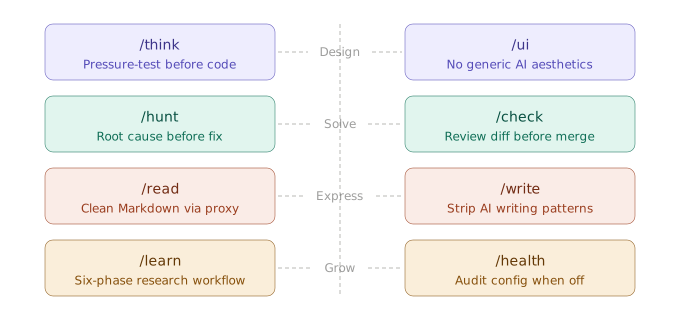
 Waza is a pack of eight 'skills' that turn proven software engineering habits (planning, UI design, code review, debugging, writing, research, reading, agent health checks) into slash commands that coding agents like Claude Code can run.
Waza is a pack of eight 'skills' that turn proven software engineering habits (planning, UI design, code review, debugging, writing, research, reading, agent health checks) into slash commands that coding agents like Claude Code can run.Is this a library, or something else?It is not code you import — it is a shared skills directory. Each of the eight skills is a folder with reference docs, helper scripts and known gotchas that your AI agent reads and executes as a slash command.
It is not code you import — it is a shared skills directory. Each of the eight skills is a folder with reference docs, helper scripts and known gotchas that your AI agent reads and executes as a slash command.How do I install the skills?Run `npx skills update -g -y` to drop a shared copy into `~/.agents/skills`; for Claude Desktop, download waza.zip and add it via Customize > Skills > Create skill.
Run `npx skills update -g -y` to drop a shared copy into `~/.agents/skills`; for Claude Desktop, download waza.zip and add it via Customize > Skills > Create skill.Which coding agents can actually use these skills?Claude Code is symlinked in automatically; Codex, Cursor, Gemini CLI, Copilot, Amp, Kimi Code CLI, Pi, and any other agent that reads the shared skills directory pick up the same eight skills.
Claude Code is symlinked in automatically; Codex, Cursor, Gemini CLI, Copilot, Amp, Kimi Code CLI, Pi, and any other agent that reads the shared skills directory pick up the same eight skills.Does this know anything about my specific project?No — Waza only ships generic engineering habits. The /check skill becomes project-aware at runtime by reading a repo's public context (READMEs, manifests, CI files), but it never touches private paths, credentials, or tokens.
No — Waza only ships generic engineering habits. The /check skill becomes project-aware at runtime by reading a repo's public context (READMEs, manifests, CI files), but it never touches private paths, credentials, or tokens.What are the eight skills included?/think (pressure-test a plan before building), /ui (distinctive frontend design), /check (diff review before merge/release), /hunt (root-cause debugging), /write (natural prose editing), /learn (six-phase research workflow), /read (summarize URLs/PDFs), and /health (audit agent setup health).
/think (pressure-test a plan before building), /ui (distinctive frontend design), /check (diff review before merge/release), /hunt (root-cause debugging), /write (natural prose editing), /learn (six-phase research workflow), /read (summarize URLs/PDFs), and /health (audit agent setup health).Can I chain skills into a workflow?Yes. Each skill stops at its outcome by default, but you can authorize a chain like /think → implement → /check → merge, or /hunt → fix → /check, and the agent continues without asking for approval at every step.
Yes. Each skill stops at its outcome by default, but you can authorize a chain like /think → implement → /check → merge, or /hunt → fix → /check, and the agent continues without asking for approval at every step.Why build Waza instead of using something like Superpowers?The author found tools like Superpowers and gstack powerful but too heavy, with too many skills and too much configuration. Waza deliberately stays small: eight skills, each with one job and a clear trigger, refined through 300+ real sessions.
The author found tools like Superpowers and gstack powerful but too heavy, with too many skills and too much configuration. Waza deliberately stays small: eight skills, each with one job and a clear trigger, refined through 300+ real sessions.What is the statusline extra for?It's a minimal Claude Code statusline showing context window usage and 5-hour/7-day quota, color-coded with no progress bars; Codex instead gets native statusline config via ~/.codex/config.toml.
It's a minimal Claude Code statusline showing context window usage and 5-hour/7-day quota, color-coded with no progress bars; Codex instead gets native statusline config via ~/.codex/config.toml.What are similar projects?superpowers-zh, open-steps, Coding-Agent-Skills, pstack, pstack-claude, superpowers, evondevKit, brag
superpowers-zh, open-steps, Coding-Agent-Skills, pstack, pstack-claude, superpowers, evondevKit, bragWhich topics is it in?npx, claude-skill, copilot, gemini-cli, claude-code-skill, code-review, debugging, workflow, design, cursor, skills, agents
npx, claude-skill, copilot, gemini-cli, claude-code-skill, code-review, debugging, workflow, design, cursor, skills, agents