dsh-agent-team-gui
English | 简体中文


Give DeepSeek Harness a reusable team: one Agent plans, another implements, and a third reviews.
Save the team once, choose a model for each member, and reuse it across projects and conversations.
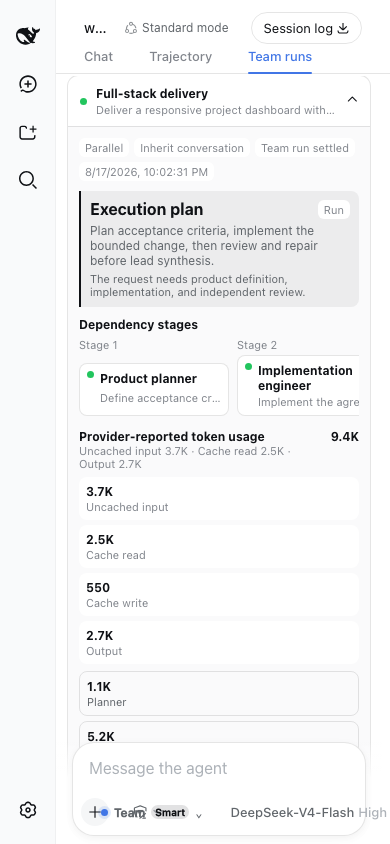
Follow the plan, member outputs, retries, and provider-reported Token usage in one Run Center.
This is an unofficial community plugin for the DeepSeek Harness Web profile.
Watch the 80-second UI guide · Install v1.0.1 · Run your first team ·
Example recipe ·
Share a workflow
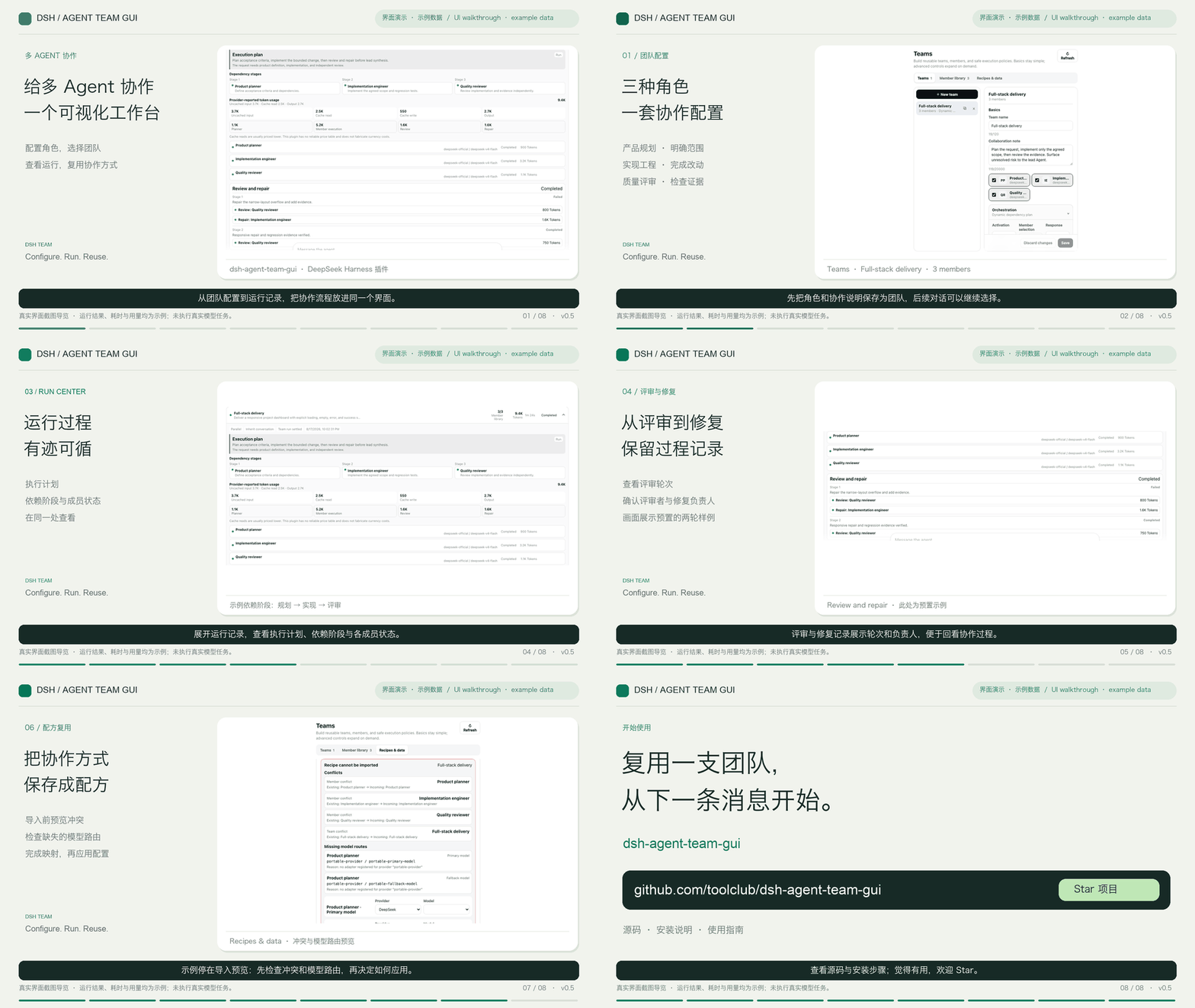
Screenshot-based UI guide with example data and Chinese synthetic narration. Displayed task results, timings, and Tokens are not a live-run benchmark. Sources and captions.
If this is useful for your DSH workflow, give the project a Star
and help another developer discover it.
Why this plugin
A team is a reusable product object, not a one-off dispatch form. Create it once in Settings →
Teams, then use it across projects and conversations.
| Capability |
User outcome |
| One model and tool policy per member |
Combine a planner, implementer, reviewer, or specialist without forcing one route on everyone |
| Dynamic workflow planning by default |
The active conversation's model assigns focused work and dependencies from the current request |
| Team / Solo / Inherited modes |
Choose a durable conversation override, a project default, or a one-message exception without ambiguous switches |
| Bounded DAG, retries, quality gate, background work |
Long work is observable, cancellable, finite, and restart-safe |
| Official provider Token usage |
See input, cache-read, cache-write, and output Tokens with full/partial/unavailable coverage—never invented prices |
| Versions, recipes, and definition backup |
Reproduce a team, share it without credentials, preview impact, and remap model routes before applying |
Install
Requirements: a working DeepSeek Harness Web profile, at least one configured provider/model,
Node.js >=22.19.0 <23 or >=24.0.0, and pnpm. Declared DSH compatibility is
>=0.1.0-rc.5 <0.2.0; the v1.0.1 release was verified against DSH 0.1.1-rc.2.
Recommended: install the compiled release package. It includes the built Host and client files,
so installation does not run this plugin's Git prepare build or require its allowBuilds entry.
dsh plugin --profile web add -w https://github.com/toolclub/dsh-agent-team-gui/releases/download/v1.0.1/dsh-agent-team-gui-1.0.1.tgz
dsh --profile web
Stop and restart an already-running DSH Web process after installing or upgrading. Then open
Settings → Teams. If a plugin marketplace chooses Git installation and fails, use the direct
release command above; see installation troubleshooting.
Release notes and checksum ·
Git/source installation
[!TIP]
If dsh is not on PATH, use the launcher that starts your working Harness installation.
With npm, replace dsh with npx @deepseek-ai/[email protected]; from a source checkout, replace
it with pnpm --dir /absolute/path/to/deepseek-harness dsh. Keep the same launcher for installation
and startup. New to Harness? Start with its official setup guide.
Verify that both the dsh-agent-team-gui bundle and the agent-team-gui configuration row are present:
dsh --profile web --dump-config
Run your first team
Use the included full-stack delivery recipe, with a
planner, implementation engineer, and reviewer. You can bind all three to the same working model
for the first run; multiple providers are optional.
- Download the recipe JSON. Open Settings → Teams → Recipes & data and choose Choose recipe file.
- Map the placeholder routes to your configured provider/model routes, review the preview, and choose
Create a copy → Import reviewed recipe. In Member library, confirm each member's exact model and tool access.
- For this first walkthrough, set the imported team's activation to Run every time and member selection to
All members, then save. The supplied recipe otherwise uses Smart/adaptive selection.
- Select an empty scratch project, choose the imported team beside the composer, select Always use team, and send the
ready-to-copy task: build and test a small to-do list.
- Open Team runs to inspect the plan, outputs, review, and actual Token coverage. Check the delivered
files and test results before treating the task as complete.
Full walkthrough, expected results, and troubleshooting →
Create your own team
In Settings → Teams → Member library, save each member's role, model, optional fallback, and tool policy.
In Settings → Teams, add those members and choose activation, member selection, and execution options.
Leave Fixed order off for dynamic planning, or enable it for a fixed serial sequence.
Choose Team, Solo, or Inherited beside the composer to control the current conversation.
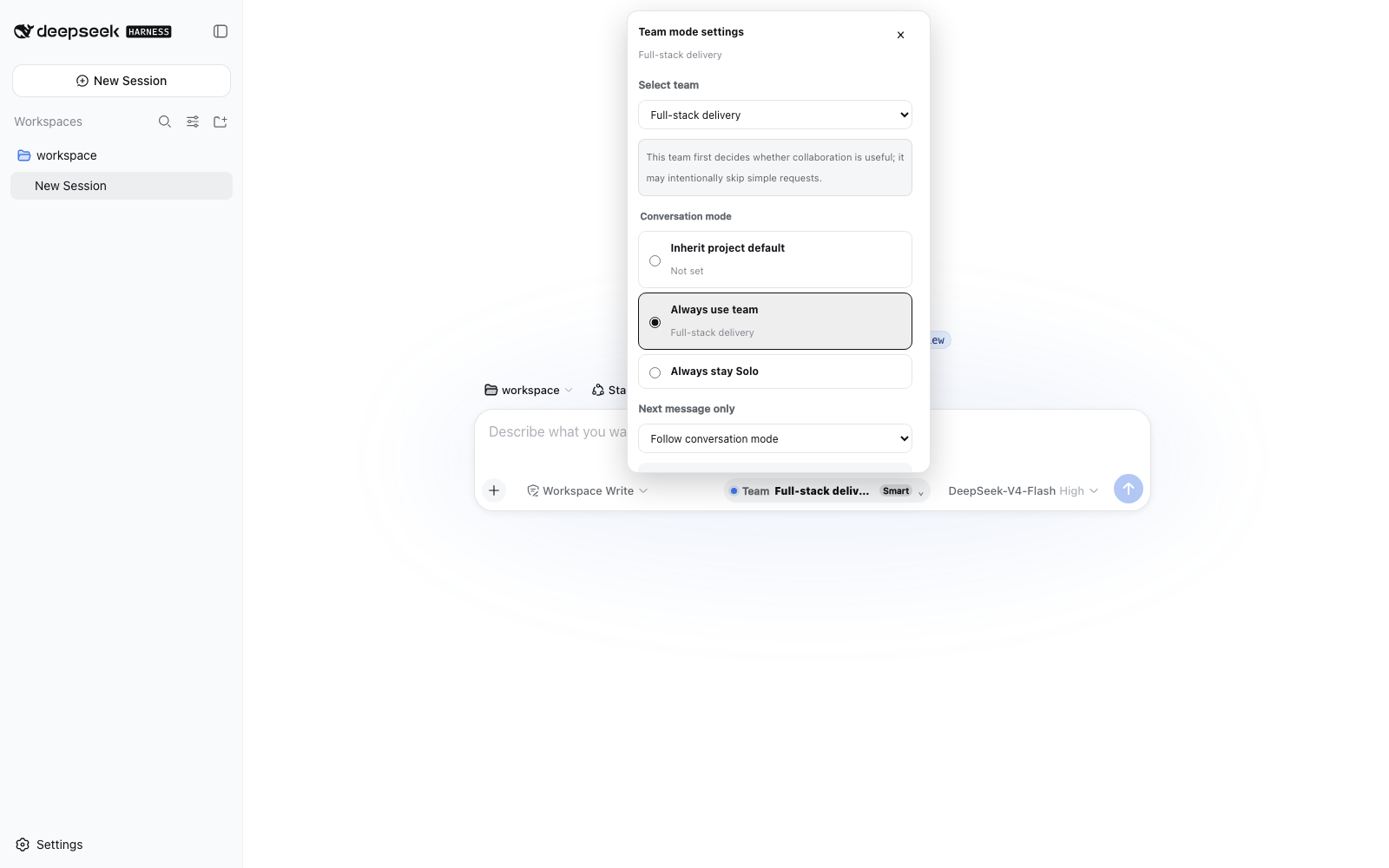
UI example with demonstration data.
How orchestration works
flowchart LR
    U["Normal user message"] --> M{"Conversation mode"}
    M -->|"Solo"| L["Lead Agent answers normally"]
    M -->|"Team / inherited default"| A{"Activation"}
    A -->|"Manual"| L
    A -->|"Smart may skip"| P["Bounded lead-model planner"]
    A -->|"Always"| P
    P --> D["Validated acyclic plan"]
    D --> W1["Ready member wave"]
    W1 --> W2["Dependent member wave"]
    W2 --> Q{"Optional quality gate"}
    Q -->|"Approved / disabled"| H["Bounded handoffs"]
    Q -->|"At most 2 repairs"| R["Named repair owner"]
    R --> Q
    H --> L
    D -. "live state + official Tokens" .-> C["Run Center and Insights"]
With no fixed order, the plugin uses the active conversation's provider/model route in a bounded,
tool-free planner child. It receives the member roles and returns structured assignments plus an
acyclic dependency graph. It does not turn one member into a replacement for the whole team. A
bad, cyclic, or unavailable plan falls back to deterministic role-scoped assignments.
Ready DAG nodes run up to maxConcurrency. Dependants receive only bounded structured handoffs;
full member output remains in durable run history. A fixed member order is an explicit serial
override and bypasses DAG planning.
Activation and selection
- Always runs the selected team for every eligible top-level user message.
- Smart lets the bounded planner skip unsuitable/trivial work.
- Manual keeps ordinary sends Solo; queue the team for the next message or use the model tool.
- All members assigns each configured member exactly once.
- Adaptive lets Smart planning select the smallest useful non-empty subset.
Conversation modes
- Team is an explicit durable team selection for this conversation.
- Solo is an explicit durable opt-out, even when the project has a default team.
- Inherited removes the conversation override and follows the project default when one exists.
- Next message is a separate crash-safe one-shot Team or Solo choice, consumed exactly once.
These states remain interactive after page refresh, cold Host startup, and live reconnect. An empty
or temporarily unavailable catalog never silently deletes a saved selection.
Safety bounds
- Planner, member, reviewer, and repair prompts put the exclusive role and no-delegation contract
before a bounded excerpt of user content.
- Delegated sessions cannot dispatch another team. Detected DSH subagent tools—including renamed
registrations—are denied inside team children.
- One durable claim binds automatic and model-tool dispatch to the latest human message, so repeated
tool calls cannot create hundreds of duplicate teams.
- Member timeout, concurrency, retry-once, soft team Token budget, and quality rounds are finite.
- A retry creates a linked immutable run and replays the original normalized assignments, order,
and DAG; it does not silently ask the model to invent a different workflow.
Run Center and Token usage
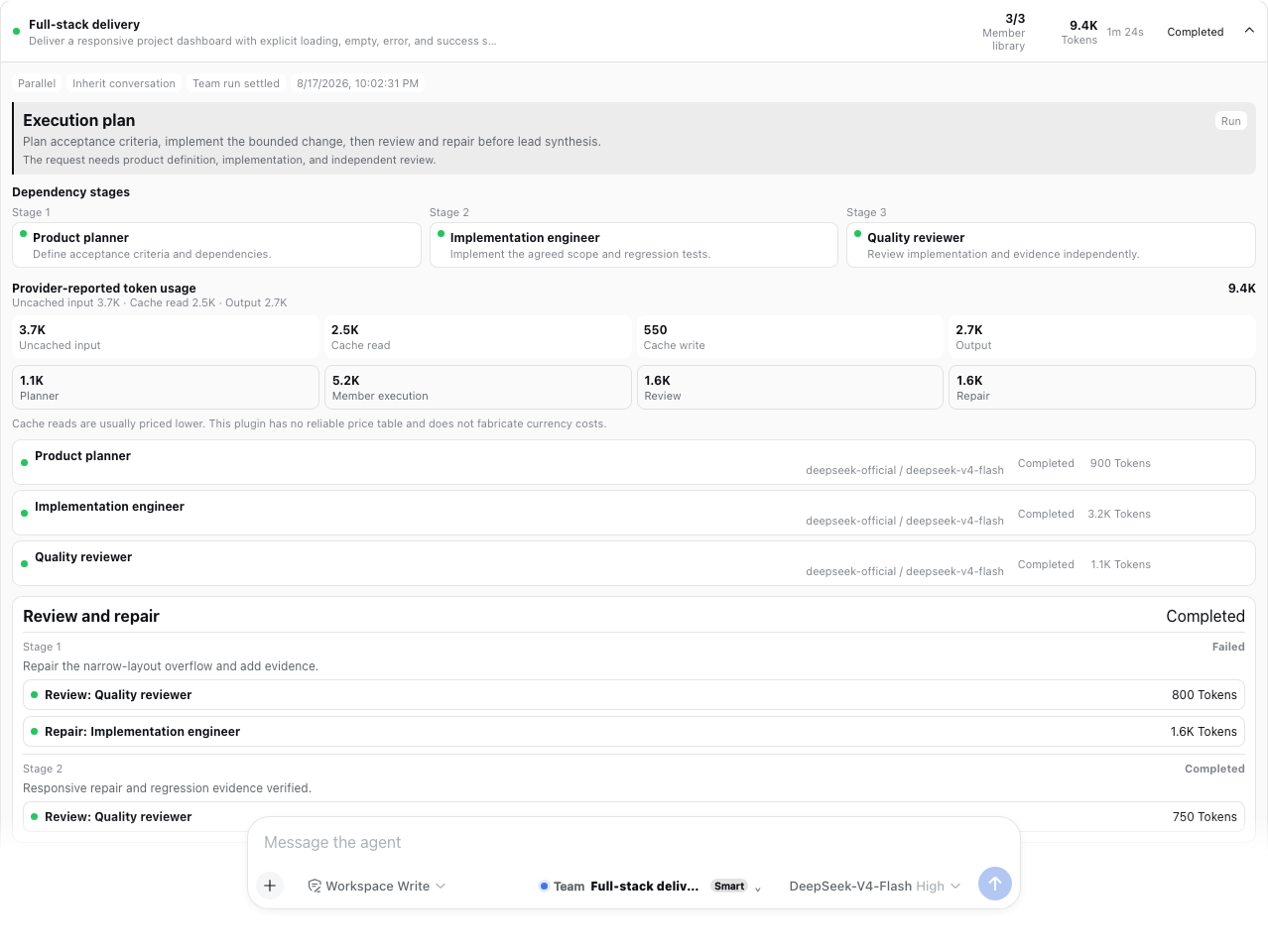
Every execution is written before planning starts. The Run Center exposes foreground/background
state, live phase, elapsed time, child IDs, complete outputs, bounded handoffs, stop, linked whole
or member retry, export, filters, and retention-safe clear.
If a DSH child settles with stopReason: "error" after delivering non-empty plain text, the member
counts as Completed instead of losing a valid long-form deliverable. The stop reason remains
recorded and Run Center shows a protocol-delivery warning. Empty output, rejected runs, cleanup
failures, timeouts, and other non-completed reasons such as max-tokens remain failures.
Each member handoff summary keeps up to 16,000 characters by default. A team may set
handoffSummaryMaxChars from 1,000 to 32,000. Complete raw output remains durable in Run Center;
dependency and lead prompts retain separate aggregate bounds so one long artifact cannot make model
context unbounded.
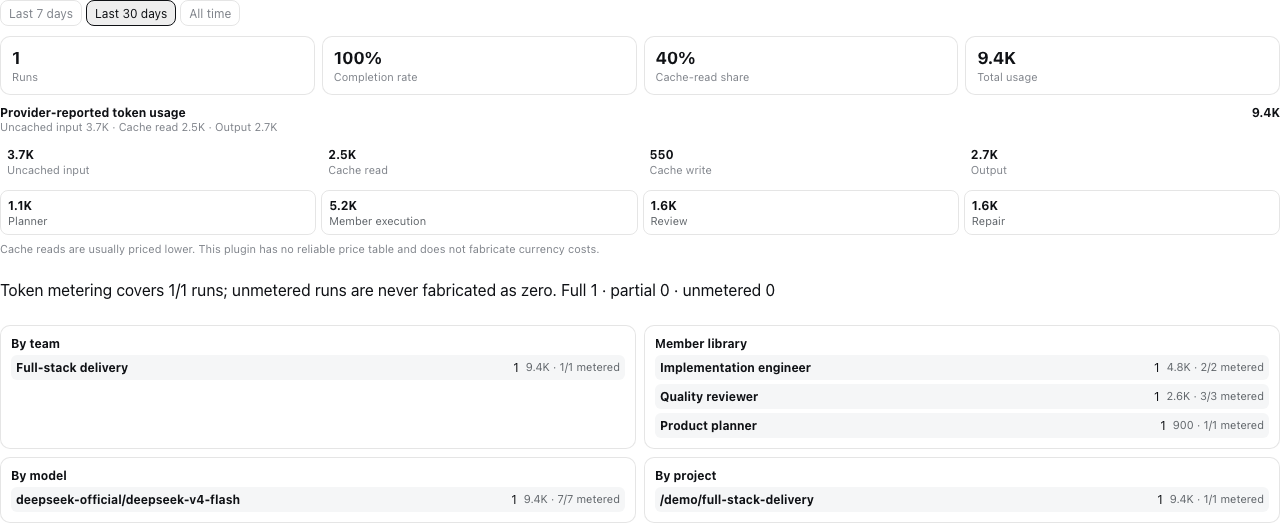
The plugin reuses DSH's official tokenUsage projection and keeps four buckets:
- uncached input;
- cache read;
- cache write;
- output.
Planner, member, review, and repair usage remain separately attributable. Coverage is explicitly
full, partial, or unavailable at run and retry-attempt level. Before a provider reports a
sample, the UI says Metering… instead of showing a false zero. Tokens are not money; the plugin
does not guess prices that Harness providers do not publish through a stable pricing contract.
Quality gate and background runs
An optional quality gate names one reviewer, one repair owner, explicit criteria, and 0..2 repair
rounds. A rejection can rerun only that repair owner, followed by the named reviewer. It cannot
create arbitrary agents or recurse.
Foreground runs finish before the lead Agent synthesizes bounded handoffs. Background runs return a
short acknowledgement and stay visible in the plugin Run Center; when the official DSH Jobs service
is present, the same run is also registered there with a shared cancel hook. Without that optional
service, the plugin falls back to process-local background execution; a Host restart then reconciles
unfinished durable state as Interrupted rather than pretending it completed.
Versions, recipes, and definition backup
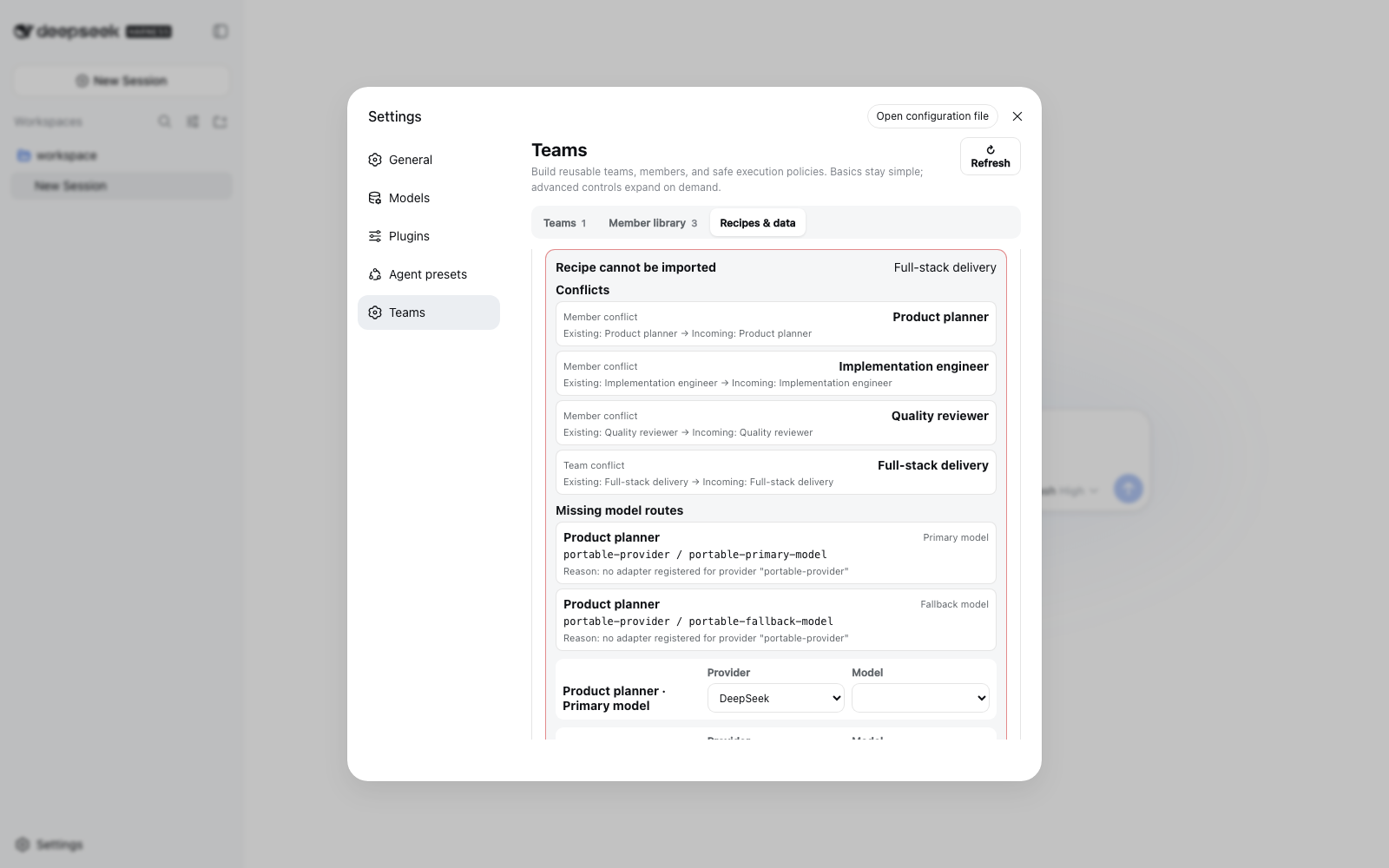
- Each saved team version includes immutable snapshots of all referenced member definitions.
- Restore is preview-first and warns when a shared member would change another team.
- Recipes contain one team and its members, never provider credentials. Import supports Copy or
Merge, conflict preview, and separate primary/fallback route remapping.
- Definition backup exports agents and teams. Import is preview-first with Merge or Replace;
replace reports deletions, dangling mode/default cleanup, and affected teams before confirmation.
- Multi-table writes are serialized and use compensating rollback on validation, cancellation, or
storage failure. Readers see either the previous or committed definition graph, not a half-import.
- Remote recipe URLs are disabled in v0.5. Import a reviewed local JSON file; this intentionally
avoids exposing an unprotected server-side fetch/SSRF surface.
Start with the credential-free
full-stack delivery recipe, preview it, and remap its
your-provider / your-model placeholders to routes configured in your own DSH profile.
Definition exports include member system prompts and model route names. Run exports additionally
include the user task and member outputs. Review those files before sharing them.
Settings reference
Member
| Field |
Meaning |
| Name and role prompt |
Durable identity and exclusive instructions for this member |
| Primary provider/model |
Existing DSH route; credentials stay in DSH |
| Fallback provider/model |
Optional paired route for retry-once |
maxTokens |
Hard per-attempt output ceiling sent to the provider |
| Tool allow/deny |
Least-privilege visibility for registered DSH tools; recursive team/subagent tools remain denied |
Team
| Field |
Meaning |
| Members and collaboration note |
Reusable member definitions plus team-level coordination guidance |
| Fixed order |
Complete serial permutation; leave off for dynamic assignments and DAG dependencies |
| Execution/context |
Serial or bounded parallel; spawn, fork, or serial-only chain |
| Activation/selection |
Always, Smart, or Manual; all members or adaptive subset |
| Response |
Foreground synthesis or observable background run |
| Planner |
Current/recent/full context and a bounded planner Token ceiling |
| Resilience |
Continue, stop, or retry-once; member timeout and fallback route |
| Limits |
Maximum concurrency and a soft provider-reported team Token budget |
| Handoff summary |
Per-member summary ceiling in characters; blank uses 16,000, configurable from 1,000–32,000 |
| Quality |
Named reviewer, repair owner, criteria, and at most two repair rounds |
Host configuration
The Web bundle inserts one unique Host row; it relies on the Web profile's existing storage,
Connection RPC, models, sessions, and browser module services.
- id: agent-team-gui
  name: dsh-agent-team-gui
  config:
    defaultProvider: spawn
    defaultExecutionMode: serial
    defaultContextMode: spawn
    historyMaxRuns: 0
    historyMaxAgeDays: 0
    versionMaxPerSquad: 0
| Field |
Default |
Meaning |
defaultProvider |
spawn |
Registered DSH subagent provider |
defaultExecutionMode |
serial |
Effective mode when a team omits it |
defaultContextMode |
spawn |
Effective context when a team omits it |
historyMaxRuns |
0 |
Count retention; 0 disables automatic run deletion |
historyMaxAgeDays |
0 |
Age retention in days; 0 disables automatic run deletion |
versionMaxPerSquad |
0 |
Version retention per team; 0 disables automatic version deletion |
If you override the row in a profile patch, restate every needed field: DSH patch rows replace the
complete config object rather than deep-merging it. chain is valid only for serial execution.
Retention is deliberately opt-in: upgrading to v0.5 does not silently delete existing run history
or team versions. Set a positive limit only when automatic cleanup is the behavior you want.
Other installation paths
Git source installation
Use this alternative when you intend to build from source:
dsh plugin --profile web add -w github:toolclub/dsh-agent-team-gui#v1.0.1
Git dependencies run this repository's prepare build. On pnpm 10+, authorize only the exact
package key pnpm prints under allowBuilds in the profile's pnpm-workspace.yaml, then repeat the
same pinned command. The key can include the resolved revision; copy the actual key from the error.
This grants that dependency permission to execute build scripts. The compiled release path above
avoids this step.
Exact commit
Resolve and review a full commit SHA, then use the same allowBuilds rule as the tagged Git install:
dsh plugin --profile web add -w github:toolclub/dsh-agent-team-gui#<full-commit-sha>
This is the most reproducible source install. The release CI performs the same fresh-profile check
against the exact pushed revision.
Local checkout
From this repository:
pnpm install --frozen-lockfile
pnpm run preflight
dsh plugin --profile web add -w .
preflight type-checks Host, Client, and tests; runs Host/rendered Client suites; builds from a clean
output directory; audits the tarball and secrets; and boots an isolated temporary DSH Web profile.
Compiled tarball
mkdir -p dist
pnpm pack --pack-destination dist
dsh plugin --profile web add -w ./dist/dsh-agent-team-gui-1.0.1.tgz
The package audit verifies runtime/declaration closure, examples, governance files, screenshots,
source maps, external dependency declarations, no absolute paths, no symlinks, and no known
credential patterns.
Ask a terminal-capable Agent
You can send this single instruction inside DeepSeek Harness:
Follow the installation and security notes in
https://github.com/toolclub/dsh-agent-team-gui. Install the compiled v1.0.1 Release tarball into
the Web profile, restart Web, verify the composed configuration, and report the installed version
and installation source.
dispatch_to_squad remains available for explicit/manual model-driven use. It accepts a team ID or
unique case-insensitive name, a task, optional assignments/order, and execution/context overrides
where the saved team permits them. Its model-facing result is bounded; the complete canonical run is
durable and available through the Run Center/export.
The package also exports AgentTeamService, record/result types, Zod schemas, and the in-process
definition/dispatch/version/recipe/run APIs. Treat those APIs as developer-preview surfaces while
DSH itself is pre-stable.
Security and privacy
- The dedicated RPC channel is registered loopback-only and validates every payload/result. This is
not an authentication layer for exposing DSH Web to the public Internet.
- Provider credentials are never copied into plugin records, recipes, examples, logs, or exports.
- Durable local storage does contain team role prompts, selected route names, conversation/project
identifiers, user tasks, run outputs, errors, and Token usage. Protect the DSH home directory.
- Use least-privilege member tools. A model may perform any action that its allowed DSH tools permit.
- URL recipe fetching is disabled. Installation scripts are the only extra machine-code authority;
review and pin Git dependencies or use a compiled tarball.
- Report vulnerabilities privately using SECURITY.md, not a public issue containing
credentials or private prompts.
Compatibility and

 dsh-agent-team-gui is an unofficial plugin for DeepSeek Harness (DSH) that lets you build a reusable multi-agent team: one agent plans the work, another implements it, and a third reviews it, with its own Run Center for tracking progress and Token usage.