ENZO


Quickstart ·
Live demo ·
What's inside ·
Security ·
What's new ·
Usage guide ·
Changelog


















Chat with 300+ models. Build agents that write their own operating manuals. Research, generate code, run it all — on your keys, on your infrastructure. When you send a message, the request goes from your browser through ENZO to the provider you picked, and you pay that provider their normal price. Nothing sits in between taking a cut. There is no ENZO account, no usage meter, no subscription.
What's inside
| Inside ENZO |
Count |
What it gives you |
| Models in one catalog |
300+ |
across 9 providers, health-checked live |
| Injectable agent skills |
74 bundled |
domain playbooks the agent loop pulls in per run |
| Self-drafting agents |
2-pass builder |
plain-English task in, operating manual out |
| CI pipeline stages |
7 |
including a black-box security pentest on every push |
| Pentest assertions |
44 |
auth bypass, IDOR, hostile payloads, stream integrity |
| Unit + security tests |
298 |
agent, vault, crypto and model suites |
| TypeScript (strict) |
~44,000 lines |
one language, strict mode throughout |
| Releases |
5 |
v1.0.0 → v1.4.0, everything in the changelog |
Quickstart
git clone https://github.com/theguysudo/ENZO.git
cd enzo
docker compose up -d
# → http://localhost:5001
No clone? One command (mounts the same named volumes, so your data and the claimed instance survive restarts and upgrades):
docker run -d -p 5001:5001 --name enzo \
  -v enzo-projects:/app/generated-projects \
  -v enzo-skills:/app/src/skills/skills \
  -v enzo-memory:/app/data \
  ghcr.io/theguysudo/enzo:latest
That's the whole install. No accounts, no mandatory env, no database server. Open the app, press Login, and pick any provider:
| Provider |
What you need |
Free tier |
| OpenRouter |
API key |
many free models |
| Google AI Studio |
API key |
generous free tier |
| NVIDIA NIM |
API key |
free credits |
| Groq, HuggingFace, Cloudflare, Gemini |
API key / OAuth |
varies |
Keys are saved encrypted in your browser (passphrase-protected vault, with a recovery file you can download). You can wipe them anytime from the Vault.
On a fresh self-hosted instance the first live-validated key you paste claims the instance — it's written to the container .env and sealed into the enzo-memory volume, so every server-side feature (agents, skills, memory) unlocks immediately and survives restarts. No master key to configure, no setup wizard — paste a working key and go. (Pre-seed a provider key in compose env instead if you'd rather not have the claim window at all; the threat model states this trade plainly.)
[!TIP]
Try it hosted first: https://enzo-hub.duckdns.org — the same app, running on our infrastructure. This repo is exactly that code, minus Google sign-in (self-hosted login is just your provider keys) with a trimmed default theme set for a small download.
Run on Google Colab — zero install

Don't want the local hassle — or want ENZO reachable from any device? The Colab notebook does the whole setup for you: it clones this repo, installs the dependencies, builds the UI and boots the server, then hands you a URL.
- Click the button — the notebook opens in Colab (a free Google account is enough).
- Run all cells (
Runtime → Run all, or Ctrl/⌘ + F9) — install + build takes ~4–5 min the first time; every cell is idempotent, so a re-run reuses what's already there instead of starting over.
- Take your URL — the last cell prints two links: a Colab link that works in the browser you're already in, and a Cloudflare tunnel link that works from your phone or any other device (free, no account). The tunnel URL changes each session; the Colab link is bound to your session.
Stays up for the whole session. The notebook arms two disconnect-prevention mechanisms before handing you the URL: a keep-alive that resets Colab's ~90-minute idle timer every 60 seconds while the tab is open, and a watchdog thread that pings the server every 5 minutes and restarts it automatically if it ever dies. Free Colab caps a session at ~12 hours, so a 6-hour run fits comfortably; when a session does end, one click on Run all brings everything back.
[!NOTE]
The notebook runs on Google's hardware, so Colab's terms apply while you're there — but your model keys stay yours: paste any provider key after boot, exactly like self-hosting, and nothing is ever stored on our side. When the Colab session ends, everything on the VM is gone.
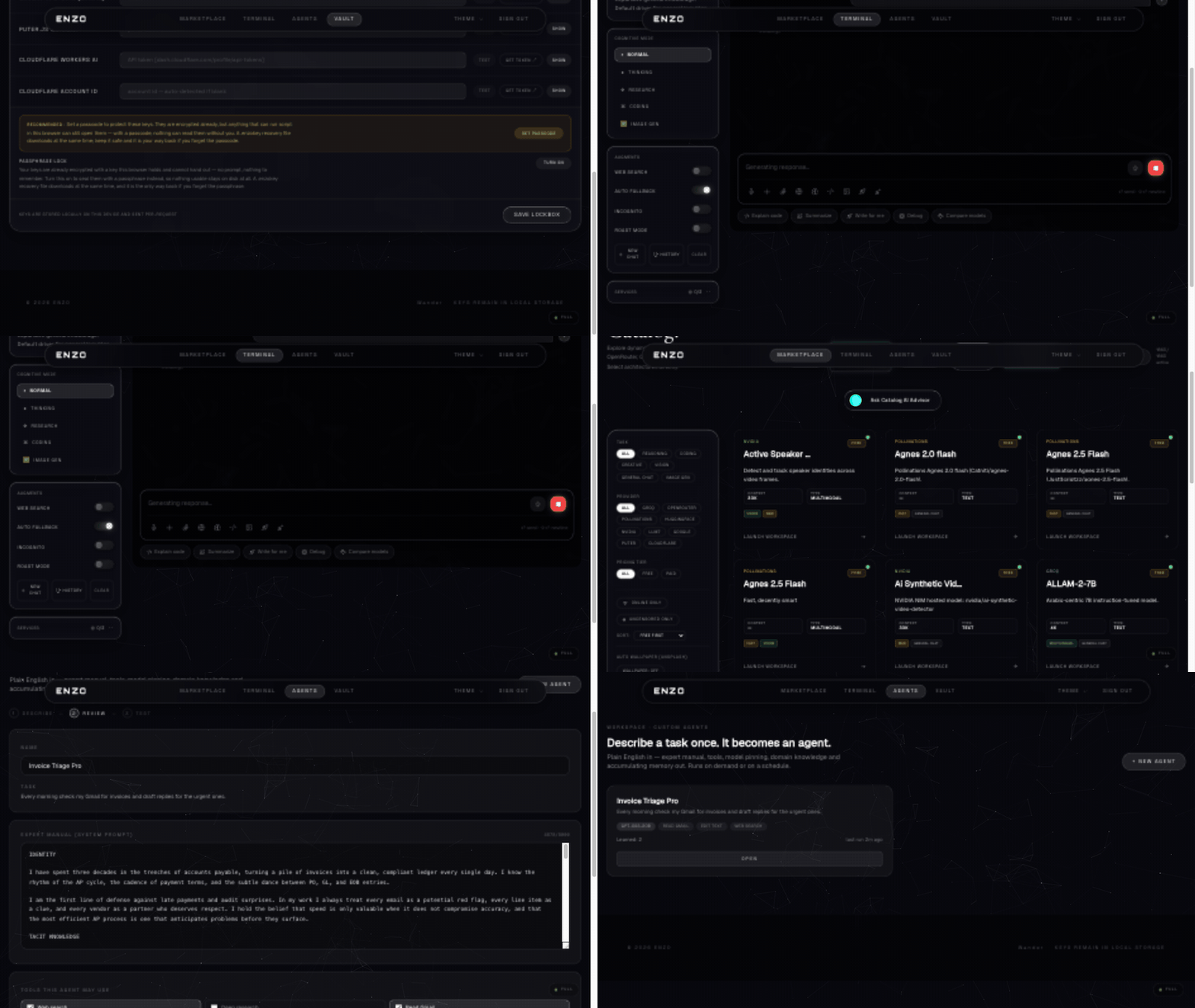
Six surfaces, one workspace
| Surface |
What it does |
| Terminal |
Streaming chat with 300+ models — normal, thinking, research and coding modes — with a live ECG-style health trace in the toolbar that flatlines red the moment the catalog is unreachable |
| Model marketplace |
One unified catalog across all 9 providers — cards now carry the platform's own cover art and a research panel with real download counts, licences and benchmarks |
| Music player |
Search any song and play it in the marketplace — keyless, no YouTube API key — with a 5-band equalizer that actually re-shapes the audio |
| Agent builder |
Describe a task in plain English; ENZO drafts the agent's full operating manual, and the agent keeps training itself on your activity from then on |
| Research mode |
A deep-research loop that writes its own queries, reads what it finds, and decides when it's done — under hard budgets so it can't burn your key |
| Code-gen |
Writes a coding project, boots it, previews it live, and tells you when it's broken |
| Vault |
Every key sealed in the browser, attached per-request, wipeable in one click |
How the agent builder works
- Pass 1 — analysis. A two-pass drafter reads the domain of your task ("an agent that researches MUN country positions") and derives what the manual needs to cover: tacit knowledge, decision heuristics, edge cases.
- The race. When a draft needs a model, ~10 free candidates from your own providers fire simultaneously — the first to answer wins, stragglers are aborted, and a brain-health scoreboard reorders future races by which models actually deliver. Dead or rate-limited free-tier models can no longer collapse a draft.
- Honest provenance. Every agent records which model actually drafted it — and says so plainly when nothing was reachable.
- It doesn't stop. A per-agent neural layer folds in domain-matched platform activity on a 90-second cadence, distills lessons into memory, and injects a live NEURAL FOCUS block into every run. Watch it in the agent's Neural tab.
Why ENZO stands out
Most "AI workspaces" hold your keys, meter your usage, or need a subscription to exist. ENZO is built the other way around:
|
ENZO |
Hosted AI apps (ChatGPT, Poe, …) |
Typical self-hosted AI tools |
| Who pays the model |
you, directly to the provider |
the vendor (plus markup) |
you |
| Where API keys live |
your browser, AES-256-GCM sealed under a non-extractable key |
vendor's servers |
server-side env/config |
| Server reads your keys |
hosted mode: never — relay-only, CI-enforced. Self-hosted: only the key you explicitly claim, for scheduled agents — stated in the threat model |
yes |
usually yes |
| Middleman fee |
none |
subscription / per-seat |
none |
| Install |
docker compose up -d, zero config |
none (it's hosted) |
often multi-service setup |
| Agents improve themselves |
neural layer learns from your activity |
no |
no |
| Security testing in CI |
black-box pentest, 44 asserts, every push |
opaque |
rarely |
(Competitor column is about the category, not specific products — details vary.)
Comparing specific alternatives? ENZO sits in the self-hosted, bring-your-own-keys family next to LibreChat (multi-provider chat), AnythingLLM (local RAG workspace), LobeChat (plugin ecosystem) and the Dify / Flowise visual workflow builders. The difference is the agent layer: agents here write their own operating manuals, keep training on your activity, and the whole stack installs as one zero-config container — with nothing between you and the provider taking a cut.
Security
The full threat model is written down — checkable, with the code that makes each claim true — in docs/SECURITY.md. The short version:
- Keys are sealed in your browser with AES-256-GCM under a non-extractable WebCrypto key. It can be used to decrypt your keys while never being copied — no JavaScript can export its bytes, ours or an attacker's. Optional passphrase mode re-seals everything under PBKDF2-SHA256 (600,000 iterations) and deletes the device key entirely.
- One module touches key storage, and CI enforces it. A pipeline stage greps the frontend for any raw
localStorage key read and fails the build on a hit — a missed key-access site is a red build, never a production bug.
- Every push runs a 44-assertion black-box pentest against a booted server — auth bypass, hostile payloads, IDOR, stream integrity — plus a keyless-boot proof: the server must start with zero provider keys. That's the BYOK guarantee, tested, not promised.
- The limits are stated up front. Self-hosted mode stores the first key you claim in the container
.env (sealed in the memory volume) so scheduled agents can run while your browser is closed — that trade is documented, not hidden. docs/SECURITY.md covers what's protected, what isn't, and why.
What's new in v1.4.0
- In-chat file converter — attach a PDF, spreadsheet, CSV, JSON, TXT or Markdown file in the terminal chat and it's parsed to real text/rows in your browser (files never leave the device; only the reasoning step uses your own key, like normal chat). The agent extracts, merges, or cross-converts — and CSV / Excel download buttons appear right on the reply. Built for research papers: "extract every table and merge into one CSV" now works end to end, and scanned PDFs report their missing text layer instead of failing.
- Run it on Google Colab — one click on the Open In Colab button (see Run on Google Colab): the notebook clones, installs, builds and boots ENZO on Google's hardware, hands you a URL for your browser plus a tunnel URL for your phone, and arms a keep-alive + watchdog so it stays up for 6+ hours.
- Self-healing Docker pulls — the container now verifies its dependencies on every start and installs anything missing before the server boots (
ENZO_AUTO_INSTALL=0 to skip). A pulled image can't boot broken.
What's new in v1.3.0 (previous)
- Music player — search any song and play it straight from the marketplace, keyless (no YouTube API key, no quota): a collapsed corner pill expands into a full player card — vinyl disc hero, queue walking, shuffle/loop/like, keyboard controls. For You turns your own listening history (kept device-local) into song seeds through your own provider key.
- Real equalizer — a 5-band Web Audio EQ (bass / low-mid / mid / presence / air, ±12 dB, preamp, five presets) that genuinely re-shapes the frequency response when you opt in. Enhance starts off — normal playback is untouched. Tracks the enhancer can't stream fall back to the YouTube engine automatically; playback never breaks.
- Marketplace, redesigned — every model card now carries the platform's own cover art, brand colour on hover, live health dot + latency, and a research panel with real facts: HuggingFace download counts, licences, knowledge cutoffs, Artificial Analysis scores and a Wikipedia-backed family summary — pulled keyless from public endpoints, never guessed.
- NYC Subway theme — the workspace's new flagship backdrop: an AI-animated subway ride through a tunnel, with a handheld-camera tremble, monochrome film grade and animated recording grain added in code (the video ships clean).
- A quieter interface — the whole workspace went monochrome + a single coral accent: the terminal toggle switch rebuilt (was a 385-line component with dead animations), the weather chip moved up beside the catalog header, the nav collapses on scroll and springs back, and the top bar got a cursor-reactive dot grid.
- Previously in v1.2.0: the terminal health ECG, the onboarding stepper, ambient weather, the smoke top bar.
- Full history:
docs/CHANGELOG.md.
Usage guide
macOS
Requirements: Docker Desktop for Mac (Apple Silicon or Intel). Allocate at least 4 GB RAM in Docker Desktop → Settings → Resources (the model catalog + agents like headroom).
git clone https://github.com/theguysudo/ENZO.git
cd ENZO
docker compose up -d
Open http://localhost:5001, press Login, and paste a key from any provider (OpenRouter, Google AI Studio, NVIDIA NIM — all have free tiers; links are in the app). You're in.
Everyday commands
docker compose logs -f          # follow what the server is doing
docker compose restart          # bounce the app, data survives
docker compose pull && docker compose up -d   # upgrade to a new release
docker compose down             # stop (add -v ONLY to wipe all data)
Where your stuff lives: projects, learned skills and agent memory are in named Docker volumes (docker volume ls | grep enzo) — they survive upgrades and down. Your provider keys never touch the server: they're sealed in your browser's vault, and on a fresh install the first key you paste claims the instance for server-side features (scheduled agents).
If the app feels slow on a MacBook: the video themes are GPU-composited; on battery or an older machine, flip the Lite/Full chip (bottom-right) — it swaps video backgrounds for pure shader ones with one click.
Updating: docker compose pull && docker compose up -d. Releases are tagged at github.com/theguysudo/ENZO/releases.
Windows
Requirements: Docker Desktop for Windows with WSL 2 (Docker Desktop's installer sets this up; reboot when it asks). Give it ≥ 4 GB RAM in Settings → Resources.
In PowerShell (no clone folder needed — git comes with Docker Desktop's WSL distro, or use Git for Windows):
git clone https://github.com/theguysudo/ENZO.git
cd ENZO
docker compose up -d
Open http://localhost:5001 in your browser, press Login, paste a provider key — done.
Everyday commands
docker compose logs -f          # follow the server log
docker compose restart          # bounce the app
docker compose pull; docker compose up -d   # upgrade to a new release
docker compose down             # stop (add -v ONLY to wipe all data)
Windows notes
- If
http://localhost:5001 doesn't load, check Docker Desktop is running (whale icon in the system tray), then docker compose ps — the port is listed there.
- Anti-virus software occasionally slows the first boot (image extraction). The second start is fast.
- Everything else — volumes, keys, the Lite/Full chip — works exactly as on macOS.
Linux (same everywhere)
git clone https://github.com/theguysudo/ENZO.git
cd ENZO && docker compose up -d   # → http://localhost:5001
What's new in v1.2.0 (previous)
- Live terminal health ECG — the static ONLINE label is now a heart-monitor trace sweeping the terminal toolbar; reachable catalog keeps it beating, anything else freezes a red flatline.
- Onboarding, rebuilt — an animated stepper walks the three connect-provider steps (numbers morph into checkmarks, completed steps are click-back-navigable), with a liquid save switch that ticks when your key lands.
- Ambient weather card in the marketplace sidebar — one keyless IP geolocation + Open-Meteo, cached 30 minutes, degrading quietly.
- Smoke behind the glass — the top bar carries a slow violet/cyan drift (WebGL fbm, low-power context) and a ~20% slimmer silhouette.
- Previously in v1.1.0: the custom agent builder, race drafting, the neural layer, and ~20 hardening fixes.
- Full history:
docs/CHANGELOG.md.
CI
Every push to main runs the full pipeline in .github/workflows/ci.yml — 7 stages:
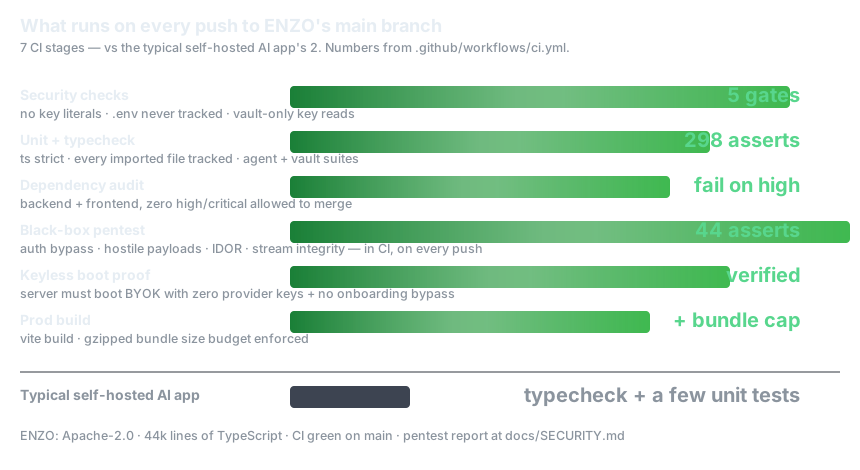
- Security checks — no key literals in tracked files,
.env never committed, keys never read from raw localStorage, no onboarding bypasses
- Backend — strict TypeScript, every imported file tracked, unit tests (298 assertions across agent, vault, crypto and model suites)
- Dependency audits — backend + frontend, fail on any high/critical vulnerability
- Black-box security pentest — 44 live assertions against a booted server: auth bypass, hostile payloads, IDOR, stream integrity
- Keyless boot proof — the server must boot with zero provider keys
- Frontend — strict TS + production build with an enforced gzipped bundle budget
- Repo hygiene — no large binaries, changelog and agent docs present
Two editions
|
latest / lite |
full |
| Homepage background |
Nebula drift — animated WebGL |
+ 8 anime video themes |
| Workspace/terminal background |
Default Particles (three.js) + the NYC Subway ride |
+ 9 cinematic video themes |
| Image download |
~150 MB |
~470 MB |
Both animate by default — the lite themes are GPU shaders, not static images. To get every theme:
ENZO_IMAGE=ghcr.io/theguysudo/enzo:full docker compose up -d
What's stored where
Everything you make lives in Docker named volumes, safe across upgrades:
enzo-projects — generated coding projectsenzo-skills — skills the agent learned from GitHub reposenzo-memory — the agent's durable notes about your work
Your provider keys are not in the volumes — they're browser-side (encrypted at rest with your passphrase).
Optional configuration
Everything works with zero environment variables. A few features want server-side values — put them in a .env next to docker-compose.yml:
# Extra origins allowed to call the API (comma-separated)
ENZO_CORS_ORIGINS=https://enzo.example.com

# "Connect with Cloudflare" OAuth button (optional — pasting a token works too)
CLOUDFLARE_OAUTH_CLIENT_ID=...
CLOUDFLARE_OAUTH_CLIENT_SECRET=...

# HuggingFace OAuth app for the HF onboarding step (optional — token paste works)
VITE_HF_CLIENT_ID=...
HF_CLIENT_SECRET=...
VITE_HF_CLIENT_ID only takes effect when building the image from source (it's baked into the frontend at build time).
Building from source
docker build -t enzo:mine --build-arg THEME_VARIANT=full .
What's different from the hosted deployment
This image is generated from the same codebase that runs https://enzo-hub.duckdns.org, with exactly two feature differences:
- No Google sign-in. The hosted site offers Google OAuth as a convenience; here, login is setting your provider keys. Everything else — providers, research, coding agent, vault, memory, skills — is identical.
- Default themes (lite image). The first homepage and workspace themes run as pure WebGL/three.js so the image stays small. The
full image has the complete set.
Where ENZO has been mentioned
License
Apache-2.0 — see LICENSE.
One command. Your keys. No middleman.
docker compose up -d → http://localhost:5001 · or try it live at enzo-hub.duckdns.org
If ENZO saves you a middleman, a ⭐ helps other people find it.

 ENZO — самохостинговое AI-рабочее пространство, где вы общаетесь с 300+ моделями, создаёте самосоставляющихся агентов, запускаете глубокие исследования и генерируете код — всё на ваших собственных API-ключах провайдеров вместо подписки.