dquickts
A fork of QuickJS, Fabrice Bellard's small embeddable JavaScript
engine, that adds three things:
- Durable execution. You can pause a running program, even in the middle of a
for loop,
serialize its whole heap to bytes, and resume it later in a different process.
- Native TypeScript.
.ts files run directly. The parser erases the types as it reads them,
so there is no transpile step.
- Python 3.15. Python is compiled to QuickJS bytecode and runs on the same VM, heap and GC
as JS, with objects shared between the two languages. A CPython-compatible C API loads
extension modules: pip, abi3 wheels, and source builds of numpy, Pillow and matplotlib.
It also includes Rust bindings (a port of rquickjs) that
expose all three.
git clone https://github.com/stencil-hq/dquickts
cd dquickts
make                 # builds qjs, qjsc, qpy and libquickjs.a
./qjs hello.ts
./qpy hello.py               # Python, with CPython's command line
./qjs                        # the REPL: JS, or Python after \py (\js switches back)
./qjs --drepl session.snap   # a REPL whose state survives restarts
./qjs --drepl py.snap --python   # the same for Python and JS together
make test-snapshot   # builds and runs the suspension and snapshot test hosts
Contents
What this fork adds
This fork tracks upstream QuickJS 2026-06-04 (see VERSION). Everything upstream ships,
including the experimental Temporal and Intl support (qjs --experimental), is still here. The
fork adds:
| Feature |
API |
| In-process suspension of running code |
JS_RequestSuspend(), JS_IsSuspended(), JS_Resume() |
| Durable host calls: a C function parks its JS caller until the host supplies a result |
JS_SuspendCall(), JS_ResumeWith() |
| Heap snapshots of a whole runtime, including a suspended call stack |
JS_WriteSnapshot(), JS_ReadSnapshot() |
| Incremental snapshots: a delta holds only what changed since a base |
JS_SNAPSHOT_BASE, JS_SNAPSHOT_DELTA, JS_DropSnapshotBase() |
| Branch metering that stays exact across suspensions and snapshots |
JS_GetProgramBranchCount() |
| TypeScript: types erased at parse time; enums, namespaces and parameter properties compiled to bytecode |
JS_EVAL_FLAG_TYPESCRIPT, qjs --typescript, .ts/.mts/.cts |
Standard decorators (2023-05), auto-accessors, Symbol.metadata; TypeScript legacy decorators and decorator metadata |
JS_EVAL_FLAG_TS_LEGACY_DECORATORS, JS_EVAL_FLAG_TS_DECORATOR_METADATA |
| Explicit resource management (ES2026) |
using, await using, DisposableStack, AsyncDisposableStack |
| Ports from quickjs-ng |
queueMicrotask(), atob()/btoa(), DOMException, the V8 stack trace API, promise hooks, immutable ArrayBuffers, performance, os.setInterval(), std.writeFile(), the bjson module, a re-entrant event loop, C closures, private symbols, runtime dump flags, and bug fixes |
Global timers in qjs, its workers and the embedders of js_std_add_helpers() (the os timers, ids shared) |
setTimeout(), clearTimeout(), setInterval(), clearInterval() |
| Embedder helpers |
JS_IsEqual(), JS_NewProxy(), JS_GetProxyTarget(), JS_PromiseMarkAsHandled(), and others |
| A REPL whose functions and variables survive restarts |
qjs --drepl FILE |
| A REPL that switches between JS/TypeScript and Python from one input to the next, in one runtime |
\py, \js in qjs and qjs --drepl FILE --python |
| Python 3.15 compiled to QuickJS bytecode, sharing the runtime with JS; CPython-compatible C API (abi3 wheels, source builds of numpy, Pillow and matplotlib) |
qpy, JS_InitPython(), JS_EvalPython(), qjs --drepl FILE --python |
| Rust bindings built on this engine |
rquickjs/ |
The full list is under unreleased in Changelog.
Durable REPL
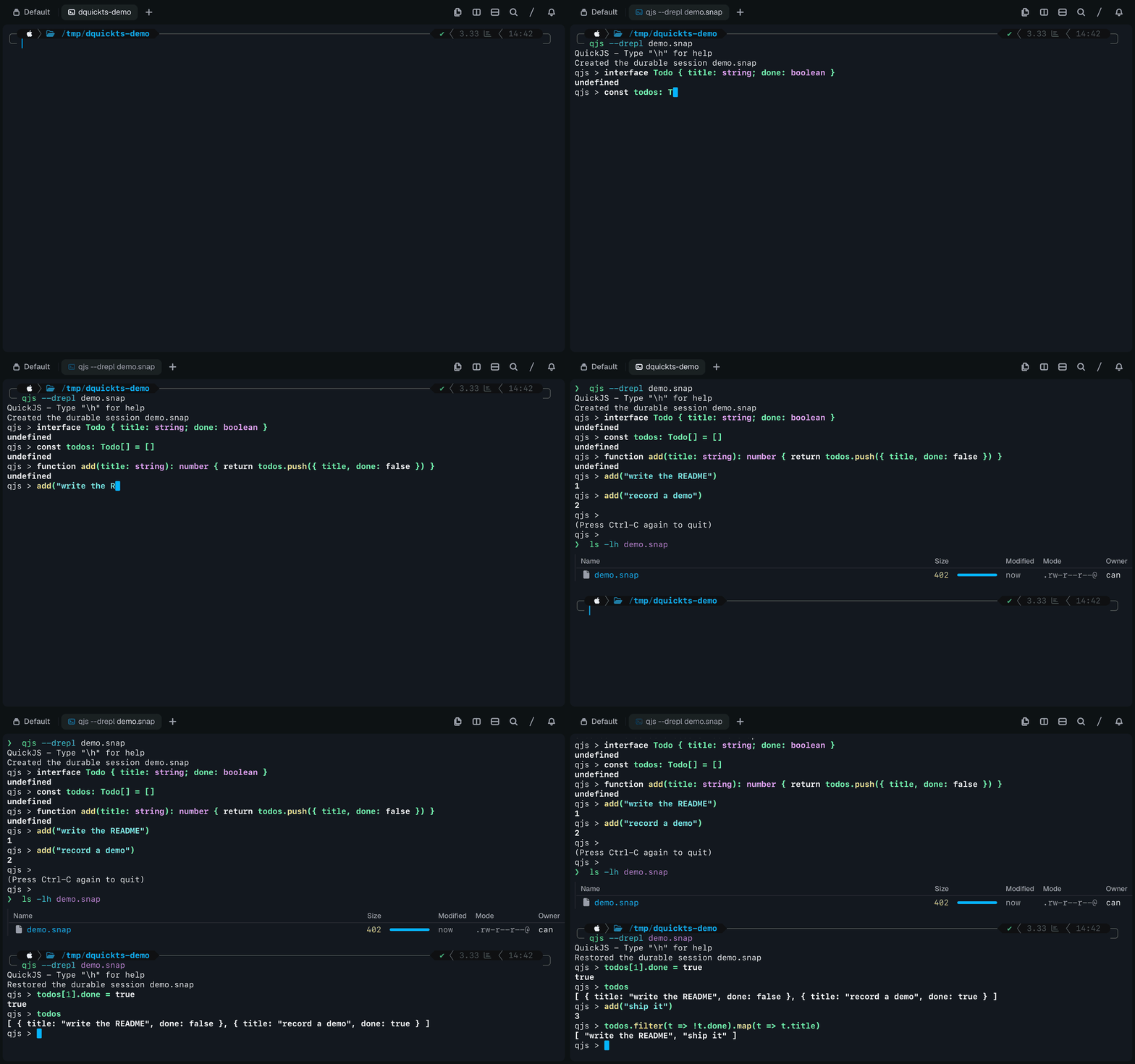
qjs --drepl FILE starts the usual REPL, with highlighting, history and tab completion, and
input is TypeScript. After every command, the whole session is saved to FILE. When you start
qjs --drepl FILE again, the session comes back with the same functions, variables, objects and
closures:
$ ./qjs --drepl session.snap
QuickJS - Type "\h" for help
Created the durable session session.snap
qjs> function add(a: number, b: number): number { return a + b }
undefined
qjs> let total: number = add(2, 3)
undefined
qjs> class Counter { constructor(private n = 0) {} inc(): number { return ++this.n } }
undefined
qjs> const c = new Counter()
undefined
qjs> c.inc()
1
qjs> ^C
(Press Ctrl-C again to quit)
qjs> ^C
$ ./qjs --drepl session.snap
QuickJS - Type "\h" for help
Restored the durable session session.snap
qjs> add(total, 10)
15
qjs> c.inc()
2
The commands don't run in the REPL's own runtime. They run in a separate runtime that holds only
the standard objects plus print() and console.log():
- The line editor (
repl.js) stays in the main runtime and passes each command to the durable
runtime. The durable runtime runs the command and its promise jobs, so top-level await works,
and sends back the rendered result.
- After each command, the durable runtime is written with
JS_WriteSnapshot() as a delta of a
new session. It goes to a temporary file that is then renamed over FILE, so the file always
holds a complete delta. The session in the transcript above takes about 400 bytes.
- At startup,
qjs rebuilds the base, which is a new session with every lazily created builtin
already instantiated. Bases are reproducible, so this rebuilt base is
byte-identical to the one the deltas were written against. JS_ReadSnapshot() then applies
FILE on top of it. If the file is missing, a new session starts.
Limits:
- The
std and os modules and the global timers (setTimeout()...) are not available. Their
files, timers and handlers are host state that a snapshot cannot save.
\load file evaluates a file inside the session.- Ctrl-C interrupts a running command. The session is not affected.
- A session file only loads into the
qjs build that wrote it.
- Tab completion lists properties of the global object. Like the regular REPL, it does not list
top-level
let, const and class names, but it does complete their members (c.in →
c.inc()).
Python sessions
qjs --drepl FILE --python is the same REPL for Python 3.15. It follows the CPython REPL:
>>> and ... prompts (sys.ps1, sys.ps2), a block ends with an empty line,
sys.displayhook prints the results and sets builtins._, sys.excepthook prints the
tracebacks, and top-level await works:
$ ./qjs --drepl session.snap --python
Python 3.15.2 (main) [dquickts 2026-06-04] on darwin
Type "help", "copyright", "credits" or "license" for more information.
Created the durable session session.snap
>>> class Counter:
...     def __init__(self):
...         self.n = 0
...     def inc(self):
...         self.n += 1
...         return self.n
...
>>> c = Counter()
>>> c.inc()
1
>>> def squares():
...     for i in range(10):
...         yield i * i
...
>>> g = squares()
>>> next(g), next(g)
(0, 1)
>>> ^D
$ ./qjs --drepl session.snap --python
Python 3.15.2 (main) [dquickts 2026-06-04] on darwin
Type "help", "copyright", "credits" or "license" for more information.
Restored the durable session session.snap
>>> c.inc()
2
>>> next(g)
4
The architecture is the one above: repl.js edits the lines, the durable runtime holds a Python
session (python/pythonrun.c, the qp_drepl_* functions) and runs the inputs, and the runtime
is saved as a delta after each input (about 34 KB for the transcript above, in a directory with
a few files: the import system caches the listing of the working directory). In detail:
- The whole heap is saved: globals, functions, classes, instances, closures, generators and
coroutines suspended in the middle, the imported modules (not imported again on load),
sys.path and the sources that the tracebacks show.
- The
js module works in a session: the JS objects that Python holds, the Python objects
that JS holds and Function.prototype.callKw are saved with the rest.
- Python decides when the lines form a complete input (
codeop rules) and writes the results
and the tracebacks itself.
- Top-level
await (PyCF_ALLOW_TOP_LEVEL_AWAIT): an input that awaits runs as a coroutine
until it ends, with the job queue of the runtime. A bare yield lets the pending jobs run, a
JavaScript promise is awaited until a job settles it, any other value raises
RuntimeError: Task got bad yield.
- Ctrl-C raises
KeyboardInterrupt in the running input, which can catch it. At the prompt it
drops the input. Ctrl-D, or the end of a piped input, quits. SystemExit (sys.exit()) ends
qjs with its exit status, after the session is saved.
FILE starts with a header that holds the hash seed of the session (the str hashes are
randomized per session) and the language of the inputs, then the delta. The base is rebuilt
with that seed. So that the base
is the same in every process, the session ignores the PYTHON* environment variables (like
python -E), runs in UTF-8 mode without the user site, has sys.argv == [''] and unbuffered,
non-seekable standard streams that record nothing about their file descriptors, starts with
an empty sys.path_importer_cache (it depends on the working directory), and records the
default action of every signal. The snapshots write the hash tables whose layout depends on
object addresses (sets of classes, of functions...) in a canonical order.os.environ comes from the environment of the running qjs, but it is emptied while the
session is written: FILE never holds the values of the environment variables (tokens,
passwords), and a restored session sees the environment of the new process.- Tab completes the keywords, the globals and the builtins, and after a dotted name its
attributes (evaluating the name, like
rlcompleter). At the start of a line it indents.
\js switches the session to TypeScript (see below).
Limits:
- Objects holding host state cannot be saved: files other than the standard streams, sockets,
child processes, running threads other than the main thread,
os.scandir() iterators,
select.poll() objects, C extension objects that cannot be pickled. The input still
runs, but qjs reports the TypeError naming the object and FILE keeps the previous state
(qjs: FILE not saved: TypeError: snapshot: cannot save Python object 'select.poll': poll object on file descriptors). The next inputs are not saved either, until the object is no
longer reachable (del p).
- A session file only loads into the
qjs build and the mode that wrote it: --python rejects
a JavaScript session ("not a Python session") and the JavaScript mode rejects a Python session
("a Python session (add --python)").
Sessions may import the CPython C modules (re, json, decimal, datetime, asyncio,
csv, threading, logging, subprocess...) and keep their objects: the snapshot saves their
C state. Locks no thread holds and finished threads are saved as values, and the main thread's
threading objects are bound to the main thread of the process that restores the session.
JS and Python in one REPL

The REPL of qjs takes JavaScript (TypeScript with --typescript) and Python inputs, and
both languages run in the same runtime and heap. \py switches the next inputs to Python and
\js switches back. \py CODE and \js CODE run a single input in the other language,
including its continuation lines. The prompt shows the language: qjs> for JavaScript,
sys.ps1 and sys.ps2 (>>> , ... ) for Python. \h lists the commands.
Neither language needs an import to reach the other:
- In Python,
js is already imported in __main__. js.name reads a JavaScript global
variable, including the top-level let, const and class declarations of earlier inputs.
- In JavaScript,
py is Python's __main__ module. py.fib(10) calls a Python function and
py.x = 1 sets a Python global.
Python inputs behave as in the Python sessions: codeop decides when an
input is complete, sys.displayhook and sys.excepthook print, top-level await works and Tab
completes Python names. JavaScript inputs keep the usual REPL behavior. In a terminal, the input
is syntax-highlighted in its language, with the colors of the JavaScript REPL; the rest of a
\py CODE or \js CODE line is highlighted as that language.
qjs --drepl FILE --python sessions start in Python. The JavaScript state is part of the same
heap snapshot as the Python state, and a restored session comes back in the language it was
left in:
$ ./qjs --drepl session.snap --python
Python 3.15.2 (main) [dquickts 2026-06-04] on darwin
Type "help", "copyright", "credits" or "license" for more information.
Created the durable session session.snap
>>> def fib(n):
...     return n if n < 2 else fib(n - 1) + fib(n - 2)
...
>>> \js
qjs> let scale: number = 10
undefined
qjs> function area(w: number, h: number): number { return w * h * scale }
undefined
qjs> py.fib(10)
55
qjs> \py [js.area(2, i) for i in range(3)]
[0, 20, 40]
qjs> ^D
$ ./qjs --drepl session.snap --python
QuickJS - Type "\h" for help
Restored the durable session session.snap
qjs> py.fib(scale)
55
qjs> \py
>>> fib(js.area(1, 1))
55
In those sessions, JavaScript inputs get the same print() and console.log() as a
JavaScript session. A JavaScript session (qjs --drepl FILE without --python) has no Python
in its base snapshot, so it cannot switch: \py prints an error telling you to start the
session with --python.
The plain REPL (qjs without --drepl) starts in JavaScript. Python is initialized by the
first Python input, or by the first use of py, so a JavaScript-only REPL starts as fast as
before. It runs like the interactive python with no arguments (the PYTHON* environment
variables apply, sys.argv == ['']), except that its standard streams are unbuffered so that
Python and JavaScript output come out in order. SystemExit ends qjs with its exit status.
If stdin is not a terminal, every REPL reads its lines without editing, echo or colors, and
runs them one input at a time, waiting for an asynchronous JavaScript result before reading the
next input. When the input ends, the REPL quits.
Snapshots
What a snapshot is
A snapshot is the entire state of a JavaScript runtime, written out as one byte buffer. It
includes:
- every context (realm), with its global object and its intrinsics,
- every object, closure, string, symbol and compiled function,
- pending promise jobs, paused generators, and async functions waiting on an
await,
- loaded modules, with their bindings and evaluation state (a module can be saved in the middle
of a top-level
await),
- the call stack of the synchronous code that was running, if the runtime is currently suspended.
To restore, you read the snapshot into a fresh, empty runtime. You get the same program in the
same state:
- objects keep their identity, so two references to one object still point to one object,
- closures still share their captured variables,
- pending work is still pending.
The snapshot holds indexes instead of pointers. That means the rebuilt heap can live at any
address, in any process, on any machine that runs the same build of the engine.
Some things you can do with this:
- Hibernate. Write an idle or long-running script to disk, free its memory, and bring it
back when there is work for it.
- Durable workflows. A script calls a host function whose answer arrives hours later. The
process saves the script and exits. A later process loads it and finishes the call (see
durable host calls).
- Time slicing across machines. Run a computation in slices, with each slice in whichever
worker is free.
- Warm starts. Run your setup once, snapshot the result, and start every new instance from
that snapshot instead of running the setup again.
When you can take one
You can only take a snapshot when no JavaScript is running on the C stack. There are two ways to
get to that point.
- Between jobs. The script has returned, and the host is not running any job. Async code
reaches this state on its own at every
await. A waiting async function, a yielded
generator and a pending promise are all ordinary heap objects at that point, so you can
snapshot right away.
- While suspended. This covers synchronous code. A long loop never yields, so you ask the
engine to stop it:
- Call
JS_RequestSuspend(), usually from the interrupt handler.
- At the next safepoint (described under How it works), the engine moves
the running frames to the heap and unwinds the C stack.
- The call that started the execution, such as
JS_Eval() or JS_Call(), returns
JS_EXCEPTION, and JS_IsSuspended() returns true.
- Take the snapshot now. Later, in the same runtime or in a restored one,
JS_Resume()
continues from the exact instruction where the code stopped.
Example: hibernating in the middle of a loop
#include <stdio.h>
#include <string.h>
#include "quickjs.h"

static JSValue js_print(JSContext *ctx, JSValueConst this_val,
                        int argc, JSValueConst *argv)
{
    const char *str = JS_ToCString(ctx, argv[0]);
    if (!str)
        return JS_EXCEPTION;
    puts(str);
    JS_FreeCString(ctx, str);
    return JS_UNDEFINED;
}

/* Every C pointer the heap can hold. Same list, same order, when reading. */
static const void * const natives[] = { (const void *)js_print };
static const JSSnapshotHost host = { .natives = natives, .native_count = 1 };

static int on_interrupt(JSRuntime *rt, void *opaque)
{
    JS_RequestSuspend(rt); /* suspend at the next safepoint */
    return 0;
}

int main(void)
{
    const char *src =
        "let sum = 0;\n"
        "for (let i = 0; i < 1e6; i++) sum += i;\n"
        "print(`sum = ${sum}`);\n"
        "sum\n";
    JSRuntime *rt = JS_NewRuntime();
    JSContext *ctx = JS_NewContext(rt);
    JSValue global = JS_GetGlobalObject(ctx), val;
    JS_SetPropertyStr(ctx, global, "print",
                      JS_NewCFunction(ctx, js_print, "print", 1));
    JS_FreeValue(ctx, global);

    JS_SetInterruptHandler(rt, on_interrupt, NULL);
    val = JS_Eval(ctx, src, strlen(src), "<loop>", JS_EVAL_TYPE_GLOBAL);
    if (JS_IsException(val) && JS_IsSuspended(rt)) {
        /* Stopped in the middle of the loop: save the whole runtime. */
        size_t len;
        uint8_t *snap = JS_WriteSnapshot(ctx, &len, &host, NULL, 0, 0);
        printf("suspended, snapshot = %zu bytes\n", len);

        /* Rebuild it in a fresh runtime (could be another process, later). */
        JSRuntime *rt2 = JS_NewRuntime();
        JSSnapshotResult res;
        char err[128];
        if (JS_ReadSnapshot(rt2, snap, len, NULL, 0, &host, &res,
                            err, sizeof(err))) {
            fprintf(stderr, "restore failed: %s\n", err);
            return 1;
        }
        js_free(ctx, snap);
        JS_FreeContext(ctx);
        JS_FreeRuntime(rt); /* the original runtime is gone */

        rt = rt2;
        ctx = res.contexts[0];
        JS_FreeSnapshotResult(rt, &res);
        val = JS_Resume(ctx); /* continues inside the for loop */
    }
    /* prints "sum = 499999500000" */
    JS_FreeValue(ctx, val);
    JS_FreeContext(ctx);
    JS_FreeRuntime(rt);
    return 0;
}
$ cc -I. example.c libquickjs.a -lm -lpthread -o example && ./example
suspended, snapshot = 13185 bytes
sum = 499999500000
The restored runtime has no interrupt handler, so the loop runs to the end. For a version where
each slice runs in a new process, see
tests/snapshot/hibernate.c and
tests/snapshot/cross_process.sh.
Durable host calls
A C function can suspend the JavaScript code that called it. The function returns
JS_SuspendCall(). The JS call then stays open until the host completes it with
JS_ResumeWith(), which can happen after a snapshot and in another process:
/* fetch(url): the script waits; the host completes the call later. */
static JSValue js_fetch(JSContext *ctx, JSValueConst this_val,
                        int argc, JSValueConst *argv)
{
    /* record argv[0] somewhere durable, e.g. pass it as a snapshot root */
    return JS_SuspendCall(ctx);
}

/* ...snapshot, exit, restore in another process, then: */
val = JS_ResumeWith(ctx, JS_NewString(ctx, body), /* throw_flag */ 0);
From the script's side, const body = fetch(url) is an ordinary synchronous call. If you pass
throw_flag = 1, the call throws the value instead of returning it. The caller has to call the
C function directly, from a stack that can be suspended. If it doesn't, JS_SuspendCall()
throws a TypeError.
Incremental snapshots
A full snapshot of even an empty runtime is about 13 KB, because the realm's intrinsics are part
of the heap. Incremental snapshots avoid writing those bytes over and over:
- Write one snapshot with
JS_SNAPSHOT_BASE. A good moment is after the host natives are
installed and the application script has run. This full snapshot becomes the runtime's
base.
- Write later snapshots with
JS_SNAPSHOT_DELTA. A delta holds only the cells (objects, closure
variables, frames, and so on) that were created or modified since the base, plus their new
strings and atoms, plus the roots. A modified object is saved as a patch of its base version,
so adding or setting a property costs a few bytes.
- To restore, call
JS_ReadSnapshot(rt, base, base_len, delta, delta_len, ...).
Deltas are not chained: each delta needs only the base. A runtime restored from a base has that
base attached, so the deltas it writes are relative to the same base. Many runtimes can share
one base.
Bases are reproducible. Runtimes of the same engine build that are set up the same way (same host
natives, same code run) write byte-identical bases, in any process. So a host doesn't have to
store the base: it can rebuild it and keep only the deltas. qjs --drepl works this way. The
Math.random() state is not part of a base. Full snapshots and deltas save it, and a base read
without a delta starts with a fresh seed.
sequenceDiagram
    participant A as Process 1
    participant S as Storage
    participant B as Process 2..N
    A->>A: install natives, run setup
    A->>S: JS_WriteSnapshot(BASE) → base
    A->>A: JS_Eval() … suspended
    A->>S: JS_WriteSnapshot(DELTA) → state
    Note over A: exit
    loop until done
        S->>B: base + state
        B->>B: JS_ReadSnapshot(base, state), JS_Resume()
        B->>S: JS_WriteSnapshot(DELTA) → state
    end
These sizes come from tests/snapshot/cross_process.sh. Each slice runs in a new process. The
base (12,931 bytes) is taken before the script runs, so every delta also carries the script's
compiled code and all of its data:
| Script |
Processes |
Largest delta (bytes) |
hibernate-sync.js |
365 |
19,915 |
control-async.js |
92 |
18,722 |
control-generators.js |
82 |
17,696 |
data-map.js |
5 |
14,715 |
control-using.js |
66 |
7,536 |
If you take the base after setup instead, the deltas shrink to the size of the change. In the
Rust example, the base is 13,403 bytes and the delta after one function call is
128 bytes.
While a base is attached, the runtime keeps every cell, string and atom of the base alive, so
that they keep their identity. They are not garbage collected, and weak references to them never
become empty. JS_DropSnapshotBase() releases them. After that, the next delta needs a new base.
How it works
The implementation is in quickjs-snapshot.c (format, writer, reader, frames),
quickjs-snapshot-data.c (collections, weak containers, buffers, typed arrays) and
quickjs-snapshot-control.c (generators, promises, iterators, Proxy, disposable stacks,
modules). quickjs.c #includes all three, so embedders compile nothing extra.
Suspension. QuickJS already polls an interrupt counter at every goto and conditional jump.
The counter fires every 10,000 branches by default (JS_INTERRUPT_COUNTER_INIT). When a
suspension is pending and the counter fires, the engine checks whether the whole call stack is
suspendable. That holds when:
- every frame is a plain JS function (not a generator and not async),
- the outermost frame was called by the host through
JS_Eval(), JS_Call() or a similar entry
point,
- every other frame was called by the frame below it through a plain call, method call,
new,
spread call, tail call or bound function.
If the check passes, each frame (its bytecode position, operand stack, arguments and locals) is
moved into a heap frame object. That is the same structure an async function uses to survive an
await. The C stack then unwinds. Closures that captured a frame's variables keep pointing at
the moved frame.
If any frame was entered on behalf of native code, the request stays pending until a later
safepoint. That includes getters and setters, valueOf/toString conversions, Proxy traps,
forEach/JSON.stringify callbacks, eval code and promise jobs. Because of this rule, the
engine never has to save a C stack.
JS_GetProgramBranchCount(ctx) returns the number of branch instructions (gotos and conditional
jumps, forward or backward, taken or not) executed by the functions of the realm ctx; a function
counts in its own realm even when another context calls it. Snapshots do not save the count (a
restored context starts at zero), so summing it across hibernated slices equals an uninterrupted
run. Work done inside native functions (RegExp matching, BigInt arithmetic, sorting) adds nothing,
so the count does not bound CPU time: the interrupt handler does.
Writing. The writer walks the heap from the roots:
- the context list,
- the job queue,
- the host's
roots[],
- the suspended frame chain, if there is one.
Each object it reaches becomes a cell with an index. A reference to a cell is written as a
LEB128 index, which is how shared objects and cycles come out right. Atoms and strings go into
their own tables. Predefined atoms are never written. Shapes (hidden classes) are not written
either: each object stores its prototype and its property list, and the reader rebuilds the
shape. The output is laid out as follows:
| Section |
Contents |
| Header |
magic QJSSNAP\n, format version, full/delta, base id (FNV-1a-64 of the base), build signature, host class names |
| Cell headers |
type and allocation size of every cell |
| Changed cells |
delta only: indexes of base cells whose body changed |
| Atoms, strings |
the ones the base does not already have |
| Roots |
contexts, jobs, host roots, suspended frame |
| Bodies |
one length-prefixed body per cell (index-prefixed in a delta) |
Native code pointers. The heap holds C pointers: builtin functions, job functions, lazily
created builtins, and host functions. Each one is written as an index into a registry. The
registry is built in a fixed order: the engine's builtin function lists and natives first, then
the host's natives[] and func_lists[]. A pointer that is not in the registry fails the write
with snapshot: unregistered native code pointer.
The header also carries a hash of the registry's layout: engine version, format and bytecode
versions, sizeof(JSValue), builtin names, and the native counts. JS_ReadSnapshot() rejects a
snapshot when the hash differs.
Reading.
- The reader allocates an empty shell for every cell from the cell headers, before it reads any
body. Because every cell already exists, bodies can refer to each other in any order, and
cycles need no special handling.
- It fills the bodies:
- Contexts get back their saved intrinsics. Nothing is created from scratch.
- Bytecode goes back through the regular bytecode reader (
JS_ReadFunctionHeader() /
JS_ReadFunctionBody()).
- Frames are checked against their function's layout.
- It runs fixups, restores object flags, and calls the host's
load_opaque() for each host
object.
The reader rejects bad magic, wrong versions, a delta from a different base, a registry or class
mismatch, truncation, duplicate or missing bodies, and trailing bytes. If it fails partway, it
turns half-built objects back into plain ones so that no finalizer runs on garbage. You then
free the runtime.
Deltas. Deltas use byte comparison, not dirty bits. While a base is attached, the runtime
keeps the encoded body of every base cell. A delta write serializes every reachable cell and
every base cell, then compares each base cell's bytes with the stored body. Only bodies that
differ, and new cells, go into the delta.
A changed body is written as a patch whenever that is shorter. The patch records how long a
prefix and suffix the body shares with its base body, plus the bytes in between. An object body
ends its property list with a terminator instead of starting it with a count. So adding,
setting or deleting one property changes only a few bytes in the middle. A change to a global
object with a hundred properties costs about twenty bytes.
The Math.random() state lives in the roots of full snapshots and deltas, not in the context
cell. That is why a base doesn't depend on the seed.
Base cells are walked even when nothing reaches them anymore, because a reachable object can
still change them, for example by detaching an ArrayBuffer they share. Base cells keep their
indexes, and new cells are numbered after them. To apply a delta, the reader loads the base,
skips the bodies of changed cells, and reads those bodies from the delta.
Weak references. A WeakRef or WeakMap entry whose target has already been collected is
written as dead and restored as dead. A FinalizationRegistry entry whose target is dead still
gets its cleanup callback after the restore. Objects that are only weakly reachable are freed by
the restored runtime.
The host's side of the contract
- Natives. List every C function the heap can reference: functions given to
JS_NewCFunction*(), JSCFunctionData callbacks, job functions and C module init functions.
Also list the function lists you gave to JS_SetPropertyFunctionList(). Use the same list in
the same order when writing and when reading. A change in the number of natives is detected,
but swapping two natives is not.
- Host classes. Register the same classes with the same class IDs before reading. Objects
that carry opaque data need the
save_opaque() hook (to describe the data as a JS value) and
the load_opaque() hook (to rebuild it with JS_SetOpaque()).
- Host-held values. Values the host keeps outside the heap are not in the snapshot. Pass them
as
roots. JS_ReadSnapshot() returns them in the same order.
- Runtime configuration. None of the runtime's configuration is saved. Set these again after
a restore: the interrupt handler, module loader, memory and stack limits, promise rejection
tracker, context opaque pointers, and locale callbacks. Modules imported after the restore go
through the new runtime's loader.
- Buffers.
ArrayBuffer data is always restored into memory the engine owns. Host buffers
are copied, and their free functions are not kept.
Limitations
JS_WriteSnapshot() throws a TypeError for:
- contexts with the Intl or Temporal intrinsics,
SharedArrayBuffers whose memory may be shared with another thread,- host-class objects with opaque data when there is no
save_opaque() hook,
- C closures (
JS_NewCClosure()), whose opaque pointer is host state,
- any call made while JS code is running on the C stack.
- A runtime can have only one suspended execution at a time.
- If a suspended frame cannot be resumed (stack overflow, or the interrupt handler interrupts
it), it and its callees are terminated without running
catch/finally blocks or using
disposals. The error is thrown at the frame's call site.
- A snapshot only loads into the same engine build: same version, same native registry, same
word size.
- Snapshots are trusted input, like bytecode. Truncated or mismatched snapshots are rejected,
but malicious ones are not detected.
- Clocks keep running.
Date.now() reflects the time spent hibernated, and local-time methods
use the timezone of the process that restored the snapshot. performance.now() does not: it
continues from its value when the snapshot was written.
TypeScript
You don't need tsc, esbuild or a bundler. The parser recognizes TypeScript syntax and erases
the types while parsing, so it generates no bytecode for them. Constructs that do something at
run time (enums, namespaces, parameter properties, decorators) compile straight to ordinary
bytecode. The semantics follow tsc with isolatedModules and useDefineForClassFields. Since
the output is regular bytecode, TypeScript programs snapshot exactly like JavaScript ones.
// greet.ts
enum Level { Info, Warn = "warn" }
const enum Flags { A = 1, B = A << 1 }          // folded to constants
namespace Util { export const twice = (n: number): number => n * 2; }
interface User { name: string; age?: number }

class Greeter {
  constructor(private readonly prefix: string) {}  // parameter property
  greet<T extends User>(u: T): string { return `${this.prefix} ${u.name}`; }
}

function logged(target: any, ctx: ClassMethodDecoratorContext) {
  return function (this: any, ...args: any[]) {
    print(`call ${String(ctx.name)}`);
    return target.apply(this, args);
  };
}
class Svc { @logged run(n: number) { return Util.twice(n) + Flags.B; } }

print(new Greeter("hi").greet({ name: "ts" } satisfies User), Level[0], Level.Warn, new Svc().run(3));
$ ./qjs greet.ts
call run
hi ts Info warn 8
How code gets treated as TypeScript.
qjs, qjsc and the quickjs-libc module loader treat .ts, .mts (module) and .cts
(script) files as TypeScript.qjs --typescript does the same for -e, for stdin (-) and for REPL commands. With
qjs --drepl, REPL input is always TypeScript.- From C, pass
JS_EVAL_FLAG_TYPESCRIPT to JS_Eval().
- From JS, use
std.evalScript(src, { typescript: true }).
- Direct
eval() and Function() bodies are always JavaScript.
Imports resolve the way TypeScript projects expect. If ./x.js or ./x doesn't exist,
./x.ts is used, and ./x.mjs falls back to ./x.mts. Imports used only as types are dropped,
and so is export { T } when T is a type.
What's supported.
- The full TypeScript 5 type syntax: annotations, generics (with
const/in/out), as,
as const, satisfies, !, <T>x, overloads, abstract, accessibility modifiers,
readonly, override, declare, index signatures, import type / export type, and the
ambiguous cases resolved the way tsc resolves them, such as f<T>(x) and arrow functions
with return types.
- Enums compile the way
tsc compiles them, including reverse mappings and merged
declarations. Constant initializers are evaluated at compile time.
const enum members are folded to constants within the compilation unit. The enum object
is still emitted, so dynamic accesses and exports keep working.- Namespaces support dotted names, merging, and
import X = N.Y aliases.
- Decorators are the standard ones by default. For
tsc-style legacy decorators use
qjs --experimental-decorators (JS_EVAL_FLAG_TS_LEGACY_DECORATORS). To also emit
design:type, design:paramtypes and design:returntype metadata, use
--emit-decorator-metadata (JS_EVAL_FLAG_TS_DECORATOR_METADATA).
Limitations.
- There is no type checking.
- JSX/TSX,
export = and import x = require() are rejected with a SyntaxError.
- As with
isolatedModules, re-exporting an imported type needs export type, and const enums
from other modules are accessed as objects.
- Code that relies on
useDefineForClassFields: false behaves differently.
The full reference is the TypeScript section of doc/quickjs.texi.
Python
dquickts also runs Python 3.15. Python source is compiled to QuickJS bytecode and runs on the
same VM as JS: one runtime, one heap, one GC, one job queue and one snapshot format. Python and JS
values are shared by identity, not copied. The front end lives in python/ (built with
CONFIG_PYTHON, on by default on 64-bit POSIX hosts, whose C API provides the C modules that the
standard library needs) and the pure-Python standard library subset in pylib/.
make qpy                   # the Python launcher (CPython's command line: -c, -m, -X, -O, -I...)
./qpy script.py
./qpy -c 'print(sum(range(10)))'
./qjs file.py              # a .py file runs with the qpy command line
./qjs --python -m json.tool data.json
The stdlib directory is $QPYHOME/pylib, else the build's default, else pylib/ next to the
executable. It holds CPython's whole pure-Python Lib/ except the test suite and the Tk
packages (test, idlelib, tkinter, turtle, turtledemo, __phello__), copied by
make pylib-sync; pylib/MANIFEST.txt lists the copied entries and, per pure module, the C
modules it imports. tools/pylib_sweep.py imports every vendored module under ./qpy and
reports the ones that fail for another reason than a listed C module quickpy does not provide.
JS and Python together
list is an Array, str a string, int an int32 or BigInt, float a float64, None is
undefined (null also reads as None), and functions are functions.- From JS, a Python object's
o.x is getattr (a missing attribute is undefined), integer
keys and the string keys of mappings are items, Symbol.iterator iterates, toString() is
str(), toJSON() converts dicts to objects and tuples/sets to arrays, coroutines are
thenables and instanceof on a Python type is isinstance().
js.name is the JS global variable name, resolved the way JS resolves a global name: a
top-level let, const or class of the scripts, otherwise globalThis.name.- From Python, a JS object is a
js.JsObject: attributes are JS properties, it supports
iteration, len(), in, await on promises, .new(*args) for constructors and .to_py().
- JS has no keyword arguments: call
f.callKw(args, kwargs). Python keyword arguments passed to
a JS function arrive as one trailing plain object.
- Python exceptions are thrown into JS unchanged; JS throws reach Python as
js.JsError (the
thrown value is its js_error attribute).
- An ES
import of a .py file loads the Python module: its public globals are the named
exports and the module object is the default export.
- In a program started by
qpy, qjs file.py or qjs --python, the JS side has the
environment of qjs: js.import_module("os") (and std, bjson), js.setTimeout(),
js.setInterval() and their clear functions (a Python callable is a valid callback),
print(), console.log() and scriptArgs (sys.argv). After the main module, the event loop
runs until no timer or handler is left, as in Node, then the interpreter finalizes (atexit,
flushed streams). Other Python threads run while it waits. A callback that raises is reported
through sys.excepthook and the loop goes on, as qjs does for its handlers (the exit status
does not change). SystemExit and KeyboardInterrupt (Ctrl-C) end it with their exit status.
The loop does not run after an uncaught exception or sys.exit() in the main module.
js.run() only drives the job queue.
# timer.py: prints "main done", then "fired" 0.3 s later
import js
js.setTimeout(lambda: print("fired"), 300)
print("main done")
// main.js
import { mean } from "./stats.py";      // def mean(xs): return sum(xs) / len(xs)
console.log(mean([1, 2, 3, 4]));         // 2.5
Embedding Python in C
The API is in quickjs.h:
JS_InitPython(ctx, cfg) creates the Python state of a context (builtins, sys,
importlib, __main__; site is not imported). JSPythonConfig gives sys.argv,
sys.executable, the home (the stdlib is <home>/pylib), sys.path, the hash seed, -O,
-I and the recursion limit. It is optional: the first JS_EvalPython(),
JS_PythonImport() or .py import initializes Python with the defaults.JS_EvalPython(ctx, src, len, filename, flags) runs source in the globals of __main__, in
mode JS_PY_EVAL_EXEC, JS_PY_EVAL_EVAL or JS_PY_EVAL_SINGLE; with
JS_PY_EVAL_FLAG_ASYNC top-level await is allowed and the result is a promise settled by
the job queue. A Python exception is the pending JS exception.JS_PythonImport(ctx, name) is importlib.import_module(name).JS_PythonSaveThread(rt) and JS_PythonRestoreThread(rt, state) release and take back the
GIL around a blocking wait of the host, like Py_BEGIN_ALLOW_THREADS. Passed to
js_std_set_wait_hooks(), they let the other Python threads run while the quickjs-libc event
loop waits.JS_FreeRuntime() finalizes Python first, as Py_FinalizeEx() does at the exit of qpy
(threading._shutdown, atexit, flushed streams, finalized modules), then frees the C
extension state, so nothing leaks.
The CPython C modules (built-in or loaded with dlopen) are bound to one runtime of the
process at a time: the first context that imports one owns them, other contexts and runtimes
(in other threads too) get ImportError for them until that runtime is freed, and a later
runtime then binds them again. Pure-Python code has no such limit.
C API and extension modules
On 64-bit POSIX hosts (CONFIG_PYTHON_CAPI), the Python runtime includes a CPython-compatible
C API and CPython's own C modules from capi/modules (see capi/Setup.qp). The
self-contained ones (_json, _sre, itertools, _struct, _pickle, _datetime, math,
unicodedata, _decimal, the hash modules, pyexpat, _socket, _elementtree, the CJK
codecs and others) are part of libquickjs and available to every embedder (qpy, qjs,
rquickjs, libquickjs.a). The modules that need a system library (zlib, _bz2, _lzma,
_zstd, _sqlite3, _ssl/_hashlib, _ctypes, readline, _uuid on Linux) are linked by
qpy and qjs; rquickjs has one python-* cargo feature per library. Optional libraries are
found with pkg-config and each can be turned off with a
CONFIG_PYTHON_CAPI_NO_* variable. make capi-sync re-vendors the sources and headers from the
pinned CPython tag.
Third-party extensions load with dlopen (the C API symbols are exported by qpy and qjs):
- Stable ABI wheels:
*.abi3.so and *.abi3t.so (and their -<multiarch> forms). qpy
has venv, ensurepip and pip, so ./qpy -m venv env && env/bin/python -m pip install --only-binary=:all: bcrypt works. tests/py/abi3/run.sh installs 13 abi3 wheels from PyPI
(bcrypt, cramjam, nh3, psutil, rpds-py, safetensors, charset-normalizer, uuid-utils,
css-inline, jsonschema-rs, html-to-markdown, hf-xet, watchfiles) into a qpy venv and a
CPython venv and compares their smoke tests.
- Source builds against
capi/include, which may use the full non-limited API. sysconfig
reports EXT_SUFFIX .quickpy-315-<plat>.so (.quickpy-315-darwin.so,
.quickpy-315-<arch>-linux-gnu.so), SOABI and the include directory, so setuptools and
meson-python build for qpy unchanged. tools/build_numpy.sh, tools/build_pillow.sh and
tools/build_matplotlib.sh build numpy, Pillow and matplotlib (with kiwisolver and the
pybind11-based contourpy) from their sdists into a qpy venv, running pip, meson and the
compilers' build helpers under qpy, and optionally run their tests. tests/py/mpl/run.sh
runs a numpy + matplotlib script under qpy and CPython and compares the printed results and
the rendered PNGs pixel by pixel (identical).
- Version-specific CPython binaries (
*.cpython-315-*.so, cp315 wheels) raise ImportError
naming their ABI tag (a pure-Python module of the same name still wins). The free-threaded
build is not a goal.
Runtime features
- Threads:
_thread/threading run real OS threads under a GIL (sys.getswitchinterval(),
blocking calls, time.sleep() and the wait of the event loop for a JS timer release it), with
fork(), signals delivered to the main thread, _thread.interrupt_main() and
sys._current_frames().
- Tracing:
sys.settrace()/sys.setprofile() (and threading.settrace_all_threads())
follow CPython's legacy tracing, including frame.f_lineno jumps, so pdb, bdb, trace,
profile and cProfile work (test_sys_settrace 448/448, test_pdb 235/237).
sys.monitoring (PEP 669) delivers every event, with local events, DISABLE and
co_branches() laid out like CPython's bytecode (co_code is synthesized in CPython's
format), so coverage.py's line and branch reports match CPython's.
- tracemalloc traces the runtime's allocations (Python objects,
PyObject_Malloc,
PyMem_*, PyTraceMalloc_Track() domains) with Python tracebacks; -X tracemalloc[=N] and
PYTHONTRACEMALLOC start it at startup. It costs one test per allocation while it is off.
- faulthandler: CPython's
faulthandler module dumps the Python tracebacks of the current
or all threads on SIGSEGV/SIGFPE/SIGABRT/SIGBUS/SIGILL, on a timeout
(dump_traceback_later()) or on a user signal (register()); -X faulthandler,
PYTHONFAULTHANDLER and -X dev enable it at startup, and Py_FatalError() dumps the
thread tracebacks.
- Frozen modules:
importlib._bootstrap[_external], zipimport, the startup and runpy
modules and __hello__/__phello__ are embedded as bytecode written at build time;
-X frozen_modules and PYTHON_FROZEN_MODULES work as in CPython.
- Startup snapshot:
qpy embeds a heap snapshot of an initialized interpreter (made by
qpy --write-base-snapshot at build time with the frozen modules) and starts by reading it
when the configuration and the stdlib sources match. qpy -I -c pass takes about 15 ms, like
CPython 3.15 (about 43 ms without the snapshot, e.g. with -X frozen_modules=off).
- Bytecode cache:
marshal serializes code objects as QuickJS bytecode and
sys.implementation.cache_tag is quickpy-315, so imports read and write
__pycache__/*.quickpy-315.pyc like CPython (-B, PYTHONDONTWRITEBYTECODE,
PYTHONPYCACHEPREFIX). Importing asyncio, json and email.parser takes about 90 ms with
the cache and about 230 ms compiling the sources (CPython: 50 ms).
Known deviations
- Strings are UTF-16: a surrogate pair can't be told apart from two lone surrogates, so Python
sees one character where CPython sees two.
x is y on ints and floats that crossed into C separately may be false (fresh mirrors; legal
CPython behaviour). C API objects are 8-byte aligned (CPython: 16).tp_finalize/__del__ is skipped for objects in a garbage cycle.- C accelerator modules are built in (a static build), so they appear in
sys.builtin_module_names and have no __file__; pkgutil.iter_modules() does not list them.
- Running a script whose source can't be decoded reports the error like
compile() of the file's
bytes (whole-file positions), not like CPython's line-by-line file tokenizer.
- The C modules are bound to one runtime at a time (see Embedding);
subinterpreters, per-interpreter GILs and the free-threaded ABI are not supported.
- CPython internals that have no equivalent on this VM differ: inline values and the object
layout of
__dict__, frame f_locals writes, exact bytecode offsets in dis and
sys.monitoring (co_code is CPython-shaped, not identical) and locale-aware
int/float formatting.
- Code objects carry QuickJS bytecode;
.pyc files are not interchangeable with CPython's.
Testing Python
make testpy-bootstrap    # clone CPython at the pinned tag into the test tree
make testpy              # L0, the L2 stdlib parser check and L3a
make testpy-l3b          # L3b: stdlib test modules
make testpy-l3c          # L3c: the rest of Lib/test (threads, signals, import, tools, io)
make testpy-ast          # L2 on Lib/ and the corpus
make testpy-replay       # L1: replay recorded sessions in qpy and CPython
make testpy-golden       # regenerate the L0 .out files with host CPython 3.15
make bench-py            # micro benchmarks, qpy vs CPython (tests/py/bench)
The harness, tests/py/run.py, runs under a host CPython 3.15 and drives qpy. L0 runs small
golden scripts in tests/py/golden and compares their output with files produced by CPython.
L1 replays recorded sessions cell by cell in qpy and CPython side by side (make testpy-replay). L2 compares ast.dump() from our parser with CPython's on every file of Lib/.
L3 runs CPython's own Lib/test modules with unittest: L3a is the language core, L3b the
stdlib, L3c the remaining modules (tests/py/cpython.conf lists the sets). Expected failures are
listed in tests/py/l0_errors.txt and tests/py/cpython_errors.txt; a run fails on any other
failure. Current results: L0 207/211, L2 100% of Lib/, L3a 4562/4617, L3b 9043/9082,
L3c 14128/14180 tests.
Other suites: tests/py/{threads,finalize,interop,posix,l1gaps,monitoring}/run.sh,
tests/py/mpl/run.sh (numpy + matplotlib vs CPython),
tests/py/trace/test_trace.py (compared with its .out),
tests/py/abi3/run.sh (the abi3 wheels, network access needed), make test-embed (the
embedder API and teardown) and make test-snapshot-capi (snapshots of C module state).
make bench-py reports a geometric mean of about 1.5x CPython's time over 16 benchmarks and
startup at about 1.0x. tools/build_numpy.sh (with NUMPY_TESTS=1) and
tools/build_pillow.sh -t build and test numpy and Pillow. See
doc/python-plan.md for the design and status.
Rust bindings
rquickjs/ contains rquickjs 0.14.0, vendored and ported to this engine.
rquickjs-sys compiles the QuickJS sources two directories above it. On top of upstream
rquickjs it adds:
Runtime::suspender() returns a Suspender that you can trigger from any thread or from
the interrupt handler. The suspended call returns Error::Suspended, and Ctx::resume()
continues it.Ctx::write_snapshot() and Runtime::read_snapshot() write and read full, base or delta
snapshots. A SnapshotHost registers the Rust functions and classes that a snapshot can
reference. Class instances are saved through the Persist trait.SnapshotHost::builtins() gives scripts snapshot() and restore(state, value), which
work like setjmp()/longjmp() for the whole runtime.- TypeScript:
EvalOptions::typescript, or files named *.ts/*.mts/*.cts. Set the
decorator flavor with Runtime::set_decorators().
[dependencies]
rquickjs = { git = "https://github.com/stencil-hq/dquickts" }
use rquickjs::{snapshot::{SnapshotHost, SnapshotKind}, Context, Function, Runtime};

let host = SnapshotHost::new().function("add", |ctx| {
    Function::new(ctx.clone(), |a: i32, b: i32| a + b)?.with_name("add")
});

let rt = Runtime::new()?;
let ctx = Context::full(&rt)?;
let base = ctx.with(|ctx| {
    let natives = host.natives(&ctx)?;
    ctx.globals().set("add", natives.function("add")?)?;
    ctx.eval::<(), _>("var total = 0; function step(n) { total = add(total, n); return total; }")?;
    ctx.write_snapshot(&host, SnapshotKind::Base, &[])
})?;                                   // 13,403 bytes
let delta = ctx.with(|ctx| {
    ctx.eval::<i32, _>("step(2)")?;
    ctx.write_snapshot(&host, SnapshotKind::Delta, &[])
})?;                                   // 128 bytes

// later, in another runtime or process
let rt = Runtime::new()?;
let restored = rt.read_snapshot(&host, &base, Some(&delta))?;
let total: i32 = restored.contexts[0].with(|ctx| ctx.eval("step(3)"))?;
assert_eq!(total, 5);
The crates are not published to crates.io. The rquickjs README lists what
was removed (QuickJS-NG-only APIs) and the supported targets.
qbun: Bun and Node.js programs
qbun runs programs written for Bun or Node.js:
make qbun
./qbun app.ts --flag          # also: qbun run app.ts, qbun -e 'console.log(Bun.version)'
./qbun --preload ./setup.ts app.ts   # load modules first, like bun --preload
- Modules. Bun's resolution:
node_modules, package.json exports/imports/main,
TypeScript sources behind .js specifiers, CommonJS with require() of ES modules, JSON,
TOML, YAML and text imports (with { type: "text" }), other files as their path (Bun's
file loader), JSX through Bun.Transpiler, and N-API addons (.node).
- APIs. The
node: modules (fs, path, child_process, net, http, https, tls, crypto, zlib,
stream, worker_threads, async_hooks, readline, util...), the Bun global and "bun"
(Bun.file, Bun.write, Bun.spawn, Bun.$, Bun.serve, Bun.Glob, Bun.hash,
Bun.Image, Bun.Archive, parsers...), bun:sqlite, bun:ffi, bun:jsc, and the web
globals (fetch, WebSocket, URL, web streams, crypto.subtle, structuredClone...).
- Runtime. A libuv event loop with Node's phases (timers, I/O, immediates,
nextTick),
AsyncLocalStorage carried across await by the engine's async context
(JS_SetAsyncContext()), uncaught errors and unhandled rejections handled like Node, and
worker threads with their own runtime and loop.
- Bytecode cache. Compiled modules are cached in
$QBUN_CACHE_DIR (default
~/.cache/qbun), keyed by path and source; QBUN_NO_CACHE=1 turns it off.
The native bindings are in node/*.c (C modules qbun:<name> on libuv, libcurl, OpenSSL,
sqlite3, zlib/brotli/zstd, libffi and the image codecs) and the library in node/lib
(TypeScript, read at run time from $QBUN_LIB or the build's node/lib).
Testing
make test                         # upstream tests, plus TypeScript, decorators and `using`
make test-snapshot                # suspension and snapshot hosts (tests/snapshot)
make -C tests/snapshot ASAN=1 check   # the same, under AddressSanitizer and UBSan
make -C tests/snapshot stress     # suspend every 97 branches across the upstream test suite
make test2-bootstrap && make test2    # test262
(cd rquickjs && cargo test)       # Rust bindings
tests/snapshot contains these hosts:
| Host |
What it checks |
test_suspend |
suspends at every call and resumes until done; checks that output matches an uninterrupted run, that no suspension happens in non-suspendable regions, and that GC can run while suspended |
test_snapshot_api |
the native registry, host classes, host roots, multiple realms, deltas, JS_SuspendCall(), and error handling |
test_snapshot |
snapshots, frees and rebuilds the runtime at every job boundary (full and delta) |
test_hibernate |
suspends from the interrupt handler, then snapshots and rebuilds mid-execution, on js/ and on the upstream tests |
cross_process.sh |
checks that running each slice in a fresh process gives the same output as one uninterrupted run |
Documentation
quickjs.h: the Suspension and Heap snapshots comment blocks are the API
reference.doc/quickjs.texi: the full manual, including suspension, snapshots,
TypeScript, decorators, resource management and stack traces. make build_doc builds the HTML
and PDF versions.Changelog: everything added since upstream 2026-06-04.rquickjs/README.md: the Rust bindings.doc/python-plan.md: the Python design and milestones.
Credits and license
dquickts is based on QuickJS by Fabrice Bellard and Charlie Gordon. It includes code ported from
quickjs-ng, and its Rust bindings are derived from
rquickjs. Everything is under the MIT license; see
LICENSE and rquickjs/LICENSE. The Python front end, C API
headers, vendored modules and pylib/ are ported from or copied from CPython and are under the
PSF License Version 2, also reproduced in LICENSE.

 dquickts — это форк QuickJS, небольшого встраиваемого движка JavaScript от Фабриса Беллара. Он добавляет долговременное выполнение (можно приостановить работающий скрипт, сохранить снимок всей кучи и продолжить выполнение в другом процессе) и нативную поддержку TypeScript, а также привязки к Rust для обеих этих возможностей.