
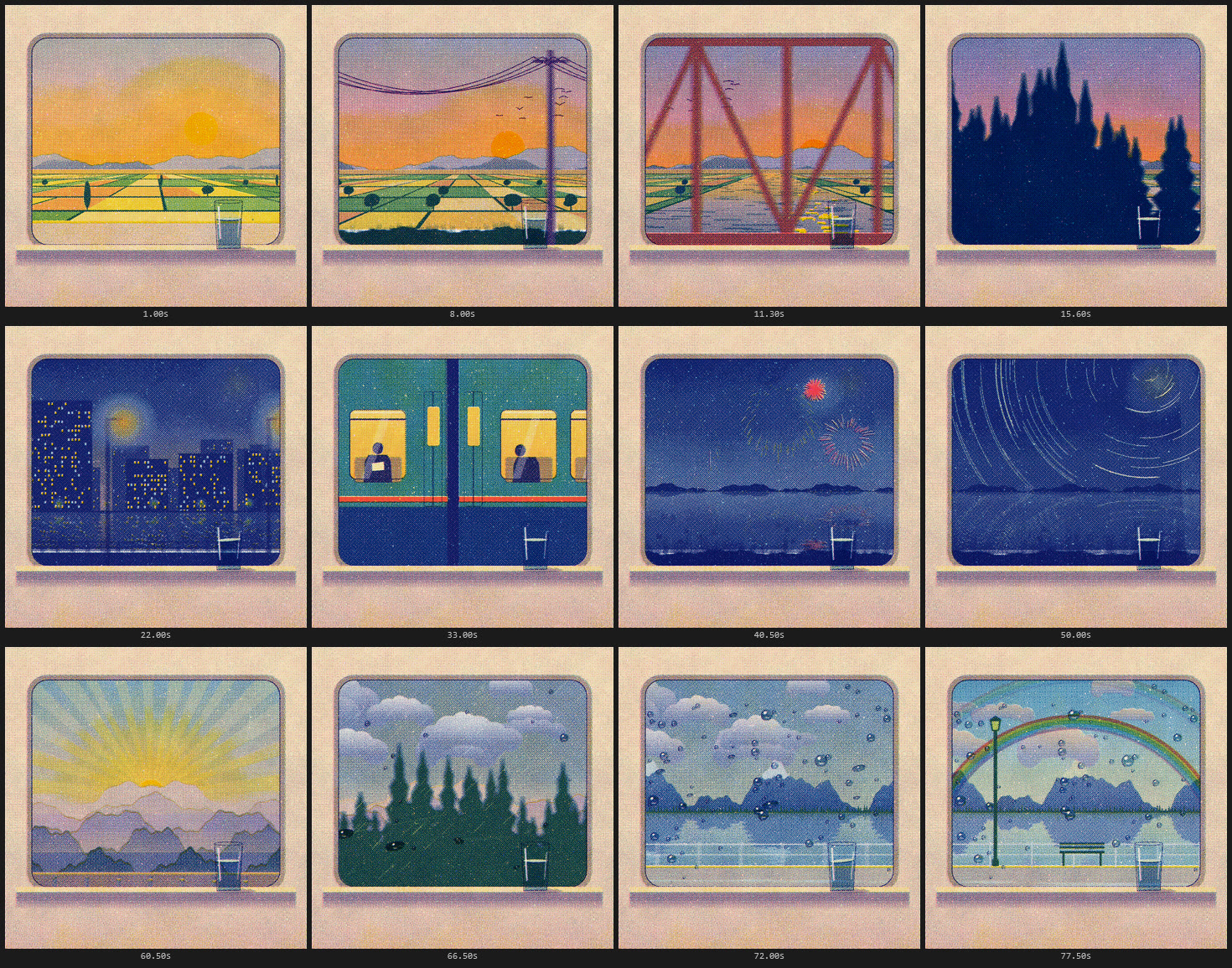
What is this?
 Procedural risograph-style animated films, each a single self-contained HTML file of Canvas 2D and Web Audio, plus the Claude Code skills, craft docs and tools used to make them.
Procedural risograph-style animated films, each a single self-contained HTML file of Canvas 2D and Web Audio, plus the Claude Code skills, craft docs and tools used to make them.Are these videos I download, or do they run in a browser?Both: each film is one index.html you open in a browser and press play, and rendered MP4s — all 1080 × 1080 at 30 fps — are on the v1.0 release.
Both: each film is one index.html you open in a browser and press play, and rendered MP4s — all 1080 × 1080 at 30 fps — are on the v1.0 release.How do I make my own film with it?Open Claude Code in the repo root and just ask — e.g. 'Make a 40 second riso film of a lighthouse keeper's night.' The riso-film, riso-still and riso-score skills in .claude/skills/ carry the workflow and its quality gates.
Open Claude Code in the repo root and just ask — e.g. 'Make a 40 second riso film of a lighthouse keeper's night.' The riso-film, riso-still and riso-score skills in .claude/skills/ carry the workflow and its quality gates.Do I need Claude Code, or anything else, installed just to watch the films?No — a browser is enough. The files ship no libraries, fonts or images and make no network calls, so they even play offline; Claude Code is only needed to create new works with the kit.
No — a browser is enough. The files ship no libraries, fonts or images and make no network calls, so they even play offline; Claude Code is only needed to create new works with the kit.Can I tweak a film's code without breaking it?Every frame is a pure function of time, so any moment stays exactly inspectable and the exported MP4 cannot drop frames — and a hook warns as soon as an edit breaks that determinism.
Every frame is a pure function of time, so any moment stays exactly inspectable and the exported MP4 cannot drop frames — and a hook warns as soon as an edit breaks that determinism.Which films are included?Six: Window Seat (78 s, a night train journey scored for piano), Roost (70 s, a starling murmuration), Held (70 s, a kite that flies only while something holds its line), Nonpareil (70 s, paper marbling), plus two 28-second shorts, Lumen and Emergence.
Six: Window Seat (78 s, a night train journey scored for piano), Roost (70 s, a starling murmuration), Held (70 s, a kite that flies only while something holds its line), Nonpareil (70 s, paper marbling), plus two 28-second shorts, Lumen and Emergence.How do the films get the printed risograph look?The halftone is procedural: in Roost each starling is a 2–3 px ink dot, so the flock itself is the halftone, piling into dark printed ribbons where the sheet turns edge-on. Nonpareil's marbling is closed-form geometry, so every frame is exact.
The halftone is procedural: in Roost each starling is a 2–3 px ink dot, so the flock itself is the halftone, piling into dark printed ribbons where the sheet turns edge-on. Nonpareil's marbling is closed-form geometry, so every frame is exact.Whose music and sounds are embedded?Sample libraries: Window Seat's piano is Salamander Grand Piano V3 (CC BY 3.0), while Roost, Held and Nonpareil draw on CC0 sets such as VSCO 2 CE, VCSL and a Freesound handpan pack — all credited in AUDIO-SOURCES.md.
Sample libraries: Window Seat's piano is Salamander Grand Piano V3 (CC BY 3.0), while Roost, Held and Nonpareil draw on CC0 sets such as VSCO 2 CE, VCSL and a Freesound handpan pack — all credited in AUDIO-SOURCES.md.How is a film's quality checked?Each work is designed in a FILM.md, its hardest frame is proved first, and tools/ renders frame strips, 1:1 crops, contact sheets, audio analysis and MP4 exports for inspection; every FILM.md also lists the film's remaining weaknesses.
Each work is designed in a FILM.md, its hardest frame is proved first, and tools/ renders frame strips, 1:1 crops, contact sheets, audio analysis and MP4 exports for inspection; every FILM.md also lists the film's remaining weaknesses.What are similar projects?procedural-film, pdoom-video, awesome-opus5-5-videos, world-execute-me-dsh-pv, huashu-art-motion, PDoomVideo, genart-skill, motion-video-kit
procedural-film, pdoom-video, awesome-opus5-5-videos, world-execute-me-dsh-pv, huashu-art-motion, PDoomVideo, genart-skill, motion-video-kitWhich topics is it in?procedural, web-audio, ai-art, 2d, motion-graphics, claude-code-skills, generative-art, art, agentic-coding, creative-coding, no-dependencies, canvas
procedural, web-audio, ai-art, 2d, motion-graphics, claude-code-skills, generative-art, art, agentic-coding, creative-coding, no-dependencies, canvas