


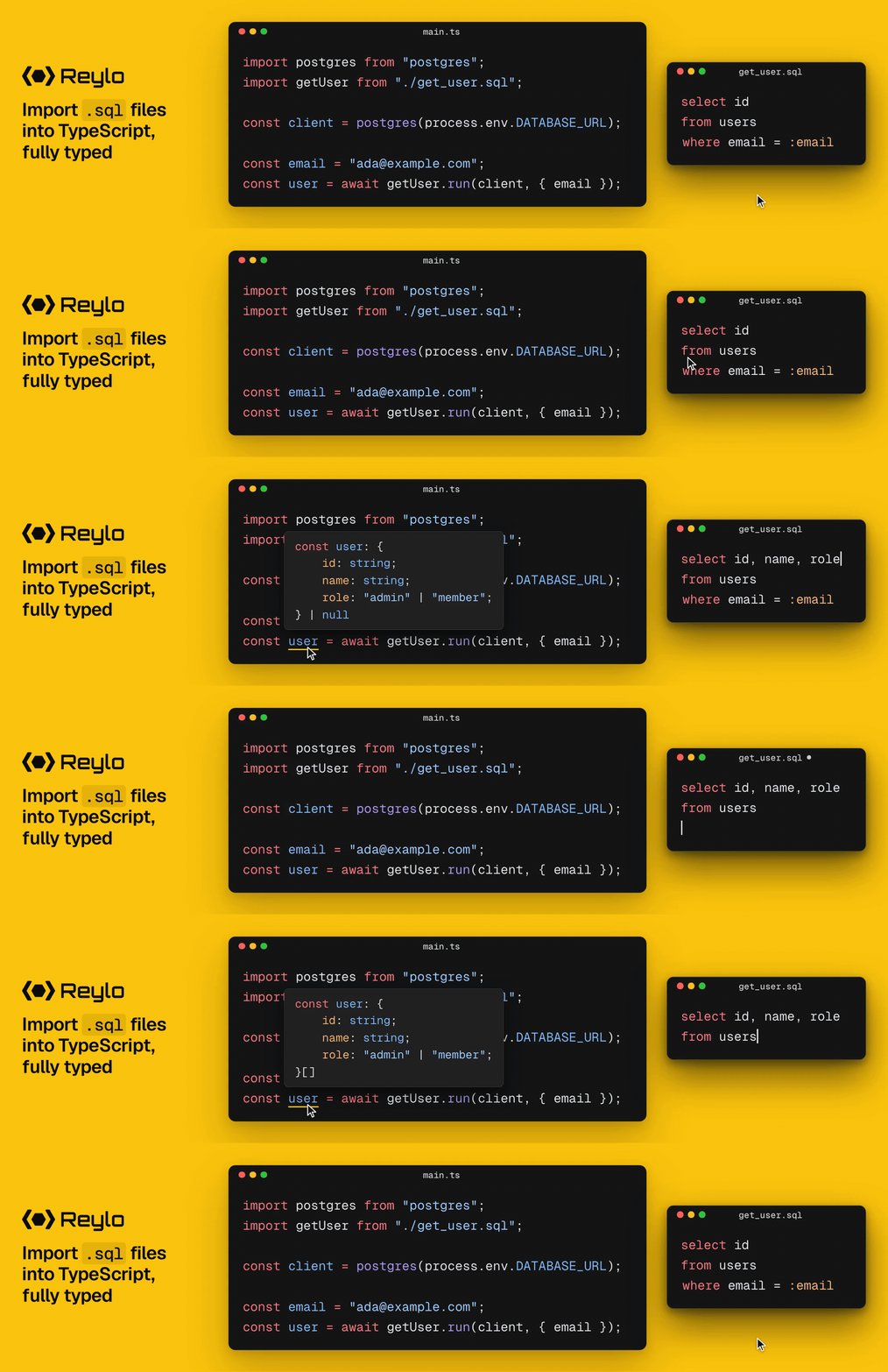
What is this?
 Reylo lets you import .sql files directly into your TypeScript code and get full type inference for the query's rows and parameters, with no code-generation step.
Is this an ORM or just a typing layer?It is a bring-your-own-driver typing layer, not an ORM: you write raw SQL and still pass your own database client (pg, mysql2, better-sqlite3, etc.) to run queries, Reylo just type-checks and types them.
It is a bring-your-own-driver typing layer, not an ORM: you write raw SQL and still pass your own database client (pg, mysql2, better-sqlite3, etc.) to run queries, Reylo just type-checks and types them.How do I get it running in a project?Install Reylo, add it to tsconfig.json for .sql files and its project file (.reylo.yaml or .reylo.yml), then type-check with the --runExternalCode flag and point DATABASE_URL at your dev database.
Install Reylo, add it to tsconfig.json for .sql files and its project file (.reylo.yaml or .reylo.yml), then type-check with the --runExternalCode flag and point DATABASE_URL at your dev database.Do I need a specific TypeScript version or a live database?Yes to both: Reylo requires TypeScript 7.1 (currently in beta, the first release with content mappers), Node 24 or later, and a running dev Postgres, MySQL 8.0.22+, or SQLite database it can read the schema from.
Yes to both: Reylo requires TypeScript 7.1 (currently in beta, the first release with content mappers), Node 24 or later, and a running dev Postgres, MySQL 8.0.22+, or SQLite database it can read the schema from.Can I use this with the stable TypeScript release today?Not really — Reylo depends on content mappers, a feature that only exists in the TypeScript 7.1 beta, so you're pinned to a pre-release compiler until that version ships.
Not really — Reylo depends on content mappers, a feature that only exists in the TypeScript 7.1 beta, so you're pinned to a pre-release compiler until that version ships.Which bundlers and runtimes does it plug into at runtime?Node works out of the box, and plugins or copyable example projects exist for Bun, Nub, Vite, Next.js, esbuild, webpack, Rspack, Cloudflare Workers, and Jest.
Node works out of the box, and plugins or copyable example projects exist for Bun, Nub, Vite, Next.js, esbuild, webpack, Rspack, Cloudflare Workers, and Jest.Which databases and drivers does it work with?Postgres, MySQL and SQLite, through drivers like pg, postgres.js, mysql2, better-sqlite3, Bun.sql, Cloudflare D1 and more, including a Drizzle database over any of them.
Postgres, MySQL and SQLite, through drivers like pg, postgres.js, mysql2, better-sqlite3, Bun.sql, Cloudflare D1 and more, including a Drizzle database over any of them.What does Reylo actually infer beyond column types?It infers nullability from schema/joins/where clauses, cardinality (single row, row-or-null, array, or void), unions from enums or check constraints, and the shape of JSON columns and JSON Schema checks.
It infers nullability from schema/joins/where clauses, cardinality (single row, row-or-null, array, or void), unions from enums or check constraints, and the shape of JSON columns and JSON Schema checks.Why does it call itself agent-friendly?Because every type fact lives in one place — the SQL itself — an AI coding agent can't leave a stale hand-written row type behind, and the type checker will flag every caller it missed.
Because every type fact lives in one place — the SQL itself — an AI coding agent can't leave a stale hand-written row type behind, and the type checker will flag every caller it missed.What does an imported query return at runtime?Calling .run() resolves to the rows shaped by the query: a unique-key match or limit 1 returns Row or null, an aggregate/one-row insert returns Row, a plain insert/update/delete returns void, and anything else returns Row[].
Calling .run() resolves to the rows shaped by the query: a unique-key match or limit 1 returns Row or null, an aggregate/one-row insert returns Row, a plain insert/update/delete returns void, and anything else returns Row[].What are similar projects?motherload, kysely, react-starter-kit, auth, TablePro, sqlc, effect-mq, drizzle-orm
motherload, kysely, react-starter-kit, auth, TablePro, sqlc, effect-mq, drizzle-ormWhich topics is it in?jest, type-safe, cloudflare-d1, drizzle-orm, webpack, bun, cloudflare, compiler, mysql, vite, sql, nextjs
jest, type-safe, cloudflare-d1, drizzle-orm, webpack, bun, cloudflare, compiler, mysql, vite, sql, nextjs