




What is this?
 TiDB is an open-source, cloud-native distributed SQL database written in Go — MySQL-compatible and built for high availability, horizontal scalability, strong consistency, and mixing transactions with analytics.
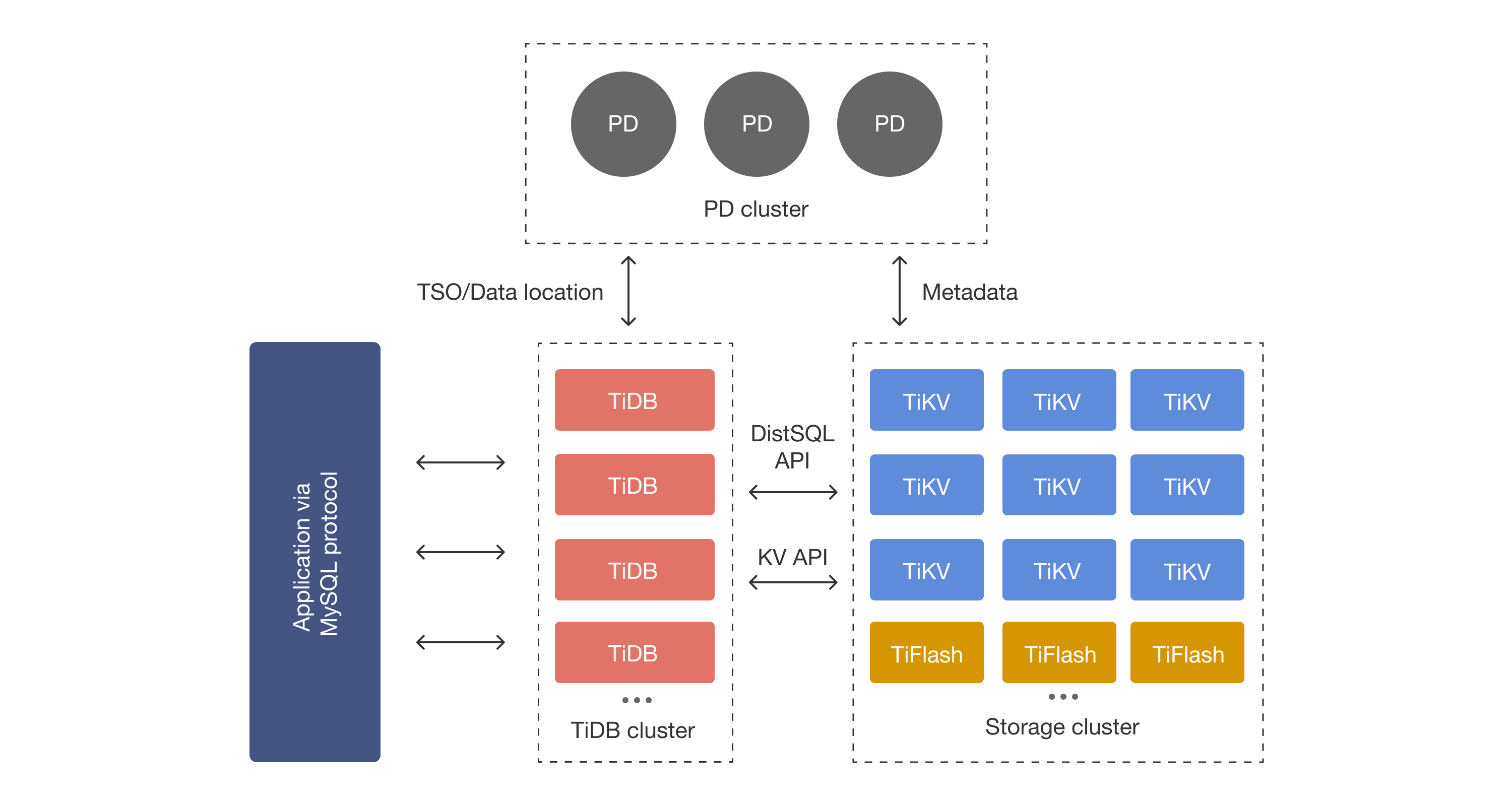
TiDB is an open-source, cloud-native distributed SQL database written in Go — MySQL-compatible and built for high availability, horizontal scalability, strong consistency, and mixing transactions with analytics.Is it a single database process or a cluster of components?A distributed cluster: the TiDB server handles SQL, TiKV stores row data, and TiFlash keeps a columnar copy for analytics. Compute and storage are separated, so you scale each independently without downtime.
A distributed cluster: the TiDB server handles SQL, TiKV stores row data, and TiFlash keeps a columnar copy for analytics. Compute and storage are separated, so you scale each independently without downtime.What's the fastest way to get a cluster running?Sign up for TiDB Cloud — a free managed cluster in seconds, no credit card. For self-hosting, run the local playground for testing or deploy to Kubernetes with TiDB Operator.
Sign up for TiDB Cloud — a free managed cluster in seconds, no credit card. For self-hosting, run the local playground for testing or deploy to Kubernetes with TiDB Operator.My app is already on MySQL — how much work to move it over?Usually very little: TiDB is compatible with MySQL 8.0, so existing drivers, frameworks, and tools connect as-is, and a suite of migration tools moves the data. Most apps need no or minimal code changes.
Usually very little: TiDB is compatible with MySQL 8.0, so existing drivers, frameworks, and tools connect as-is, and a suite of migration tools moves the data. Most apps need no or minimal code changes.Where does TiDB actually run — do I need Kubernetes to use it?No — it deploys in public clouds, on-premises, or natively in Kubernetes, where TiDB Operator automates cluster operations. There is also a local playground for testing and the managed TiDB Cloud.
No — it deploys in public clouds, on-premises, or natively in Kubernetes, where TiDB Operator automates cluster operations. There is also a local playground for testing and the managed TiDB Cloud.Is it fully open source, or is part of it paid?The database is fully open source under Apache 2.0 — all code is on GitHub, including enterprise-grade features. The paid option is TiDB Cloud, the optional managed service, which also has a free plan.
The database is fully open source under Apache 2.0 — all code is on GitHub, including enterprise-grade features. The paid option is TiDB Cloud, the optional managed service, which also has a free plan.Can I run analytics on the same live data as my transactions?Yes — that is the HTAP part: TiFlash is a columnar replica fed from TiKV in real time over the Multi-Raft Learner protocol, so analytics run on consistent live data instead of a separate ETL copy.
Yes — that is the HTAP part: TiFlash is a columnar replica fed from TiKV in real time over the Multi-Raft Learner protocol, so analytics run on consistent live data instead of a separate ETL copy.What happens if a node dies in the middle of a write?TiDB keeps multiple replicas under the Raft consensus protocol and commits a transaction only after a majority of replicas have it, so data survives failures. Failover is automatic, and replica placement can be tuned geographically for disaster tolerance.
TiDB keeps multiple replicas under the Raft consensus protocol and commits a transaction only after a majority of replicas have it, so data survives failures. Failover is automatic, and replica placement can be tuned geographically for disaster tolerance.Does it have anything built in for AI agents?Yes — vector search ships as a key feature, and the project is pitched at agentic workloads that grow unpredictably. Since it speaks the MySQL protocol, agents connect with standard drivers and ORMs.
Yes — vector search ships as a key feature, and the project is pitched at agentic workloads that grow unpredictably. Since it speaks the MySQL protocol, agents connect with standard drivers and ORMs.Why pick it over plain MySQL, since it is MySQL-compatible anyway?Plain MySQL does not scale out horizontally without downtime or run columnar analytics on live transactional data. TiDB adds two-phase-commit ACID transactions across nodes, Raft-replicated storage, and the TiFlash columnar engine behind MySQL-compatible SQL.
Plain MySQL does not scale out horizontally without downtime or run columnar analytics on live transactional data. TiDB adds two-phase-commit ACID transactions across nodes, Raft-replicated storage, and the TiFlash columnar engine behind MySQL-compatible SQL.Which topics is it in?tidb, distributed-database, distributed, agentic, vector-search, serverless, storage, cloud-native, analytics, high-performance, agent-memory, memory
tidb, distributed-database, distributed, agentic, vector-search, serverless, storage, cloud-native, analytics, high-performance, agent-memory, memory