






:newspaper: What's NEW! :sparkling_heart:
Recent released features
Introducing  : LLM-Based Autonomous Evolving Agents for Industrial Data-Driven R&D
We are excited to announce the release of RD-Agent📢, a powerful tool that supports automated factor mining and model optimization in quant investment R&D.
RD-Agent is now available on GitHub, and we welcome your star🌟!
To learn more, please visit the RD-Agent repository. We have prepared several public demo videos for you:
@misc{li2025rdagentquant,
    title={R\&D-Agent-Quant: A Multi-Agent Framework for Data-Centric Factors and Model Joint Optimization},
    author={Yuante Li and Xu Yang and Xiao Yang and Minrui Xu and Xisen Wang and Weiqing Liu and Jiang Bian},
    year={2025},
    eprint={2505.15155},
    archivePrefix={arXiv},
    primaryClass={cs.AI}
}

| Feature |
Status |
| R&D-Agent-Quant Published |
Apply R&D-Agent to Qlib for quant trading |
| BPQP for End-to-end learning |
📈Coming soon!(Under review) |
| 🔥LLM-driven Auto Quant Factory🔥 |
🚀 Released in ♾️RD-Agent on Aug 8, 2024 |
| KRNN and Sandwich models |
:chart_with_upwards_trend: Released on May 26, 2023 |
| Release Qlib v0.9.0 |
:octocat: Released on Dec 9, 2022 |
| RL Learning Framework |
:hammer: :chart_with_upwards_trend: Released on Nov 10, 2022. #1332, #1322, #1316,#1299,#1263, #1244, #1169, #1125, #1076 |
| HIST and IGMTF models |
:chart_with_upwards_trend: Released on Apr 10, 2022 |
| Qlib notebook tutorial |
📖 Released on Apr 7, 2022 |
| Ibovespa index data |
:rice: Released on Apr 6, 2022 |
| Point-in-Time database |
:hammer: Released on Mar 10, 2022 |
| Arctic Provider Backend & Orderbook data example |
:hammer: Released on Jan 17, 2022 |
| Meta-Learning-based framework & DDG-DA |
:chart_with_upwards_trend: :hammer: Released on Jan 10, 2022 |
| Planning-based portfolio optimization |
:hammer: Released on Dec 28, 2021 |
| Release Qlib v0.8.0 |
:octocat: Released on Dec 8, 2021 |
| ADD model |
:chart_with_upwards_trend: Released on Nov 22, 2021 |
| ADARNN model |
:chart_with_upwards_trend: Released on Nov 14, 2021 |
| TCN model |
:chart_with_upwards_trend: Released on Nov 4, 2021 |
| Nested Decision Framework |
:hammer: Released on Oct 1, 2021. Example and Doc |
| Temporal Routing Adaptor (TRA) |
:chart_with_upwards_trend: Released on July 30, 2021 |
| Transformer & Localformer |
:chart_with_upwards_trend: Released on July 22, 2021 |
| Release Qlib v0.7.0 |
:octocat: Released on July 12, 2021 |
| TCTS Model |
:chart_with_upwards_trend: Released on July 1, 2021 |
| Online serving and automatic model rolling |
:hammer: Released on May 17, 2021 |
| DoubleEnsemble Model |
:chart_with_upwards_trend: Released on Mar 2, 2021 |
| High-frequency data processing example |
:hammer: Released on Feb 5, 2021 |
| High-frequency trading example |
:chart_with_upwards_trend: Part of code released on Jan 28, 2021 |
| High-frequency data(1min) |
:rice: Released on Jan 27, 2021 |
| Tabnet Model |
:chart_with_upwards_trend: Released on Jan 22, 2021 |
Features released before 2021 are not listed here.

Qlib is an open-source, AI-oriented quantitative investment platform that aims to realize the potential, empower research, and create value using AI technologies in quantitative investment, from exploring ideas to implementing productions. Qlib supports diverse machine learning modeling paradigms, including supervised learning, market dynamics modeling, and reinforcement learning.
An increasing number of SOTA Quant research works/papers in diverse paradigms are being released in Qlib to collaboratively solve key challenges in quantitative investment. For example, 1) using supervised learning to mine the market's complex non-linear patterns from rich and heterogeneous financial data, 2) modeling the dynamic nature of the financial market using adaptive concept drift technology, and 3) using reinforcement learning to model continuous investment decisions and assist investors in optimizing their trading strategies.
It contains the full ML pipeline of data processing, model training, back-testing; and covers the entire chain of quantitative investment: alpha seeking, risk modeling, portfolio optimization, and order execution.
For more details, please refer to our paper "Qlib: An AI-oriented Quantitative Investment Platform".
Plans
New features under development(order by estimated release time).
Your feedbacks about the features are very important.
Framework of Qlib
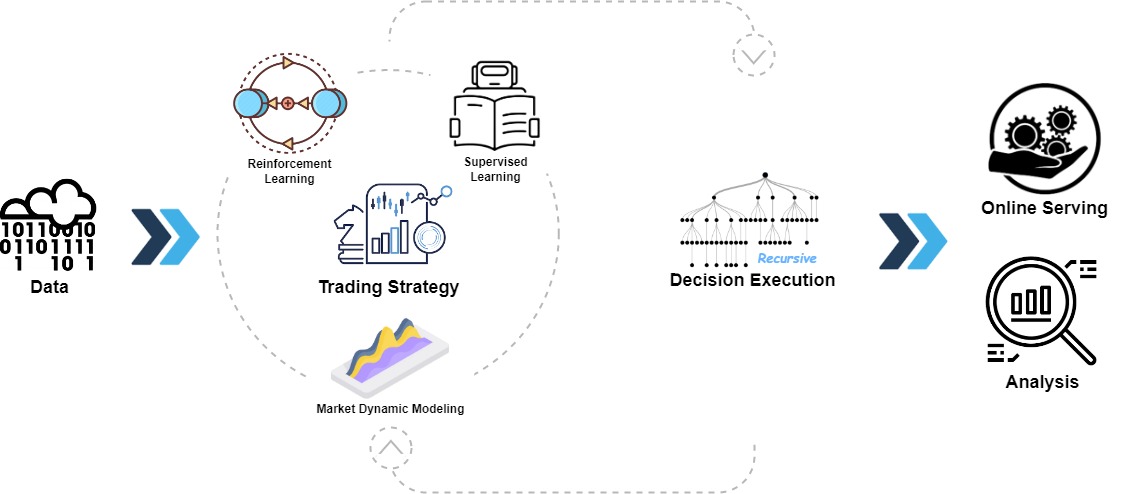
The high-level framework of Qlib can be found above(users can find the detailed framework of Qlib's design when getting into nitty gritty).
The components are designed as loose-coupled modules, and each component could be used stand-alone.
Qlib provides a strong infrastructure to support Quant research. Data is always an important part.
A strong learning framework is designed to support diverse learning paradigms (e.g. reinforcement learning, supervised learning) and patterns at different levels(e.g. market dynamic modeling).
By modeling the market, trading strategies will generate trade decisions that will be executed. Multiple trading strategies and executors in different levels or granularities can be nested to be optimized and run together.
At last, a comprehensive analysis will be provided and the model can be served online in a low cost.
Quick Start
This quick start guide tries to demonstrate
- It's very easy to build a complete Quant research workflow and try your ideas with Qlib.
- Though with public data and simple models, machine learning technologies work very well in practical Quant investment.
Here is a quick demo shows how to install Qlib, and run LightGBM with qrun. But, please make sure you have already prepared the data following the instruction.
Installation
This table demonstrates the supported Python version of Qlib:
|
install with pip |
install from source |
plot |
| Python 3.8 |
:heavy_check_mark: |
:heavy_check_mark: |
:heavy_check_mark: |
| Python 3.9 |
:heavy_check_mark: |
:heavy_check_mark: |
:heavy_check_mark: |
| Python 3.10 |
:heavy_check_mark: |
:heavy_check_mark: |
:heavy_check_mark: |
| Python 3.11 |
:heavy_check_mark: |
:heavy_check_mark: |
:heavy_check_mark: |
| Python 3.12 |
:heavy_check_mark: |
:heavy_check_mark: |
:heavy_check_mark: |
Note:
- Conda is suggested for managing your Python environment. In some cases, using Python outside of a
conda environment may result in missing header files, causing the installation failure of certain packages.
- Please pay attention that installing cython in Python 3.6 will raise some error when installing
Qlib from source. If users use Python 3.6 on their machines, it is recommended to upgrade Python to version 3.8 or higher, or use conda's Python to install Qlib from source.
Install with pip
Users can easily install Qlib by pip according to the following command.
pip install pyqlib
Note: pip will install the latest stable qlib. However, the main branch of qlib is in active development. If you want to test the latest scripts or functions in the main branch. Please install qlib with the methods below.
Install from source
Also, users can install the latest dev version Qlib by the source code according to the following steps:
Before installing Qlib from source, users need to install some dependencies:
pip install numpy
pip install --upgrade cython
Clone the repository and install Qlib as follows.
git clone https://github.com/microsoft/qlib.git && cd qlib
pip install .  # `pip install -e .[dev]` is recommended for development. check details in docs/developer/code_standard_and_dev_guide.rst
Tips: If you fail to install Qlib or run the examples in your environment, comparing your steps and the CI workflow may help you find the problem.
Tips for Mac: If you are using Mac with M1, you might encounter issues in building the wheel for LightGBM, which is due to missing dependencies from OpenMP. To solve the problem, install openmp first with brew install libomp and then run pip install . to build it successfully.
Data Preparation
❗ Due to more restrict data security policy. The official dataset is disabled temporarily. You can try this data source contributed by the community.
Here is an example to download the latest data.
wget https://github.com/chenditc/investment_data/releases/latest/download/qlib_bin.tar.gz
mkdir -p ~/.qlib/qlib_data/cn_data
tar -zxvf qlib_bin.tar.gz -C ~/.qlib/qlib_data/cn_data --strip-components=1
rm -f qlib_bin.tar.gz
The official dataset below will resume in short future.
Load and prepare data by running the following code:
Get with module
# get 1d data
python -m qlib.cli.data qlib_data --target_dir ~/.qlib/qlib_data/cn_data --region cn

# get 1min data
python -m qlib.cli.data qlib_data --target_dir ~/.qlib/qlib_data/cn_data_1min --region cn --interval 1min
Get from source
# get 1d data
python scripts/get_data.py qlib_data --target_dir ~/.qlib/qlib_data/cn_data --region cn

# get 1min data
python scripts/get_data.py qlib_data --target_dir ~/.qlib/qlib_data/cn_data_1min --region cn --interval 1min
This dataset is created by public data collected by crawler scripts, which have been released in
the same repository.
Users could create the same dataset with it. Description of dataset
Please pay ATTENTION that the data is collected from Yahoo Finance, and the data might not be perfect.
We recommend users to prepare their own data if they have a high-quality dataset. For more information, users can refer to the related document.
Automatic update of daily frequency data (from yahoo finance)
This step is Optional if users only want to try their models and strategies on history data.
It is recommended that users update the data manually once (--trading_date 2021-05-25) and then set it to update automatically.
NOTE: Users can't incrementally update data based on the offline data provided by Qlib(some fields are removed to reduce the data size). Users should use yahoo collector to download Yahoo data from scratch and then incrementally update it.
For more information, please refer to: yahoo collector
Automatic update of data to the "qlib" directory each trading day(Linux)
Manual update of data
python scripts/data_collector/yahoo/collector.py update_data_to_bin --qlib_data_1d_dir <user data dir> --trading_date <start date> --end_date <end date>
- trading_date: start of trading day
- end_date: end of trading day(not included)
Checking the health of the data
- We provide a script to check the health of the data, you can run the following commands to check whether the data is healthy or not.
python scripts/check_data_health.py check_data --qlib_dir ~/.qlib/qlib_data/cn_data
- Of course, you can also add some parameters to adjust the test results, such as this.
python scripts/check_data_health.py check_data --qlib_dir ~/.qlib/qlib_data/cn_data --missing_data_num 30055 --large_step_threshold_volume 94485 --large_step_threshold_price 20
`

 Qlib 是微软开源的、面向 AI 的量化投资平台,覆盖完整的量化研究流程,包括数据处理、模型训练、回测和订单执行,采用监督学习、市场动态建模和强化学习等方法。