Cindy is an open-source AI agent, ready out of the box and yours to shape.
Connect your computers and phone, bring the models and subscriptions you already
use, and build a companion that knows how you like to work.
All your devices. One Cindy.
Your work computer, home desktop, laptop and phone belong together.
Pick up the same work. Open a session from another device, continue the
conversation, and access its files without copying everything into a new chat.
Share more than a screen. Use model providers configured on another
computer — including supported subscriptions, API providers and local models.
Reach your whole desktop. Built-in remote desktop on your phone lets you
open apps, type and operate a connected computer when a chat isn't enough.
Your computer becomes your server: no server rental or self-hosting setup.
How connections and data work
For remote access to your computers, keep them online, sign in with the same
account and enable the relevant permissions. Model sharing requires allowing
remote access to that provider; remote desktop also needs its own permissions.
Project files stay on their computer — remote access is not whole-disk sync.
Cloud companions sync their conversations, memory, skills and shared attachments
through Cindy's services; model providers process the requests sent to them.
Provider and service billing still apply.
Keep your favorite agents. Get a better way to work.
Already using Claude Code or Codex? Cindy brings them together with Pi,
then adds a shared interface, multi-device access, tools and a companion of
your own.
Harness
What it brings
Claude Code
Claude Code's agent workflow, with Cindy's interface and connected tools.
Codex
Codex's coding workflow, available alongside your other agents.
Pi
A lean, open-source, extensible agent with support for multiple model providers.
Choose a supported harness and model combination, and change it as the work
evolves. Your session stays in Cindy; switching harnesses hands off or rebuilds
the engine context rather than making their internal states identical.
One agent not enough? Let her lead a team. Use different agents for planning,
parallel implementation and independent review, with a shared goal and clear
acceptance criteria.
Real work, in your actual tools
Work with your files, browser and apps. Ask for a change, inspect what happened,
and keep working from the result. Answers can include charts, interactive
controls and rich HTML, not just a wall of text.
Build a recurring routine with automations, or hand over work through
connected chat channels such as Slack and Telegram. Connect more tools through
Skills, plugins and MCP.
Ready from day one. Yours to shape over time.
Create your own companions. Give them a role, instructions, skills and
recurring work — a reviewer, researcher, project partner, or something of your own.
Make experience reusable. Keep useful preferences and knowledge in memory;
turn a good way of working into a Skill you can reuse and share.
Extend the product. Discover Skills and plugins in SkillHub, connect your
own tools, or build on the official plugins.
Help shape Cindy. Audit the code, fork it, improve an interaction, fix a bug,
or contribute a useful integration. The client is Apache-2.0 licensed.
The client is free. Authorize a supported subscription you already pay for,
including Claude Code or Codex plans, connect your own API keys, or use a local
model. You can also use Cindy's managed model service. Provider limits and
billing still apply; the free client does not mean unlimited model usage.
This repository contains Cindy's open-source desktop and mobile clients and
their shared packages, organized as a pnpm monorepo.
What's in this repo
Path
Description
apps/desktop
Electron desktop client
apps/mobile
Expo / React Native mobile client
packages/*
Shared client capabilities (auth, device-link, agent orchestration, model providers, …)
apps/*-bin
Tool binaries shipped with the desktop app; none are committed — claude-code, codex, and ripgrep are downloaded per platform by pnpm install, and the Android platform-tools binaries are fetched (pinned version, sha256-verified) before Windows packaging
Not in this repo: the backend service lives in a separate
repository and is not part of this monorepo.
Choose “Skip Sign-In” on the login screen to use local agents; the app then shows the account state as “Not signed in”. Server-backed capabilities are unavailable in this state.
Prerequisites
Node.js 22.x
pnpm 10.x (v11 is not yet supported)
Git LFS
Getting started
Contributor setup, Git LFS, dependency updates, and access requirements are maintained in
CONTRIBUTING.en.md.
Plugins are installed through SkillHub or manually.
Minimal entry point:
git clone https://github.com/makecindy/cindy.git
cd cindy
git lfs pull
pnpm install
Development entry points
# Mainland China Cindy account
pnpm restart:desktop:remote --region=cn

# Global Cindy account
pnpm restart:desktop:remote --region=global
Remote development uses your own Cindy cloud account and existing login state, so
you can continue existing sessions and work while developing the client. Use cn
for Mainland China accounts and global for everyone else; do not rely
on the internal default. Full desktop, mobile, data-isolation, and validation
workflows are in CONTRIBUTING.en.md.
“Skip Sign-In” on the login screen runs local agents without a Cindy account
(shown in the app as “Not signed in”), not a connection to a local server.
Server-backed capabilities are unavailable in this state.
About the default servers: the client connects to Cindy's official cloud
services by default (endpoint manifests in
config/endpoint.json and
config/endpoint.global.json; desktop
auto-updates also come from the official CDN). This is intentional — external
developers don't need to self-host a server: sign in with your own Cindy
account in a dev build and develop / test directly against the official
servers.
Skill Hub migration uses two separate manifest fields: released clients keep
using skillhubApiBaseUrl (the deprecated XD proxy), while current clients use
cindySkillHubApiBaseUrl. The current client deliberately does not fall back to
the legacy field when the new endpoint is absent.
Architecture
DESIGN.md — visual design system, color tokens, and UI conventions
Never commit credentials or authorization files to the working tree. If you
discover a security issue, follow SECURITY.en.md to report it
privately rather than opening a public issue.
Privacy & telemetry
Official distribution builds include TapDB
usage analytics for product-level aggregate statistics, including device identifiers,
OS / app version, startup and activity events. Events are associated with your account
ID after sign-in, so this is not fully anonymous. TapDB does not collect chat
content, file content, or working-directory data.
You can disable usage analytics without editing code: on Desktop, use
Settings → About → Usage statistics; on Mobile, use Usage statistics in Settings.
The SDK checks the stored privacy-consent state and the statistics preference,
which defaults to on. Accepting the Privacy Policy records consent; a one-time
migration also records consent for eligible existing signed-in users.
Known Mobile exception: enterprise SSO skips the policy-acceptance step. If no
analytics consent record exists and that sign-in is restored after restarting the
app, the current migration can mark even a new installation as consented. With
TapDB configured and statistics enabled, reporting can then start without explicit
policy acceptance. See Mobile sign-in restoration
and the consent migration.
Turning off Usage statistics prevents reporting from being enabled by this migration.
Desktop stops subsequent analytics reporting immediately when disabled. Local
mode (Skip sign-in) does not report to TapDB.
Mobile immediately unlinks the account and stops reports explicitly triggered
by Cindy. An already initialized native SDK cannot be uninitialized; fully quit
and relaunch the app to keep the SDK uninitialized.
Online heartbeats and diagnostic logs are separate mechanisms, unaffected by the
usage statistics switch. Desktop sends heartbeats to Cindy services only during a
verified cloud sign-in (account ID, platform, and version); local mode sends none.
Desktop native crash dumps stay local and are never uploaded automatically.
Diagnostic logs can be uploaded manually; a separate, default-off automatic crash
log upload option is also available. Log uploads require privacy consent. See the
heartbeat implementation and
log upload rules.
Building from source? You are not required to keep analytics:
Desktop development builds do not initialize TapDB by default. Explicitly setting
XDT_TAPDB_DEV=1 lifts the build gate but still requires consent and the statistics
preference. Self-packaged Desktop builds use the same analytics gates as official
builds; you can disable analytics in Settings.
Mobile does not initialize the SDK without injected TapDB configuration
(clientId / clientToken). This does not mean all source builds default to off:
the self-hosted release pipeline requires nonempty configuration, while local
development permits empty values. See the
Mobile build guide.
License / 许可证
Except as otherwise noted, the source code in this repository is licensed under
the Apache License, Version 2.0. Individual source files do not
carry per-file license headers; the repository-root LICENSE governs.
Model weights, datasets, prompts, trademarks, and other separately identified
materials may be subject to their own license terms and are not automatically
covered by the repository-level Apache-2.0 grant. Third-party open-source
components retain their own copyright and license. Their attribution notices and
SPDX SBOMs are managed under docs/legal/, with artifact-specific
outputs in docs/legal/notices/. See NOTICE
for this project's copyright and attribution information.
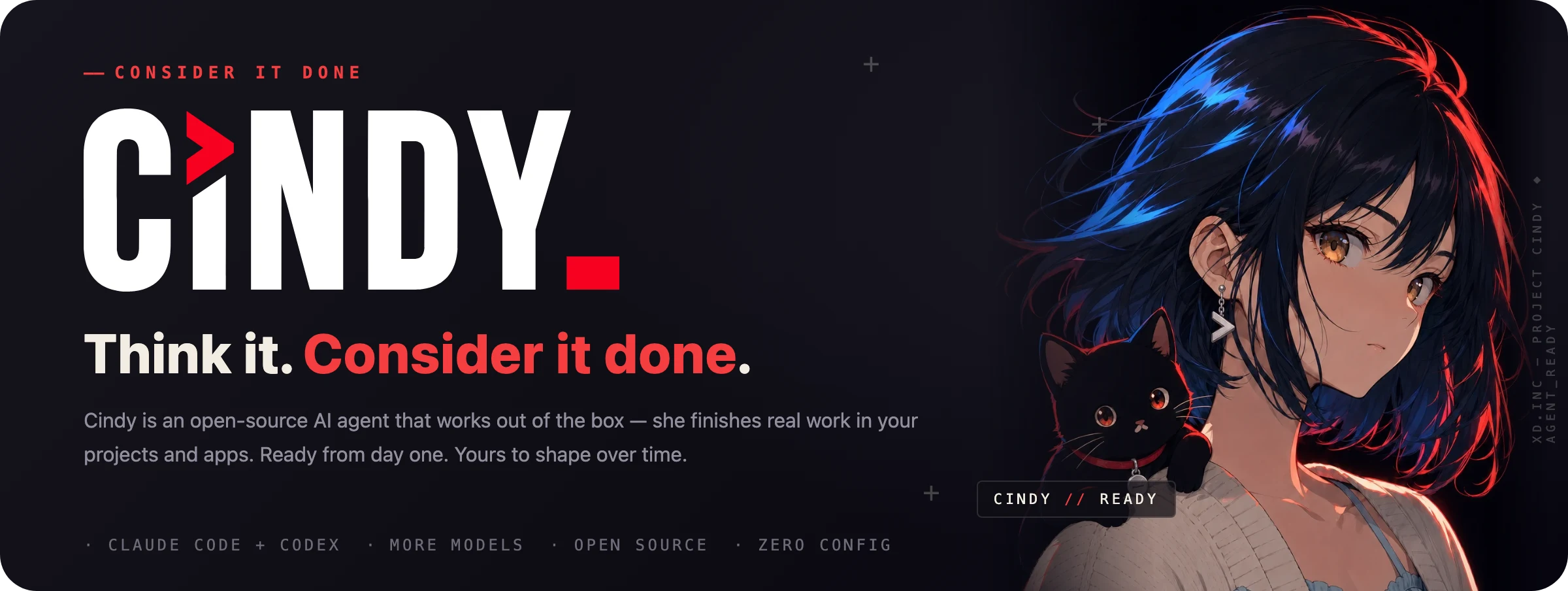


 Cindy 是一个开箱即用的开源 AI 智能体,它把多个运行框架(harness,如 Claude Code 和 Codex)、模型和工具整合到一个智能体中,能在你的项目和应用里完成实际工作。