💡 Zilan — Where Knowledge Converges: a Minimalist Knowledge Hub Unifying RAG, Agent Reasoning, and Auto-Wiki
📌 Overview
Zilan (知澜) is an LLM-powered knowledge management and intelligent Q&A platform with a minimalist product experience that unifies RAG quick Q&A, ReAct agent reasoning, and auto-generated Wiki knowledge distillation.
Zilan is a thorough re-imagination built on a battle-tested open-source knowledge framework, carrying product genes entirely its own:
🎨 A brand-new minimalist design language — no clutter, no visual noise: a dark monochrome brand color (#333 family), large rounded corners, feather-light shadows, and pure solid backgrounds; one consistent visual system from the login page through chat streams to the settings center — quiet, restrained, and content-first
📄 A deep document parsing pipeline — structured PDF table extraction, mathematical formula recognition, and dual-column layout awareness; automatic routing selects parsing engine intensity per document profile, low-scoring results are retried with heavier engines, and stubborn documents land in a human review queue
🕸️ GraphRAG-enhanced retrieval — entity-relation storage on Neo4j; community summaries + local subgraph retrieval complement dense/sparse vector recall, widening coverage and explainability for complex multi-hop questions
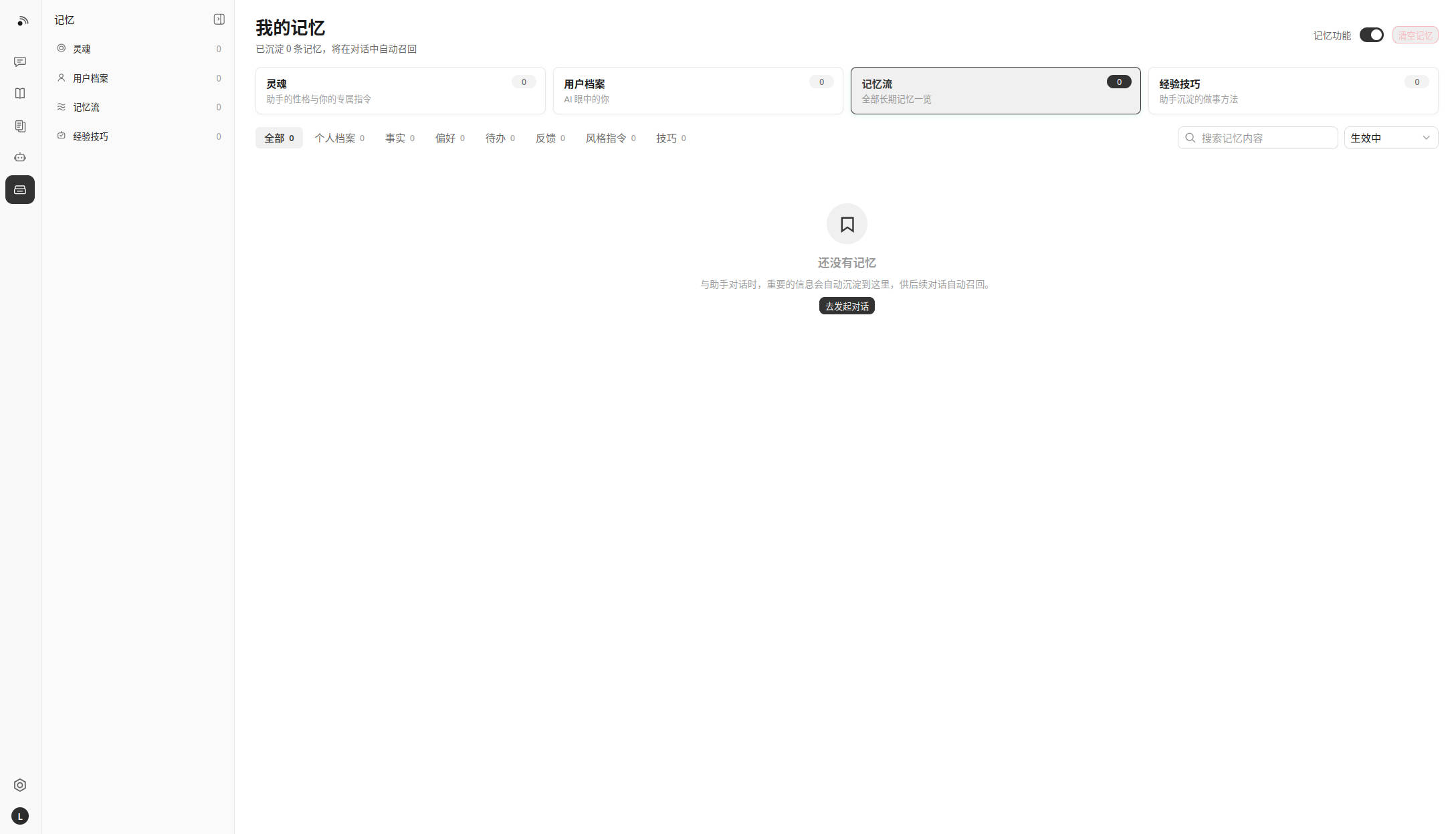
🧠 Memory & knowledge distillation system — a three-layer memory architecture: L1 working memory (current conversation), L2 short-term memory (vectorized summaries of recent conversations), L3 long-term memory (user profile + fact triples + to-dos); memories are extracted asynchronously after each session and injected into the system prompt scored by semantic similarity × time decay × (1 + log(access count)); long-term memory is further structured into four semantic modules — Soul / User / Memory / Agent (persona directives, user profile, memory stream, distilled skills), each with its own view on the My Memory page where users can view, edit, and delete everything the AI remembers — GDPR-compliant by design
🔐 An independent identity and protocol stack — a fully self-owned namespace across branding, JWT audience (aud=zilan), webhook signature (X-Zilan-Signature), and embed SDK (zilan-widget.js) — zero upstream traces
On top of that, Zilan inherits engineering capabilities proven through large-scale production use: multi-source ingestion (Feishu / Notion / Yuque / RSS, and growing), 20+ LLM provider integrations, a dozen IM channels, website embed widgets, a 4-tier RBAC role matrix with workspace audit logs, AES-256-GCM credential encryption at rest, full-stack Langfuse observability plus a runtime task-queue governance dashboard, and a fully self-hostable modular architecture — LLMs, vector databases, and storage backends are all swappable, keeping data sovereignty entirely yours.
✨ Highlights
🎨 Minimalist Design Language · An Interface Built for Focus
Principle
Details
Dark monochrome brand
Brand color stays in the #333 family; interaction states shift luminance only — no flashy gradients, no saturated clashes
Large radii × light shadows
A global radius system (starting at 8/10/12px); cards and chat bubbles use feather-light or no shadows
Pure solid backgrounds
Pages return to solid colors (light #fafafa / dark #181818) — no textures, no decorative animations
Centered login
A single vertical focal point of brand mark + form; every login-irrelevant element removed
Symmetric chat bubbles
User-side dark, assistant-side light-gray symmetric rounded bubbles with inline citations and reasoning chains
Responsive
Consistent desktop / tablet / mobile experience; dark mode follows the system
📄 Deep Document Parsing · Read Every PDF Properly
Capability
Details
Table extraction
Detects table boundaries and restores them as Markdown tables, preserving row/column semantics
Formula recognition
Extracts mathematical formulas and converts them to LaTeX for fine-grained retrieval in academic and technical docs
Dual-column awareness
Detects two-/multi-column layouts and restores the correct reading order
Auto routing
Picks light or heavy parsing engines by file size and content profile, balancing throughput and quality
Quality scoring & retry
Parse results are auto-scored; short or low-scoring content is retried with a heavier engine
Human review queue
Documents that exhaust retries enter a review queue for human-in-the-loop closure
🕸️ GraphRAG-Enhanced Retrieval
Entities and relations are extracted into Neo4j at ingest time to build a knowledge graph; at query time, community summaries provide the global view while local subgraph retrieval supplies neighborhood detail — fused with BM25 / dense vector recall via RRF, markedly improving answers to multi-hop and cross-document aggregation questions.
🧠 Memory & Knowledge Distillation
Toward a more personal, context-aware knowledge assistant, Zilan is building a three-layer memory architecture:
L1 working memory — full context and intermediate state of the current conversation
L2 short-term memory — vectorized summaries of the last N conversations (pgvector), recalled by relevance at session start
L3 long-term memory — user profile, fact triples (subject-relation-object), and to-do items: structured tables + vector indexes + an optional image library
Supporting mechanics: memory is extracted asynchronously after each session via the Asynq task queue (fact triples / to-dos / emotional feedback); injection scores each memory as score = semantic similarity × time decay × (1 + log(access count)) and loads the Top-K into the system prompt; high-value conversations (favorited or heavily followed-up) auto-distill into Wiki pages linked back to the source session.
The dedicated My Memory page makes long-term memory fully transparent and controllable:
Browse & filter — category tabs (profile / fact / preference / to-do / feedback) with per-category counts, keyword search, status filter (active / done / archived), and pagination; each card shows importance, confidence, recall count, and last-recall time
Edit — modify content, related object, importance, and status; content edits automatically re-embed the memory so recall follows the latest wording
Delete & clear — single-entry delete with confirmation, or clear everything behind a type-to-confirm guard (session rolling summaries cleared together, GDPR right-to-erasure)
Global switch — pause memory extraction & recall anytime; stored memories are kept and can be re-enabled later
All operations are isolated per user and available in four languages (zh-CN / en-US / ru-RU / ko-KR) — GDPR / privacy compliant by design.
🗂️ Four Structured Memory Modules (Soul / User / Memory / Agent)
Beyond a flat fact list, long-term memory is organized into four semantic modules — so the assistant not only remembers facts, but also knows who it should be, who you are, and how to work best with you:
Module
What it holds
What you see
Soul
Read-only global persona + your style directives ("call me Zhang Gong", "answer in bullet points")
Persona card + directive list; directives are auto-extracted from chat and injected into every answer
User
Stable attributes about you (identity / role / preferences)
Profile card with grouped sections, a completeness meter, and drill-down into the memory stream
Memory
The full memory stream: all facts, to-dos, feedback, plus L2 session summaries
The original category-filtered list (as above)
Agent
Distilled skills — reusable know-how learned from your feedback
Skill cards + a feedback wall showing which feedback has been upgraded into a skill
How it works:
Extraction — two new memory categories (soul, skill) are extracted alongside the existing ones; a skill is only produced from explicit feedback/instructions (confidence ≥ 0.7) to avoid hallucinated "tips"
Feedback → skill upgrade — when you criticize an answer ("too verbose"), the raw feedback is archived and distilled into an actionable skill ("keep answers in bullet points"); the feedback wall links the two together
Module-aware injection — recalled memories are rendered as four labeled blocks in a fixed order (style directives → user profile → relevant memories → assistant skills), each with its own budget: soul directives inject in full, profile takes the top 4 by importance, skills take the top 3 by importance × confidence; soul directives also get a ×1.5 semantic-weight boost so persona-level instructions are never crowded out by topical matches
Zero schema change: the modules are a code-level mapping over the existing memory_facts table, so all existing memory management (edit / delete / clear / switch) applies unchanged.
Zilan completely rethinks how conversation context is organized, moving beyond a naive sliding window to a precise token budget + five-layer context architecture, so every answer spends its budget where it matters:
Precise multi-vendor token counting — built-in tiktoken (OpenAI), qwen (Tongyi Qianwen), and glm (Zhipu GLM) tokenizers with calibration factors; no more character-count guesswork
Five-layer token budget (L0-L4) — System (fixed) → Memory (fixed 10%) → Retrieval (elastic 30-50%) → History (elastic 20-40%) → Query (fixed), each layer with its own overflow strategy
Intent-based dynamic allocation — budget shifts by query intent: code/technical questions favor the retrieval layer, casual/creative ones favor history, and summarize/analyze balances both
Smart history compression — restored & enhanced Summary: Map-Reduce incremental summarization, sticky turns (decisions/numbers/deadlines/favorites) permanently preserved, and auto alias compression for long entity names (e.g. "Tencent Cloud Vector DB" → "TCVDB")
Retrieval context optimization — relevance-tiered rendering (high-relevance full text / mid first half / low title+summary), embedding-cosine semantic dedup, and full section-path citation tracing
Agent context governance — oversized tool results are Inner-Summarized before injection, ReAct scratchpad checkpoint compression on a cadence, and structured JSON tool-output normalization — saving tokens and sharpening reasoning on long contexts
Enabled globally via config/config.yaml, and customizable per tenant:
conversation:
  context_manager:
    max_tokens: 0                  # 0 = resolve the model's window automatically
    compression_strategy: "smart"  # "sliding_window" (default) or "smart" (five-layer)
    recent_message_count: 0        # 0 = use the system default recent rounds
    summarize_threshold: 0         # 0 = 3x the recent window (deep fetch for summarization)
🔐 Independent Brand · Independent Protocol
Product name, UI marks, browser titles, storage keys, JWT audience, webhook signature header, and embed SDK are unified under the Zilan namespace — a fully self-owned product identity.
📱 Interface Showcase
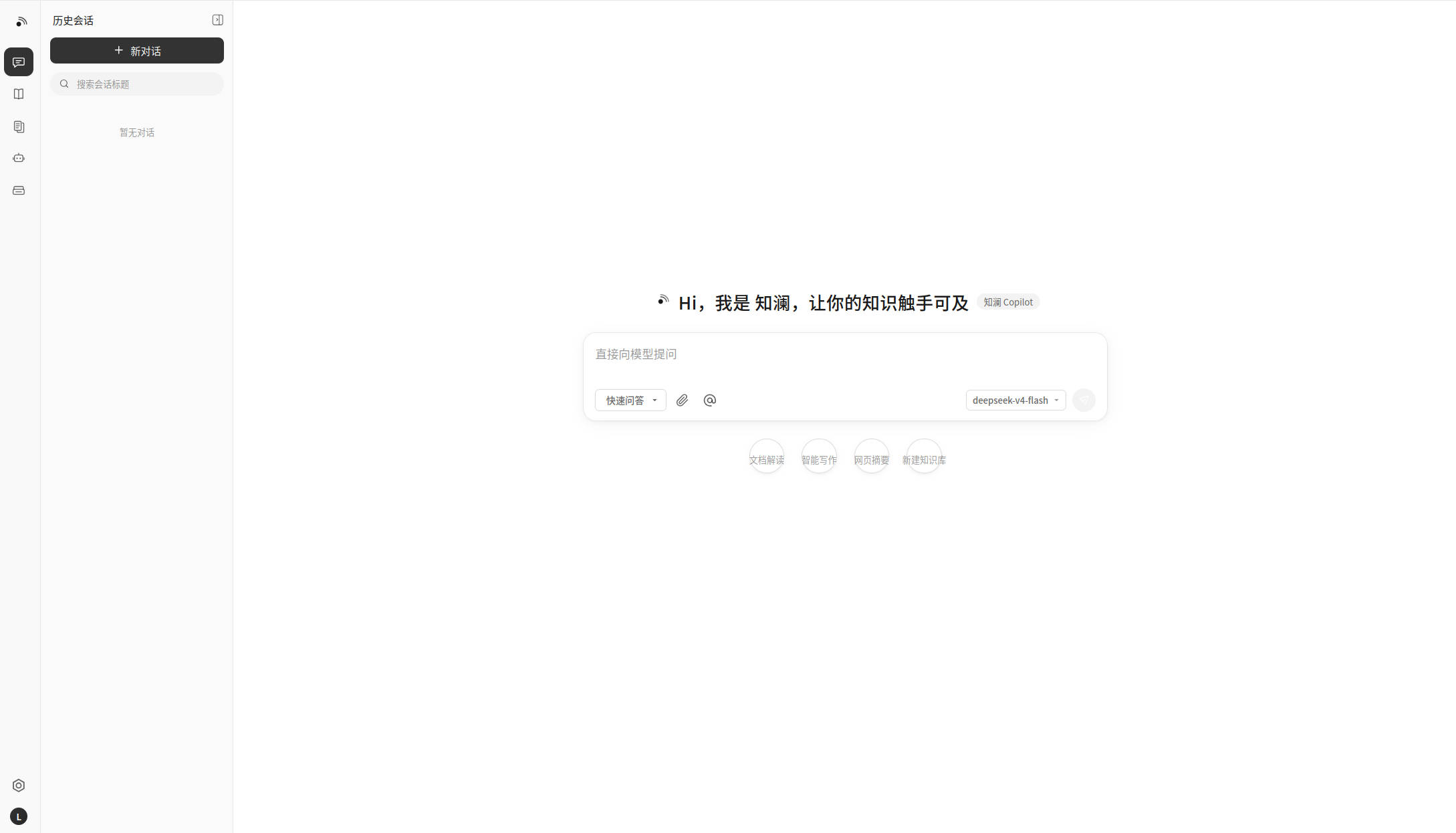
💬 Intelligent Q&A Conversation
📖 Wiki Browser
🕸️ Wiki Knowledge Graph
🤖 Agent Mode · Tool Call Process
⚙️ Conversation Settings
🔭 Observability · Langfuse Tracing
🖥️ Real Product Screenshots
💬 New Chat
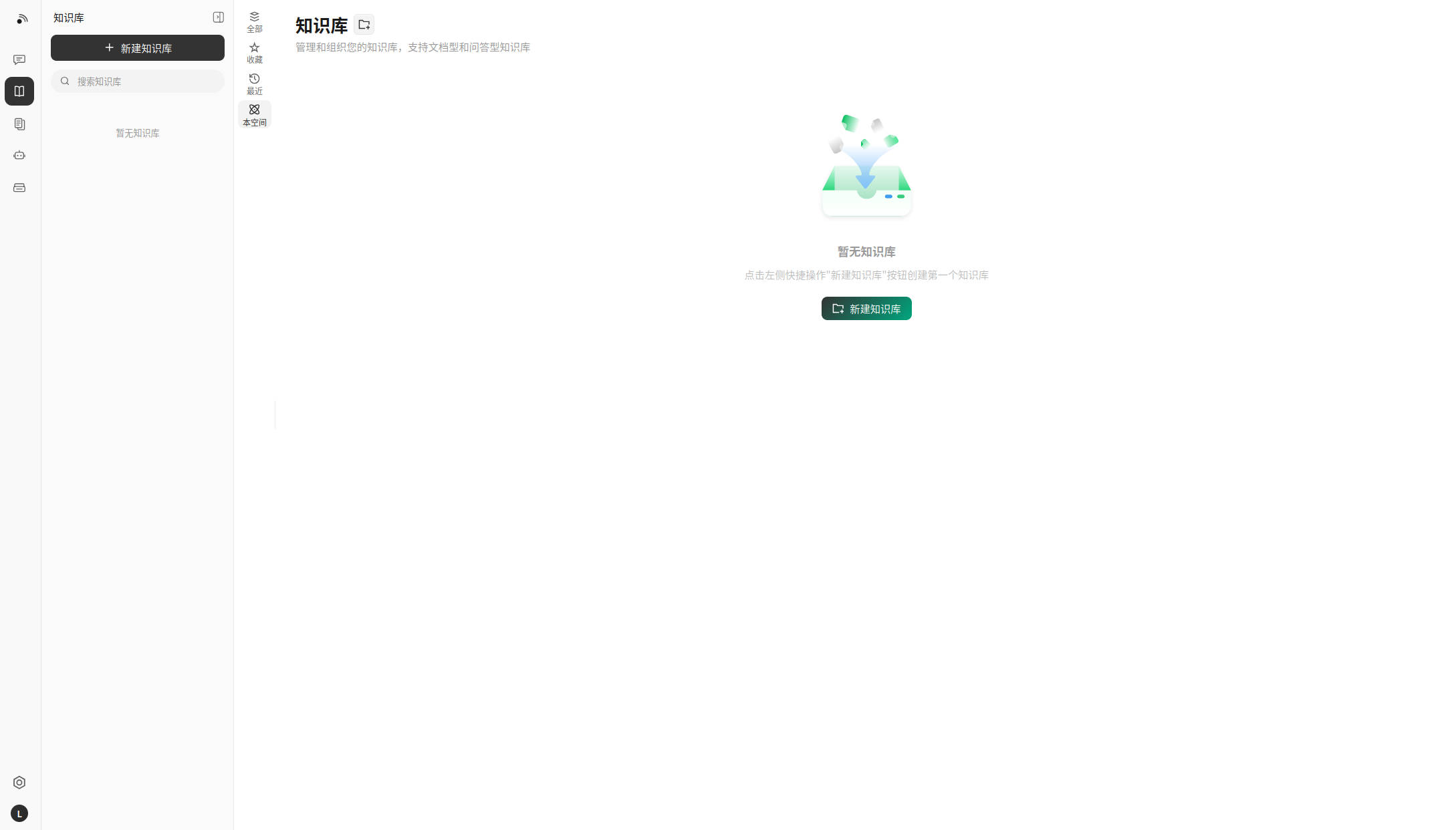
📚 Knowledge Base
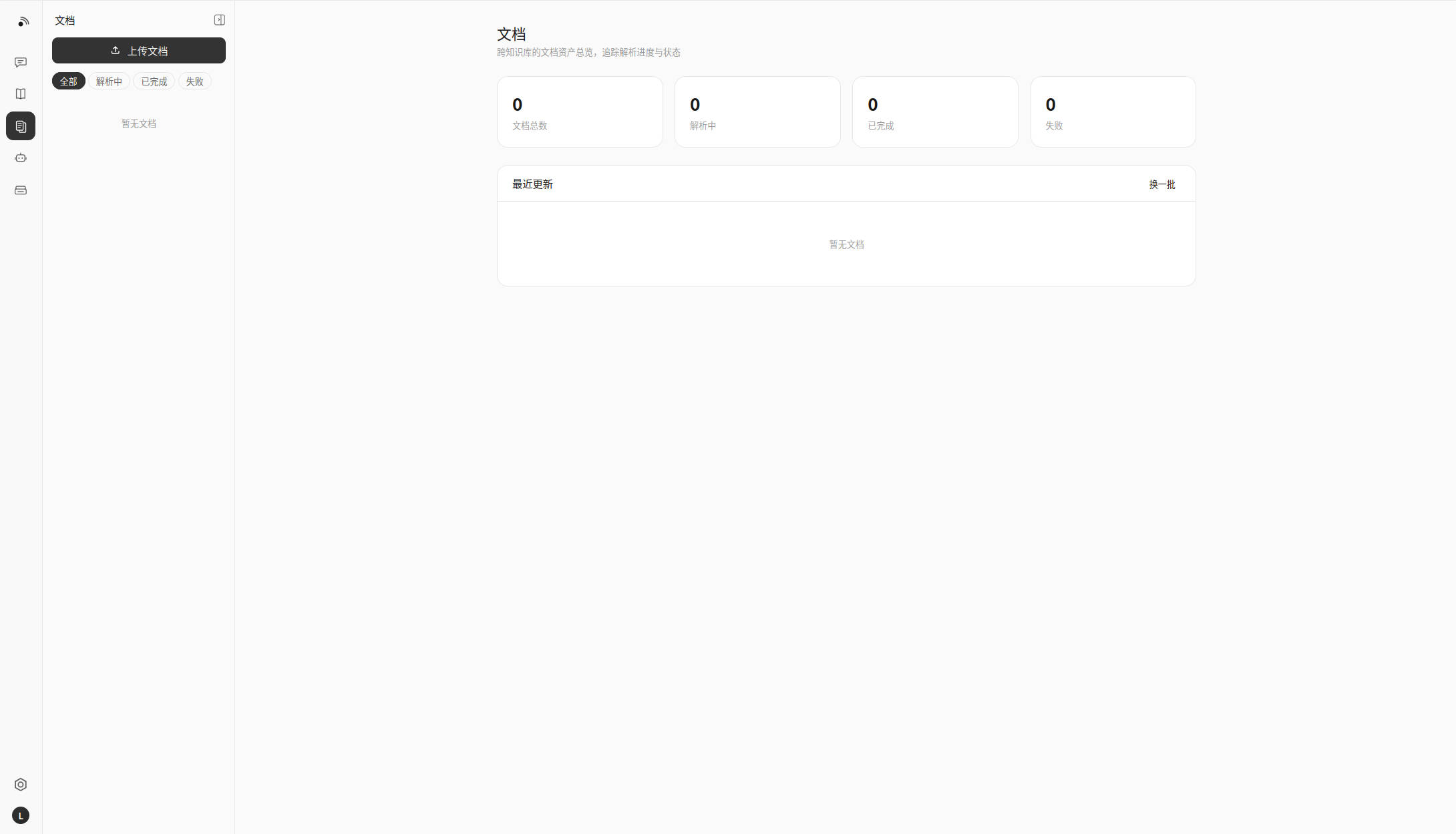
📄 Documents
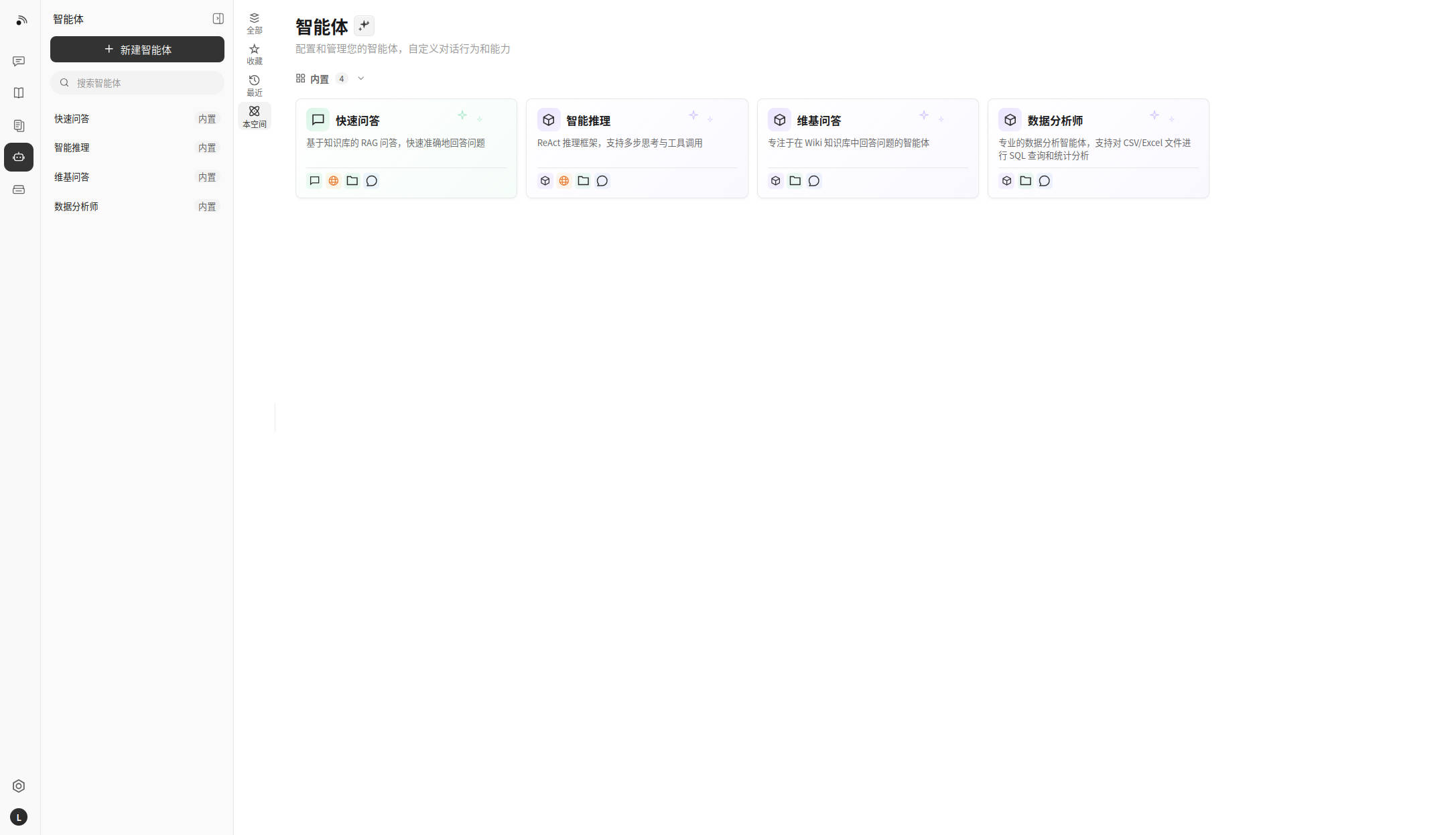
🤖 Agent
🧠 My Memory
🏗️ Architecture
Fully modular pipeline from document parsing, vectorization, and retrieval to LLM inference — every component is swappable and extensible. Supports local / private cloud deployment with full data sovereignty and a zero-barrier Web UI for quick onboarding.
🧩 Feature Overview
Intelligent Conversation
Capability
Details
Intelligent Reasoning
ReACT progressive multi-step reasoning, autonomously orchestrating knowledge retrieval, MCP tools, and web search
Quick Q&A
RAG-based Q&A over knowledge bases for fast and accurate answers
Wiki Mode
Agent-driven auto-generation of structured, interlinked markdown Wiki pages from raw documents
Tool Calling
Built-in tools, MCP tools (incl. OAuth2 remote services, mid-conversation OAuth), web search; @Skill / @MCP mentions to scope the agent runtime per turn
Auto-generated question suggestions and after-answer follow-ups based on knowledge base content
Temporary Attachments
Session-scoped image / document uploads with async parsing for one-off Q&A, with a combined image + attachment limit
Citations & RAG Progress
Inline citation popovers and a references drawer (web / KB source distinction), shared markdown rendering, and stage-by-stage RAG pipeline progress in chat
Session Management
Filter and group sidebar sessions by source (Web / IM / Embed), with inline session-title rename
Memory & Personalization
Three-layer memory architecture (see Highlights): async fact extraction, scored recall injection, and a dedicated My Memory page structured into four modules (Soul / User / Memory / Agent) for browsing / editing / deleting memories with a global memory switch
Knowledge Management
Capability
Details
Knowledge Base Types
FAQ / Document / Wiki with folder import, URL import, multi-tag management, and online entry
Deep Parsing Pipeline
PDF table extraction / formula recognition / dual-column awareness / auto routing / quality-scored retry / human review queue
Per-Upload Process Config
Override parser, chunking, multimodal (VLM / ASR), graph extraction, and question generation per upload batch via upload-confirm dialog or process_config API; reparse with new settings
Batch Reparse
Re-queue parsing for multiple documents at once with optional per-batch process_config
Data Source Import
Auto-sync from Feishu / Notion / Yuque / RSS feeds (more data sources coming soon); incremental and full sync
Document Formats
PDF / Word / Txt / Markdown / HTML / EPUB / MHTML / Images / CSV / Excel / PPT / JSON
Publish agents to any site via zilan-widget.js with domain allowlists, rate limits, and secure-mode token exchange
Web Search
DuckDuckGo / Bing / Google / Tavily / Baidu / Ollama / SearXNG / Keenable / Zhipu AI
API Integration
Scoped API keys (capability-level grants + per-KB restriction + throttled last-used tracking) with an API integration playground; MCP OAuth and embed sessions isolated per principal
Platform
Capability
Details
Deployment
Local / Docker / Kubernetes (Helm) with private and offline support
UI
Web UI / RESTful API / Website Embed Widget; the Zilan minimalist design language covers the whole journey








 Zilan 是一个由大语言模型驱动的知识管理与问答平台,把 RAG 快速问答、ReAct 智能体推理和自动生成的 Wiki 知识沉淀统一到一个极简的知识中枢里。