Why We Built This
Diagrams are essential for AI-assisted programming. When you're working with an AI coding assistant, being able to visualize data flows, state machines, and system architecture—directly in your terminal or chat interface—makes complex concepts instantly graspable.
Mermaid is the de facto standard for text-based diagrams. It's brilliant. But the default renderer has problems:
- Aesthetics — Might be personal preference, but wished they looked more professional
- Complex theming — Customizing colors requires wrestling with CSS classes
- No terminal output — Can't render to ASCII for CLI tools
- Heavy dependencies — Pulls in a lot of code for simple diagrams
We built beautiful-mermaid at Craft to power diagrams in Craft Agents. It's fast, beautiful, and works everywhere—from rich UIs to plain terminals.
The ASCII rendering engine is based on mermaid-ascii by Alexander Grooff. We ported it from Go to TypeScript and extended it. Thank you Alexander for the excellent foundation! (And inspiration that this was possible.)
Features
- 6 diagram types — Flowcharts, State, Sequence, Class, ER, and XY Charts (bar, line, combined)
- Dual output — SVG for rich UIs, ASCII/Unicode for terminals
- Synchronous rendering — No async, no flash. Works with React
useMemo()
- 15 built-in themes — And dead simple to add your own
- Full Shiki compatibility — Use any VS Code theme directly
- Live theme switching — CSS custom properties, no re-render needed
- Mono mode — Beautiful diagrams from just 2 colors
- Zero DOM dependencies — Pure TypeScript, works everywhere
- Ultra-fast — Renders 100+ diagrams in under 500ms
Installation
npm install beautiful-mermaid
# or
bun add beautiful-mermaid
# or
pnpm add beautiful-mermaid
Quick Start
SVG Output
import { renderMermaidSVG } from 'beautiful-mermaid'

const svg = renderMermaidSVG(`
  graph TD
    A[Start] --> B{Decision}
    B -->|Yes| C[Action]
    B -->|No| D[End]
`)
Rendering is fully synchronous — no await, no promises. The ELK.js layout engine runs synchronously via a FakeWorker bypass, so you get your SVG string instantly.
Need async? Use renderMermaidSVGAsync() — same output, returns a Promise<string>.
ASCII Output
import { renderMermaidASCII } from 'beautiful-mermaid'

const ascii = renderMermaidASCII(`graph LR; A --> B --> C`)
┌───┐     ┌───┐     ┌───┐
│   │     │   │     │   │
│ A │────►│ B │────►│ C │
│   │     │   │     │   │
└───┘     └───┘     └───┘
React Integration
Because rendering is synchronous, you can use useMemo() for zero-flash diagram rendering:
import { renderMermaidSVG } from 'beautiful-mermaid'

function MermaidDiagram({ code }: { code: string }) {
  const { svg, error } = React.useMemo(() => {
    try {
      return {
        svg: renderMermaidSVG(code, {
          bg: 'var(--background)',
          fg: 'var(--foreground)',
          transparent: true,
        }),
        error: null,
      }
    } catch (err) {
      return { svg: null, error: err instanceof Error ? err : new Error(String(err)) }
    }
  }, [code])

  if (error) return <pre>{error.message}</pre>
  return <div dangerouslySetInnerHTML={{ __html: svg! }} />
}
Why this works well:
- No flash — SVG is computed synchronously during render, not in a useEffect
- CSS variables — Pass
var(--background) etc. instead of hex colors. The SVG inherits from your app's CSS, so theme switches apply instantly without re-rendering
- Memoized — Only re-renders when
code changes
Theming
The theming system is the heart of beautiful-mermaid. It's designed to be both powerful and dead simple.
The Two-Color Foundation
Every diagram needs just two colors: background (bg) and foreground (fg). That's it. From these two colors, the entire diagram is derived using color-mix():
const svg = renderMermaidSVG(diagram, {
  bg: '#1a1b26',  // Background
  fg: '#a9b1d6',  // Foreground
})
This is Mono Mode—a coherent, beautiful diagram from just two colors. The system automatically derives:
| Element |
Derivation |
| Text |
--fg at 100% |
| Secondary text |
--fg at 60% into --bg |
| Edge labels |
--fg at 40% into --bg |
| Faint text |
--fg at 25% into --bg |
| Connectors |
--fg at 50% into --bg |
| Arrow heads |
--fg at 85% into --bg |
| Node fill |
--fg at 3% into --bg |
| Group header |
--fg at 5% into --bg |
| Inner strokes |
--fg at 12% into --bg |
| Node stroke |
--fg at 20% into --bg |
Enriched Mode
For richer themes, you can provide optional "enrichment" colors that override specific derivations:
const svg = renderMermaidSVG(diagram, {
  bg: '#1a1b26',
  fg: '#a9b1d6',
  // Optional enrichment:
  line: '#3d59a1',    // Edge/connector color
  accent: '#7aa2f7',  // Arrow heads, highlights
  muted: '#565f89',   // Secondary text, labels
  surface: '#292e42', // Node fill tint
  border: '#3d59a1',  // Node stroke
})
If an enrichment color isn't provided, it falls back to the color-mix() derivation. This means you can provide just the colors you care about.
CSS Custom Properties = Live Switching
All colors are CSS custom properties on the <svg> element. This means you can switch themes instantly without re-rendering:
// Switch theme by updating CSS variables
svg.style.setProperty('--bg', '#282a36')
svg.style.setProperty('--fg', '#f8f8f2')
// The entire diagram updates immediately
For React apps, pass CSS variable references instead of hex values:
const svg = renderMermaidSVG(diagram, {
  bg: 'var(--background)',
  fg: 'var(--foreground)',
  accent: 'var(--accent)',
  transparent: true,
})
// Theme switches apply automatically via CSS cascade — no re-render needed
Built-in Themes
15 carefully curated themes ship out of the box:
| Theme |
Type |
Background |
Accent |
zinc-light |
Light |
#FFFFFF |
Derived |
zinc-dark |
Dark |
#18181B |
Derived |
tokyo-night |
Dark |
#1a1b26 |
#7aa2f7 |
tokyo-night-storm |
Dark |
#24283b |
#7aa2f7 |
tokyo-night-light |
Light |
#d5d6db |
#34548a |
catppuccin-mocha |
Dark |
#1e1e2e |
#cba6f7 |
catppuccin-latte |
Light |
#eff1f5 |
#8839ef |
nord |
Dark |
#2e3440 |
#88c0d0 |
nord-light |
Light |
#eceff4 |
#5e81ac |
dracula |
Dark |
#282a36 |
#bd93f9 |
github-light |
Light |
#ffffff |
#0969da |
github-dark |
Dark |
#0d1117 |
#4493f8 |
solarized-light |
Light |
#fdf6e3 |
#268bd2 |
solarized-dark |
Dark |
#002b36 |
#268bd2 |
one-dark |
Dark |
#282c34 |
#c678dd |
import { renderMermaidSVG, THEMES } from 'beautiful-mermaid'

const svg = renderMermaidSVG(diagram, THEMES['tokyo-night'])
Adding Your Own Theme
Creating a theme is trivial. At minimum, just provide bg and fg:
const myTheme = {
  bg: '#0f0f0f',
  fg: '#e0e0e0',
}

const svg = renderMermaidSVG(diagram, myTheme)
Want richer colors? Add any of the optional enrichments:
const myRichTheme = {
  bg: '#0f0f0f',
  fg: '#e0e0e0',
  accent: '#ff6b6b',  // Pop of color for arrows
  muted: '#666666',   // Subdued labels
}
Full Shiki Compatibility
Use any VS Code theme directly via Shiki integration. This gives you access to hundreds of community themes:
import { getSingletonHighlighter } from 'shiki'
import { renderMermaidSVG, fromShikiTheme } from 'beautiful-mermaid'

// Load any theme from Shiki's registry
const highlighter = await getSingletonHighlighter({
  themes: ['vitesse-dark', 'rose-pine', 'material-theme-darker']
})

// Extract diagram colors from the theme
const colors = fromShikiTheme(highlighter.getTheme('vitesse-dark'))

const svg = renderMermaidSVG(diagram, colors)
The fromShikiTheme() function intelligently maps VS Code editor colors to diagram roles:
| Editor Color |
Diagram Role |
editor.background |
bg |
editor.foreground |
fg |
editorLineNumber.foreground |
line |
focusBorder / keyword token |
accent |
| comment token |
muted |
editor.selectionBackground |
surface |
editorWidget.border |
border |
Supported Diagrams
Flowcharts
graph TD
  A[Start] --> B{Decision}
  B -->|Yes| C[Process]
  B -->|No| D[End]
  C --> D
All directions supported: TD (top-down), LR (left-right), BT (bottom-top), RL (right-left).
State Diagrams
stateDiagram-v2
  [*] --> Idle
  Idle --> Processing: start
  Processing --> Complete: done
  Complete --> [*]
Sequence Diagrams
sequenceDiagram
  Alice->>Bob: Hello Bob!
  Bob-->>Alice: Hi Alice!
  Alice->>Bob: How are you?
  Bob-->>Alice: Great, thanks!
Class Diagrams
classDiagram
  Animal <|-- Duck
  Animal <|-- Fish
  Animal: +int age
  Animal: +String gender
  Animal: +isMammal() bool
  Duck: +String beakColor
  Duck: +swim()
  Duck: +quack()
ER Diagrams
erDiagram
  CUSTOMER ||--o{ ORDER : places
  ORDER ||--|{ LINE_ITEM : contains
  PRODUCT ||--o{ LINE_ITEM : "is in"
Inline Edge Styling
Use linkStyle to override edge colors and stroke widths — just like Mermaid's linkStyle:
graph TD
  A --> B --> C
  linkStyle 0 stroke:#ff0000,stroke-width:2px
  linkStyle default stroke:#888888
| Syntax |
Effect |
linkStyle 0 stroke:#f00 |
Style a single edge by index (0-based) |
linkStyle 0,2 stroke:#f00 |
Style multiple edges at once |
linkStyle default stroke:#888 |
Default style applied to all edges |
Index-specific styles override the default. Supported properties: stroke, stroke-width.
Works in both flowcharts and state diagrams.
XY Charts
Bar charts, line charts, and combinations — using Mermaid's xychart-beta syntax.
Bar chart:
xychart-beta
    title "Monthly Revenue"
    x-axis [Jan, Feb, Mar, Apr, May, Jun]
    y-axis "Revenue ($K)" 0 --> 500
    bar [180, 250, 310, 280, 350, 420]
Line chart:
xychart-beta
    title "User Growth"
    x-axis [Jan, Feb, Mar, Apr, May, Jun]
    line [1200, 1800, 2500, 3100, 3800, 4500]
Combined bar + line:
xychart-beta
    title "Sales with Trend"
    x-axis [Jan, Feb, Mar, Apr, May, Jun]
    bar [300, 380, 280, 450, 350, 520]
    line [300, 330, 320, 353, 352, 395]
Horizontal orientation:
xychart-beta horizontal
    title "Language Popularity"
    x-axis [Python, JavaScript, Java, Go, Rust]
    bar [30, 25, 20, 12, 8]
Axis configuration:
- Categorical x-axis:
x-axis [A, B, C]
- Numeric x-axis range:
x-axis 0 --> 100
- Axis titles:
x-axis "Category" [A, B, C]
- Y-axis range:
y-axis "Score" 0 --> 100
Multi-series: Add multiple bar and/or line declarations. Each series gets a distinct color from a monochromatic palette derived from the theme's accent color.
XY Chart Styling
The chart renderer follows a clean, minimal design philosophy inspired by Apple and Craft:
- Dot grid — A subtle dot pattern fills the plot area instead of traditional solid grid lines
- Rounded bars — All bar corners are rounded for a modern, polished look
- Smooth curves — Line series use natural cubic spline interpolation, producing mathematically smooth curves through all data points (not straight segments or staircase steps)
- Floating labels — No visible axis lines or tick marks; labels float freely for a clutter-free aesthetic
- Drop-shadow lines — Each line series has a subtle shadow beneath it for depth
- Monochromatic palette — Series 0 uses the theme's accent color; additional series get darker/lighter shades of the same hue with subtle hue drift, adapting automatically to light or dark backgrounds
- Interactive tooltips — When rendered with
interactive: true, hovering over bars or data points shows value tooltips. Multi-line tooltips appear when multiple series share an x-position
- Sparse line dots — Lines with 12 or fewer data points show data point dots by default for readability
- Full theme support — All 15 built-in themes (and custom themes) apply to charts. The accent color drives the entire series color palette
- Live theme switching — Chart series colors are CSS custom properties (
--xychart-color-N), so theme changes apply instantly without re-rendering
ASCII Output
For terminal environments, CLI tools, or anywhere you need plain text, render to ASCII or Unicode box-drawing characters:
import { renderMermaidASCII } from 'beautiful-mermaid'

// Unicode mode (default) — prettier box drawing
const unicode = renderMermaidASCII(`graph LR; A --> B`)

// Pure ASCII mode — maximum compatibility
const ascii = renderMermaidASCII(`graph LR; A --> B`, { useAscii: true })
Unicode output:
┌───┐     ┌───┐
│   │     │   │
│ A │────►│ B │
│   │     │   │
└───┘     └───┘
ASCII output:
+---+     +---+
|   |     |   |
| A |---->| B |
|   |     |   |
+---+     +---+
ASCII Options
renderMermaidASCII(diagram, {
  useAscii: false,      // true = ASCII, false = Unicode (default)
  paddingX: 5,          // Horizontal spacing between nodes
  paddingY: 5,          // Vertical spacing between nodes
  boxBorderPadding: 1,  // Padding inside node boxes
  colorMode: 'auto',    // 'none' | 'auto' | 'ansi16' | 'ansi256' | 'truecolor' | 'html'
  theme: { ... },       // Partial<AsciiTheme> — override default colors
})
ASCII XY Charts
XY charts render to ASCII with dedicated chart-drawing characters:
- Bar charts —
█ blocks (Unicode) or # (ASCII mode)
- Line charts — Staircase routing with rounded corners:
╭╮╰╯│─ (Unicode) or +|- (ASCII)
- Multi-series — Each series gets a distinct ANSI color from the theme's accent palette
- Legends — Automatically shown when multiple series are present
- Horizontal charts — Fully supported with categories on the y-axis
API Reference
renderMermaidSVG(text, options?): string
Render a Mermaid diagram to SVG. Synchronous. Auto-detects diagram type.
Parameters:
text — Mermaid source codeoptions — Optional RenderOptions object
RenderOptions:
| Option |
Type |
Default |
Description |
bg |
string |
#FFFFFF |
Background color (or CSS variable) |
fg |
string |
#27272A |
Foreground color (or CSS variable) |
line |
string? |
— |
Edge/connector color |
accent |
string? |
— |
Arrow heads, highlights |
muted |
string? |
— |
Secondary text, labels |
surface |
string? |
— |
Node fill tint |
border |
string? |
— |
Node stroke color |
font |
string |
Inter |
Font family |
transparent |
boolean |
false |
Render with transparent background |
padding |
number |
40 |
Canvas padding in px |
nodeSpacing |
number |
24 |
Horizontal spacing between sibling nodes |
layerSpacing |
number |
40 |
Vertical spacing between layers |
componentSpacing |
number |
24 |
Spacing between disconnected components |
thoroughness |
number |
3 |
Crossing minimization trials (1-7, higher = better but slower) |
interactive |
boolean |
false |
Enable hover tooltips on XY chart bars and data points |
XY Charts: Diagrams starting with xychart-beta are auto-detected — no separate function needed. The accent color option drives the chart series color palette.
renderMermaidSVGAsync(text, options?): Promise<string>
Async version of renderMermaidSVG(). Same output, returns a Promise<string>. Useful in async server handlers or data loaders.
renderMermaidASCII(text, options?): string
Render a Mermaid diagram to ASCII/Unicode text. Synchronous.
AsciiRenderOptions:
| Option |
Type |
Default |
Description |
useAscii |
boolean |
false |
Use ASCII instead of Unicode |
paddingX |
number |
5 |
Horizontal node spacing |
paddingY |
number |
5 |
Vertical node spacing |
boxBorderPadding |
number |
1 |
Inner box padding |
colorMode |
string |
'auto' |
'none', 'auto', 'ansi16', 'ansi256', 'truecolor', or 'html' |
theme |
Partial<AsciiTheme> |
— |
Override default colors for ASCII output |
parseMermaid(text): MermaidGraph
Parse Mermaid source into a structured graph object (for custom processing).
fromShikiTheme(theme): DiagramColors
Extract diagram colors from a Shiki theme object.
THEMES: Record<string, DiagramColors>
Object containing all 15 built-in themes.
DEFAULTS: { bg: string, fg: string }
Default colors (#FFFFFF / #27272A).
Attribution
The ASCII rendering engine is based on mermaid-ascii by Alexander Grooff. We ported it from Go to TypeScript and extended it with:
- Sequence diagram support
- Class diagram support
- ER diagram support
- Unicode box-drawing characters
- Configurable spacing and padding
Thank you Alexander for the excellent foundation!
License
MIT — see LICENSE for details.
Built with care by the team at Craft
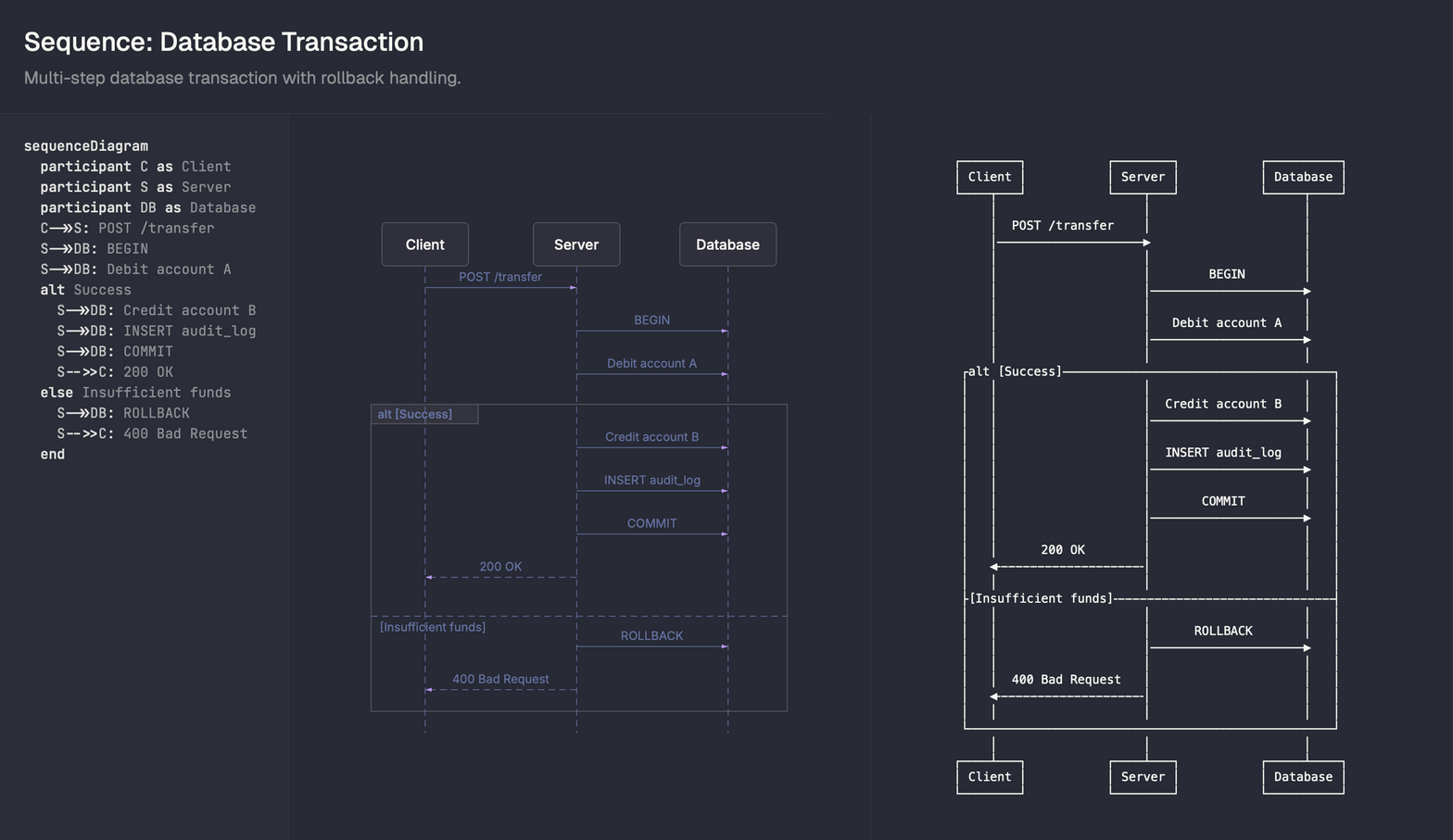


 beautiful-mermaid is a TypeScript library that renders Mermaid diagrams as polished SVGs or ASCII/Unicode art, built so AI coding assistants and chat UIs can show flowcharts, state machines, and other diagrams inline.