










What is this?
 LitmusChaos is an open source, cloud-native chaos engineering platform built for Kubernetes that lets SREs and developers run controlled chaos experiments to find weaknesses before a real outage does.
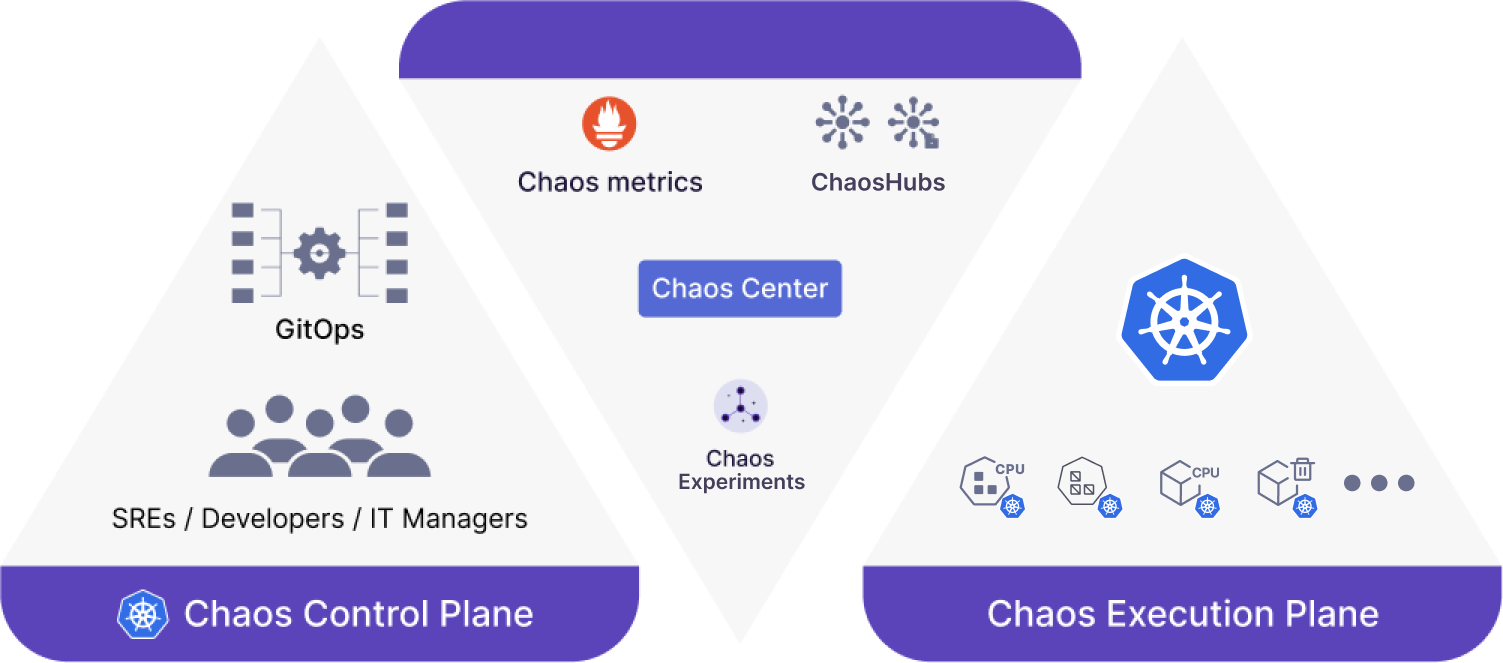
LitmusChaos is an open source, cloud-native chaos engineering platform built for Kubernetes that lets SREs and developers run controlled chaos experiments to find weaknesses before a real outage does.Is this a standalone app or something that runs inside my Kubernetes cluster?It runs as a set of microservices on top of Kubernetes: a Chaos Control Plane (chaos-center) builds, schedules and visualizes chaos workflows, while the Chaos Execution Plane (a chaos agent plus operators) actually runs the faults against your target cluster.
It runs as a set of microservices on top of Kubernetes: a Chaos Control Plane (chaos-center) builds, schedules and visualizes chaos workflows, while the Chaos Execution Plane (a chaos agent plus operators) actually runs the faults against your target cluster.How do I get Litmus running?The README points to the Installation section of the Getting Started with Litmus page in the official docs rather than giving install commands directly.
The README points to the Installation section of the Getting Started with Litmus page in the official docs rather than giving install commands directly.Do I need an existing Kubernetes cluster to use this?Yes — Litmus is built entirely around Kubernetes custom resources (ChaosExperiment, ChaosEngine, ChaosResult) that are deployed against a target Kubernetes environment, so a running cluster is required.
Yes — Litmus is built entirely around Kubernetes custom resources (ChaosExperiment, ChaosEngine, ChaosResult) that are deployed against a target Kubernetes environment, so a running cluster is required.Who is Litmus meant for — developers, CI/CD, or ops teams?All three: developers can run chaos tests as an extension of unit/integration testing, CI/CD pipeline builders can add chaos as a pipeline stage, and SREs can plan and schedule chaos experiments to harden production infrastructure.
All three: developers can run chaos tests as an extension of unit/integration testing, CI/CD pipeline builders can add chaos as a pipeline stage, and SREs can plan and schedule chaos experiments to harden production infrastructure.What is the ChaosHub?ChaosHub (hub.litmuschaos.io) is a central hub where developers and vendors publish their ChaosExperiment custom resources so other users can reuse them to test the resilience of their own applications.
ChaosHub (hub.litmuschaos.io) is a central hub where developers and vendors publish their ChaosExperiment custom resources so other users can reuse them to test the resilience of their own applications.Can I plug in my own fault-injection tooling instead of using Litmus's built-in experiments?Yes, through BYOC (bring-your-own-chaos) a ChaosExperiment can wrap any third-party fault-injection tool while Litmus still handles scheduling and the steady-state checks.
Yes, through BYOC (bring-your-own-chaos) a ChaosExperiment can wrap any third-party fault-injection tool while Litmus still handles scheduling and the steady-state checks.How do I see whether a chaos experiment passed or failed?Each run produces a ChaosResult resource with the verdict and rollback status, and a chaos-exporter turns that into Prometheus metrics for dashboards and automated pipelines.
Each run produces a ChaosResult resource with the verdict and rollback status, and a chaos-exporter turns that into Prometheus metrics for dashboards and automated pipelines.What are ChaosExperiment, ChaosEngine and ChaosResult?ChaosExperiment defines a reusable fault template, ChaosEngine links that fault to a specific target workload/node with run and probe settings, and ChaosResult stores the outcome of the run.
ChaosExperiment defines a reusable fault template, ChaosEngine links that fault to a specific target workload/node with run and probe settings, and ChaosResult stores the outcome of the run.What are similar projects?thanos, istio, post-mortems, apisix, cilium, chaosmonkey, jaeger, faas
thanos, istio, post-mortems, apisix, cilium, chaosmonkey, jaeger, faasWhich topics is it in?chaos-engineering, reliability, fault-tolerance, k8s, cncf, prometheus, cloud-native, microservices, observability, golang, kubernetes, testing
chaos-engineering, reliability, fault-tolerance, k8s, cncf, prometheus, cloud-native, microservices, observability, golang, kubernetes, testing