Content Studio is the design agent LangChain runs, now open source. Add your brand and deploy it
to your team's Slack with Managed Deep Agents. Anyone can ask it like they'd ask a designer, attach what they have, and
get finished, on-brand files back, from a resized ad to a launch film.
Since August it has shipped over 3,000 assets for us, posts with its work drew about 4.5M views on
X, and three in four requests come from outside marketing. How we built it goes deeper
into each part.
See it work
We asked Content Studio for its own launch film. It went full Rocky.
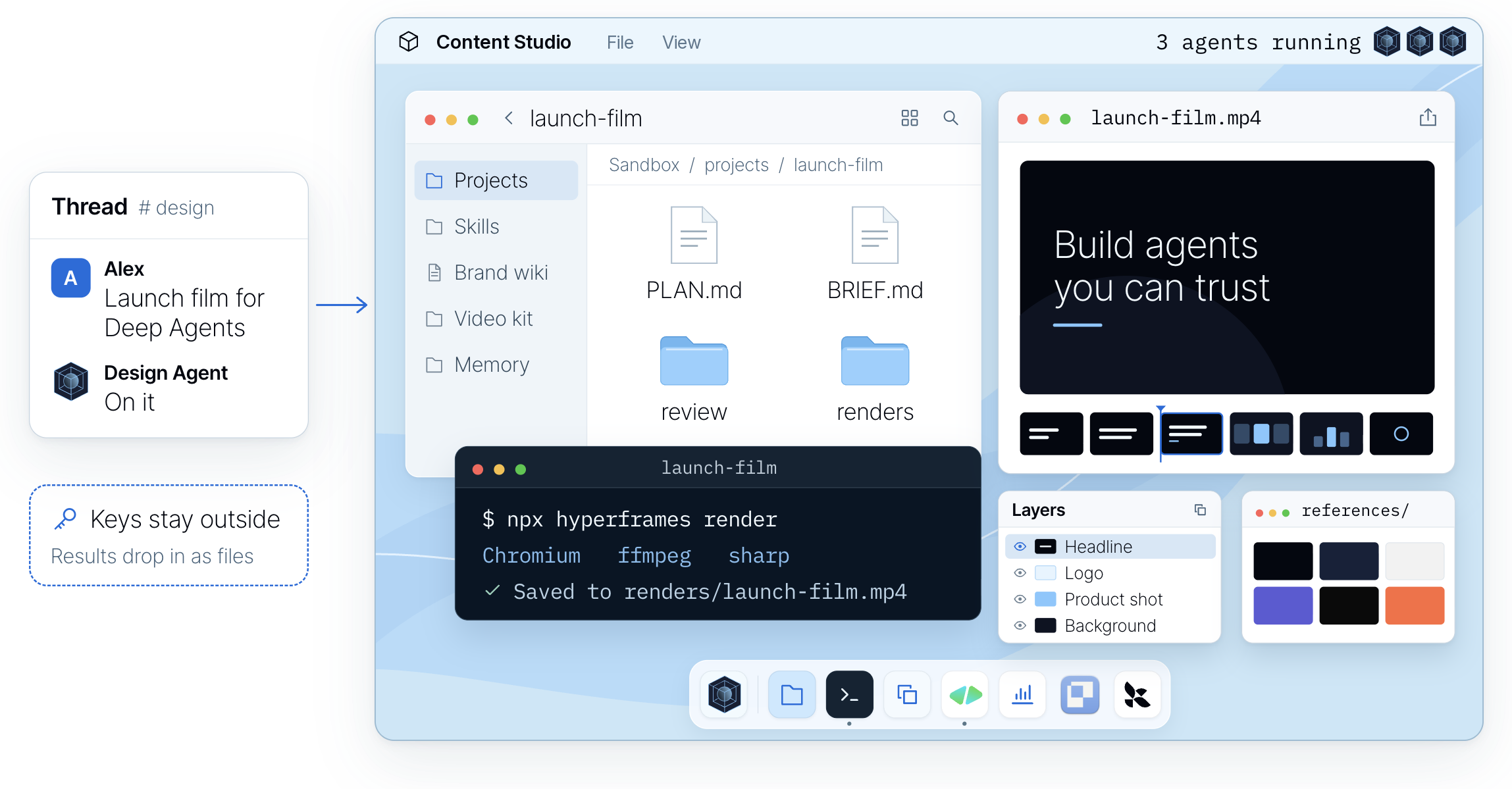
Content Studio is a Deep Agents agent deployed on
Managed Deep Agents.
Managed Deep Agents runs the infrastructure: Slack, sandboxes, memory, schedules and tracing. This
repo is the design agent on top. The model makes the creative calls, and code renders, checks and
delivers.
How we run it at LangChain. Your copy starts with the integrations you turn on (Integrations).
Slack. Mention it in a thread with a brief and any files. MDA's Slack app hands the message
and attachments to the agent, and the finished files come back to the same thread. While it
works, one message updates step by step, a footer shows what's running and the cost so far, and
anything you add mid-job reaches the work in progress.
A computer per thread. Each thread gets its own LangSmith sandbox: a Linux machine with
Chrome, FFmpeg, HyperFrames, D2 and your fonts, built from one
pinned recipe (sandbox/setup.sh). Everything it makes is code in a project folder
there (a slide is HTML, a film is an animation timeline), so a change is an edit and a re-render,
not a restart. API keys never enter it.
Skills and a design wiki. The always-on prompt is small. For each ask it first reads a router
skill that picks the right workflow, from a resized ad to a launch film, out of 35
skills. The wiki holds the craft (type, colour, layout, charts) and your brand pack
holds the facts. Skills load only when a job needs them, served by MDA from Context Hub.
Your tools. Video is built in HyperFrames, which treats a film as a web page on a timeline.
Paper is a shared canvas where you edit a storyboard or layout directly.
Image, voice and music models run as tools outside the sandbox, and MCP servers like Notion,
Linear, GitHub and Figma connect through MDA, with each person signed in as themselves.
Async subagents. On a big job the main agent plans, splits the work and starts subagents in
the background on the same sandbox and files. MDA wakes it when one finishes, fails or stalls, so
it never sits waiting and can keep talking to you. Films go storyboard, animatic, then
production, and code makes every part pass review before assembly.
Memory. Tell it a rule once ("never use orange on LinkedIn") and it saves it that turn. MDA
gives it two layers of files: team memory everyone shares and personal memory for each person,
and each layer's index loads into every run.
It gets better. After a job, learn_from_job writes notes on what worked against the skill
it used. Later jobs read and rate those notes, and the ones that don't hold up are dropped.
Watch it explain itself
We asked it to explain its own harness as a nature documentary, starring a pixel parrot. It walks
through the computer, the tools and the context behind its work.
Storyboarded, built and narrated by the agent, in one Slack thread.
The prompt that made this film
The agent made it from this ask and a few rounds of notes:
Make a short explainer of how you create videos in code, end to end, for our blog post on the
media harness we built on Deep Agents. Narrate it like a David Attenborough nature documentary,
starring the pixel parrot from our promo, with your subagents as its flock. Keep it technical
enough for an engineer, in real terms: skills, wiki, tools, apps. Storyboard it before you build,
and end on "Built on Managed Deep Agents".
The same prompt to a local coding agent with a brand skill, and to Content Studio.
It looks at its work. It renders, then looks at the image before it posts anything.
Your brand is code. Layouts only take your tokens: your colours, fonts and spacing.
It checks what a machine can count. Colours, fonts, contrast, sizes and chart math are checked
in code on every render. Taste stays with your designers.
Quickstart
Building it yourself
Starting here
Months on a harness, a sandbox, skills and a Slack UX
Fork it, add your brand, deploy with one command
Polished work that looks like a hundred others
Work that follows your brand, checked on every render
Design requests wait in a queue
Anyone asks in Slack: a graphic in minutes, a long deck overnight
Every team fixes the same mistakes
Fix a skill once, and every asset after it follows
This repository is a Managed Deep Agents project, so it deploys to your LangSmith
workspace as it is. You need a LangSmith account (Managed Deep Agents is in public beta on
LangSmith Cloud) and a model key:
curl -fsSL https://raw.githubusercontent.com/langchain-ai/design-agent/main/install.sh | bash
cd design-agent
uv run design-agent config set LANGSMITH_API_KEY ANTHROPIC_API_KEY   # type each key; it stays hidden
uv run design-agent sandbox publish   # once per workspace, 10-15 min: the agent's computer
uv run mda deploy                     # the agent itself, and its Slack app
The installer gets uv if you don't have it, clones the repository and
installs its dependencies; git clone and uv sync do the same.
The two last commands do different things. sandbox publish builds the Linux machine every thread
works on, as a snapshot in your LangSmith workspace; nothing you can talk to exists yet. mda deploy
deploys the agent, which clones that machine for each thread. Publish again only when
sandbox/setup.sh changes.
On the LangSmith Gateway? Skip the provider key and run
uv run design-agent config set DESIGN_AGENT_MODEL=langsmith:anthropic/claude-opus-5-5. The agent
then uses LANGSMITH_GATEWAY_API_KEY, else LANGSMITH_API_KEY, and image generation goes through
the gateway too when there is no OPENAI_API_KEY. For any other OpenAI-compatible endpoint, set
DESIGN_AGENT_MODEL_BASE_URL and DESIGN_AGENT_MODEL_API_KEY_ENV (Models).
The first deploy sets up the agent's Slack app: mda deploy prints a Slack link, you approve the
app for your workspace (an admin may need to), and press Enter. The agent then sends you a DM;
reply to it, or /invite it to a channel and mention it. It's how we run ours at LangChain. Try changes on a separate copy with
uv run mda deploy --name design-agent-test. In a workspace with agent mode,
uv run mda deploy --agent-environment production (or staging, development) deploys into that
environment of the agent, and each environment keeps its own traces: open the agent in LangSmith
and pick the environment. uv run mda dev traces to its Local environment.
Deploy with MDA covers keys, what ships and checking it works.
Or ask your coding agent. Paste this into Claude Code, Codex or Cursor, from any folder:
Deploy LangChain's open-source design agent to my Slack workspace with Managed Deep Agents.

1. Install it with `curl -fsSL https://raw.githubusercontent.com/langchain-ai/design-agent/main/install.sh | bash`, then work in the `design-agent` folder it creates.
2. Read `AGENTS.md` and follow the `design-agent-deploy` skill.
3. Tell me which keys you need. I'll type them myself with `uv run design-agent config set <KEY>` in my terminal; never ask me to paste a key in chat.
4. Run `uv run design-agent doctor` and fix what it flags. Its `mda-deploy` line lists what a deploy still needs.
5. Ask me before `uv run design-agent sandbox publish`, which bills. Then have me run the first deploy, `uv run mda deploy`, in my own terminal, since it sets up the Slack app.
6. When it's live, walk me through messaging the agent in Slack and sending a first request.
Once the repo is open, say what you want.
AGENTS.md routes each request to a step-by-step skill:
Say
It will
"Deploy it to our Slack."
publish the sandbox, check what ships, and deploy after your yes
"Build our brand pack from our website and brand guide."
draft the pack, validate it, and ask you to review it
"Teach it to make our weekly newsletter header."
add a skill for it and try it on a real request
"Did that change make it better?"
run the evals before and after, and show you the numbers
Try it locally
The demo runs the real agent, sandbox and checks with a scripted model and no API keys. It needs
Docker, and leaves a launch card in three sizes and a 4-second teaser in workspace/out/demo/:
uv run design-agent sandbox build
uv run design-agent demo
With a model key in .env, ask for something real. Files land in workspace/out/<thread>/, and the
last line tells you what the run cost:
uv run design-agent ask "A LinkedIn card announcing our design review service, 1200x627."
Make it yours
This repo has two kinds of skills. The ones in .agents/skills/ are for your
coding agent, to set up, brand, deploy and change this repo. The ones in skills/ are
what Content Studio reads while it works. Customization covers both.
Want
Add
Guide
Your brand
workspace/brand/ (until then, a neutral sample brand), then redeploy
Once it's yours, ask it in Slack like you'd ask a designer:
"A launch card for our new feature, in LinkedIn, X and Instagram sizes."
"A Rocky-themed promo film for our launch, with music and sound effects."
"A chart of our weekly signups from this CSV." (attach the file)
"A YouTube thumbnail for this video."
"Caption this webinar clip." (attach the clip)
Everything on this page uses LangChain's brand, because that's the one we run. Licensed fonts go in
private-fonts/, which Git ignores.
Questions
What does it cost? The code is free (Apache 2.0). You pay your model provider: at LangChain the
median request costs about 50 cents in model spend, and long films and decks cost more. Managed Deep
Agents hosting is paid; it runs the agent, the sandboxes,
the Slack app and the schedules that you'd otherwise build and operate yourself.
Will it use my brand? Yes. Add your brand pack and every file follows it. The
brand-onboarding skill builds the pack with you from
your brand guide, website, files or a Paper file.
Where do I start? With the graphic your team asks for every week. Let people brief the agent,
review the work and ask for changes in Slack, then teach it the next thing.
Do I need Slack? No. Call the deployment's API, open it in LangSmith Studio, or use the
terminal (design-agent ask). On Managed Deep Agents, long jobs that work in the background
(films, parallel looks) report back in Slack; over the API, keep to requests that finish in one
turn.
Is it safe with my keys? The sandbox never holds a credential and has no network by default.
Host tools do the fetching, generating and delivering, and drop results in as files.
Which models? Claude Opus 5.5 by default. OpenAI and Google models, any OpenAI-compatible
endpoint and the LangSmith Gateway work too. See Models.
Can I run it on my own servers? Yes. It's Apache 2.0, and Self-hosting
runs the same agent with Docker, an HTTP API and your own Slack app.
Why two names? Content Studio is what we call the agent at LangChain, and the name its Slack app
gets unless you set DESIGN_AGENT_SLACK_NAME. The repository, package and command are design-agent.
Does it replace a designer? No. It takes the repetitive requests, so designers spend their time on
the work only they can do, and their judgment lives on in its skills and checks.
Build your own. Fork it, add your brand tokens, fonts and skills, and deploy it to your team's
Slack. Quickstart. If it's useful, a star helps other teams find it.












 Deep Agents
 Managed Deep Agents
 HyperFrames
 Paper

 Content Studio 是一个开源设计智能体,可以根据 Slack 聊天线程创建符合品牌风格的静态图、演示文稿、示意图、图表和动态图形,基于 LangChain 的 Deep Agents 构建。