

What is this?
 Micrograd is a tiny scalar-valued autograd engine that implements backpropagation (reverse-mode autodiff) over a dynamically built DAG, plus a small neural network library on top with a PyTorch-like API.
Micrograd is a tiny scalar-valued autograd engine that implements backpropagation (reverse-mode autodiff) over a dynamically built DAG, plus a small neural network library on top with a PyTorch-like API.Is this a full deep learning framework like PyTorch, or something smaller?It's a minimal educational library, not a production framework: the core autograd engine is about 100 lines of code and the neural net library on top is about 50 lines.
It's a minimal educational library, not a production framework: the core autograd engine is about 100 lines of code and the neural net library on top is about 50 lines.How do I try it out?Install the package, then use the demo.ipynb notebook to train a 2-layer MLP binary classifier on the moons dataset, or write your own scalar operations directly using the micrograd.nn module.
Install the package, then use the demo.ipynb notebook to train a 2-layer MLP binary classifier on the moons dataset, or write your own scalar operations directly using the micrograd.nn module.Do I need anything beyond Python to use it?No extra dependencies are needed to use the engine itself, but if you want to run the unit tests you need PyTorch installed, since the tests compare gradients against PyTorch as a reference.
No extra dependencies are needed to use the engine itself, but if you want to run the unit tests you need PyTorch installed, since the tests compare gradients against PyTorch as a reference.How does it handle neural net layers under the hood?It only operates over scalar values, so every neuron is chopped up into individual tiny adds and multiplies rather than using vectorized tensor operations — this makes it simple but not performant for real training.
It only operates over scalar values, so every neuron is chopped up into individual tiny adds and multiplies rather than using vectorized tensor operations — this makes it simple but not performant for real training.Can I visualize the computation graph?Yes, the tracegraph.ipynb notebook produces graphviz visualizations of the DAG, showing both the data value and gradient at each node by calling drawdot on your expression.
Yes, the tracegraph.ipynb notebook produces graphviz visualizations of the DAG, showing both the data value and gradient at each node by calling drawdot on your expression.Is there a bigger project built on this?Yes, microgpt extends the ideas here into a full GPT-2-like transformer trained in pure, dependency-free Python, using a more efficient version of the autograd engine.
Yes, microgpt extends the ideas here into a full GPT-2-like transformer trained in pure, dependency-free Python, using a more efficient version of the autograd engine.What can the included neural net actually do?The demo trains a 2-layer MLP with two 16-node hidden layers as a binary classifier using an SVM max-margin loss and SGD, achieving a decision boundary on the moons dataset.
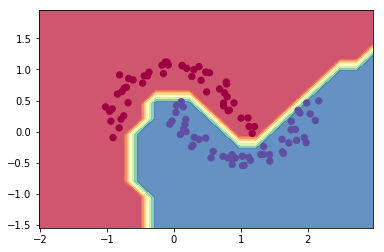
The demo trains a 2-layer MLP with two 16-node hidden layers as a binary classifier using an SVM max-margin loss and SGD, achieving a decision boundary on the moons dataset.What are similar projects?spinningup, fastbook, MLAlgorithms, DeepLearning, llama3-from-scratch, homemade-machine-learning, ai-edu, pytorch-tutorial
spinningup, fastbook, MLAlgorithms, DeepLearning, llama3-from-scratch, homemade-machine-learning, ai-edu, pytorch-tutorialWhich topics is it in?graph, algorithms, neural-network, jupyter notebook, beginner-friendly, pytorch, learning, tutorial, deep-learning, research, machine-learning, education
graph, algorithms, neural-network, jupyter notebook, beginner-friendly, pytorch, learning, tutorial, deep-learning, research, machine-learning, education