
card README

The project's README from github.com/jessepollak/card. As one markdown file: README.md.

npm

Card - check out the demo

A better credit card form in one line of code

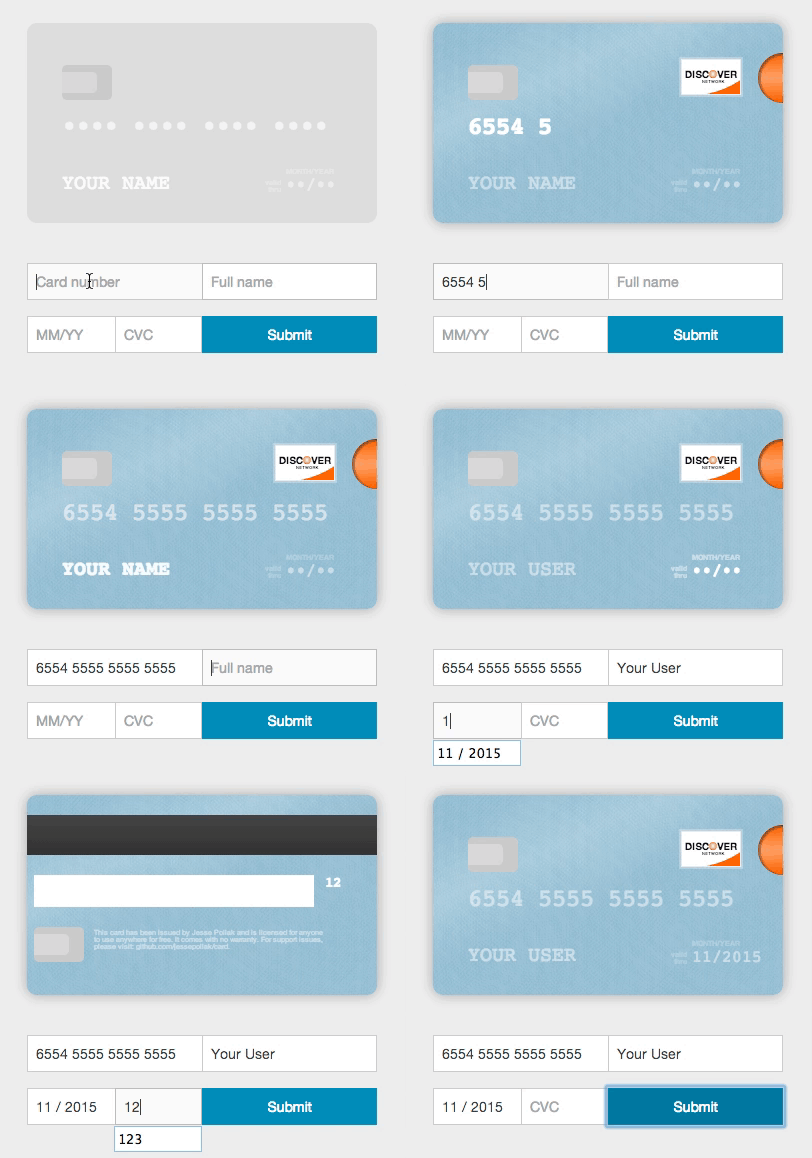
Card will take any credit card form and make it the best part of the checkout process (without you changing anything). Everything is created with pure CSS, HTML, and Javascript — no images required.

card

Usage (without jQuery)

To use, you'll need to include the Card JavaScript files into your HTML, no CSS link is necessary as the JavaScript file does this for you. You can find the necessary file at /dist/card.js and include it in your HTML like so.

<!-- at the end of BODY -->
<!-- CSS is included via this JavaScript file -->
<script src="/path/to/card.js"></script>

Once you've included those files, you can initialize Card.

var card = new Card({
    // a selector or DOM element for the form where users will
    // be entering their information
    form: 'form', // *required*
    // a selector or DOM element for the container
    // where you want the card to appear
    container: '.card-wrapper', // *required*

    formSelectors: {
        numberInput: 'input#number', // optional — default input[name="number"]
        expiryInput: 'input#expiry', // optional — default input[name="expiry"]
        cvcInput: 'input#cvc', // optional — default input[name="cvc"]
        nameInput: 'input#name' // optional - defaults input[name="name"]
    },

    width: 200, // optional — default 350px
    formatting: true, // optional - default true

    // Strings for translation - optional
    messages: {
        validDate: 'valid\ndate', // optional - default 'valid\nthru'
        monthYear: 'mm/yyyy', // optional - default 'month/year'
    },

    // Default placeholders for rendered fields - optional
    placeholders: {
        number: '•••• •••• •••• ••••',
        name: 'Full Name',
        expiry: '••/••',
        cvc: '•••'
    },

    masks: {
        cardNumber: '•' // optional - mask card number
    },

    // if true, will log helpful messages for setting up Card
    debug: false // optional - default false
});

Installing card from bower

If you're using bower, you can install card.js with:

bower install card --save

Installing card from npm

If you're using npm, you can install card.js with:

npm install --save card

var $ = require("jquery");
// The current card.js code does not explictly require jQuery, but instead uses the global, so this line is needed.
window.jQuery = $;
var card = require("card");

Using multiple inputs for one field

Card can be used in forms where you have multiple inputs that render to a single field (i.e. you have a first and last name input). To use Card with this functionality, just pass in a selector that selects the fields in the correct order. For example,

<html>
<body>
<div class='card-wrapper'></div>
<!-- CSS is included via this JavaScript file -->
<script src="/path/to/card.js"></script>
<form id="cc-form">
    <input type="text" name="number">
    <input type="text" name="first-name"/>
    <input type="text" name="last-name"/>
    <input type="text" name="expiry"/>
    <input type="text" name="cvc"/>
</form>
<script>
var card = new Card({
    form: 'cc-form',
    container: '.card-wrapper',

    formSelectors: {
        nameInput: 'input[name="first-name"], input[name="last-name"]'
    }
});
</script>
</body>
</html>

Rendering with different initial card placeholders

Card renders with default placeholders for card name, number, expiry, and cvc. To override these placeholders, you can pass in a placeholders object.

<html>
<body>
<div class='card-wrapper'></div>
<!-- CSS is included via this JavaScript file -->
<script src="/path/to/card.js"></script>
<form id="cc-form">
    <input type="text" name="number">
    <input type="text" name="name"/>
    <input type="text" name="expiry"/>
    <input type="text" name="cvc"/>
</form>
<script>

var card = new Card({
    form: 'cc-form',
    container: '.card-wrapper',

    placeholders: {
        number: '**** **** **** ****',
        name: 'Arya Stark',
        expiry: '**/****',
        cvc: '***'
    }
});
</script>
</body>
</html>

Translation

To render the card with the strings in a different language, you can pass in a messages object.

<html>
<body>
<div class='card-wrapper'></div>
<!-- CSS is included via this JavaScript file -->
<script src="/path/to/card.js"></script>
<form id="cc-form">
    <input type="text" name="number">
    <input type="text" name="name"/>
    <input type="text" name="expiry"/>
    <input type="text" name="cvc"/>
</form>
<script>

var card = new Card({
    form: 'cc-form',
    container: '.card-wrapper',

    messages: {
        validDate: 'expire\ndate',
        monthYear: 'mm/yy'
    }
});
</script>
</body>
</html>

Using with jQuery

To use with jQuery, you'll need to include the jquery.card.js file into your HTML. You can find the necessary file at /dist/jquery.card.js and include it in your HTML like so.

<!-- at the end of BODY -->
<!-- CSS is included via this JavaScript file -->
<script src="/path/to/jquery.card.js"></script>

Once you've included those files, you can initialize Card with jQuery.

$('form').card({
    // a selector or DOM element for the container
    // where you want the card to appear
    container: '.card-wrapper', // *required*

    // all of the other options from above
});

Using with other javascript libraries

Card has wrappers that make it easy to use with other javascript libraries:

Angular 1.x

Angular 2+

Ember

React

Vue

For use with VueJs, install card.js from npm:

npm install card --save

Add in your component an Div with class 'card-wrapper', just pass in a selector that selects the fields in the correct order. Import the component card.js and add the object in instance mounted like this example:

<div class='card-wrapper'></div>

<form>
    <input type="text" name="number">
    <input type="text" name="first-name"/>
    <input type="text" name="last-name"/>
    <input type="text" name="expiry"/>
    <input type="text" name="cvc"/>
</form>

<script>
import * as Card from "card";

export default {
    name: "Form CreditCard",
    mounted() {
    new Card({ 
      form: "form#cc-form",
      container: ".card-wrapper",
      formSelectors: { 
        numberInput: "input#cc-number",
        expiryInput: "input#cc-expiration",
        cvcInput: "input#cc-cvv",
        nameInput: "input#cc-name"
      },
      width: 270,
      formatting: true,
      placeholders: {
        number: "•••• •••• •••• ••••",
        name: "Nome Completo",
        expiry: "••/••",
        cvc: "•••"
      }
    });
  },
}
</script>

Development

To contribute, follow this steps:

$ git clone --recursive https://github.com/jessepollak/card.git
$ cd card
$ git submodule init && git submodule update
$ npm install
$ npm run development

Now, if you go to localhost:8080/example in your browser, you should see the demo page.

Places using Card

Card is used in the wild in these places:

Are you using Card in production? If so, we'd love to link to you from this page. Open a PR or drop @jessepollak a line on Twitter and we'll add you right away!

Project scope

The project scope is to improve the capture of payment cards on websites. Issues and fixes related to the user interface and validating of payment cards are in scope.

For questions on how to use Card in your particular project, please ask on Stack Overflow or similar forum.

Donations

If you'd like to donate to help support development of Card, send Bitcoin directly to 17NUKd3v7GWben18kGhmFafa4ZpWrXpQSC or through Coinbase here.

card (jessepollak/card)

Searching Database…

11.7K ·GitHub
What is this?Card is a JavaScript/CSS library that turns a plain credit card form into an animated, realistic-looking credit card UI, without requiring any images.
Is this a library I drop into my form, or a full payment framework?It is a small front-end library focused purely on visual rendering of card input; it does not handle payment processing, validation logic, or transactions itself.
How do I add Card to my project?Install via npm (npm install --save card) or bower (bower install card --save), or just include the built dist/card.js (and dist/jquery.card.js for the jQuery version) in your HTML and initialize it against your form fields.
Do I need jQuery to use it?No, jQuery is optional — there is a vanilla JS build and a separate jquery.card.js build for projects that already use jQuery.
Does it do any payment processing or validation?No, Card only renders and animates the card form UI; it does not validate card numbers or process payments, and support questions about using it in a specific project are directed to Stack Overflow.
Does it work with frameworks other than jQuery?Yes, community wrappers exist for Angular 1.x and 2+, Ember, React (multiple options), and Vue.
Does it support custom placeholder text or localization?Yes, you can pass a placeholders object to override default card name/number/expiry/CVC placeholders, and a messages object to translate the rendered strings into another language.
Can it handle a split first/last name field setup?Yes, you can pass a selector that targets multiple inputs rendering to a single field, like separate first and last name inputs mapped to the card name.
Who is actually using this in production?The README lists real companies using Card in production, including Netlify, PubNub, Bizzabo, and GigSalad, among others.
Size
2.2 MB
Stars
11.7K
Age
12y
Commits · 90 Days