






HTML Webpack Plugin
Plugin that simplifies creation of HTML files to serve your bundles
[!WARNING]
html-webpack-plugin is deprecated — webpack scaffolds the HTML around your bundles itself and no longer needs it.
Read the Native HTML guide and follow its migration guide.
Existing setups keep working: webpack only emits a page when you ask for one with output.html, so this plugin keeps owning your HTML until you migrate.
Install
Webpack 5
npm i --save-dev html-webpack-plugin
yarn add --dev html-webpack-plugin
Webpack 4
npm i --save-dev html-webpack-plugin@4
yarn add --dev html-webpack-plugin@4
This is a webpack plugin that simplifies creation of HTML files to serve your webpack bundles. This is especially useful for webpack bundles that include a hash in the filename which changes every compilation. You can either let the plugin generate an HTML file for you, supply
your own template using lodash templates or use your own loader.
Sponsors










Thanks for supporting the ongoing improvements to the html-webpack-plugin!
Zero Config
The html-webpack-plugin works without configuration.
It's a great addition to the ⚙️ webpack-config-plugins.
Plugins
The html-webpack-plugin provides hooks to extend it to your needs. There are already some really powerful plugins which can be integrated with zero configuration
Usage
The plugin will generate an HTML5 file for you that includes all your webpack
bundles in the head using script tags. Just add the plugin to your webpack
config as follows:
webpack.config.js
const HtmlWebpackPlugin = require("html-webpack-plugin");

module.exports = {
  entry: "index.js",
  output: {
    path: __dirname + "/dist",
    filename: "index_bundle.js",
  },
  plugins: [new HtmlWebpackPlugin()],
};
This will generate a file dist/index.html containing the following
<!doctype html>
<html>
  <head>
    <meta charset="utf-8" />
    <title>Webpack App</title>
    <script defer src="index_bundle.js"></script>
  </head>
  <body></body>
</html>
If you have multiple webpack entry points, they will all be included with script tags in the generated HTML.
If you have any CSS assets in webpack's output (for example, CSS extracted with the mini-css-extract-plugin)
then these will be included with <link> tags in the HTML head.
If you have plugins that make use of it, html-webpack-plugin should be ordered first before any of the integrated Plugins.
Options
You can pass a hash of configuration options to html-webpack-plugin.
Allowed values are as follows:
| Name |
Type |
Default |
Description |
title |
{String} |
Webpack App |
The title to use for the generated HTML document |
filename |
{String|Function} |
'index.html' |
The file to write the HTML to. Defaults to index.html. You can specify a subdirectory here too (eg: assets/admin.html). The [name] placeholder will be replaced with the entry name. Can also be a function e.g. (entryName) => entryName + '.html'. |
template |
{String} |
`` |
webpack relative or absolute path to the template. By default it will use src/index.ejs if it exists. Please see the docs for details |
templateContent |
{string|Function|false} |
false |
Can be used instead of template to provide an inline template - please read the Writing Your Own Templates section |
templateParameters |
{Boolean|Object|Function} |
false |
Allows to overwrite the parameters used in the template - see example |
inject |
{Boolean|String} |
true |
true || 'head' || 'body' || false Inject all assets into the given template or templateContent. When passing 'body' all javascript resources will be placed at the bottom of the body element. 'head' will place the scripts in the head element. Passing true will add it to the head/body depending on the scriptLoading option. Passing false will disable automatic injections. - see the inject:false example |
publicPath |
{String|'auto'} |
'auto' |
The publicPath used for script and link tags |
scriptLoading |
{'blocking'|'defer'|'module'|'systemjs-module'} |
'defer' |
Modern browsers support non blocking javascript loading ('defer') to improve the page startup performance. Setting to 'module' adds attribute type="module". This also implies "defer", since modules are automatically deferred. |
favicon |
{String} |
`` |
Adds the given favicon path to the output HTML |
meta |
{Object} |
{} |
Allows to inject meta-tags. E.g. meta: {viewport: 'width=device-width, initial-scale=1, shrink-to-fit=no'} |
base |
{Object|String|false} |
false |
Inject a base tag. E.g. base: "https://example.com/path/page.html |
minify |
{Boolean|Object} |
true if mode is 'production', otherwise false |
Controls if and in what ways the output should be minified. See minification below for more details. |
hash |
{Boolean} |
false |
If true then append a unique webpack compilation hash to all included scripts and CSS files (i.e. main.js?hash=compilation_hash). This is useful for cache busting |
cache |
{Boolean} |
true |
Emit the file only if it was changed |
showErrors |
{Boolean} |
true |
Errors details will be written into the HTML page |
chunks |
{?} |
? |
Allows you to add only some chunks (e.g only the unit-test chunk) |
chunksSortMode |
{String|Function} |
auto |
Allows to control how chunks should be sorted before they are included to the HTML. Allowed values are 'none' | 'auto' | 'manual' | {Function} |
excludeChunks |
{Array.<string>} |
`` |
Allows you to skip some chunks (e.g don't add the unit-test chunk) |
xhtml |
{Boolean} |
false |
If true render the link tags as self-closing (XHTML compliant) |
Here's an example webpack config illustrating how to use these options
webpack.config.js
{
  entry: 'index.js',
  output: {
    path: __dirname + '/dist',
    filename: 'index_bundle.js'
  },
  plugins: [
    new HtmlWebpackPlugin({
      title: 'My App',
      filename: 'assets/admin.html'
    })
  ]
}
Generating Multiple HTML Files
To generate more than one HTML file, declare the plugin more than
once in your plugins array
webpack.config.js
{
  entry: 'index.js',
  output: {
    path: __dirname + '/dist',
    filename: 'index_bundle.js'
  },
  plugins: [
    new HtmlWebpackPlugin(), // Generates default index.html
    new HtmlWebpackPlugin({  // Also generate a test.html
      filename: 'test.html',
      template: 'src/assets/test.html'
    })
  ]
}
Writing Your Own Templates
If the default generated HTML doesn't meet your needs you can supply
your own template. The easiest way is to use the template option and pass a custom HTML file.
The html-webpack-plugin will automatically inject all necessary CSS, JS, manifest
and favicon files into the markup.
Details of other template loaders are documented here.
plugins: [
  new HtmlWebpackPlugin({
    title: "Custom template",
    // Load a custom template (lodash by default)
    template: "index.html",
  }),
];
index.html
<!doctype html>
<html>
  <head>
    <meta charset="utf-8" />
    <title><%= htmlWebpackPlugin.options.title %></title>
  </head>
  <body></body>
</html>
If you already have a template loader, you can use it to parse the template.
Please note that this will also happen if you specify the html-loader and use .html file as template.
webpack.config.js
module: {
  loaders: [
    { test: /\.hbs$/, loader: "handlebars-loader" }
  ]
},
plugins: [
  new HtmlWebpackPlugin({
    title: 'Custom template using Handlebars',
    template: 'index.hbs'
  })
]
You can use the lodash syntax out of the box. If the inject feature doesn't fit your needs and you want full control over the asset placement use the default template of the html-webpack-template project as a starting point for writing your own.
The following variables are available in the template by default (you can extend them using the templateParameters option):
htmlWebpackPlugin: data specific to this plugin
htmlWebpackPlugin.options: the options hash that was passed to
the plugin. In addition to the options actually used by this plugin,
you can use this hash to pass arbitrary data through to your template.
htmlWebpackPlugin.tags: the prepared headTags and bodyTags Array to render the <base>, <meta>, <script> and <link> tags.
Can be used directly in templates and literals. For example:
<html>
  <head>
    <%= htmlWebpackPlugin.tags.headTags %>
  </head>
  <body>
    <%= htmlWebpackPlugin.tags.bodyTags %>
  </body>
</html>
htmlWebpackPlugin.files: direct access to the files used during the compilation.
publicPath: string;
js: string[];
css: string[];
manifest?: string;
favicon?: string;
webpackConfig: the webpack configuration that was used for this compilation. This
can be used, for example, to get the publicPath (webpackConfig.output.publicPath).
compilation: the webpack compilation object.
This can be used, for example, to get the contents of processed assets and inline them
directly in the page, through compilation.assets[...].source()
(see the inline template example).
The template can also be directly inlined directly into the options object.
⚠️ templateContent does not allow to use webpack loaders for your template and will not watch for template file changes
webpack.config.js
new HtmlWebpackPlugin({
  templateContent: `
    <html>
      <body>
        <h1>Hello World</h1>
      </body>
    </html>
  `,
});
The templateContent can also access all templateParameters values.
⚠️ templateContent does not allow to use webpack loaders for your template and will not watch for template file changes
webpack.config.js
new HtmlWebpackPlugin({
  inject: false,
  templateContent: ({ htmlWebpackPlugin }) => `
    <html>
      <head>
        ${htmlWebpackPlugin.tags.headTags}
      </head>
      <body>
        <h1>Hello World</h1>
        ${htmlWebpackPlugin.tags.bodyTags}
      </body>
    </html>
  `,
});
Filtering Chunks
To include only certain chunks you can limit the chunks being used
webpack.config.js
plugins: [
  new HtmlWebpackPlugin({
    chunks: ["app"],
  }),
];
It is also possible to exclude certain chunks by setting the excludeChunks option
webpack.config.js
plugins: [
  new HtmlWebpackPlugin({
    excludeChunks: ["dev-helper"],
  }),
];
Minification
If the minify option is set to true (the default when webpack's mode is 'production'),
the generated HTML will be minified using html-minifier-terser
and the following options:
{
  collapseWhitespace: true,
  keepClosingSlash: true,
  removeComments: true,
  removeRedundantAttributes: true,
  removeScriptTypeAttributes: true,
  removeStyleLinkTypeAttributes: true,
  useShortDoctype: true
}
To use custom html-minifier options
pass an object to minify instead. This object will not be merged with the defaults above.
To disable minification during production mode set the minify option to false.
If the meta option is set the html-webpack-plugin will inject meta tags.
For the default template the html-webpack-plugin will already provide a default for the viewport meta tag.
Please take a look at this well maintained list of almost all possible meta tags.
name/content meta tags
Most meta tags are configured by setting a name and a content attribute.
To add those use a key/value pair:
webpack.config.js
plugins: [
  new HtmlWebpackPlugin({
    meta: {
      viewport: "width=device-width, initial-scale=1, shrink-to-fit=no",
      // Will generate: <meta name="viewport" content="width=device-width, initial-scale=1, shrink-to-fit=no">
      "theme-color": "#4285f4",
      // Will generate: <meta name="theme-color" content="#4285f4">
    },
  }),
];
The http-equiv attribute is essentially used to simulate a HTTP response header.
This format is supported using an object notation which allows you to add any attribute:
webpack.config.js
plugins: [
  new HtmlWebpackPlugin({
    meta: {
      "Content-Security-Policy": {
        "http-equiv": "Content-Security-Policy",
        content: "default-src https:",
      },
      // Will generate: <meta http-equiv="Content-Security-Policy" content="default-src https:">
      // Which equals to the following http header: `Content-Security-Policy: default-src https:`
      "set-cookie": {
        "http-equiv": "set-cookie",
        content: "name=value; expires=date; path=url",
      },
      // Will generate: <meta http-equiv="set-cookie" content="value; expires=date; path=url">
      // Which equals to the following http header: `set-cookie: value; expires=date; path=url`
    },
  }),
];
Base Tag
When the base option is used,
html-webpack-plugin will inject a base tag.
By default, a base tag will not be injected.
The following two are identical and will both insert <base href="http://example.com/some/page.html">:
new HtmlWebpackPlugin({
  base: "http://example.com/some/page.html",
});
new HtmlWebpackPlugin({
  base: { href: "http://example.com/some/page.html" },
});
The target can be specified with the corresponding key:
new HtmlWebpackPlugin({
  base: {
    href: "http://example.com/some/page.html",
    target: "_blank",
  },
});
which will inject the element <base href="http://example.com/some/page.html" target="_blank">.
Long Term Caching
For long term caching add contenthash to the filename.
Example:
plugins: [
  new HtmlWebpackPlugin({
    filename: "index.[contenthash].html",
  }),
];
contenthash is the hash of the content of the output file.
Refer webpack's Template Strings for more details
Events
To allow other plugins to alter the HTML this plugin executes
tapable hooks.
The lib/hooks.js contains all information
about which values are passed.
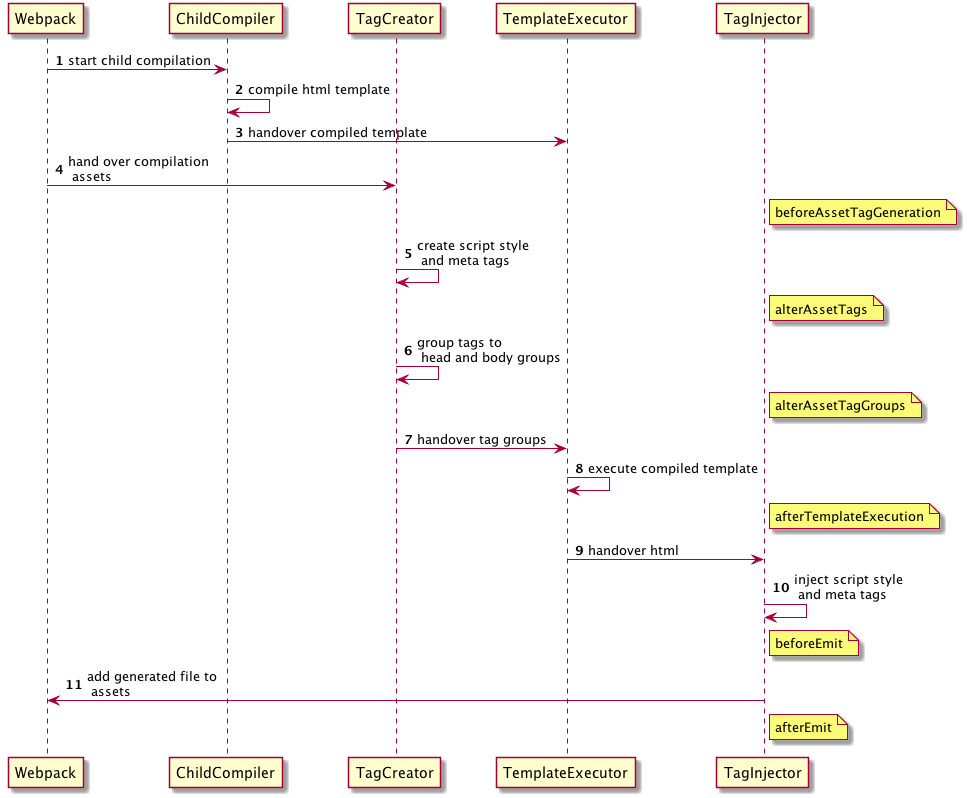
beforeAssetTagGeneration hook
    AsyncSeriesWaterfallHook<{
      assets: {
        publicPath: string,
        js: Array<{string}>,
        css: Array<{string}>,
        favicon?: string | undefined,
        manifest?: string | undefined
      },
      outputName: string,
      plugin: HtmlWebpackPlugin
    }>
    AsyncSeriesWaterfallHook<{
      assetTags: {
        scripts: Array<HtmlTagObject>,
        styles: Array<HtmlTagObject>,
        meta: Array<HtmlTagObject>,
      },
      publicPath: string,
      outputName: string,
      plugin: HtmlWebpackPlugin
    }>
alterAssetTagGroups hook
    AsyncSeriesWaterfallHook<{
      headTags: Array<HtmlTagObject | HtmlTagObject>,
      bodyTags: Array<HtmlTagObject | HtmlTagObject>,
      publicPath: string,
      outputName: string,
      plugin: HtmlWebpackPlugin
    }>
afterTemplateExecution hook
    AsyncSeriesWaterfallHook<{
      html: string,
      headTags: Array<HtmlTagObject | HtmlTagObject>,
      bodyTags: Array<HtmlTagObject | HtmlTagObject>,
      outputName: string,
      plugin: HtmlWebpackPlugin,
    }>
beforeEmit hook
    AsyncSeriesWaterfallHook<{
      html: string,
      outputName: string,
      plugin: HtmlWebpackPlugin,
    }>
afterEmit hook
    AsyncSeriesWaterfallHook<{
      outputName: string,
      plugin: HtmlWebpackPlugin
    }>
Example implementation: webpack-subresource-integrity
plugin.js
// If your plugin is direct dependent to the html webpack plugin:
const HtmlWebpackPlugin = require("html-webpack-plugin");
// If your plugin is using html-webpack-plugin as an optional dependency
// you can use https://github.com/tallesl/node-safe-require instead:
const HtmlWebpackPlugin = require("safe-require")("html-webpack-plugin");

class MyPlugin {
  apply(compiler) {
    compiler.hooks.compilation.tap("MyPlugin", (compilation) => {
      console.log("The compiler is starting a new compilation...");

      // Static Plugin interface |compilation |HOOK NAME | register listener
      HtmlWebpackPlugin.getCompilationHooks(compilation).beforeEmit.tapAsync(
        "MyPlugin", // <-- Set a meaningful name here for stacktraces
        (data, cb) => {
          // Manipulate the content
          data.html += "The Magic Footer";
          // Tell webpack to move on
          cb(null, data);
        },
      );
    });
  }
}

module.exports = MyPlugin;
webpack.config.js
plugins: [new MyPlugin({ options: "" })];
Note that the callback must be passed the HtmlWebpackPluginData in order to pass this onto any other plugins listening on the same beforeEmit event
Maintainers
Backers
Thank you to all our backers!
If you want to support the project as well become a sponsor or a a backer.



Contributors
This project exists thanks to all the people who contribute.
You're free to contribute to this project by submitting issues and/or pull requests. This project is test-driven, so keep in mind that every change and new feature should be covered by tests.




 它是一个 webpack 插件,可以自动生成 HTML 文件来承载你的 webpack 打包产物,并为你处理带哈希的文件名和资源注入。