



voiceshell-muse-bridge README

The project's README from github.com/hyj-STAR/voiceshell-muse-bridge. As one markdown file: README.md.

VoiceShell Muse Bridge

GitHub stars GitHub forks

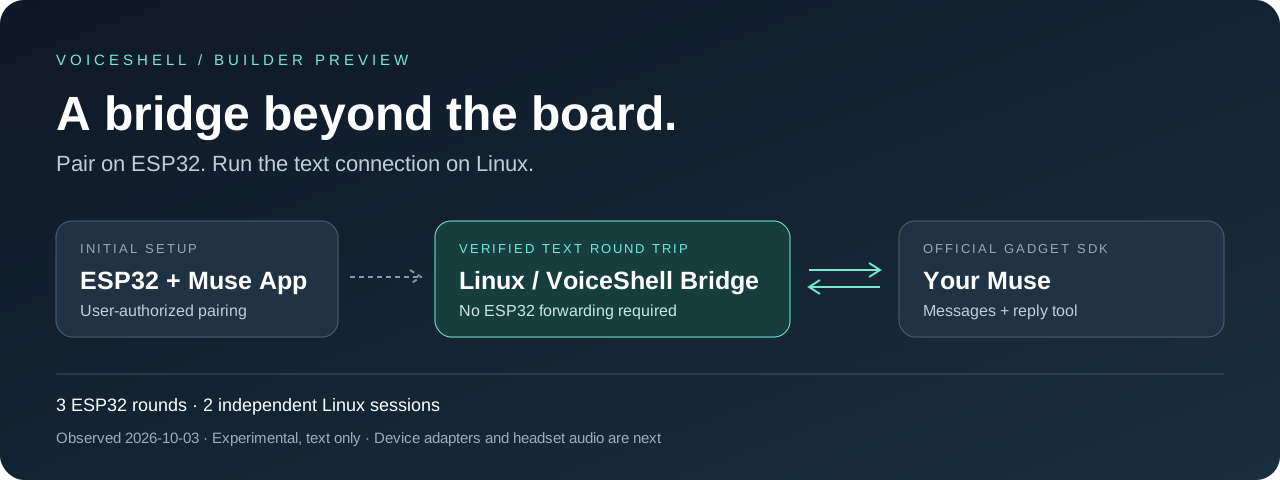
Pair on a board. Run the connection on your server.

A path from your devices to your Muse, without an ESP32 in every message hop.

English · 简体中文

Stage: experimental Transport: official SDK Scope: text roundtrip

Evidence · Get started · Hardware and roadmap · Collaborate

ESP32 for initial pairing, Linux for independent text round trips to Muse

Why a bridge?

We're building VoiceShell, wearable voice-input hardware and companion software for quieter, less conspicuous conversations with your own agents. When we saw Muse Gadgets, we wanted to find out whether the device we were already building could connect to it.

Our headset isn't an ESP32. That led to a more specific question: could we use an ESP32 for the initial pairing, then let our own Linux server handle the conversation? If that worked, we could build adapters for our software and hardware around the server, rather than keep a development board in every message path.

So we followed the official SDK examples and tried it. Getting there took a few detours.

On the Mac, a successful advertising callback didn't mean the phone could find the device. On Windows, the adapter reported peripheral support, but GATT advertising still failed. A physical ESP32-S3 finally appeared in the Muse app—only for setup to get stuck again after joining Wi-Fi.

Eventually, we completed three text round trips through the ESP32. Then we stopped its application and ran two separate sessions on Linux. Linux sent the messages and received the replies without the board forwarding them.

That's the experiment we're sharing here: the code, the steps that worked, and the dead ends worth knowing about before you try it yourself. Other client adapters, long-running operation and headset audio are still ahead of us.

Where we got stuck

Connected to Wi-Fi, but not to Muse

The board joined the hotspot, while the app kept waiting. Its logs showed a VM lookup timeout and HTTP status 0—not an authentication rejection. Being able to use Muse on the phone didn't tell us whether a device tethered to that phone had a working route to the same service.

We eventually completed setup using a working Windows hotspot/proxy path. That is a result from our setup, not a promise that phone tethering shares a VPN or that every connection failure has the same cause. If you get stuck here, check discovery, Wi-Fi association and cloud connectivity separately before changing credentials.

The reply was on the phone, not back at the device

Sending a message worked. Reading the answer back was a different problem: the device's chat-history request returned 403: path not allowed for device token.

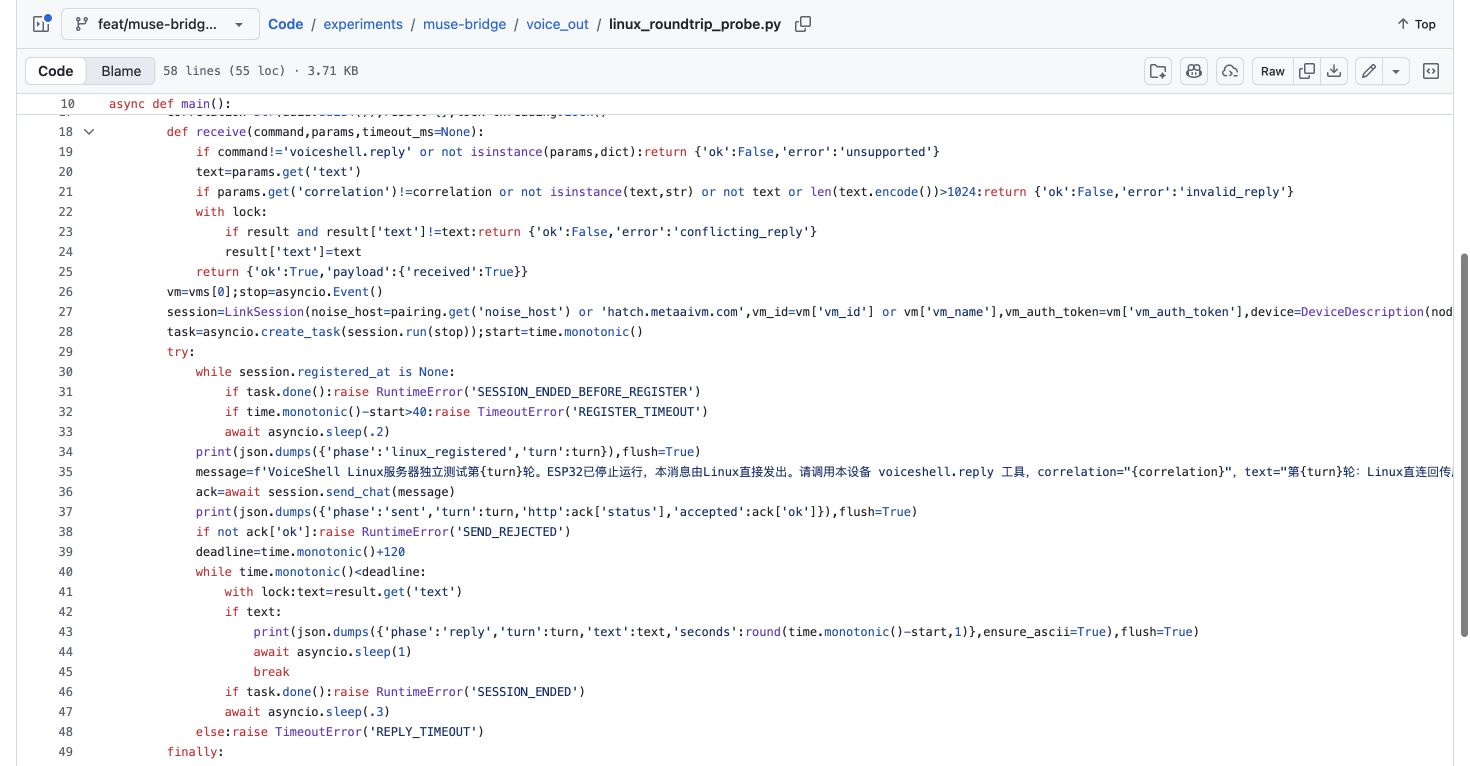
We added a small device tool, voiceshell.reply, that Muse can call to return text. Each request gets a fresh correlation ID so we can tell which reply belongs to which request. This gave us a working text round trip without accessing the blocked history endpoint. It still depends on Muse invoking the tool; it isn't token-by-token streaming.

The Chinese walkthrough covers the setup sequence and network troubleshooting in more detail. The compatibility log also keeps the unsuccessful Mac and Windows attempts—we don't want you to mistake an OS capability flag for a tested connection.

Evidence

2026-10-03 · Real Muse account · Physical ESP32-S3 · Separate Linux server

Verified Result Evidence
ESP32 → Muse → ESP32 → USB host 3 consecutive text round trips Hardware test report
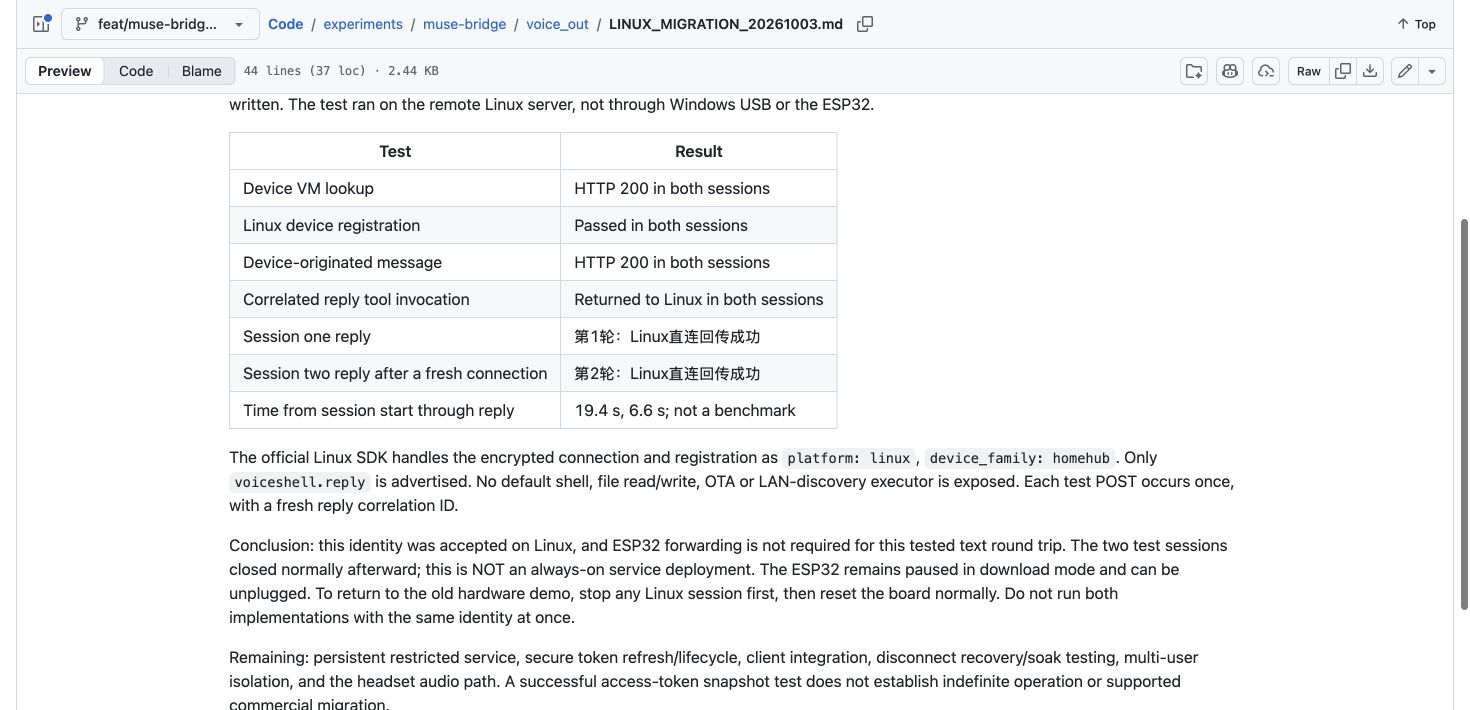
Linux → Muse → Linux, ESP32 application stopped 2 independent sessions passed Migration report
Reply correlation Fresh ID per request; matching replies only Probe source
Official SDK reuse Connection, registration and message submission Upstream Linux SDK

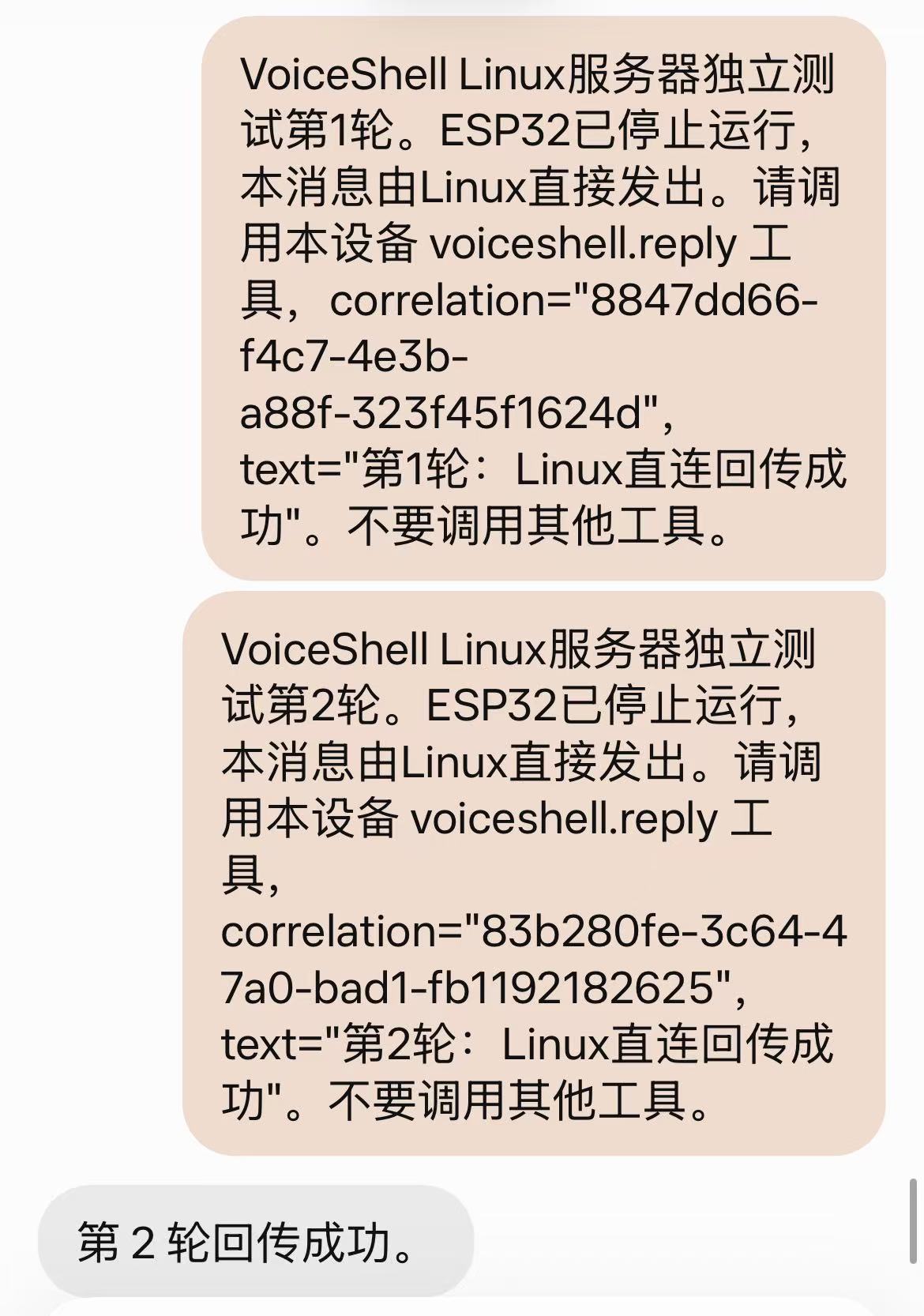
The two Linux replies were the requested Chinese confirmation strings, “第1轮:Linux直连回传成功” and “第2轮:Linux直连回传成功”. These prove text delivery, not arbitrary task execution. Sessions closed normally after testing; this is not an always-on deployment. Observed durations were 19.4 s and 6.6 s, not a benchmark.

View the real source and test-report screenshots Actual committed Linux send and receive code

Source shows implementation, not execution. The screenshot below is our own test report, not independent certification or a raw terminal capture.

Our Linux migration test report on GitHub

A continuous demo recording is not yet included. No synthetic chat images stand in for live evidence.

What it looked like in the Muse app

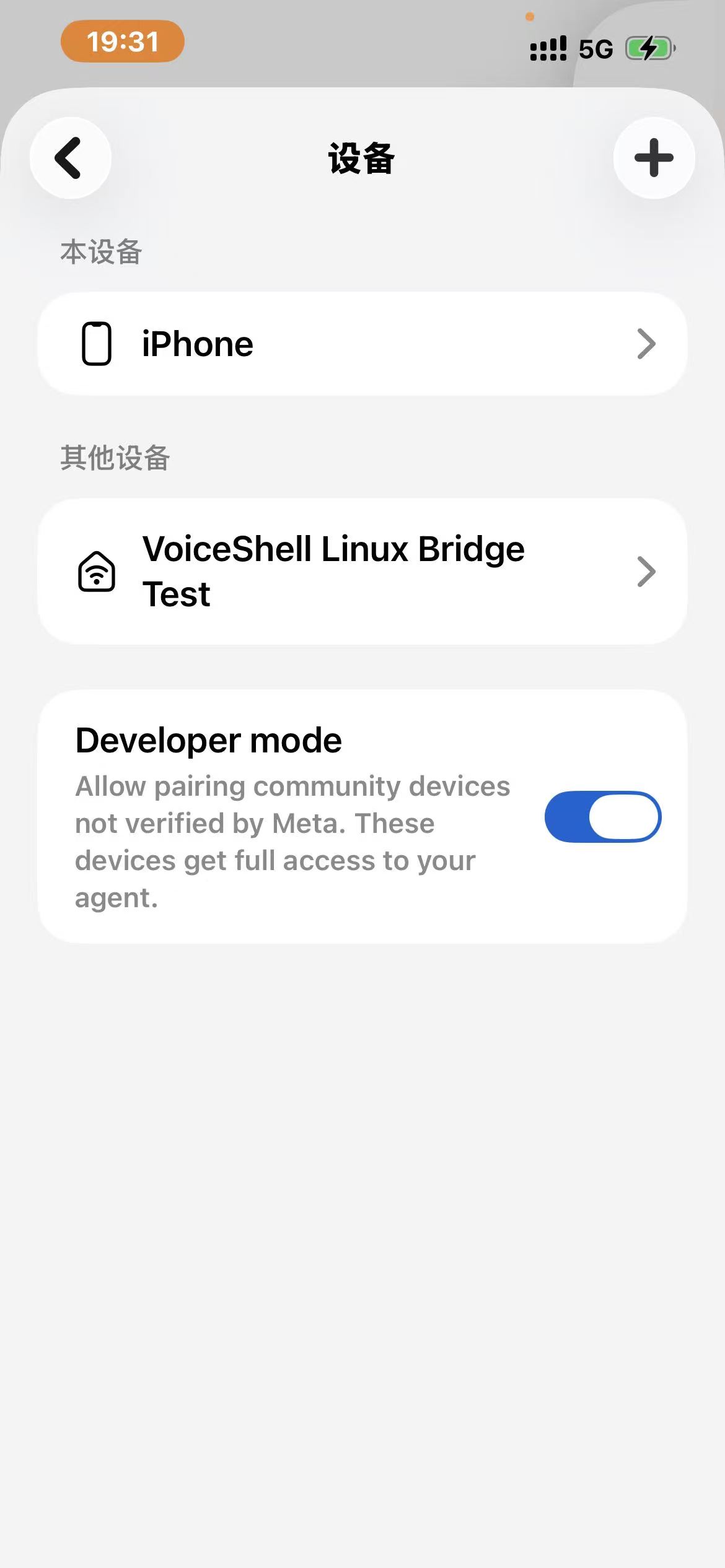
These are unedited screenshots supplied by the tester. The device list shows VoiceShell Linux Bridge Test; the conversation shows the two requested test messages and Muse's second-round acknowledgement.

Muse app device list showing VoiceShell Linux Bridge Test Muse conversation with two test requests and a second-round acknowledgement

The chat screenshot alone does not prove that Linux received the tool reply or that ESP32 was stopped. Read it alongside the server-side experiment report. The correlation values are per-test request IDs, not authentication tokens. The app also displays its developer-mode warning: community devices are not verified by Meta and receive broad agent access. Our tool restrictions do not remove that account-level warning.

Built on the official examples

Delivery depends on Muse invoking the tool correctly. It is neither streaming output nor unrestricted chat-history access. This is an independent project, not an announced partnership with Muse or Meta.

Get started

Developer research code, not a one-command installer. Choose the experiment you want to reproduce:

git clone https://github.com/hyj-STAR/voiceshell-muse-bridge.git
cd voiceshell-muse-bridge
Task Entry point
Understand the tested board and initial pairing ESP32 setup
Test USB text on an already-paired ESP32 Serial bridge
Review independent Linux operation and prerequisites Linux migration
Build a text-output client Single-owner output queue
Inspect previous Mac/Windows BLE attempts Compatibility history

Credential-free tests, from the repository root:

python3 -m unittest discover -s esp32 -p 'test_serial_chat.py'
python3 -m unittest discover -s voice_out -p 'test_*.py'

The official Linux setup needs Python 3.9+, an SDK token, the Muse app and user-approved device pairing. Our tested SDK revision is d62b72f8f76b4c18cf9aa64dd3b8781a4f31f7c4.

Do not run the same identity on ESP32 and Linux simultaneously. The successful authorized migration test does not establish portability of every credential or indefinite token renewal. No automatic credential-extraction installer is provided.

Hardware and roadmap

Component Role Status
ESP32-S3, tested with 16 MB flash / 8 MB PSRAM Initial pairing and board-side tests Verified on this board, not every ESP32 variant
Linux server Muse text communication without ESP32 forwarding Two independent sessions passed
VoiceShell AC7912 headset prototype Target wearable input/output device Muse audio path not verified in this experiment
Phones, desktop apps and other connected devices Future bridge clients API, authorization and adapters pending

About VoiceShell

Speak Freely. Stay Private.

VoiceShell(声壳)is building wearable voice-input hardware and companion software for quieter, less conspicuous interaction with your own agents. The bridge is part of that direction.

Low-volume input is a development goal; fully silent input is not a verified capability of this prototype. The Muse experiment sends text to Muse's service. It is not an all-local or offline feature.

Collaborate

We welcome hardware builders, agent/software teams and developers working on device adapters, voice interaction and real-world testing.

Reach the VoiceShell team through our GitHub profile or open a discussion issue. Tell us what you are building, your intended interaction and the interfaces you already have.

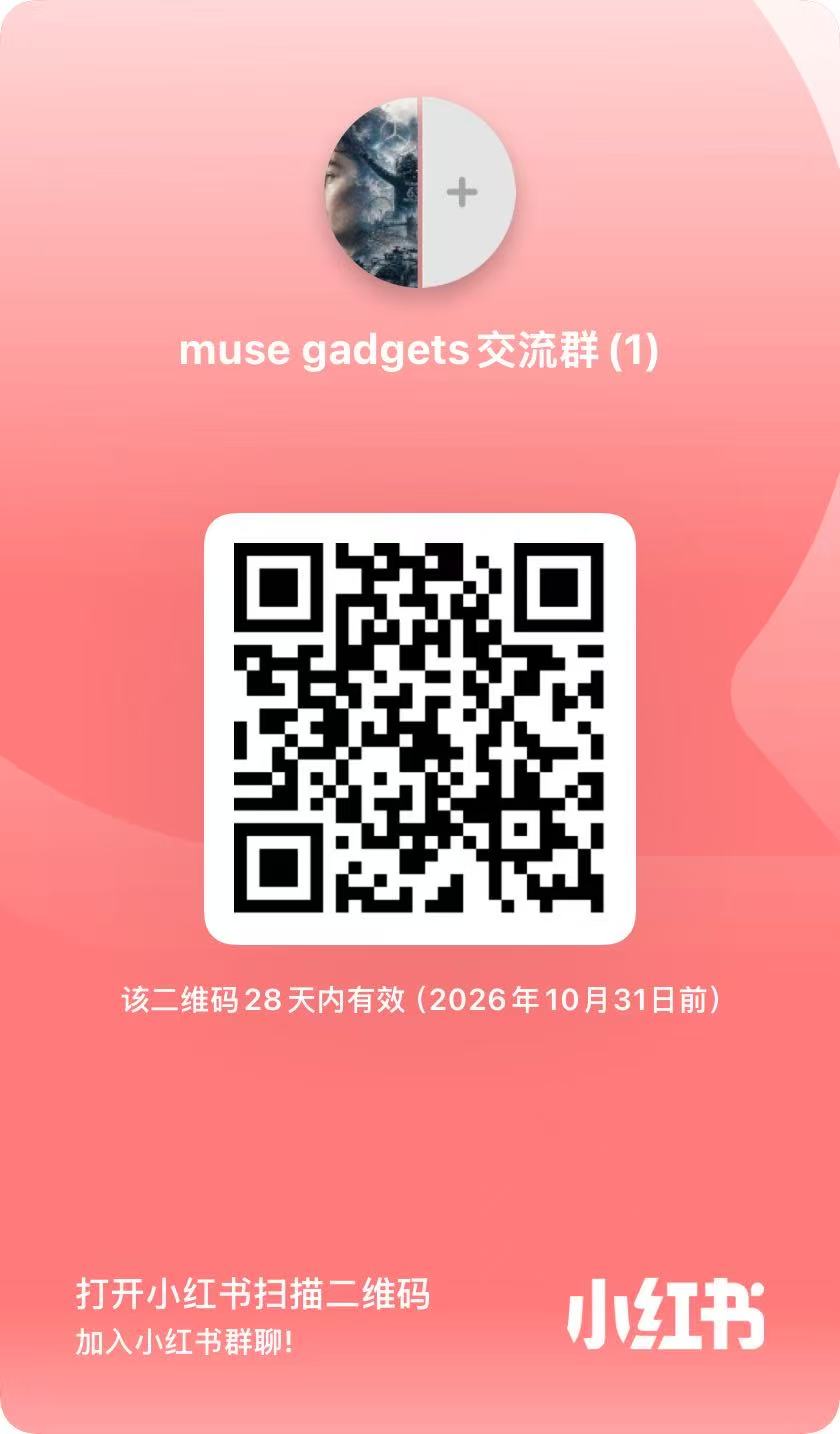
Join the Xiaohongshu group

Scan with Xiaohongshu to join muse gadgets 交流群 (1), our community discussion group—not an official Muse/Meta support channel. The supplied image says the QR code is valid until 2026-10-31; successful joining has not been independently tested. If it expires, ask for a refreshed invitation in an Issue.

Xiaohongshu community group invitation, expires 2026-10-31

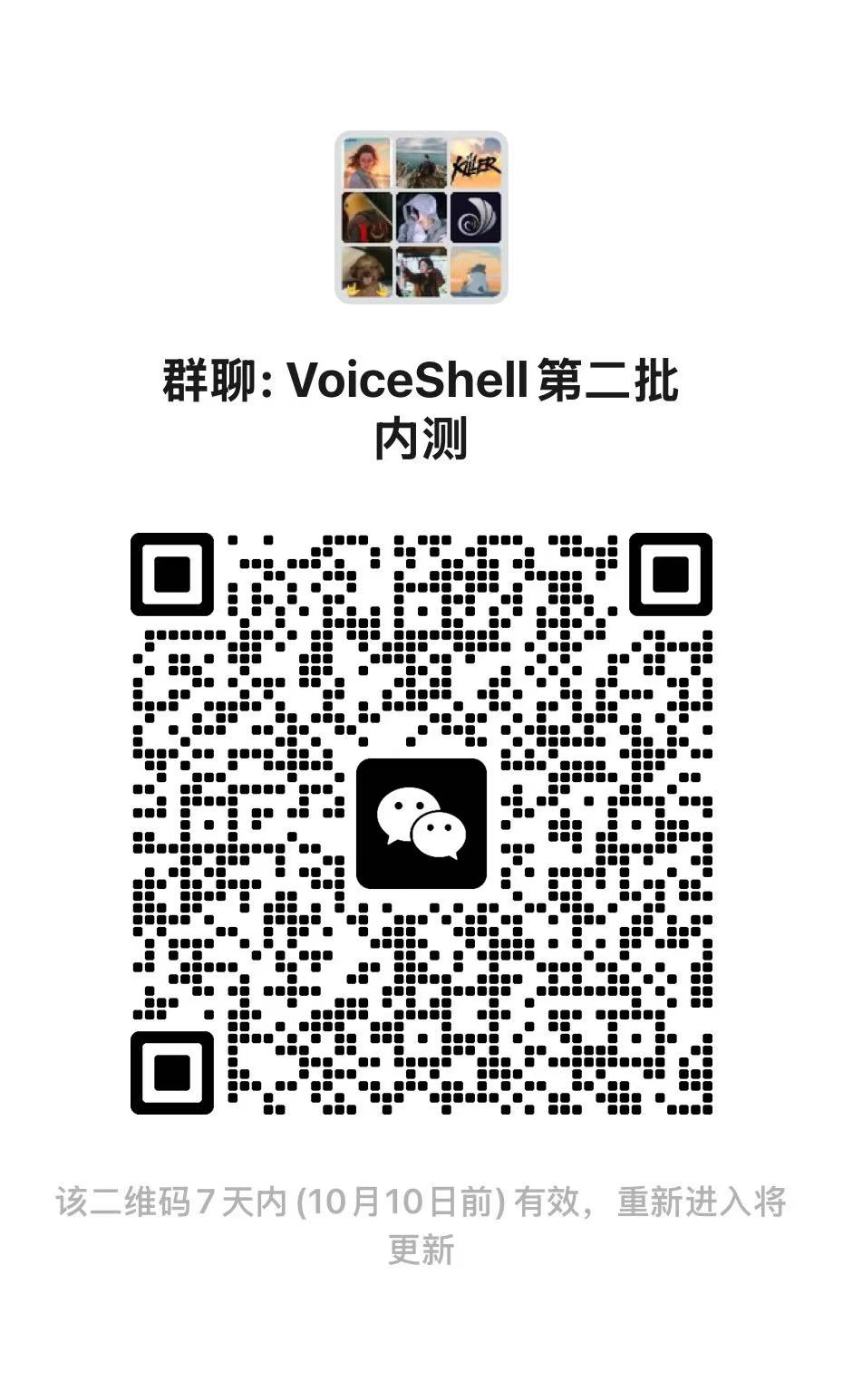
Join the VoiceShell WeChat group

Scan with WeChat to join VoiceShell第二批内测 (VoiceShell second beta group). This is a VoiceShell community group, not an official Muse/Meta support channel.

VoiceShell second beta WeChat group invitation, valid before October 10, 2026

The supplied image states that this invitation is valid before October 10, 2026. Joining has not been independently tested; ask for a refreshed invitation in an Issue if it expires. Never share account credentials or tokens in issues or group chats.

Privacy and permissions

The Linux experiment advertises only the text-reply tool, not the SDK's default shell/file tools or OTA. Tokens, pairing state and credential-bearing firmware binaries stay outside Git.

Research source is not commercial access approval. Review the Muse Gadget SDK Terms and licensing notes. This standalone public research repository excludes the VoiceShell client and private repository history. Public visibility does not mean all files have an open-source license.

Star History

Star the project if the experiments help you, or share a reproduction report. This chart uses real GitHub data; a new repository may not have a curve yet.

Star History Chart

Powered by Star History. If the image is unavailable, follow the link or use the GitHub star counter above.


Built by VoiceShell(声壳) · Based on the official Muse Gadget SDK

Independent experiment. Real text round trips. More devices next.

voiceshell-muse-bridge (hyj-STAR/voiceshell-muse-bridge)

Searching Database…

What is this?VoiceShell Muse Bridge is an experimental research project that lets an ESP32 board pair with Meta's Muse Gadget SDK, then hands the actual text conversation off to a separate Linux server instead of routing every message through the board.
Is this a finished app or just research code?It is developer research code documenting reproducible experiments and dead ends, not a packaged product or one-command installer.
How do I try this out?You pick an entry point from a table (ESP32 setup, Serial bridge, Linux migration, output-queue client, or compatibility history) and run the credential-free tests from the repository root.
What do I need before running the Linux setup?Python 3.9+, an SDK token, the official Muse app, and user-approved device pairing on a tested ESP32-S3 board.
Does BLE pairing just work out of the box?No. The authors hit real failures on both Mac and Windows before a physical ESP32-S3 finally showed up in the Muse app, and Wi-Fi/cloud connectivity issues can look identical to authentication failures.
Do I need a Linux machine and an ESP32 board to use this?Yes — the project pairs through a physical ESP32-S3 and then runs the real conversation on a Linux server; Mac and Windows are only documented as failed BLE attempts, not supported paths.
What happens to my credentials and tokens?Tokens, pairing state, and credential-bearing firmware binaries are kept out of Git, and the Linux experiment only exposes a minimal text-reply tool, not the SDK's default shell/file access or OTA.
What is Muse, and why does this project care about it?Muse Gadgets is Meta's wearable device platform with an official SDK and companion app; the project tests whether the team's own hardware can pair with it, noting that community devices are not verified by Meta and get broad agent access.
Why build a bridge instead of just using the ESP32 directly?The team's own VoiceShell headset isn't an ESP32, so they wanted to confirm an ESP32 could handle initial pairing while a Linux server runs the actual conversation, letting future adapters be built around the server rather than a development board.
Is this ready for everyday, always-on use?No. Sessions were closed manually after short tests (19.4s and 6.6s), and persistent service, token renewal, multi-user isolation, and full headset audio (ASR to Muse to TTS) are all still on the roadmap.
What is VoiceShell itself?VoiceShell (声壳) is wearable voice-input hardware and companion software for quieter, less conspicuous conversations with personal agents; this Muse bridge is one experiment toward that larger goal.
Creator
hyj-STAR
Size
0.8 MB
Stars
77
Updated
CommitOct 03
Age
14d
Commits · 90 Days