













LeetCode-Go README

The project's README from github.com/halfrost/LeetCode-Go. As one markdown file: README.md.

LeetCode in Go

English | 中文

LeetCode Online Judge is a website containing many algorithm questions. Most of them are real interview questions of Google, Facebook, LinkedIn, Apple, etc. and it always help to sharp our algorithm Skills. Level up your coding skills and quickly land a job. This is the best place to expand your knowledge and get prepared for your next interview. This repo shows my solutions in Go with the code style strictly follows the Google Golang Style Guide. Please feel free to reference and STAR to support this repo, thank you!

GitHub All Releases Deploy Status Go Test Status Go Version

Code License Book License

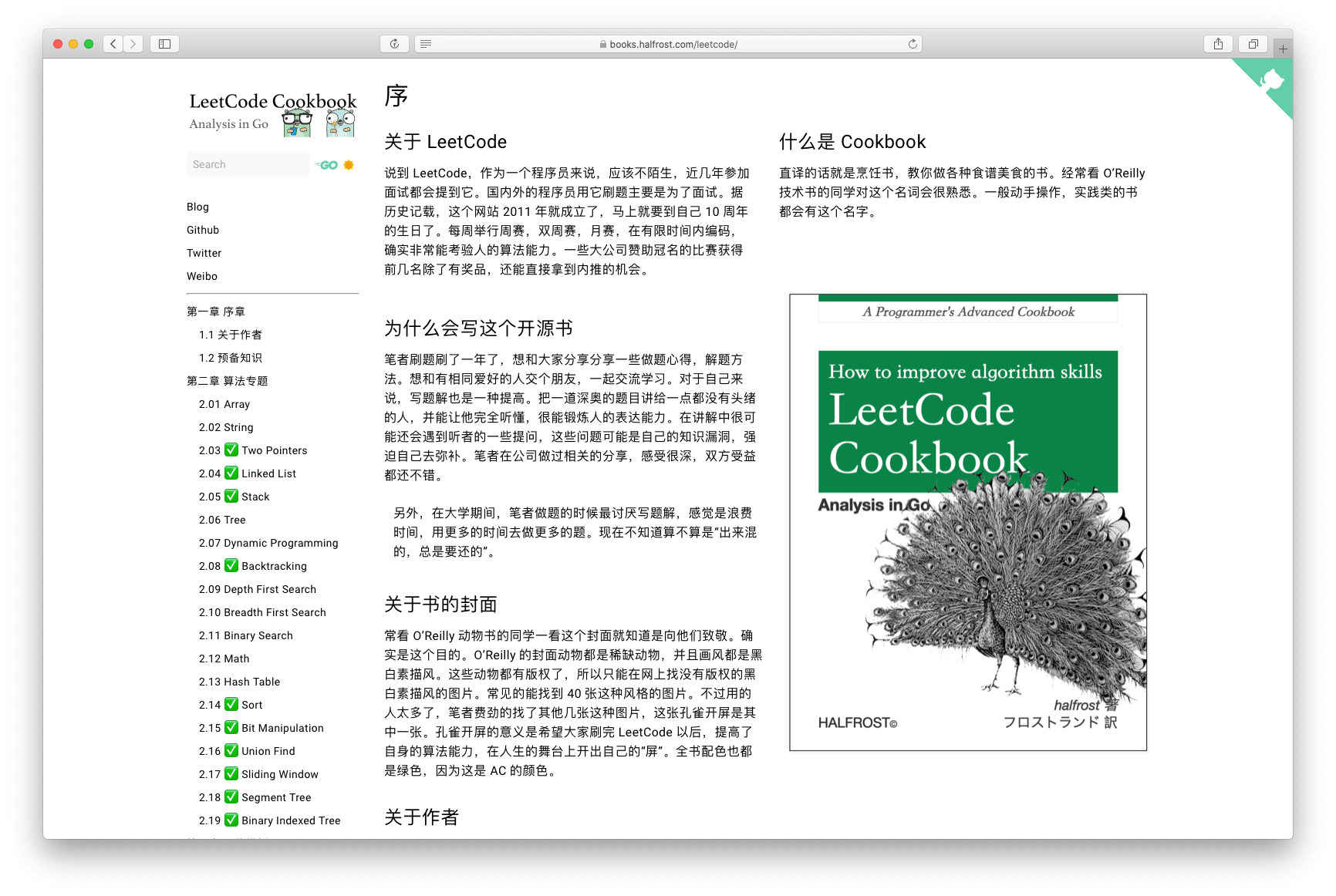
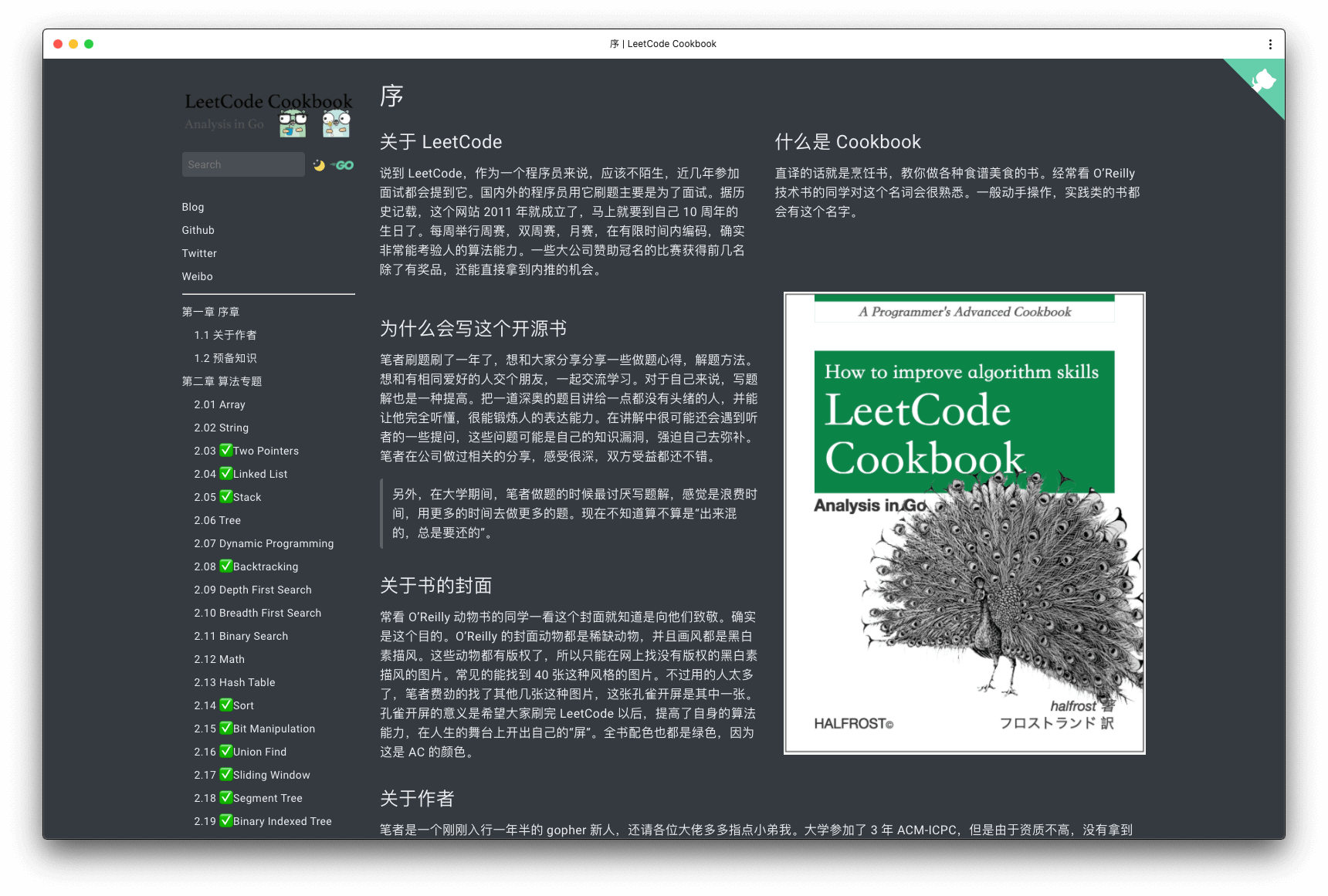
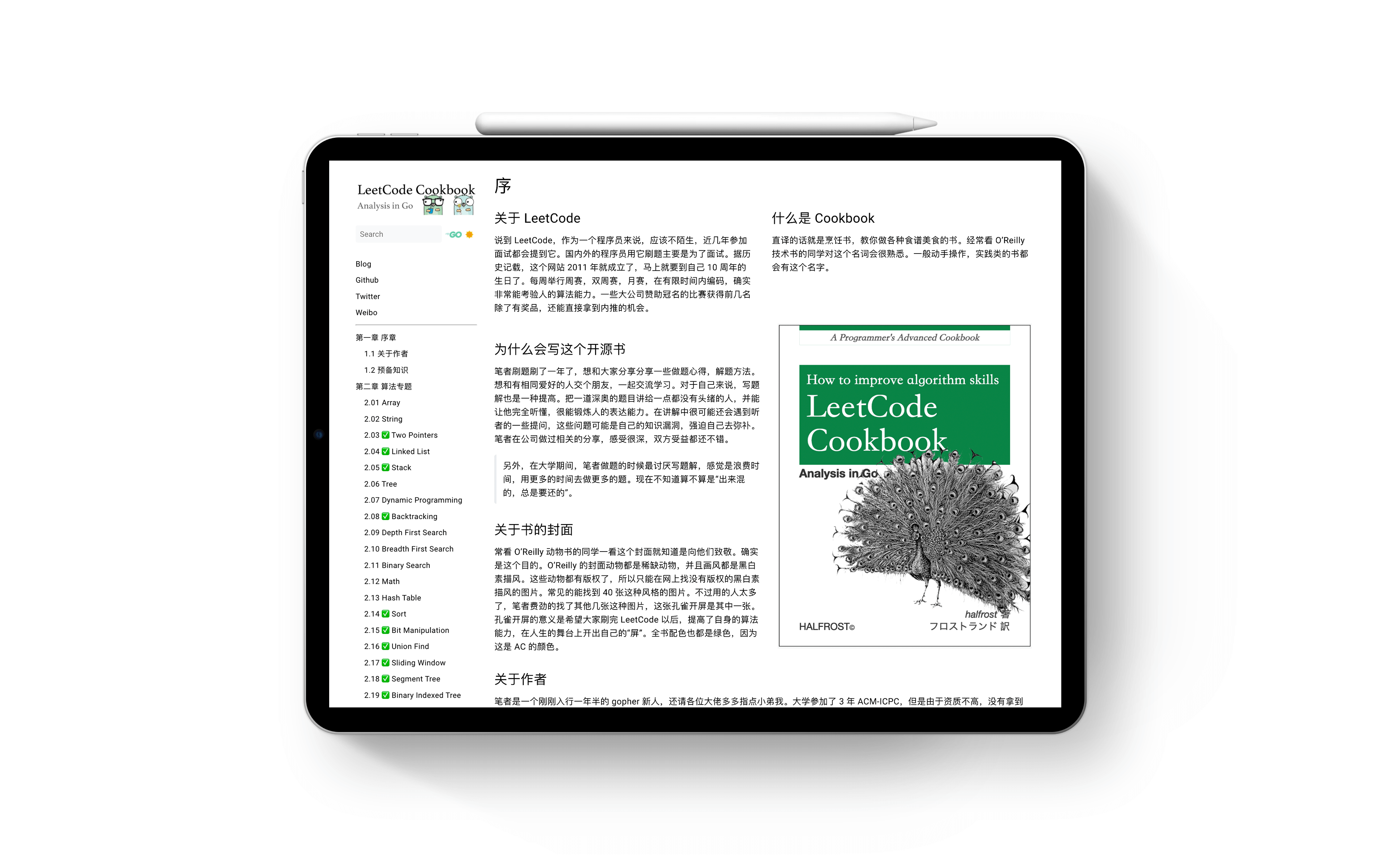
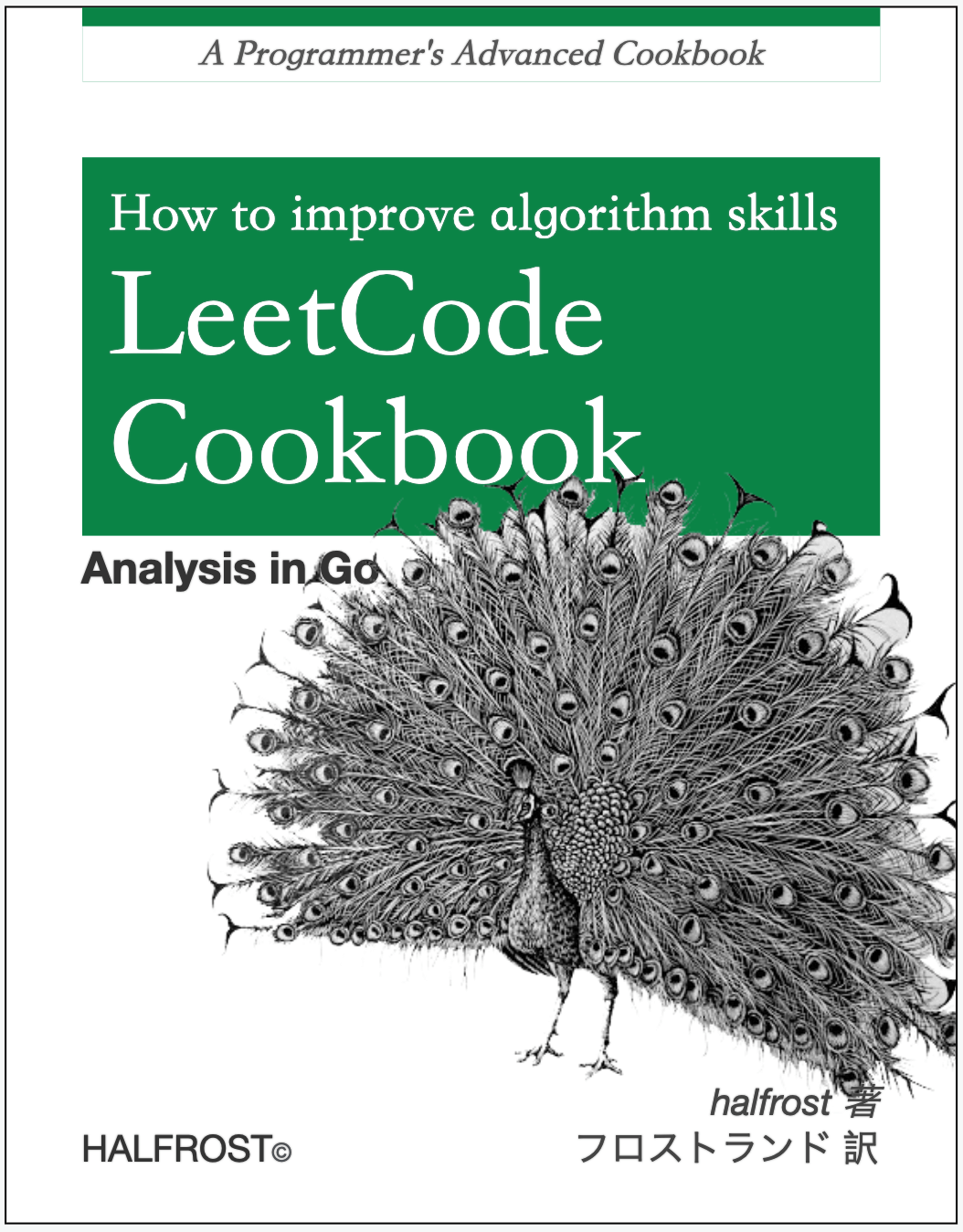
The solution e-book LeetCode Cookbook, with Progressive Web App and Dark Mode support — Online Reading

Offline PDF edition of the e-book LeetCode Cookbook — Download here

Install the PWA edition of LeetCode Cookbook to your home screen from an iOS / Android browser and study anytime.

Data Structures

Topics marked with ✅ have all their problems completed; those without the mark still have problems left to solve.

logo


Data Structure Variants Related Problems Articles
Sequential list: vector
Singly linked list 1. Doubly linked list
2. Static linked list
3. Symmetric matrix
4. Sparse matrix
Hash table 1. Hash functions
2. Collision resolution / load factor
Stack and queue 1. Generalized stack
2. Deque
Queue 1. Linked-list implementation
2. Circular-array implementation
3. Deque
String 1. KMP algorithm
2. Finite-state automaton
3. Pattern-matching finite-state automaton
4. Boyer-Moore (BM) algorithm
5. BM-KMP algorithm
6. Brute-force (BF) algorithm
Tree 1. Binary tree
2. Union-Find (disjoint set)
3. Huffman tree
Array-based heap 1. Max-heap and min-heap
2. Min-max heap
3. Double-ended heap (deap)
4. d-ary heap
Tree-based heap 1. Leftist heap
2. Skew heap
3. Binomial heap
4. Fibonacci heap
5. Pairing heap
Search 1. Hash table
2. Skip list
3. Binary search tree
4. AVL tree
5. B-tree / B+ tree / B* tree
6. AA tree
7. Red-black tree
8. Sorted binary heap
9. Splay tree
10. Double-chained tree
11. Trie
12. R-tree

Algorithm

Algorithm Specific Types Related Problems Articles
Sorting algorithms 1. Bubble sort
2. Insertion sort
3. Selection sort
4. Shell sort
5. Quicksort
6. Merge sort
7. Heap sort
8. Linear-time sorting
9. Introsort
10. Indirect sort
11. Counting sort
12. Radix sort
13. Bucket sort
14. External sort - k-way merge with a loser tree
15. External sort - optimal merge tree
Recursion & divide and conquer 1. Binary search
2. Multiplication of large integers
3. Strassen's matrix multiplication
4. Chessboard covering
5. Merge sort
6. Quicksort
7. Linear-time selection
8. Closest pair of points
9. Round-robin tournament scheduling
Dynamic programming 1. Matrix-chain multiplication
2. Longest common subsequence
3. Maximum subarray sum
4. Optimal triangulation of a convex polygon
5. The polygon game
6. Image compression
7. Circuit wiring
8. Flow-shop scheduling
9. 0-1 knapsack / the "nine knapsack lectures"
10. Optimal binary search tree
11. DP speed-up principles
12. Tree DP
Greedy 1. Activity-selection problem
2. Optimal loading
3. Huffman coding
4. Single-source shortest paths
5. Minimum spanning tree
6. Multi-machine scheduling
Backtracking 1. Loading problem
2. Batch-job scheduling
3. Sign-of-triangle problem
4. n-queens problem
5. 0-1 knapsack
6. Maximum-clique problem
7. Graph m-coloring problem
8. Traveling-salesman problem
9. Circle-arrangement problem
10. Circuit-board placement problem
11. Consecutive-postage problem
Search 1. Enumeration
2. DFS
3. BFS
4. Heuristic search
Randomization 1. Random numbers
2. Numerical randomized algorithms
3. Sherwood algorithm
4. Las Vegas algorithm
5. Monte Carlo algorithm
1. Computing the value of π
2. Computing definite integrals
3. Solving nonlinear systems
4. Linear-time selection
5. Skip list
6. n-queens problem
7. Integer factorization
8. Majority-element problem
9. Primality testing
Graph theory 1. Traversal: DFS / BFS
2. AOV / AOE networks
3. Kruskal's algorithm (MST)
4. Prim's algorithm (MST)
5. Borůvka's algorithm (MST)
6. Dijkstra's algorithm (single-source shortest path)
7. Bellman-Ford algorithm (single-source shortest path)
8. SPFA algorithm (single-source shortest path)
9. Floyd algorithm (all-pairs shortest path)
10. Johnson's algorithm (all-pairs shortest path)
11. Fleury's algorithm (Eulerian circuit)
12. Ford-Fulkerson algorithm (max-flow augmenting path)
13. Edmonds-Karp algorithm (max flow)
14. Dinic's algorithm (max flow)
15. Generic push-relabel algorithm
16. Highest-label push-relabel (HLPP) algorithm
17. Primal-Dual algorithm (min-cost flow)18. Kosaraju's algorithm (strongly connected components)
19. Tarjan's algorithm (strongly connected components)
20. Gabow's algorithm (strongly connected components)
21. Hungarian algorithm (bipartite matching)
22. Hopcroft-Karp algorithm (bipartite matching)
23. Kuhn-Munkres algorithm (optimal bipartite matching)
24. Edmonds' Blossom-Contraction algorithm (general graph matching)
1. Graph traversal
2. Strong/weak connectivity of directed and undirected graphs
3. Cut vertices / cut edges
3. AOV networks and topological sorting
4. AOE networks and the critical path
5. Minimum-cost spanning tree / second-best MST
6. Shortest-path problem / K-th shortest path
7. Maximum-flow problem
8. Minimum-cost flow problem
9. Graph-coloring problem
10. System of difference constraints
11. Eulerian circuit
12. Chinese postman problem
13. Hamiltonian cycle
14. Best edge/vertex cut set / minimum edge/vertex cut set / minimum path cover / minimum vertex cover
15. Edge cover set
16. Bipartite perfect matching and maximum matching
17. Cactus graph
18. Chordal graph
19. Stable-marriage problem
20. Maximum-clique problem
Number theory 1. Greatest common divisor
2. Least common multiple
3. Prime factorization
4. Primality testing
5. Base conversion
6. Arbitrary-precision arithmetic
7. Divisibility
8. Congruences
9. Euler's totient function
10. Extended Euclidean algorithm
11. Permutation groups
12. Generating functions
13. Discrete transforms
14. Cantor expansion
15. Matrices
16. Vectors
17. Systems of linear equations
18. Linear programming
Geometry 1. Convex hull - gift wrapping
2. Convex hull - Graham scan
3. Line-segment problems
4. Problems on polygons and polyhedra
NP-completeness 1. Computation models
2. Class-P and class-NP problems
3. NP-complete problems
4. Approximation algorithms for NP-complete problems
1. Random-access machine (RAM)
2. Random-access stored-program machine (RASP)
3. Turing machine
4. Non-deterministic Turing machine
5. Class-P and class-NP languages
6. Polynomial-time verification
7. Polynomial-time reduction
8. Cook's theorem
9. CNF satisfiability (CNF-SAT)
10. 3-CNF satisfiability (3-SAT)
11. Clique problem (CLIQUE)
12. Vertex-cover problem (VERTEX-COVER)
13. Subset-sum problem (SUBSET-SUM)
14. Hamiltonian-cycle problem (HAM-CYCLE)
15. Traveling-salesman problem (TSP)
16. Approximation algorithm for vertex cover
17. Approximation algorithm for TSP
18. TSP with the triangle inequality
19. General TSP
20. Approximation algorithm for set cover
21. Approximation algorithm for subset sum
22. Exponential-time algorithm for subset sum
23. Polynomial-time approximation scheme for subset sum

LeetCode Problems

1. Personal Stats

Easy Medium Hard Total
Optimizing 31 78 43 152
Accepted 287 484 142 913
Total 600 1305 539 2444
Perfection Rate 89.2% 83.9% 69.7% 83.4%
Completion Rate 47.8% 37.1% 26.3% 37.4%

2. Directory

787 problems already have solutions here; another 11 are still being optimized toward beats 100%.

No. Title Solution Acceptance Difficulty Frequency
0001 Two Sum Go 49.1% Easy
0002 Add Two Numbers Go 39.7% Medium
0003 Longest Substring Without Repeating Characters Go 33.8% Medium
0004 Median of Two Sorted Arrays Go 35.1% Hard
0005 Longest Palindromic Substring Go 32.4% Medium
0006 Zigzag Conversion Go 43.0% Medium
0007 Reverse Integer Go 27.2% Medium
0008 String to Integer (atoi) Go 16.6% Medium
0009 Palindrome Number Go 52.8% Easy
0010 Regular Expression Matching 28.3% Hard
0011 Container With Most Water Go 54.3% Medium
0012 Integer to Roman Go 60.5% Medium
0013 Roman to Integer Go 58.2% Easy
0014 Longest Common Prefix Go 40.7% Easy
0015 3Sum Go 32.2% Medium
0016 3Sum Closest Go 46.2% Medium
0017 Letter Combinations of a Phone Number Go 55.5% Medium
0018 4Sum Go 36.5% Medium
0019 Remove Nth Node From End of List Go 39.9% Medium
0020 Valid Parentheses Go 40.7% Easy
0021 Merge Two Sorted Lists Go 61.8% Easy
0022 Generate Parentheses Go 71.7% Medium
0023 Merge k Sorted Lists Go 48.3% Hard
0024 Swap Nodes in Pairs Go 60.3% Medium
0025 Reverse Nodes in k-Group Go 53.4% Hard
0026 Remove Duplicates from Sorted Array Go 50.3% Easy
0027 Remove Element Go 52.0% Easy
0028 Find the Index of the First Occurrence in a String Go 37.4% Medium
0029 Divide Two Integers Go 17.4% Medium
0030 Substring with Concatenation of All Words Go 30.9% Hard
0031 Next Permutation Go 37.1% Medium
0032 Longest Valid Parentheses Go 32.7% Hard
0033 Search in Rotated Sorted Array Go 38.6% Medium
0034 Find First and Last Position of Element in Sorted Array Go 41.5% Medium
0035 Search Insert Position Go 42.0% Easy
0036 Valid Sudoku Go 56.7% Medium
0037 Sudoku Solver Go 56.6% Hard
0038 Count and Say 51.1% Medium
0039 Combination Sum Go 67.5% Medium
0040 Combination Sum II Go 53.3% Medium
0041 First Missing Positive Go 36.5% Hard
0042 Trapping Rain Water Go 58.7% Hard
0043 Multiply Strings Go 38.7% Medium
0044 Wildcard Matching 26.8% Hard
0045 Jump Game II Go 38.5% Medium
0046 Permutations Go 74.6% Medium
0047 Permutations II Go 56.6% Medium
0048 Rotate Image Go 69.8% Medium
0049 Group Anagrams Go 65.9% Medium
0050 Pow(x, n) Go 32.8% Medium
0051 N-Queens Go 62.8% Hard
0052 N-Queens II Go 70.8% Hard
0053 Maximum Subarray [Go](https://github.com/halfrost/LeetCode-Go/tree/master/leetcode/00

LeetCode-Go (halfrost/LeetCode-Go)

Searching Database…

这是什么?这是一个规模庞大、组织良好的 LeetCode 题解合集,使用 Go 编写,测试覆盖率达到 100%,并且在许多题目上的运行时间超过了 100% 的提交。
这是 Go 库,还是只是一个参考仓库?它不是可以导入使用的库,而是一个参考仓库加一本配套电子书,每道 LeetCode 题目对应一个解答文件。
列表是怎么组织的,我从哪里开始?解答先按数据结构和算法主题分组(如数组、树、动态规划、图论等),然后以编号目录表格的形式列出,每道 LeetCode 题目都包含标题、解答链接、通过率和难度。
使用这个需要安装 Go 工具链吗?只有当你想自己运行或测试解答代码时才需要安装 Go;仅阅读电子书则不需要任何特别的准备。
所有题目都已经解答了吗?还没有,覆盖工作仍在进行中:已有 787 道题目提供了 Go 解答,另有 11 道题目正在优化,力求运行速度超过 100% 的提交;部分主题也明确标注为未完成。
我可以离线阅读这些解答吗?可以,除了在线 PWA 版本外,LeetCode Cookbook 电子书还提供离线 PDF 版。
我可以像应用一样把这本电子书安装到手机上吗?可以,LeetCode Cookbook 的 PWA 版本可以在 iOS 或 Android 浏览器中添加到主屏幕,方便随时学习。
它只涵盖 LeetCode 题目吗?不止,它还包含大量关于经典数据结构和算法的参考表格(如排序、图论、数论、NP 完全性等),与题目解答放在一起。
题目是如何计分或跟踪的?README 中包含个人统计表格,显示按难度(简单、中等、困难)尝试和通过的题目数量,以及各难度的完美率和完成率。
这个内容针对哪些面试公司?作者指出,大多数题目都是 Google、Facebook、LinkedIn 和 Apple 等公司的真实面试题,旨在帮助准备技术面试。
Creator
halfrost
Size
42.1 MB
Stars
33.8K
Age
9y
Commits · 90 Days