
👇 Why this guide can take your testing skills to the next level
📗 50+ best practices: Super-comprehensive and exhaustive
This is a guide for JavaScript & Node.js reliability from A-Z. It summarizes and curates for you dozens of the best blog posts, books, and tools the market has to offer
🚢 Advanced: Goes 10,000 miles beyond the basics
Hop into a journey that travels way beyond the basics into advanced topics like testing in production, mutation testing, property-based testing, and many other strategic & professional tools. Should you read every word in this guide your testing skills are likely to go way above the average
🌐 Full-stack: front, backend, CI, anything
Start by understanding the ubiquitous testing practices that are the foundation for any application tier. Then, delve into your area of choice: frontend/UI, backend, CI, or maybe all of them?
Written By Yoni Goldberg - A JavaScript & Node.js consultant
👨🏫 Exciting news: I've just released my super-comprehensive testing course after two years of recording and editing. Less than 48 hours left for the 🎁 special launch deal
Translations - read in your own language
Table of Contents
A single advice that inspires all the others (1 special bullet)
The foundation - structuring clean tests (12 bullets)
Writing backend and Microservices tests efficiently (13 bullets)
Writing tests for web UI including component and E2E tests (11 bullets)
Watching the watchman - measuring test quality (4 bullets)
Guidelines for CI in the JS world (9 bullets)
Section 0️⃣: The Golden Rule
⚪️ 0 The Golden Rule: Design for lean testing
:white_check_mark: Do:
Testing code is not production-code - Design it to be short, dead-simple, flat, and delightful to work with. One should look at a test and get the intent instantly.
See, our minds are already occupied with our main job - the production code. There is no 'headspace' for additional complexity. Should we try to squeeze yet another sus-system into our poor brain it will slow the team down which works against the reason we do testing. Practically this is where many teams just abandon testing.
The tests are an opportunity for something else - a friendly assistant, co-pilot, that delivers great value for a small investment. Science tells us that we have two brain systems: system 1 is used for effortless activities like driving a car on an empty road and system 2 is meant for complex and conscious operations like solving a math equation. Design your test for system 1, when looking at test code it should feel as easy as modifying an HTML document and not like solving 2X(17 × 24).
This can be achieved by selectively cherry-picking techniques, tools, and test targets that are cost-effective and provide great ROI. Test only as much as needed, and strive to keep it nimble, sometimes it's even worth dropping some tests and trading reliability for agility and simplicity.
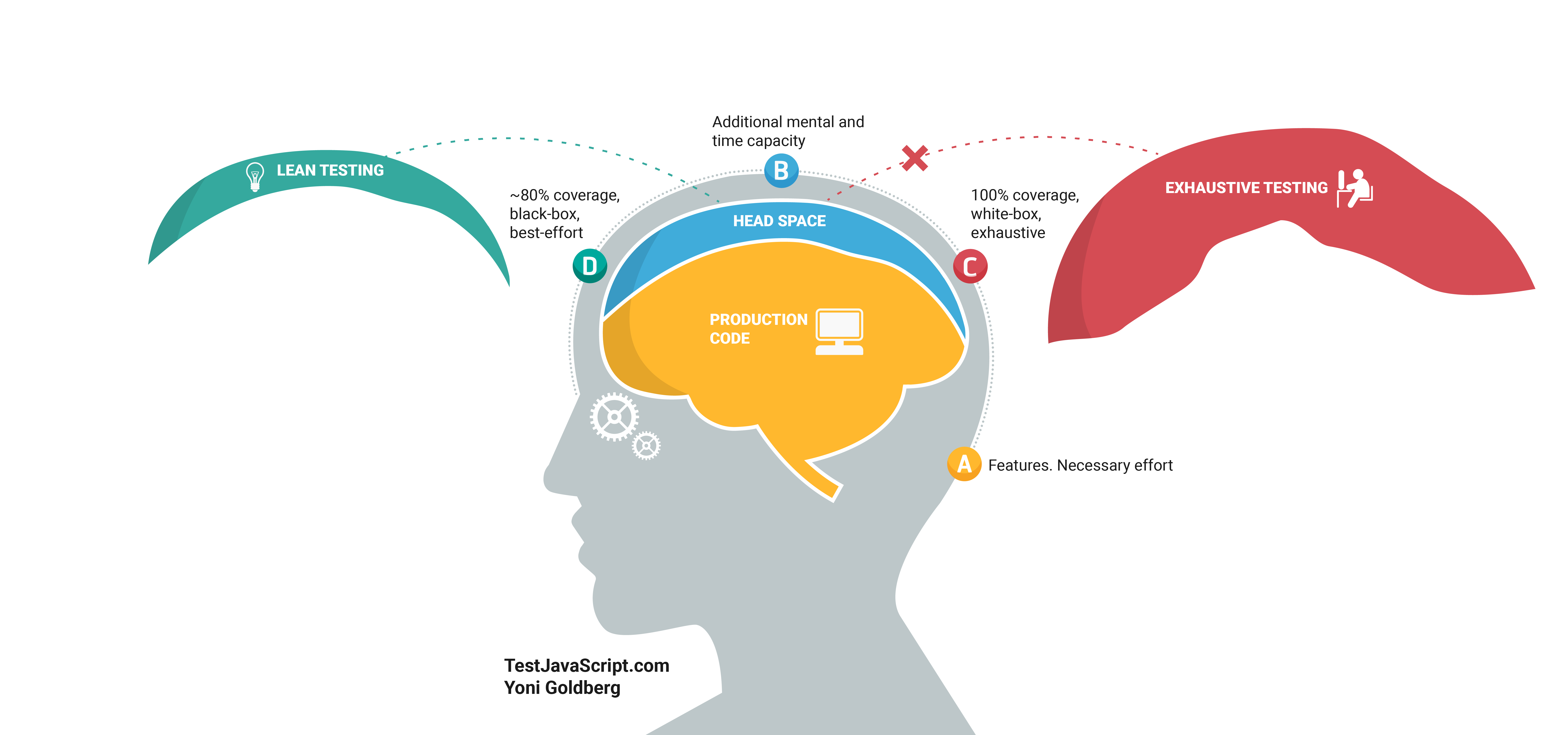
Most of the advice below are derivatives of this principle.
Ready to start?
Section 1: The Test Anatomy
⚪ ️ 1.1 Include 3 parts in each test name
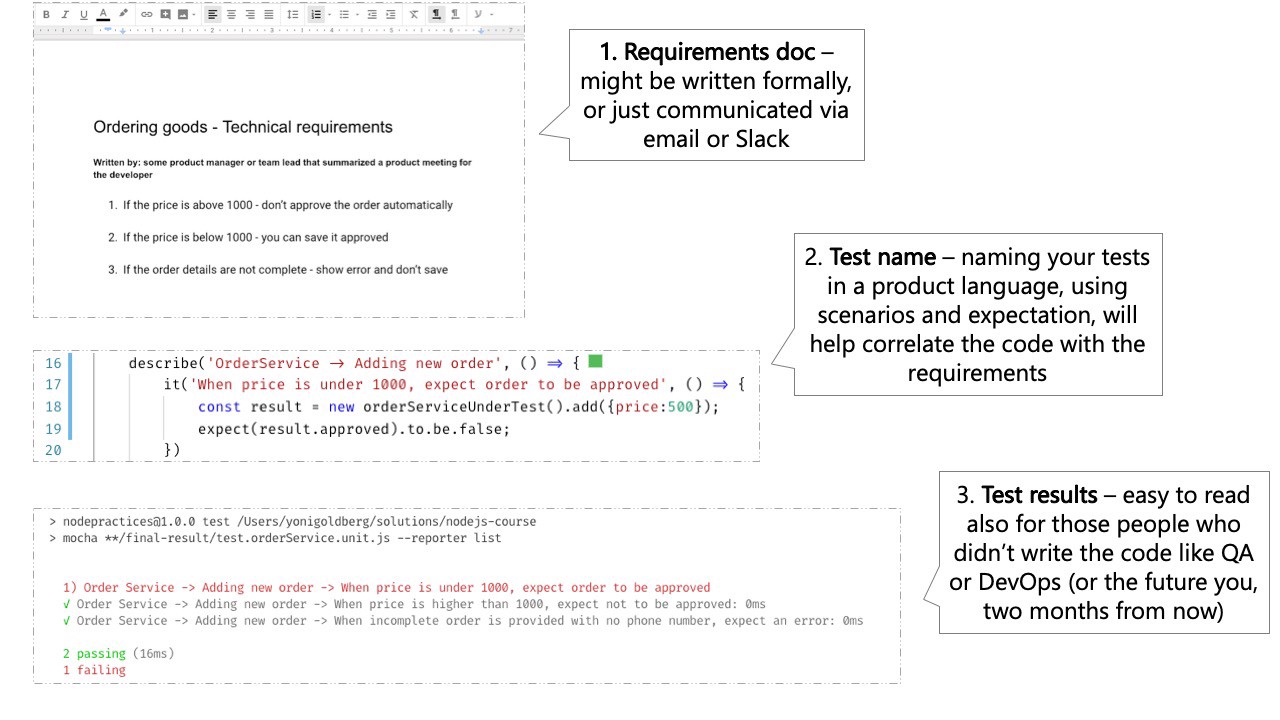
:white_check_mark: Do: A test report should tell whether the current application revision satisfies the requirements for the people who are not necessarily familiar with the code: the tester, the DevOps engineer who is deploying and the future you two years from now. This can be achieved best if the tests speak at the requirements level and include 3 parts:
(1) What is being tested? For example, the ProductsService.addNewProduct method
(2) Under what circumstances and scenario? For example, no price is passed to the method
(3) What is the expected result? For example, the new product is not approved
❌ Otherwise: A deployment just failed, a test named “Add product” failed. Does this tell you what exactly is malfunctioning?
👇 Note: Each bullet has code examples and sometime also an image illustration. Click to expand
✏ Code Examples
:clap: Doing It Right Example: A test name that constitutes 3 parts

//1. unit under test
describe('Products Service', function() {
  describe('Add new product', function() {
    //2. scenario and 3. expectation
    it('When no price is specified, then the product status is pending approval', ()=> {
      const newProduct = new ProductService().add(...);
      expect(newProduct.status).to.equal('pendingApproval');
    });
  });
});
:clap: Doing It Right Example: A test name that constitutes 3 parts
© Credits & read-more
1. Roy Osherove - Naming standards for unit tests
⚪ ️ 1.2 Structure tests by the AAA pattern
:white_check_mark: Do: Structure your tests with 3 well-separated sections Arrange, Act & Assert (AAA). Following this structure guarantees that the reader spends no brain-CPU on understanding the test plan:
1st A - Arrange: All the setup code to bring the system to the scenario the test aims to simulate. This might include instantiating the unit under test constructor, adding DB records, mocking/stubbing on objects, and any other preparation code
2nd A - Act: Execute the unit under test. Usually 1 line of code
3rd A - Assert: Ensure that the received value satisfies the expectation. Usually 1 line of code
❌ Otherwise: Not only do you spend hours understanding the main code but what should have been the simplest part of the day (testing) stretches your brain
✏ Code Examples
:clap: Doing It Right Example: A test structured with the AAA pattern


describe("Customer classifier", () => {
  test("When customer spent more than 500$, should be classified as premium", () => {
    //Arrange
    const customerToClassify = { spent: 505, joined: new Date(), id: 1 };
    const DBStub = sinon.stub(dataAccess, "getCustomer").reply({ id: 1, classification: "regular" });

    //Act
    const receivedClassification = customerClassifier.classifyCustomer(customerToClassify);

    //Assert
    expect(receivedClassification).toMatch("premium");
  });
});
:thumbsdown: Anti-Pattern Example: No separation, one bulk, harder to interpret
test("Should be classified as premium", () => {
  const customerToClassify = { spent: 505, joined: new Date(), id: 1 };
  const DBStub = sinon.stub(dataAccess, "getCustomer").reply({ id: 1, classification: "regular" });
  const receivedClassification = customerClassifier.classifyCustomer(customerToClassify);
  expect(receivedClassification).toMatch("premium");
});
⚪ ️1.3 Describe expectations in a product language: use BDD-style assertions
:white_check_mark: Do: Coding your tests in a declarative-style allows the reader to get the grab instantly without spending even a single brain-CPU cycle. When you write imperative code that is packed with conditional logic, the reader is forced to exert more brain-CPU cycles. In that case, code the expectation in a human-like language, declarative BDD style using expect or should and not using custom code. If Chai & Jest doesn't include the desired assertion and it’s highly repeatable, consider extending Jest matcher (Jest) or writing a custom Chai plugin
❌ Otherwise: The team will write less tests and decorate the annoying ones with .skip()
✏ Code Examples
:thumbsdown: Anti-Pattern Example: The reader must skim through not so short, and imperative code just to get the test story
test("When asking for an admin, ensure only ordered admins in results", () => {
  //assuming we've added here two admins "admin1", "admin2" and "user1"
  const allAdmins = getUsers({ adminOnly: true });

  let admin1Found,
    adming2Found = false;

  allAdmins.forEach(aSingleUser => {
    if (aSingleUser === "user1") {
      assert.notEqual(aSingleUser, "user1", "A user was found and not admin");
    }
    if (aSingleUser === "admin1") {
      admin1Found = true;
    }
    if (aSingleUser === "admin2") {
      admin2Found = true;
    }
  });

  if (!admin1Found || !admin2Found) {
    throw new Error("Not all admins were returned");
  }
});
:clap: Doing It Right Example: Skimming through the following declarative test is a breeze
it("When asking for an admin, ensure only ordered admins in results", () => {
  //assuming we've added here two admins
  const allAdmins = getUsers({ adminOnly: true });

  expect(allAdmins)
    .to.include.ordered.members(["admin1", "admin2"])
    .but.not.include.ordered.members(["user1"]);
});
⚪ ️ 1.4 Stick to black-box testing: Test only public methods
:white_check_mark: Do: Testing the internals brings huge overhead for almost nothing. If your code/API delivers the right results, should you really invest your next 3 hours in testing HOW it worked internally and then maintain these fragile tests? Whenever a public behavior is checked, the private implementation is also implicitly tested and your tests will break only if there is a certain problem (e.g. wrong output). This approach is also referred to as behavioral testing. On the other side, should you test the internals (white box approach) — your focus shifts from planning the component outcome to nitty-gritty details and your test might break because of minor code refactors although the results are fine - this dramatically increases the maintenance burden
❌ Otherwise: Your tests behave like the boy who cried wolf: shouting false-positive cries (e.g., A test fails because a private variable name was changed). Unsurprisingly, people will soon start to ignore the CI notifications until someday, a real bug gets ignored…
✏ Code Examples
:thumbsdown: Anti-Pattern Example: A test case is testing the internals for no good reason
class ProductService {
  //this method is only used internally
  //Change this name will make the tests fail
  calculateVATAdd(priceWithoutVAT) {
    return { finalPrice: priceWithoutVAT * 1.2 };
    //Change the result format or key name above will make the tests fail
  }
  //public method
  getPrice(productId) {
    const desiredProduct = DB.getProduct(productId);
    const finalPrice = this.calculateVATAdd(desiredProduct.price).finalPrice;
    return finalPrice;
  }
}

it("White-box test: When the internal methods get 0 vat, it return 0 response", async () => {
  //There's no requirement to allow users to calculate the VAT, only show the final price. Nevertheless we falsely insist here to test the class internals
  expect(new ProductService().calculateVATAdd(0).finalPrice).to.equal(0);
});
⚪ ️ ️1.5 Choose the right test doubles: Avoid mocks in favor of stubs and spies
:white_check_mark: Do: Test doubles are a necessary evil because they are coupled to the application internals, yet some provide immense value (Read here a reminder about test doubles: mocks vs stubs vs spies).
Before using test doubles, ask a very simple question: Do I use it to test functionality that appears, or could appear, in the requirements document? If not, it’s a white-box testing smell.
For example, if you want to test that your app behaves reasonably when the payment service is down, you might stub the payment service and trigger some ‘No Response’ return to ensure that the unit under test returns the right value. This checks our application behavior/response/outcome under certain scenarios. You might also use a spy to assert that an email was sent when that service is down — this is again a behavioral check which is likely to appear in a requirements doc (“Send an email if payment couldn’t be saved”). On the flip side, if you mock the Payment service and ensure that it was called with the right JavaScript types — then your test is focused on internal things that have nothing to do with the application functionality and are likely to change frequently
❌ Otherwise: Any refactoring of code mandates searching for all the mocks in the code and updating accordingly. Tests become a burden rather than a helpful friend
✏ Code Examples
:thumbsdown: Anti-pattern example: Mocks focus on the internals

it("When a valid product is about to be deleted, ensure data access DAL was called once, with the right product and right config", async () => {
  //Assume we already added a product
  const dataAccessMock = sinon.mock(DAL);
  //hmmm BAD: testing the internals is actually our main goal here, not just a side-effect
  dataAccessMock
    .expects("deleteProduct")
    .once()
    .withArgs(DBConfig, theProductWeJustAdded, true, false);
  new ProductService().deletePrice(theProductWeJustAdded);
  dataAccessMock.verify();
});
:clap:Doing It Right Example: spies are focused on testing the requirements but as a side-effect are unavoidably touching to the internals
it("When a valid product is about to be deleted, ensure an email is sent", async () => {
  //Assume we already added here a product
  const spy = sinon.spy(Emailer.prototype, "sendEmail");
  new ProductService().deletePrice(theProductWeJustAdded);
  //hmmm OK: we deal with internals? Yes, but as a side effect of testing the requirements (sending an email)
  expect(spy.calledOnce).to.be.true;
});
📗 Want to learn all these practices with live video?
:white_check_mark: Do: Often production bugs are revealed under some very specific and surprising input — the more realistic the test input is, the greater the chances are to catch bugs early. Use dedicated libraries like Chance or Faker to generate pseudo-real data that resembles the variety and form of production data. For example, such libraries can generate realistic phone numbers, usernames, credit cards, company names, and even ‘lorem ipsum’ text. You may also create some tests (on top of unit tests, not as a replacement) that randomize fakers' data to stretch your unit under test or even import real data from your production environment. Want to take it to the next level? See the next bullet (property-based testing).
❌ Otherwise: All your development testing will falsely show green when you use synthetic inputs like “Foo”, but then production might turn red when a hacker passes-in a nasty string like “@3e2ddsf . ##’ 1 fdsfds . fds432 AAAA”
✏ Code Examples
:thumbsdown: Anti-Pattern Example: A test suite that passes due to non-realistic data
const addProduct = (name, price) => {
  const productNameRegexNoSpace = /^\S*$/; //no white-space allowed

  if (!productNameRegexNoSpace.test(name)) return false; //this path never reached due to dull input

  //some logic here
  return true;
};

test("Wrong: When adding new product with valid properties, get successful confirmation", async () => {
  //The string "Foo" which is used in all tests never triggers a false result
  const addProductResult = addProduct("Foo", 5);
  expect(addProductResult).toBe(true);
  //Positive-false: the operation succeeded because we never tried with long
  //product name including spaces
});
it("Better: When adding new valid product, get successful confirmation", async () => {
  const addProductResult = addProduct(faker.commerce.productName(), faker.random.number());
  //Generated random input: {'Sleek Cotton Computer',  85481}
  expect(addProductResult).to.be.true;
  //Test failed, the random input triggered some path we never planned for.
  //We discovered a bug early!
});
:white_check_mark: Do: Typically we choose a few input samples for each test. Even when the input format resembles real-world data (see bullet ‘Don’t foo’), we cover only a few input combination

 A free, in-depth guide with 50+ best practices for testing JavaScript and Node.js applications, compiled and curated from dozens of blog posts, books and tools.