



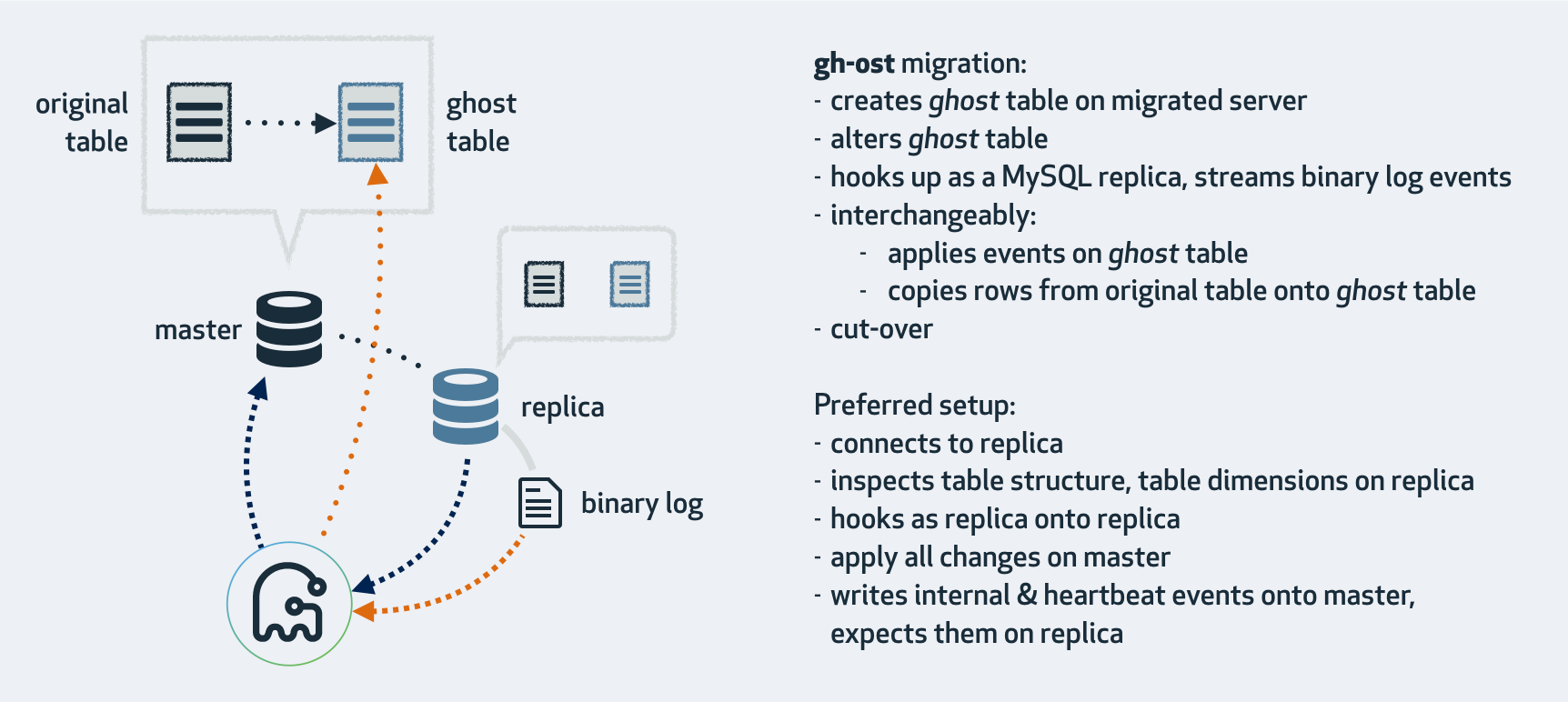
What is this?
 gh-ost is GitHub's open-source online schema migration tool for MySQL: it alters live tables by copying data into a ghost table, keeping the workload on the master light and decoupled from normal traffic.
How is it different from other online schema-change tools?It copies your table into a ghost table and swaps them at the end, but is triggerless: it reads the binary log stream and applies changes asynchronously, which lets it truly pause and decouple its load from the master.
It copies your table into a ghost table and swaps them at the end, but is triggerless: it reads the binary log stream and applies changes asynchronously, which lets it truly pause and decouple its load from the master.How do I get it and run a migration?Download a prebuilt binary for Linux or macOS, or build from source with Go 1.15+ via script/build. The cheatsheet covers all modes; the recommended flow is a noop test first, then the real migration with --execute.
Download a prebuilt binary for Linux or macOS, or build from source with Go 1.15+ via script/build. The cheatsheet covers all modes; the recommended flow is a noop test first, then the real migration with --execute.What does my database setup need for this to work?A MySQL setup whose changes it can follow through the binary log. It prefers running migrations via a replica (it figures out the servers involved), and there are official guides for AWS RDS and Azure Database for MySQL.
A MySQL setup whose changes it can follow through the binary log. It prefers running migrations via a replica (it figures out the servers involved), and there are official guides for AWS RDS and Azure Database for MySQL.Any gotchas before I point it at my production master?If your master uses Statement Based Replication, the replica-based mode is required. Also, only tagged releases are meant for production — the master branch is generally stable but not for prod use.
If your master uses Statement Based Replication, the replica-based mode is required. Also, only tagged releases are meant for production — the master branch is generally stable but not for prod use.Is it proven on large production databases?Yes — it is GA and stable, built by GitHub's database infrastructure team, which continuously migrates its whole production table fleet on replicas and checksums the results to verify correctness.
Yes — it is GA and stable, built by GitHub's database infrastructure team, which continuously migrates its whole production table fleet on replicas and checksums the results to verify correctness.What can I control while a migration is running?A lot: throttling truly ceases all writes on the master, you can reconfigure interactively mid-run, query status over a unix socket or TCP, postpone the final table swap until you are available, and couple it to your environment via external hooks.
A lot: throttling truly ceases all writes on the master, you can reconfigure interactively mid-run, query status over a unix socket or TCP, postpone the final table swap until you are available, and couple it to your environment via external hooks.Can I test it without touching production data?Yes: --test-on-replica runs the exact same migration flow on a replica without replacing the original table, leaving two tables you can compare and checksum. For master migrations, issue a noop first, then the real run with --execute.
Yes: --test-on-replica runs the exact same migration flow on a replica without replacing the original table, leaving two tables you can compare and checksum. For master migrations, issue a noop first, then the real run with --execute.Why is it called gh-ost?It is pronounced Ghost and stands for GitHub's Online Schema Transmogrifier/Translator/Transformer/Transfigurator. It began as gh-osc (Online Schema Change), in the likes of Facebook's OSC and pt-online-schema-change, until a 'rare genetic mutation' turned the c into a t.
It is pronounced Ghost and stands for GitHub's Online Schema Transmogrifier/Translator/Transformer/Transfigurator. It began as gh-osc (Online Schema Change), in the likes of Facebook's OSC and pt-online-schema-change, until a 'rare genetic mutation' turned the c into a t.Which topics is it in?devops-tools, mysql, sql, devops, database, go, command-line-tool, free, tool, cli, developer-tools, mit
devops-tools, mysql, sql, devops, database, go, command-line-tool, free, tool, cli, developer-tools, mit