
Zstandard, or zstd as short version, is a fast lossless compression algorithm,
targeting real-time compression scenarios at zlib-level and better compression ratios.
It's backed by a very fast entropy stage, provided by Huff0 and FSE library.
Zstandard's format is stable and documented in RFC8878. Multiple independent implementations are already available.
This repository represents the reference implementation, provided as an open-source dual BSD OR GPLv2 licensed C library,
and a command line utility producing and decoding .zst, .gz, .xz and .lz4 files.
Should your project require another programming language,
a list of known ports and bindings is provided on Zstandard homepage.
Development branch status:




Benchmarks
For reference, several fast compression algorithms were tested and compared
on a desktop featuring a Core i7-9700K CPU @ 4.9GHz
and running Ubuntu 24.04 (Linux 6.8.0-53-generic),
using lzbench, an open-source in-memory benchmark by @inikep
compiled with gcc 14.2.0,
on the Silesia compression corpus.
| Compressor name |
Ratio |
Compression |
Decompress. |
| zstd 1.5.7 -1 |
2.896 |
510 MB/s |
1550 MB/s |
| brotli 1.1.0 -1 |
2.883 |
290 MB/s |
425 MB/s |
| zlib 1.3.1 -1 |
2.743 |
105 MB/s |
390 MB/s |
| zstd 1.5.7 --fast=1 |
2.439 |
545 MB/s |
1850 MB/s |
| quicklz 1.5.0 -1 |
2.238 |
520 MB/s |
750 MB/s |
| zstd 1.5.7 --fast=4 |
2.146 |
665 MB/s |
2050 MB/s |
| lzo1x 2.10 -1 |
2.106 |
650 MB/s |
780 MB/s |
| lz4 1.10.0 |
2.101 |
675 MB/s |
3850 MB/s |
| snappy 1.2.1 |
2.089 |
520 MB/s |
1500 MB/s |
| lzf 3.6 -1 |
2.077 |
410 MB/s |
820 MB/s |
The negative compression levels, specified with --fast=#,
offer faster compression and decompression speed
at the cost of compression ratio.
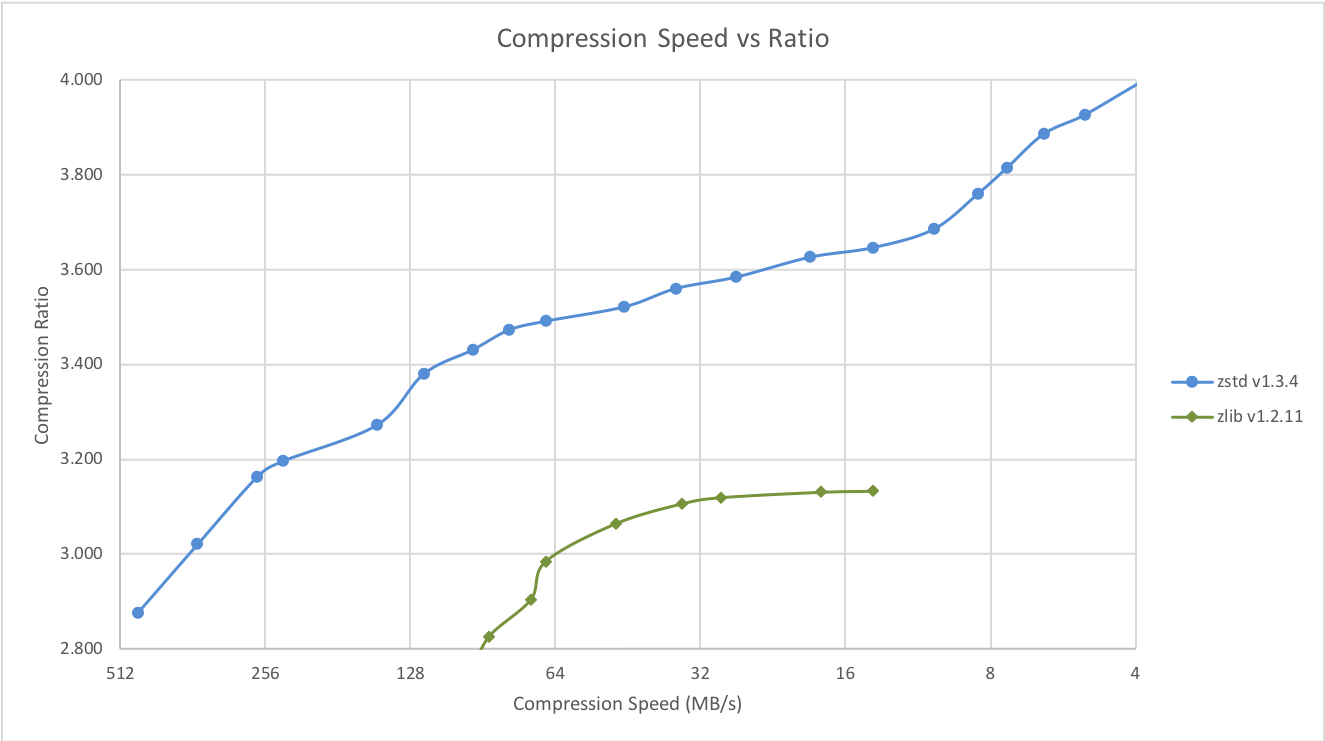
Zstd can also offer stronger compression ratios at the cost of compression speed.
Speed vs Compression trade-off is configurable by small increments.
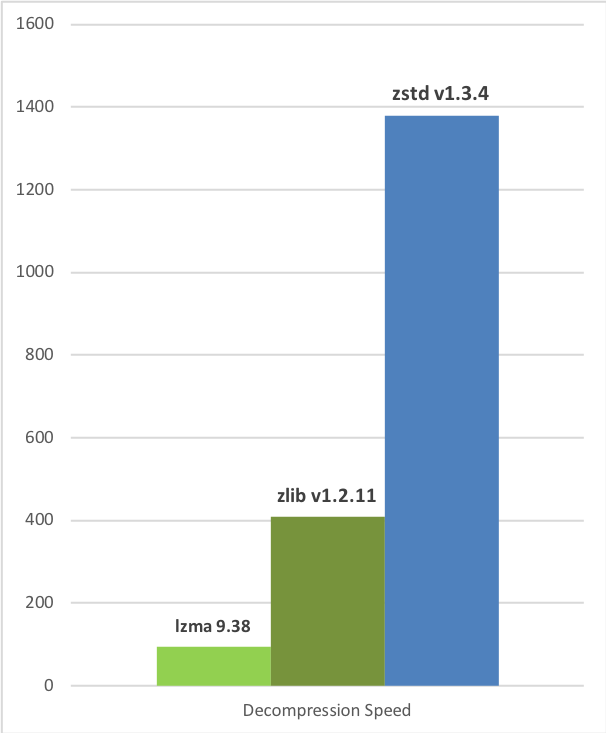
Decompression speed is preserved and remains roughly the same at all settings,
a property shared by most LZ compression algorithms, such as zlib or lzma.
The following tests were run
on a server running Linux Debian (Linux version 4.14.0-3-amd64)
with a Core i7-6700K CPU @ 4.0GHz,
using lzbench, an open-source in-memory benchmark by @inikep
compiled with gcc 7.3.0,
on the Silesia compression corpus.
| Compression Speed vs Ratio |
Decompression Speed |
 |
 |
A few other algorithms can produce higher compression ratios at slower speeds, falling outside of the graph.
For a larger picture including slow modes, click on this link.
The case for Small Data compression
Previous charts provide results applicable to typical file and stream scenarios (several MB). Small data comes with different perspectives.
The smaller the amount of data to compress, the more difficult it is to compress. This problem is common to all compression algorithms, and reason is, compression algorithms learn from past data how to compress future data. But at the beginning of a new data set, there is no "past" to build upon.
To solve this situation, Zstd offers a training mode, which can be used to tune the algorithm for a selected type of data.
Training Zstandard is achieved by providing it with a few samples (one file per sample). The result of this training is stored in a file called "dictionary", which must be loaded before compression and decompression.
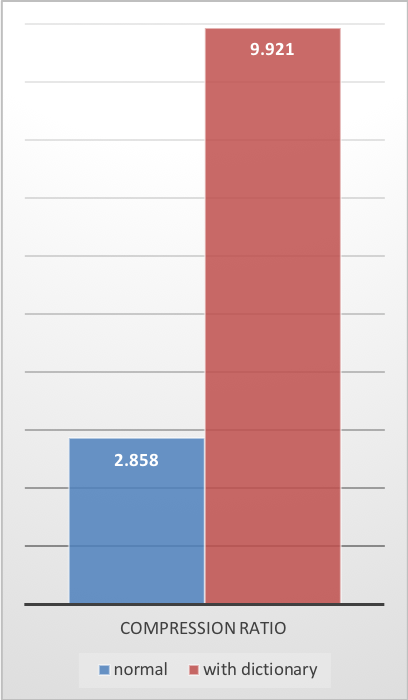
Using this dictionary, the compression ratio achievable on small data improves dramatically.
The following example uses the github-users sample set, created from github public API.
It consists of roughly 10K records weighing about 1KB each.
| Compression Ratio |
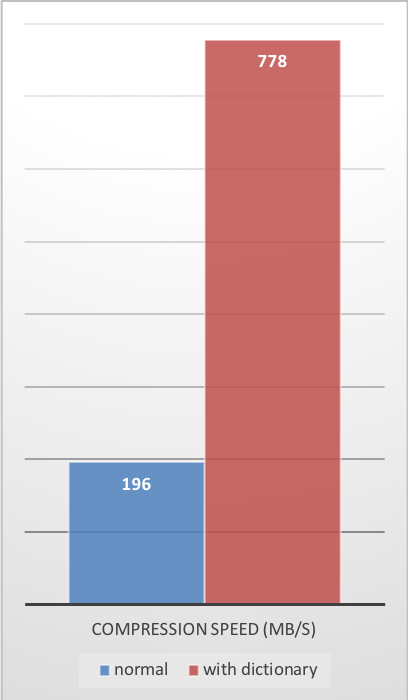
Compression Speed |
Decompression Speed |
 |
 |
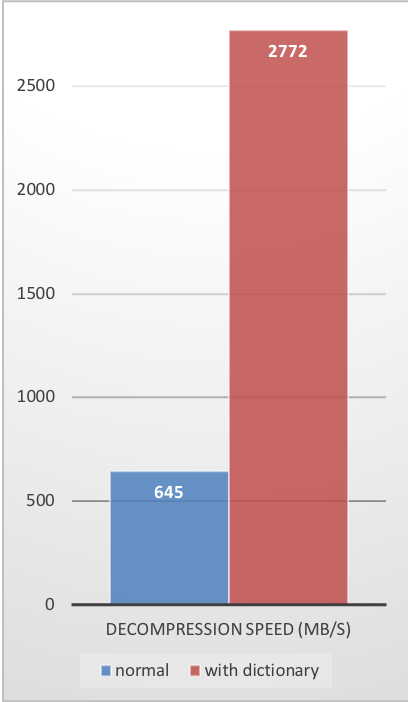 |
These compression gains are achieved while simultaneously providing faster compression and decompression speeds.
Training works if there is some correlation in a family of small data samples. The more data-specific a dictionary is, the more efficient it is (there is no universal dictionary).
Hence, deploying one dictionary per type of data will provide the greatest benefits.
Dictionary gains are mostly effective in the first few KB. Then, the compression algorithm will gradually use previously decoded content to better compress the rest of the file.
Dictionary compression How To:
Create the dictionary
zstd --train FullPathToTrainingSet/* -o dictionaryName
Compress with dictionary
zstd -D dictionaryName FILE
Decompress with dictionary
zstd -D dictionaryName --decompress FILE.zst
Build instructions
make is the main build system of this project.
It is the reference, and other build systems are periodically updated to stay compatible.
However, small drifts and feature differences can be present, since perfect synchronization is difficult.
For this reason, when your build system allows it, prefer employing make.
Makefile
Assuming your system supports standard make (or gmake),
just invoking make in root directory generates zstd cli at root,
and also generates libzstd into lib/.
Other standard targets include:
make install : install zstd cli, library and man pagesmake check : run zstd, test its essential behavior on local platform
The Makefile follows the GNU Standard Makefile conventions,
allowing staged install, standard compilation flags, directory variables and command variables.
For advanced use cases, specialized flags which control binary generation and installation paths are documented
in lib/README.md for the libzstd library
and in programs/README.md for the zstd CLI.
cmake
A cmake project generator is available for generating Makefiles or other build scripts
to create the zstd binary as well as libzstd dynamic and static libraries.
The repository root now contains a minimal CMakeLists.txt that forwards to build/cmake,
so you can configure the project with a standard cmake -S . invocation,
while the historical cmake -S build/cmake entry point remains fully supported.
cmake -S . -B build-cmake
cmake --build build-cmake
By default, CMAKE_BUILD_TYPE is set to Release.
Support for Fat (Universal2) Output
zstd can be built and installed with support for both Apple Silicon (M1/M2) as well as Intel by using CMake's Universal2 support.
To perform a Fat/Universal2 build and install use the following commands:
cmake -S . -B build-cmake-debug -G Ninja -DCMAKE_OSX_ARCHITECTURES="x86_64;x86_64h;arm64"
cd build-cmake-debug
ninja
sudo ninja install
Meson
A Meson project is provided within build/meson. Follow
build instructions in that directory.
You can also take a look at .travis.yml file for an
example about how Meson is used to build this project.
Note that default build type is release.
VCPKG
You can build and install zstd vcpkg dependency manager:
git clone https://github.com/Microsoft/vcpkg.git
cd vcpkg
./bootstrap-vcpkg.sh
./vcpkg integrate install
./vcpkg install zstd
The zstd port in vcpkg is kept up to date by Microsoft team members and community contributors.
If the version is out of date, please create an issue or pull request on the vcpkg repository.
Conan
You can install pre-built binaries for zstd or build it from source using Conan. Use the following command:
conan install --requires="zstd/[*]" --build=missing
The zstd Conan recipe is kept up to date by Conan maintainers and community contributors.
If the version is out of date, please create an issue or pull request on the ConanCenterIndex repository.
Visual Studio (Windows)
Going into build directory, you will find additional possibilities:
- Projects for Visual Studio 2008 and 2010.
- VS2010 project is compatible with VS2012, VS2013, VS2015 and VS2017.
- Automated build scripts for Visual compiler by @KrzysFR, in
build/VS_scripts,
which will build zstd cli and libzstd library without any need to open Visual Studio solution.
- It is now recommended to generate Visual Studio solutions from
cmake
Buck
You can build the zstd binary via buck by executing: buck build programs:zstd from the root of the repo.
The output binary will be in buck-out/gen/programs/.
Bazel
You can integrate zstd into your Bazel project by using the module hosted on the Bazel Central Repository.
Testing
You can run quick local smoke tests by running make check.
If you can't use make, execute the playTest.sh script from the src/tests directory.
Two env variables $ZSTD_BIN and $DATAGEN_BIN are needed for the test script to locate the zstd and datagen binary.
For information on CI testing, please refer to TESTING.md.
Status
Zstandard is deployed within Meta and many other large cloud infrastructures,
to compress humongous amounts of data in various formats and use cases.
It is also continuously fuzzed for security issues by Google's oss-fuzz program.
License
Zstandard is dual-licensed under BSD OR GPLv2.
Contributing
The dev branch is the one where all contributions are merged before reaching release.
Direct commit to release are not permitted.
For more information, please read CONTRIBUTING.

 Zstandard(zstd)是一种面向实时场景的快速无损压缩算法,压缩率达到甚至超过 zlib 的水平。这个仓库是官方的 C 语言参考实现,附带一个命令行工具;压缩格式已经稳定,并在 RFC8878 中有正式文档。