

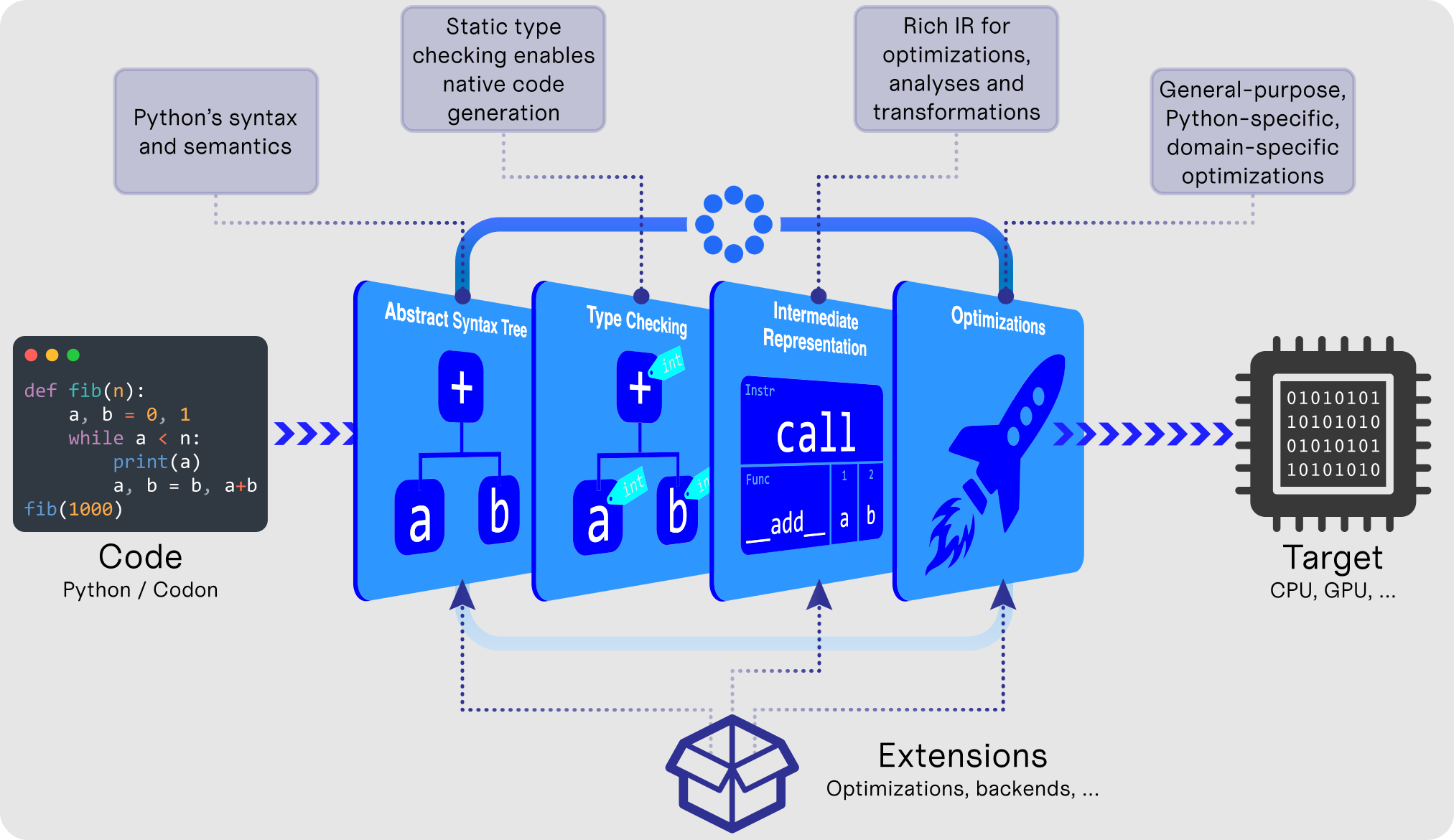
What is this?
 Codon is a high-performance Python implementation that compiles your code straight to native machine code — typically 10-100x faster than vanilla Python on a single thread, on par with C/C++.
So is it a different language I have to learn, or do I write regular Python?You write regular Python: Codon compiles it ahead of time, and many Python programs run with few or no modifications. It avoids adding new syntax, except in a couple of spots like expressing parallelism.
You write regular Python: Codon compiles it ahead of time, and many Python programs run with few or no modifications. It avoids adding new syntax, except in a couple of spots like expressing parallelism.How do I get it running?Install with the one-line command from the Quick start section; that gives you a codon command. Run scripts with codon run file.py (add -release for optimizations) or compile a standalone executable with codon build -release file.py.
Install with the one-line command from the Quick start section; that gives you a codon command. Run scripts with codon run file.py (add -release for optimizations) or compile a standalone executable with codon build -release file.py.What about my existing Python packages — do they work?Yes, via 'from python import'. Set the CODON_PYTHON environment variable to the CPython shared library, and those modules run on real CPython while the rest of your code compiles natively.
Yes, via 'from python import'. Set the CODON_PYTHON environment variable to the CPython shared library, and those modules run on real CPython while the rest of your code compiles natively.Can any Python program run on it, or are there gaps?It's not a drop-in CPython replacement: Python features that don't suit static compilation aren't supported (see 'Differences with Python' in the docs). For larger codebases there's a JIT decorator, a Python extension backend, and full Python interop.
It's not a drop-in CPython replacement: Python features that don't suit static compilation aren't supported (see 'Differences with Python' in the docs). For larger codebases there's a JIT decorator, a Python extension backend, and full Python interop.Can it run code on a GPU?Yes — Codon supports writing and executing GPU kernels, including through the same @par annotation with @par(gpu=True). The README demos a Mandelbrot kernel, and the NumPy implementation works with GPU and multithreading too.
Yes — Codon supports writing and executing GPU kernels, including through the same @par annotation with @par(gpu=True). The README demos a Mandelbrot kernel, and the NumPy implementation works with GPU and multithreading too.Does it really include its own NumPy?Yes — a feature-complete, fully compiled native NumPy re-implementation with the same API. Since it lives inside the compiler, Codon can apply optimizations like inlining, fusion and memory allocation elision, and it even integrates with PyTorch.
Yes — a feature-complete, fully compiled native NumPy re-implementation with the same API. Since it lives inside the compiler, Codon can apply optimizations like inlining, fusion and memory allocation elision, and it even integrates with PyTorch.How does parallelism work — do I manage threads myself?No. Codon has native multithreading over OpenMP with no GIL: annotate a for-loop with @par (schedule, chunk size, thread count are options) and the compiler parallelizes it, automatically turning accumulations in the loop body into atomic reductions to avoid race conditions.
No. Codon has native multithreading over OpenMP with no GIL: annotate a for-loop with @par (schedule, chunk size, thread count are options) and the compiler parallelizes it, automatically turning accumulations in the loop body into atomic reductions to avoid race conditions.When would I pick Codon over just running CPython?For compute-heavy work: number crunching, large NumPy array code, or loops you'd otherwise hand-optimize. Anywhere vanilla Python is too slow but rewriting in C/C++ or Rust feels too heavy — Codon keeps Python syntax and delivers low-level-language speed, more still with threads or GPU.
For compute-heavy work: number crunching, large NumPy array code, or loops you'd otherwise hand-optimize. Anywhere vanilla Python is too slow but rewriting in C/C++ or Rust feels too heavy — Codon keeps Python syntax and delivers low-level-language speed, more still with threads or GPU.Which topics is it in?aot, parallel-programming, llvm, gpu-programming, scientific-computing, multithreading, runtime, numpy, optimization, high-performance, compiler, pytorch
aot, parallel-programming, llvm, gpu-programming, scientific-computing, multithreading, runtime, numpy, optimization, high-performance, compiler, pytorch