






What is this?
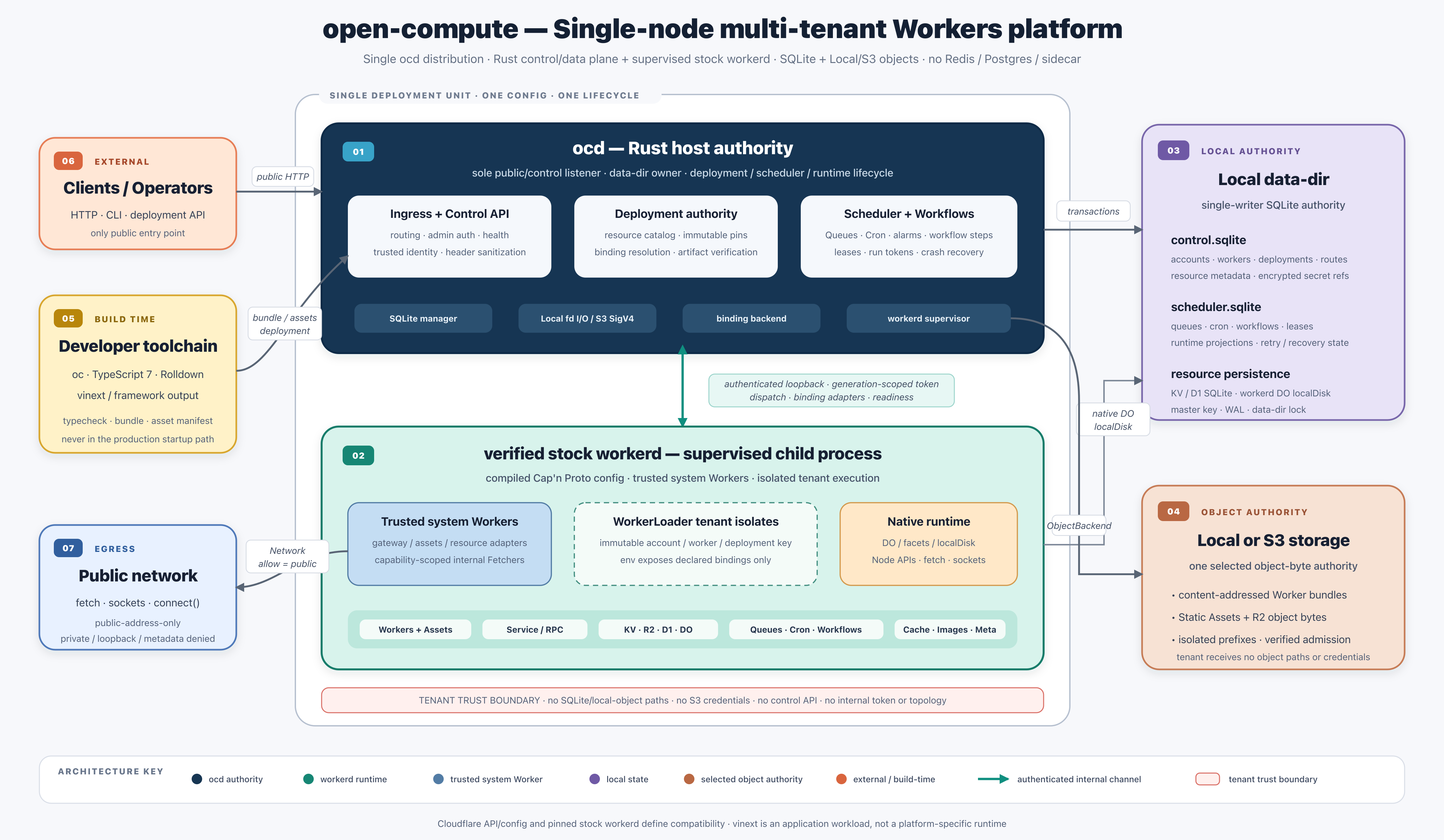
 open-compute is a self-hosted platform that runs Cloudflare Workers code unchanged on hardware you control, reimplementing Workers, KV, D1, R2, Durable Objects, Queues, Workflows, Cron, Cache, Images, Vectorize and AI Search as a single Rust binary.
open-compute is a self-hosted platform that runs Cloudflare Workers code unchanged on hardware you control, reimplementing Workers, KV, D1, R2, Durable Objects, Queues, Workflows, Cron, Cache, Images, Vectorize and AI Search as a single Rust binary.Is this just the workerd runtime, or a full platform?It is a full platform built on top of workerd. workerd only executes isolated Workers in a sandbox; open-compute adds the missing control plane — routing, durable state, scheduling, and deployment lifecycle — and ships it all as one binary (ocd).
It is a full platform built on top of workerd. workerd only executes isolated Workers in a sandbox; open-compute adds the missing control plane — routing, durable state, scheduling, and deployment lifecycle — and ships it all as one binary (ocd).How do I deploy my first Worker on it?You bring the platform up locally and then deploy with the same Wrangler CLI you already use for Cloudflare. A single command type-checks, bundles, deploys, and serves the Worker. In production it runs as one executable with one config file and one data directory.
You bring the platform up locally and then deploy with the same Wrangler CLI you already use for Cloudflare. A single command type-checks, bundles, deploys, and serves the Worker. In production it runs as one executable with one config file and one data directory.What do I need installed to build and run it?Building it needs Rust 1.98, Bun 1.3.14, Node 26, and Git LFS. The compiled production binary needs none of that — no build tooling or network access on the host at startup.
Building it needs Rust 1.98, Bun 1.3.14, Node 26, and Git LFS. The compiled production binary needs none of that — no build tooling or network access on the host at startup.Which Cloudflare features are still missing?Workers AI, Containers, Hyperdrive, Analytics Engine, Workers for Platforms, Pipelines, Rate Limiting, mTLS certificates, and Tail Workers/Logpush are all at 0%, not implemented yet. Vectorize and AI Search are only partially done at 80%.
Workers AI, Containers, Hyperdrive, Analytics Engine, Workers for Platforms, Pipelines, Rate Limiting, mTLS certificates, and Tail Workers/Logpush are all at 0%, not implemented yet. Vectorize and AI Search are only partially done at 80%.Can it scale across multiple machines like real Cloudflare?No, it's explicitly single-node by design: one data directory, one process, one machine, with no Anycast routing or cross-region replication like Cloudflare's actual edge.
No, it's explicitly single-node by design: one data directory, one process, one machine, with no Anycast routing or cross-region replication like Cloudflare's actual edge.Does it phone home to Cloudflare or need an account?No — it runs fully offline with no Cloudflare account, no egress calls, no telemetry, and no bill.
No — it runs fully offline with no Cloudflare account, no egress calls, no telemetry, and no bill.How closely does it actually match real Cloudflare behavior?The team runs the same test fixtures against open-compute and real Cloudflare and refuses to ship on mismatches: 2,097 API members implemented with zero gaps, 7 of 7 product surfaces verified byte-for-byte, and a production Next.js 16 build runs identically on both.
The team runs the same test fixtures against open-compute and real Cloudflare and refuses to ship on mismatches: 2,097 API members implemented with zero gaps, 7 of 7 product surfaces verified byte-for-byte, and a production Next.js 16 build runs identically on both.Where does my data actually live?Platform metadata lives in a local SQLite database, and object bytes like R2 data, bundles, and cache snapshots sit on the local filesystem by default, with an optional S3-compatible store as the only alternative — no Redis or external database needed.
Platform metadata lives in a local SQLite database, and object bytes like R2 data, bundles, and cache snapshots sit on the local filesystem by default, with an optional S3-compatible store as the only alternative — no Redis or external database needed.Why build this instead of just using workerd directly?workerd only runs isolated Workers — it has no routing, durable state, scheduler, or deployment API of its own. open-compute wraps stock workerd with that entire control plane (ocd) so there is nothing extra to run alongside it.
workerd only runs isolated Workers — it has no routing, durable state, scheduler, or deployment API of its own. open-compute wraps stock workerd with that entire control plane (ocd) so there is nothing extra to run alongside it.Can I still use the Cloudflare dashboard or API tooling?Wrangler works almost unchanged, pinned to 4.127.1 and 95% verified, against a local /client/v4 API, and there is a separate operator admin UI on that same API — though it is not a clone of Cloudflare's own dashboard.
Wrangler works almost unchanged, pinned to 4.127.1 and 95% verified, against a local /client/v4 API, and there is a separate operator admin UI on that same API — though it is not a clone of Cloudflare's own dashboard.What are similar projects?celld, cloudflare_temp_email, DoulorCloud, WasmEdge, mailflare, durable-git, nodewarden, company-brain
celld, cloudflare_temp_email, DoulorCloud, WasmEdge, mailflare, durable-git, nodewarden, company-brainWhich topics is it in?v8, edge-computing, queue, cloudflare-r2, cloudflare-d1, container, object-storage, workflow-engine, ai-gateway, key-value, runtime, cloudflare-workers
v8, edge-computing, queue, cloudflare-r2, cloudflare-d1, container, object-storage, workflow-engine, ai-gateway, key-value, runtime, cloudflare-workers