contractfault
An API contract consumer-impact analyzer that treats every version bump like a seismic event.
Ingest two contract versions. Feel where the ground moves. See which downstream towns get shaken.
Why this exists — the seismology of APIs
Most "API diff" tools hand you a wall of text and let you guess what matters.
That is like handing a geologist a list of every rock that moved and asking them
to intuit whether the village downhill is in danger. contractfault is not a
text differ. It is a seismograph for API contracts.
The mental model is deliberately geological:
- A contract is a section of crust — a versioned map of endpoints and types.
- A change between two versions is a tremor along a fault line.
- Each tremor has a category (does the ground crack, shift, or just settle?)
and a severity (how much energy was released?).
- Consumers are the towns built along the fault. A tremor only matters if a
town sits on top of it.
- The aggregate energy, felt through the towns, is the magnitude — a single
0–10 number with a plain-language verdict:
stable, tremor, shaken,
or rupture.
That framing is not decoration. It is the actual data model. contractfault
refuses to tell you "47 things changed." It tells you "checkout-web (high
criticality) will rupture because Order.couponCode — which it reads — was
removed, and cancelOrder — which it calls — changed from POST to DELETE."
That sentence is worth more than any diff.
                    v1.4.0  ──────────────────────────  v2.0.0
                       │                                    │
        ┌──────────────┴───────────┐          ┌─────────────┴──────────────┐
        │  endpoints · types        │  DIFF   │  endpoints · types          │
        └──────────────┬───────────┘   ═══>   └─────────────┬──────────────┘
                       │                                    │
                       ▼                                    ▼
                  ╭─────────────────  classify  ─────────────────╮
                  │  breaking · additive · behavioral            │
                  ╰───────────────────┬──────────────────────────╯
                                      │  join
                       ┌──────────────┼───────────────┐
                       ▼              ▼               ▼
                 checkout-web   analytics-etl   receipts-mailer   … named consumers
The laboratory at a glance
contractfault/
├── cmd/contractfault/        # Go stdlib CLI — the seismograph
│   └── main.go               #   flag parsing, glob expansion, pipeline, exit codes
├── internal/
│   ├── contract/             # the documented JSON contract format + strict loader
│   ├── consumer/             # consumer usage manifests + criticality weighting
│   ├── analyze/              # the classification engine (the fault mechanics)
│   ├── impact/               # change→consumer join, magnitude, verdict
│   └── report/               # deterministic JSON + text seismograph renderers
├── viewer/                   # TypeScript seismic impact map / SVG viewer
│   ├── src/{types,seismic,cli}.ts
│   └── test/viewer.test.ts
├── examples/
│   ├── contracts/orders-v{1,2}.json    # before / after
│   ├── consumers/*.json                # four named consumers
│   └── report.json                     # a generated report fixture
├── docs/
│   ├── CONTRACT.md           # the format spec + full classification table
│   └── assets/               # animated faultline-hero + impact-seismograph SVGs
├── go.mod · Makefile · LICENSE · CHANGELOG.md · .github/workflows/ci.yml
Two languages, one contract. The Go analyzer is the instrument; the TypeScript
viewer is the paper the trace is drawn on. They meet at a single JSON schema
(contractfault/v1), so either half can be replaced without touching the other.
Quick start — trigger your first quake
You need Go 1.24+ and Node 20+.
# 1. Build both halves
make build

# 2. Run the analyzer over the shipped example fault
./bin/contractfault \
    -old examples/contracts/orders-v1.json \
    -new examples/contracts/orders-v2.json \
    -consumers "examples/consumers/*.json"

# 3. Or run the whole pipeline — analyze, then render the seismic map + SVG
make demo
No flags to memorize: -old, -new, and a -consumers glob are the whole
interface. Everything else has a sensible default.
The terminal seismograph (real output)
Running the analyzer against the bundled orders-api fault produces this. It is
copied verbatim from an actual run — no artistic license:
contractfault seismic report
service : orders-api
shift   : 1.4.0 -> 2.0.0
magnitude 8.5  verdict RUPTURE
[##################################------]
breaking=8  additive=5  behavioral=2  affected-consumers=4

CHANGES (sorted by severity)
  !! [critical] cancelOrder                  method changed POST -> DELETE
      code: endpoint.method.changed
      hits: checkout-web
      fix : Update the HTTP verb from POST to DELETE.
  !! [critical] getReceipt                   endpoint GET /orders/{id}/receipt (getReceipt) was removed
      code: endpoint.removed
      hits: analytics-etl, receipts-mailer
      fix : Stop calling this endpoint; migrate to a replacement operation before upgrading.
  ~~ [major   ] cancelOrder                  idempotency changed true -> false
      code: endpoint.idempotency.changed
      hits: checkout-web
      fix : Review retry logic: repeated calls may no longer be safe.
  !! [major   ] cancelOrder                  path changed /orders/{id}/cancel -> /orders/{id}
      code: endpoint.path.changed
      hits: checkout-web
      fix : Update the request URL template to /orders/{id}.
  !! [major   ] Order.couponCode             field Order.couponCode removed
      code: field.removed
      hits: analytics-etl, checkout-web
      fix : Stop reading Order.couponCode; it is no longer present.
  !! [major   ] listOrders#query:limit       parameter query:limit became required
      code: param.required.added
      hits: analytics-etl, fulfillment-worker
      fix : Always supply limit; requests without it will be rejected.
  !! [major   ] OrderStatus                  type OrderStatus dropped enum values refunded
      code: type.enum.removed
      fix : Handle the removed enum values as invalid; they will no longer be produced.
  ~~ [minor   ] OrderStatus                  type OrderStatus gained enum values authorized,delivered
      code: type.enum.added
      fix : Ensure consumers tolerate the new enum values.
  ++ [info    ] Money.display                field Money.display added (required=false)
      code: field.added
      hits: receipts-mailer
      fix : New optional field; read it when useful.

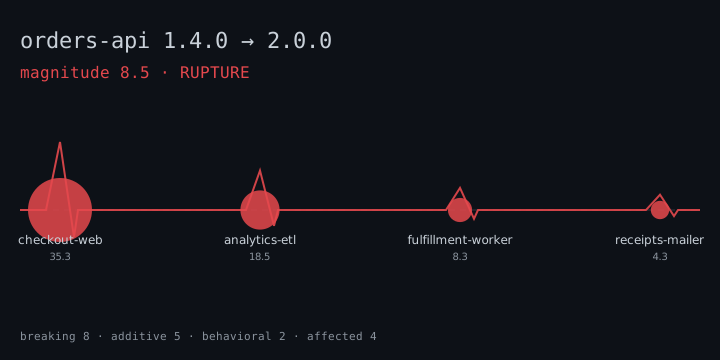
CONSUMER BLAST RADIUS
  checkout-web       high    score=35.3  breaking=3 additive=1 behavioral=1
  analytics-etl      medium  score=18.5  breaking=3 additive=1 behavioral=0
  fulfillment-worker high    score=8.3  breaking=1 additive=1 behavioral=0
  receipts-mailer    low     score=4.3  breaking=1 additive=1 behavioral=0
(The listing above is trimmed to the highest-severity tremors; the tool prints
all fifteen. The ##... bar is the magnitude meter on a 0–10 scale.)
Read it top-down like a seismologist reads a drum: the biggest tremors are at
the top, each annotated with who feels it (hits:) and how to survive it
(fix:). The blast-radius footer ranks the towns by how hard they were shaken.
The animated seismograph viewer
Pipe the JSON report into the TypeScript viewer to draw the fault as a station
map. Each consumer becomes a seismic station along the fault line; its dot grows
with its risk score, and its color encodes the worst tremor it felt.
# Emit JSON from the analyzer, then render an SVG seismograph
./bin/contractfault -old examples/contracts/orders-v1.json \
    -new examples/contracts/orders-v2.json \
    -consumers "examples/consumers/*.json" \
    -format json -out examples/report.json

cd viewer
node dist/cli.js ../examples/report.json --svg ../docs/assets/impact-seismograph.svg
The viewer also renders a colorized terminal map with per-consumer amplitude
bars, and — like the Go CLI — exits 2 on breaking, 1 on behavioral, 0 on
stable, so it can double as a CI gate when reading a stored report.
What counts as a tremor
contractfault classifies every difference into one of three categories, and each
category maps to a CI outcome. This is the crux of not being a text diff: the
tool understands the semantics of a contract, not its bytes.
| Category |
Feels like |
Examples |
CI |
| breaking |
the ground cracks |
endpoint removed, method flip, required field added, enum value dropped, response type changed |
exit 2 |
| behavioral |
the ground shifts |
idempotency flip, field became nullable, enum value added, field deprecated |
exit 1 |
| additive |
the ground settles |
new optional field, new endpoint, new status code, parameter relaxed to optional |
exit 0 |
The subtle cases are where the design earns its keep:
- A required field added is breaking; an optional one is additive. Same JSON
edit, opposite blast radius.
- Adding an enum value is behavioral, not additive — old consumers with an
exhaustive
switch may fall through on the new value.
- An idempotency flip is behavioral even though the shape is byte-identical —
it silently invalidates retry logic. A text differ would never catch this.
- A parameter addition shakes every caller of the endpoint, but a
parameter value change only shakes consumers that set that specific param.
The complete rule table (thirty-plus codes) lives in
docs/CONTRACT.md.
How the blast radius is computed
A tremor with no town on top of it is a curiosity, not an incident.
contractfault only counts a change against a consumer when that consumer
actually depends on the affected element:
- Field tremor (
Order.couponCode) → only consumers whose manifest lists
that field in readsFields/writesFields.
- Type tremor (
OrderStatus) → consumers referencing any field of that type.
- Endpoint tremor (
getReceipt removed) → every consumer that calls it.
- New required parameter → every caller of the endpoint, because they all
suddenly send an incomplete request.
Each surviving (tremor, town) pair releases energy equal to
severityWeight × criticalityWeight. A high-criticality consumer amplifies a
critical break to 4.0 × 3 = 12.0; a low-criticality consumer feeling the
same break releases only 4.0 × 1 = 4.0. The town's construction quality
matters as much as the quake.
The raw energy is then compressed onto a Richter-like 0–10 dial:
magnitude = 10 · (1 − 1 / (1 + raw / 12))
so a fistful of critical breaks dominates the reading while an avalanche of
harmless info changes never saturates the meter.
A contract is OpenAPI-like but self-contained. Endpoints are correlated across
versions by a stable id, so renaming a path is reported as a mutation, not a
delete-plus-add.
{
  "service": "orders-api",
  "version": "1.4.0",
  "types": {
    "OrderStatus": { "kind": "string", "enum": ["pending", "paid", "shipped"] },
    "Order": {
      "kind": "object",
      "fields": {
        "id":     { "type": "string", "required": true },
        "status": { "type": "OrderStatus", "required": true },
        "note":   { "type": "string", "nullable": true }
      }
    }
  },
  "endpoints": [
    {
      "id": "getOrder", "method": "GET", "path": "/orders/{id}", "idempotent": true,
      "params": [{ "name": "id", "in": "path", "type": "string", "required": true }],
      "responses": { "200": "Order", "404": "Error" }
    }
  ]
}
A consumer manifest declares only what it touches — coarse enough to publish
without exposing your source tree, precise enough to compute a real blast radius:
{
  "name": "checkout-web",
  "team": "storefront",
  "criticality": "high",
  "uses": [
    { "endpoint": "getOrder", "readsFields": ["Order.id", "Order.status"] }
  ]
}
Both formats are decoded strictly — an unknown key is a hard error, so typos
fail loudly instead of silently disarming a check. Full spec:
docs/CONTRACT.md.
CLI reference
contractfault -old <before.json> -new <after.json> [flags]

  -old string           previous contract version (required)
  -new string           new contract version (required)
  -consumers string     glob or comma-separated list of manifest paths
  -format string        output format: text | json          (default "text")
  -out string           write report to a file instead of stdout
  -fail-on-behavioral   treat behavioral-only shifts as failure (exit 2)
  -quiet                print only the one-line verdict summary
Exit codes: 0 stable · 1 shaken (behavioral) · 2 rupture (breaking) ·
3 usage/IO error. Wire it straight into a pipeline:
- name: Contract safety gate
  run: contractfault -old base.json -new head.json -consumers "consumers/*.json"
  # job fails automatically on exit 2
Building, testing, hacking
make build        # compile Go CLI + build TS viewer
make test         # go test ./...  +  viewer npm test
make report       # regenerate examples/report.json
make demo         # analyze + render terminal map + SVG
make svg          # regenerate docs/assets/impact-seismograph.svg
make vet          # go vet ./...
make ci           # exactly what CI runs
The test suites cover the fault mechanics directly: classification rules
(required-vs-optional, enum removal, idempotency, method flips), the
consumer-join attribution rules, magnitude monotonicity and bounding,
deterministic JSON output, exit-code mapping, and an end-to-end run against the
shipped examples. The TypeScript side tests schema validation, the magnitude
bar, colored/uncolored terminal rendering, XML-escaped SVG generation, and CLI
argument parsing.
Determinism is a first-class property: every collection is sorted before
emission, so two runs over the same inputs produce byte-identical JSON. This is
verified in tests and matters for CI — a report you can diff is a report you can
trust.
Design decisions worth knowing
- Stdlib only on the Go side. No third-party dependencies. The parser,
classifier, joiner and renderers are all built on
encoding/json, sort,
flag and friends. Fewer moving parts, nothing to audit, trivial to vendor.
id-based endpoint correlation. Paths and methods are attributes, not
identity. This is what lets the tool say "method changed" instead of the
useless "one endpoint removed, one added."- Criticality is a multiplier, not a filter. A low-criticality consumer
feeling a critical break still shows up — it just contributes less magnitude.
You never lose information, you only reprioritize.
- Two exit-code producers, one schema. Both the Go CLI and the TS viewer
derive the same CI verdict from the report, so you can gate on whichever half
is convenient in a given pipeline.
- Seismic vocabulary throughout.
tremor, magnitude, blast radius,
rupture — consistent metaphor, consistent code. The verdict word alone tells
a reviewer whether to keep reading.
FAQ
Is this OpenAPI-compatible? No, and deliberately so. OpenAPI is enormous;
contractfault ingests a small, purpose-built subset that captures exactly the
properties that drive consumer impact (required-ness, nullability, arity, enum
membership, idempotency). You can generate the format from OpenAPI upstream.
Why not just semver? Semver tells you that something broke. contractfault
tells you what broke, who it breaks, and how to fix it — and it computes
the semver bump for you from the change categories.
Can a change be additive to one consumer and breaking to another? The change
category is a property of the contract, but the magnitude felt is per-town.
A breaking change that touches no consumer contributes zero energy — the fault
moved, but nobody lived on it.
License
MIT — see LICENSE. Built as a seismic fault laboratory for API
evolution. Change the ground carefully; someone lives downhill.

 ContractFault is a CLI tool that diffs two versions of an API contract and maps every change onto the downstream consumers that depend on it, ranking the overall 'blast radius' with a 0-10 magnitude score and a stable/tremor/shaken/rupture verdict.