Geometry Script is a Blender extension and requires Blender 5.2 or newer.
Drag the box for your Blender version into Blender to install it:
Blender asks to allow online access if it's off, then to add the Geometry Script repository, then confirms the install. The nightly release always lists the links for every Blender version with a build.
To install manually instead:
Download the ZIP matching your Blender version from the nightly release, e.g. geometry_script-1.0.0-blender-5.2.zip
Open Blender > Preferences > Get Extensions
Open the dropdown at the top right, choose Install from Disk... and select the downloaded ZIP file
Claude Code skill
The repository is also a Claude Code plugin marketplace with a skill for building node trees with Geometry Script. Install it with:
The skill runs scripts through Blender's MCP server when it's connected, or in background Blender otherwise. Run /plugin marketplace update geometry-script to get the latest version, or turn on auto-update for the marketplace in /plugin.
What is Geometry Script?
Geometry Script is a robust yet easy to use Python API for creating Geometry Nodes with code.
At a certain point, Geometry Node trees become unmanagably large. Creating node trees in Python enables quicker editing and reorganization of large, complex trees.
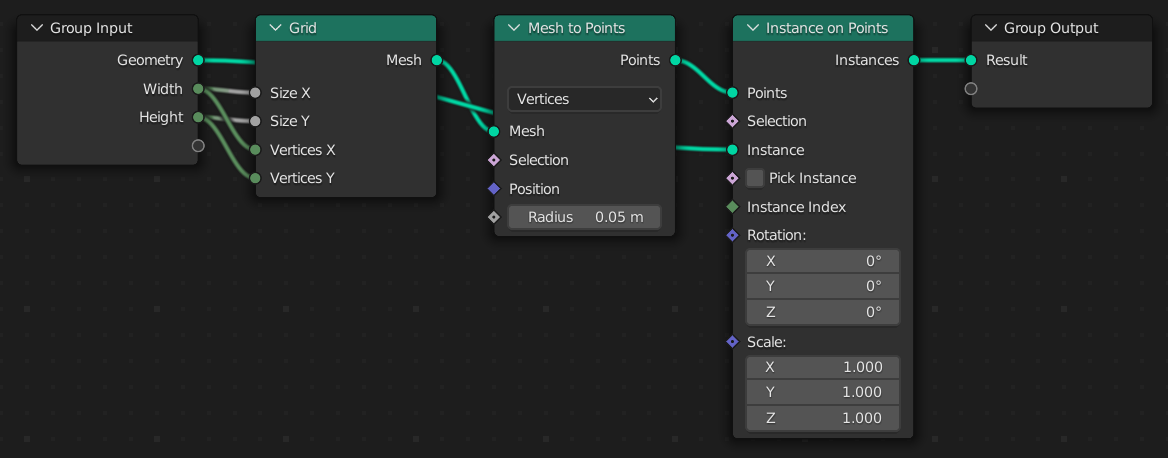
Geometry Script has all of the performance and capabilities of Geometry Nodes, but in a more managable format. The scripts are converted directly to Geometry Node trees making them easy to tweak for others unfamiliar with scripting.
Every node in your Blender version is available as a typed Python function, generated from Blender itself, so your editor can complete node names, inputs, outputs and enum values.
Shader node groups, materials, worlds and compositor node groups can be scripted the same way, with geometry_script.shader and geometry_script.compositor:
Read the documentation for more information on installation, syntax, and tutorials.
Contributing
Use uv to get fake-bpy-module and some pyright settings.
uv sync
The node modules (api/nodes.py, api/shader_nodes.py and api/compositor_nodes.py) are generated from Blender and aren't checked in. Loading the add-on from a checkout generates them with that Blender, or you can generate them yourself, e.g. for editor completions:
Blender asks to allow online access if it's off, then to add the Geometry Script repository, then confirms the install. The nightly release always lists the links for every Blender version with a build.