Apache Thrift
Introduction
Thrift is a lightweight, language-independent software stack for
point-to-point RPC implementation.
Thrift provides clean abstractions and implementations for data transport,
data serialization, and application level processing. The code generation
system takes a simple definition language as input and generates code
across programming languages that uses the abstracted stack to build
interoperable RPC clients and servers.
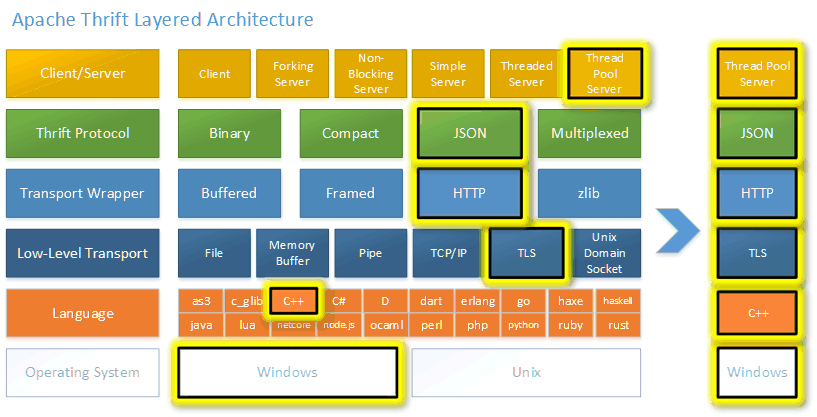
Thrift makes it easy for programs written in different programming
languages to share data and call remote procedures. With support
for 28 programming languages, chances are Thrift
supports the languages that you currently use.
Thrift is specifically designed to support non-atomic version changes
across client and server code. This allows you to upgrade your
server while still being able to service older clients; or have newer
clients issue requests to older servers. An excellent community-provided
write-up about thrift and compatibility when versioning an API can be
found in the Thrift Missing Guide.
For more details on Thrift's design and implementation, see the Thrift
whitepaper included in this distribution, or at the README.md file
in your particular subdirectory of interest.
Status
| Branch |
Travis |
Appveyor |
Coverity Scan |
codecov.io |
Website |
master |
 |
 |
 |
|
 |
0.23.0 |
 |
|
|
|
|
Releases
Thrift does not maintain a specific release calendar at this time.
We strive to release twice yearly. Download the current release.
License
Licensed to the Apache Software Foundation (ASF) under one
or more contributor license agreements. See the NOTICE file
distributed with this work for additional information
regarding copyright ownership. The ASF licenses this file
to you under the Apache License, Version 2.0 (the
"License"); you may not use this file except in compliance
with the License. You may obtain a copy of the License at
http://www.apache.org/licenses/LICENSE-2.0
Unless required by applicable law or agreed to in writing,
software distributed under the License is distributed on an
"AS IS" BASIS, WITHOUT WARRANTIES OR CONDITIONS OF ANY
KIND, either express or implied. See the License for the
specific language governing permissions and limitations
under the License.
Project Hierarchy
thrift/
compiler/
Contains the Thrift compiler, implemented in C++.
lib/
Contains the Thrift software library implementation, subdivided by
language of implementation.

cpp/
go/
java/
php/
py/
rb/
...
test/
Contains sample Thrift files and test code across the target programming
languages.
tutorial/
Contains a basic tutorial that will teach you how to develop software
using Thrift.
Development
To build the same way Travis CI builds the project you should use docker.
We have comprehensive building instructions for docker.
Requirements
See http://thrift.apache.org/docs/install for a list of build requirements (may be stale). Alternatively, see the docker build environments for a list of prerequisites.
Resources
More information about Thrift can be obtained on the Thrift webpage at:
http://thrift.apache.org
Acknowledgments
Thrift was inspired by pillar, a lightweight RPC tool written by Adam D'Angelo,
and also by Google's protocol buffers.
Installation
If you are building from the first time out of the source repository, you will
need to generate the configure scripts. (This is not necessary if you
downloaded a tarball.) From the top directory, do:
./bootstrap.sh
Once the configure scripts are generated, thrift can be configured.
From the top directory, do:
./configure
You may need to specify the location of the boost files explicitly.
If you installed boost in /usr/local, you would run configure as follows:
./configure --with-boost=/usr/local
Note that by default the thrift C++ library is typically built with debugging
symbols included. If you want to customize these options you should use the
CXXFLAGS option in configure, as such:
./configure CXXFLAGS='-g -O2'
./configure CFLAGS='-g -O2'
./configure CPPFLAGS='-DDEBUG_MY_FEATURE'
To enable gcov required options -fprofile-arcs -ftest-coverage enable them:
./configure --enable-coverage
Run ./configure --help to see other configuration options
Please be aware that the Python library will ignore the --prefix option
and just install wherever Python's distutils puts it (usually along
the lines of /usr/lib/pythonX.Y/site-packages/). If you need to control
where the Python modules are installed, set the PY_PREFIX variable.
(DESTDIR is respected for Python and C++.)
Make thrift:
make
From the top directory, become superuser and do:
make install
Uninstall thrift:
make uninstall
Note that some language packages must be installed manually using build tools
better suited to those languages (at the time of this writing, this applies
to Java, Ruby, PHP).
Look for the README.md file in the lib// folder for more details on the
installation of each language library package.
Package Managers
Apache Thrift is available via a number of package managers, a list which is
is steadily growing. A more detailed overview can be found
at the Apache Thrift web site under "Libraries"
and/or in the respective READMEs for each language under /lib
Testing
There are a large number of client library tests that can all be run
from the top-level directory.
make -k check
This will make all of the libraries (as necessary), and run through
the unit tests defined in each of the client libraries. If a single
language fails, the make check will continue on and provide a synopsis
at the end.
To run the cross-language test suite, please run:
make cross
This will run a set of tests that use different language clients and
servers.

 Apache Thrift 是一个轻量级、语言无关的软件栈,用于构建 RPC 客户端和服务器。它从单一的接口定义文件生成代码,使不同语言编写的程序能够相互调用过程并共享数据。