Nano ID

English | 日本語 | Русский | 简体中文 | Bahasa Indonesia | 한국어 | العربية
A tiny, secure, URL-friendly, unique string ID generator for JavaScript.
“An amazing level of senseless perfectionism,
which is simply impossible not to respect.”
- Small. 118 bytes (minified and brotlied). No dependencies.
Size Limit controls the size.
- Fast. 50% faster than native
crypto.randomUUID().
- Safe. It uses hardware random generator. Can be used in clusters.
- Short IDs. It uses a larger alphabet than UUID (
A-Za-z0-9_-).
So ID size was reduced from 36 to 21 symbols.
- Portable. Nano ID was ported
to over 20 programming languages.
import { nanoid } from 'nanoid'
model.id = nanoid() //=> "V1StGXR8_Z5jdHi6B-myT"
 Nano ID is built by Evil Martians, an American design and engineering consultancy for developer tools, AI, and cybersecurity startups.
Table of Contents
Comparison with UUID
Nano ID is quite comparable to UUID v4 (random-based).
It has a similar number of random bits in the ID
(126 in Nano ID and 122 in UUID), so it has a similar collision probability:
For there to be a one in a billion chance of duplication,
103 trillion version 4 IDs must be generated.
There are two main differences between Nano ID and UUID v4:
- Nano ID uses a bigger alphabet, so a similar number of random bits
are packed in just 21 symbols instead of 36.
- Nano ID is faster than
crypto.randomUUID and uuid/v4.
Benchmark
$ node ./test/benchmark.js
nope-id                 20,386,830 ops/sec
nanoid                  20,434,827 ops/sec
customAlphabet          20,544,476 ops/sec
crypto.randomUUID       12,865,759 ops/sec
uuid v4                  7,930,104 ops/sec
@napi-rs/uuid            5,573,171 ops/sec
uid/secure               6,308,267 ops/sec
@lukeed/uuid             5,278,597 ops/sec
nanoid for browser         311,497 ops/sec
secure-random-string       301,667 ops/sec
uid-safe.sync              297,815 ops/sec

Non-secure:
uid                     20,286,757 ops/sec
nanoid/non-secure        2,397,594 ops/sec
rndm                     2,445,462 ops/sec
Security
See a good article about random generators theory:
Secure random values (in Node.js)
Unpredictability. Instead of using the unsafe Math.random(), Nano ID
uses the crypto module in Node.js and the Web Crypto API in browsers.
These modules use unpredictable hardware random generator.
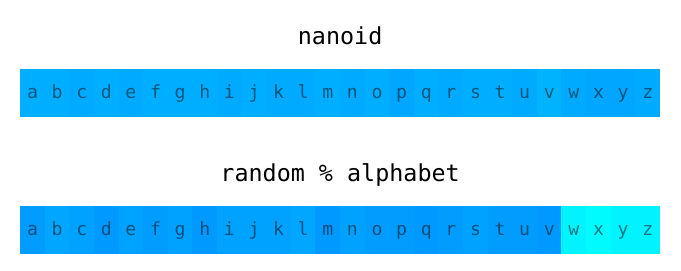
Uniformity. random % alphabet is a popular mistake to make when coding
an ID generator. The distribution will not be even; there will be a lower
chance for some symbols to appear compared to others. So, it will reduce
the number of tries when brute-forcing. Nano ID uses a better algorithm
and is tested for uniformity.
Well-documented: all Nano ID hacks are documented. See comments
in the source.
Vulnerabilities: to report a security vulnerability, please use
the Tidelift security contact.
Tidelift will coordinate the fix and disclosure.
Install
npm install nanoid
JSR
JSR is a replacement for npm with open governance
and active development (in contrast to npm).
npx jsr add @sitnik/nanoid
You can use it in Node.js, Deno, Bun, etc.
// Replace `nanoid` to `@sitnik/nanoid` in all imports
import { nanoid } from '@sitnik/nanoid'
For Deno install it by deno add jsr:@sitnik/nanoid or import
from jsr:@sitnik/nanoid.
CDN
For quick hacks, you can load Nano ID from CDN. Though, it is not recommended
to be used in production because of the lower loading performance.
import { nanoid } from 'https://cdn.jsdelivr.net/npm/nanoid/nanoid.js'
API
By default, Nano ID uses URL-friendly symbols (A-Za-z0-9_-) and returns an ID
with 21 characters (to have a collision probability similar to UUID v4).
import { nanoid } from 'nanoid'
model.id = nanoid() //=> "V1StGXR8_Z5jdHi6B-myT"
If you want to reduce the ID size (and increase collisions probability),
you can pass the size as an argument.
nanoid(10) //=> "IRFa-VaY2b"
Don’t forget to check the safety of your ID size
in our ID collision probability calculator.
You can also use a custom alphabet
or a random generator.
Custom Alphabet or Size
customAlphabet returns a function that allows you to create nanoid
with your own alphabet and ID size.
import { customAlphabet } from 'nanoid'
const nanoid = customAlphabet('1234567890abcdef', 10)
model.id = nanoid() //=> "4f90d13a42"
import { customAlphabet } from 'nanoid/non-secure'
const nanoid = customAlphabet('1234567890abcdef', 10)
user.id = nanoid()
Check the safety of your custom alphabet and ID size in our
ID collision probability calculator. For more alphabets, check out the options
in nanoid-dictionary.
Alphabet must contain from 1 to 256 symbols.
Otherwise, the security of the internal generator algorithm is not guaranteed,
and a generator built from an empty or over-256-symbol alphabet
can loop forever instead of returning an ID.
In addition to setting a default size, you can change the ID size when calling
the function:
import { customAlphabet } from 'nanoid'
const nanoid = customAlphabet('1234567890abcdef', 10)
model.id = nanoid(5) //=> "f01a2"
Custom Random Bytes Generator
customRandom allows you to create a nanoid and replace alphabet
and the default random bytes generator.
In this example, a seed-based generator is used:
import { customRandom } from 'nanoid'

const rng = seedrandom(seed)
const nanoid = customRandom('abcdef', 10, size => {
  return new Uint8Array(size).map(() => 256 * rng())
})

nanoid() //=> "fbaefaadeb"
random callback must accept the array size and return an array
with random numbers.
If you want to use the same URL-friendly symbols with customRandom,
you can get the default alphabet using the urlAlphabet.
import { customRandom, urlAlphabet } from 'nanoid'
const nanoid = customRandom(urlAlphabet, 10, random)
Note, that between Nano ID versions we may change random generator
call sequence. If you are using seed-based generators, we do not guarantee
the same result.
Non-Secure
Nano ID uses hardware random bytes generation for security and low collision
probability. If you are not so concerned with security, you can use it
for environments without hardware random generators.
import { nanoid } from 'nanoid/non-secure'
const id = nanoid() //=> "Uakgb_J5m9g-0JDMbcJqLJ"
Note, that non-secure version is slower than secure.
Use it only if you have to.
Usage
React
There’s no correct way to use Nano ID for React key prop
since it should be consistent among renders.
function Todos({ todos }) {
  return (
    <ul>
      {todos.map(todo => (
        <li key={nanoid()}>
          {' '}
          /* DON’T DO IT */
          {todo.text}
        </li>
      ))}
    </ul>
  )
}
You should rather try to reach for stable ID inside your list item.
const todoItems = todos.map(todo => <li key={todo.id}>{todo.text}</li>)
In case you don’t have stable IDs you'd rather use index as key
instead of nanoid():
const todoItems = todos.map((text, index) => (
  <li key={index}>
    {' '}
    /* Still not recommended but preferred over nanoid(). Only do this if items
    have no stable IDs. */
    {text}
  </li>
))
In case you just need random IDs to link elements like labels
and input fields together, useId is recommended.
That hook was added in React 18.
React Native
React Native does not have built-in random generator. The following polyfill
works for plain React Native and Expo starting with 39.x.
- Check
react-native-get-random-values docs and install it.
- Import it before Nano ID.
import 'react-native-get-random-values'
import { nanoid } from 'nanoid'
PouchDB and CouchDB
In PouchDB and CouchDB, IDs can’t start with an underscore _.
A prefix is required to prevent this issue, as Nano ID might use a _
at the start of the ID by default.
Override the default ID with the following option:
db.put({
  _id: 'id' + nanoid(),
  …
})
CLI
You can get unique ID in terminal by calling npx nanoid. You need only
Node.js in the system. You do not need Nano ID to be installed anywhere.
$ npx nanoid
npx: installed 1 in 0.63s
LZfXLFzPPR4NNrgjlWDxn
Size of generated ID can be specified with --size (or -s) option:
$ npx nanoid --size 10
L3til0JS4z
Custom alphabet can be specified with --alphabet (or -a) option
(note that in this case --size is required):
$ npx nanoid --alphabet abc --size 15
bccbcabaabaccab
TypeScript
Nano ID allows casting generated strings into opaque strings in TypeScript.
For example:
declare const userIdBrand: unique symbol
type UserId = string & { [userIdBrand]: true }

// Use explicit type parameter:
mockUser(nanoid<UserId>())

interface User {
  id: UserId
  name: string
}

const user: User = {
  // Automatically casts to UserId:
  id: nanoid(),
  name: 'Alice'
}
Other Programming Languages
Nano ID was ported to many languages. You can use these ports to have
the same ID generator on the client and server side.
For other environments, CLI is available to generate IDs from a command line.

 Nano ID is a tiny, secure, URL-friendly unique string ID generator for JavaScript that produces 21-character IDs with collision odds similar to UUID v4.