What is this?
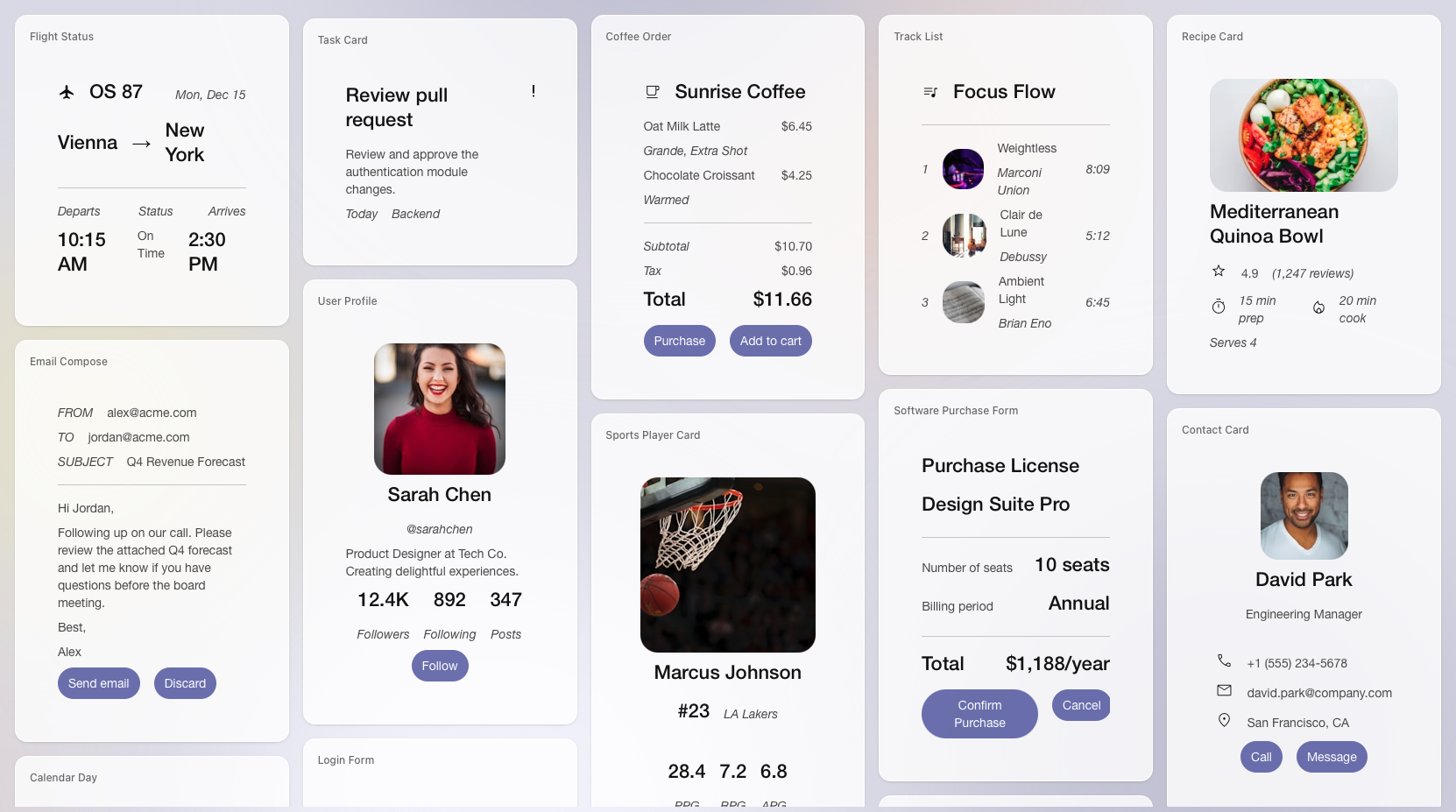
 A2UI is an open protocol and set of libraries that let AI agents send a declarative JSON description of a UI, which client apps render using their own native components (Flutter, Angular, Lit, React, etc.) instead of executing agent-generated code.
A2UI is an open protocol and set of libraries that let AI agents send a declarative JSON description of a UI, which client apps render using their own native components (Flutter, Angular, Lit, React, etc.) instead of executing agent-generated code.Is this a UI framework or more like a data protocol?It's a protocol/data format, not a rendering framework: agents emit a flat JSON list of components with ID references, and the client maps that abstract description to its own native widget library.
It's a protocol/data format, not a rendering framework: agents emit a flat JSON list of components with ID references, and the client maps that abstract description to its own native widget library.How do I try it out?Easiest no-install option is the A2UI Composer or Theater demos; for a full local run, try the Quickstart Restaurant Finder demo which spins up a Gemini-powered ADK agent with a Lit renderer, or scaffold an AG-UI app for your framework via the AG-UI CLI.
Easiest no-install option is the A2UI Composer or Theater demos; for a full local run, try the Quickstart Restaurant Finder demo which spins up a Gemini-powered ADK agent with a Lit renderer, or scaffold an AG-UI app for your framework via the AG-UI CLI.What do I need installed to run the Restaurant Finder demo?Node.js 18+ with Corepack enabled, uv, and a Gemini API key.
Node.js 18+ with Corepack enabled, uv, and a Gemini API key.Is the spec stable enough to build on right now?No — it's an early-stage public preview on protocol v0.9.1 (v0.8 is legacy, v1.0 is only a release candidate), so breaking changes are expected.
No — it's an early-stage public preview on protocol v0.9.1 (v0.8 is legacy, v1.0 is only a release candidate), so breaking changes are expected.Which frameworks can actually render A2UI today?Officially Web (Lit/Angular/React via demos) and Flutter (through the GenUI SDK) are supported now; React, Jetpack Compose, and SwiftUI are on the roadmap.
Officially Web (Lit/Angular/React via demos) and Flutter (through the GenUI SDK) are supported now; React, Jetpack Compose, and SwiftUI are on the roadmap.How does A2UI keep agent-generated UIs safe to render?The client maintains a catalog of trusted, pre-approved components (e.g. Card, Button, TextField), and the agent can only request components from that catalog rather than sending executable code.
The client maintains a catalog of trusted, pre-approved components (e.g. Card, Button, TextField), and the agent can only request components from that catalog rather than sending executable code.Can an agent update the UI mid-conversation instead of regenerating it?Yes, the UI is a flat list of components with ID references, which is easy for LLMs to generate incrementally and allows progressive, responsive updates as the conversation continues.
Yes, the UI is a flat list of components with ID references, which is easy for LLMs to generate incrementally and allows progressive, responsive updates as the conversation continues.How does A2UI connect to agent transports like A2A?A2UI payloads are transport-agnostic and are sent over existing agent communication protocols such as A2A Protocol and AG-UI, so any model that can output JSON can drive it.
A2UI payloads are transport-agnostic and are sent over existing agent communication protocols such as A2A Protocol and AG-UI, so any model that can output JSON can drive it.What is a 'Smart Wrapper' in A2UI?It's a registry pattern that lets developers map server-side component types to custom client implementations, such as native widgets, React components, or sandboxed iframes, while keeping security policy in the developer's hands.
It's a registry pattern that lets developers map server-side component types to custom client implementations, such as native widgets, React components, or sandboxed iframes, while keeping security policy in the developer's hands.What are similar projects?tambo, CopilotKit, turnstone, OpenIntelligentUI, qwen-code, harness-sdk, awesome-llm-apps, pizza-bot
tambo, CopilotKit, turnstone, OpenIntelligentUI, qwen-code, harness-sdk, awesome-llm-apps, pizza-botWhich topics is it in?generative-ui, langgraph, protocol, json, ui-components, agentic-ai, gemini, sdk, multi-agent, agents, web-app, framework
generative-ui, langgraph, protocol, json, ui-components, agentic-ai, gemini, sdk, multi-agent, agents, web-app, framework