✨ Features
- ✅ Multi-agent - Run multiple isolated AI agents with specialized roles
- ✅ Multi-team collaboration - Agents hand off work to teammates via chain execution and fan-out
- ✅ Multi-channel - Discord, WhatsApp, and Telegram
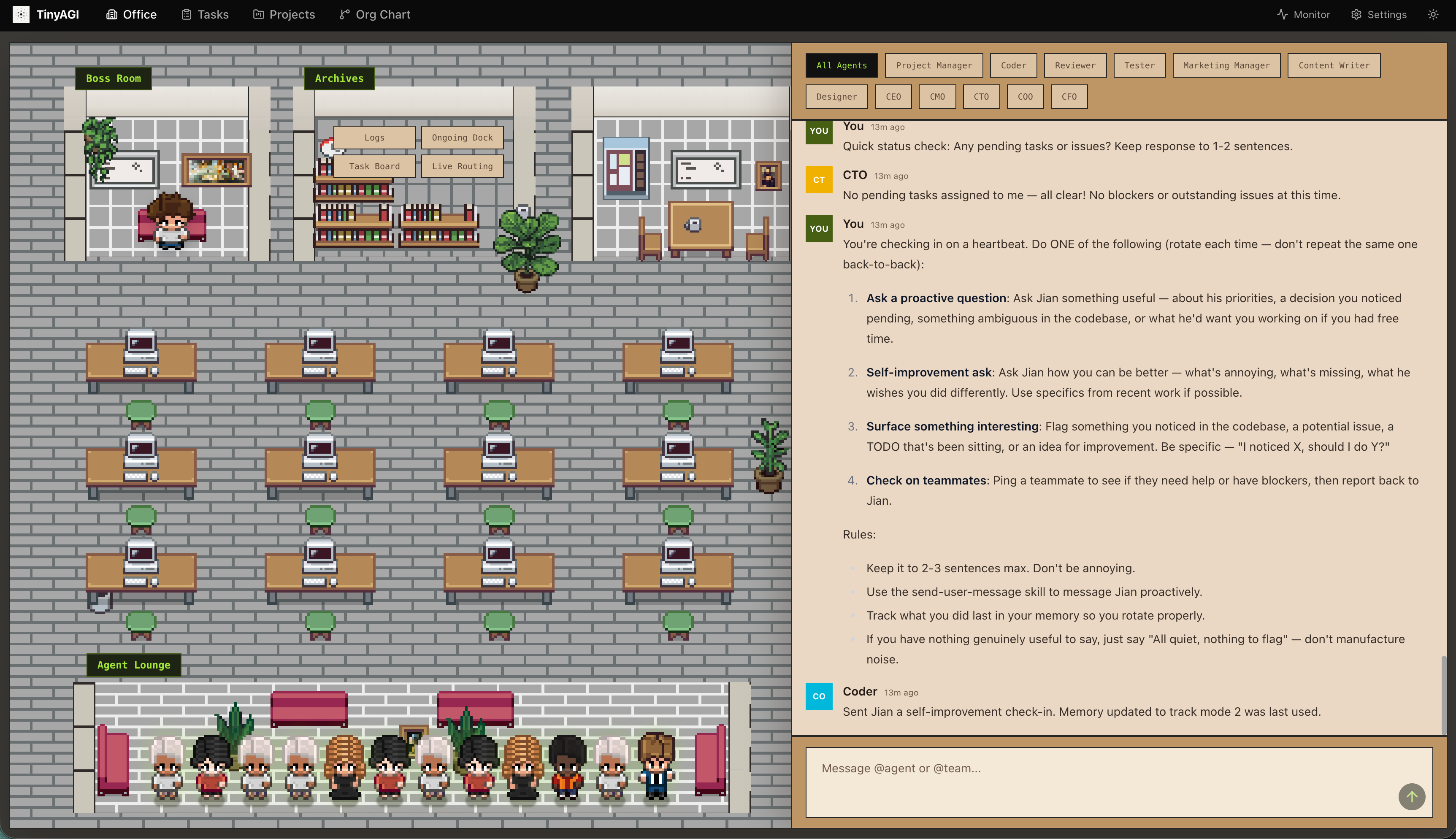
- ✅ Web portal (TinyOffice) - Browser-based dashboard for chat, agents, teams, tasks, logs, and settings
- ✅ Team chat rooms - Persistent async chat rooms per team with real-time CLI viewer
- ✅ Multiple AI providers - Anthropic Claude, OpenAI Codex, and custom providers (any OpenAI/Anthropic-compatible endpoint)
- ✅ Auth token management - Store API keys per provider, no separate CLI auth needed
- ✅ Parallel processing - Agents process messages concurrently
- ✅ Live TUI dashboard - Real-time team visualizer and chatroom viewer
- ✅ Persistent sessions - Conversation context maintained across restarts
- ✅ SQLite queue - Atomic transactions, retry logic, dead-letter management
- ✅ Plugin system - Extend TinyAGI with custom plugins for message hooks and event listeners
- ✅ 24/7 operation - Runs as a background process or Docker container
Discord
We are actively looking for contributors. Please reach out.
🚀 Quick Start
Prerequisites
Installation & First Run
curl -fsSL https://raw.githubusercontent.com/TinyAGI/tinyagi/main/scripts/install.sh | bash
This downloads and installs the tinyagi command globally. Then just run:
tinyagi
That's it. TinyAGI auto-creates default settings, starts the daemon, and opens TinyOffice in your browser. No wizard, no configuration needed.
- Default workspace:
~/tinyagi-workspace
- Default agent:
tinyagi (Anthropic/Opus)
- Channels: none initially — add later with
tinyagi channel setup
Development (run from source repo)
git clone https://github.com/TinyAGI/tinyagi.git
cd tinyagi && npm install && npm run build
npx tinyagi start
npx tinyagi agent list
Other installation methods
From Source:
git clone https://github.com/TinyAGI/tinyagi.git
cd tinyagi && npm install && ./scripts/install.sh
🐳 Docker
docker compose up -d
Set your API key in a .env file or pass it directly:
ANTHROPIC_API_KEY=sk-ant-... docker compose up -d
The API runs on http://localhost:3777. Data is persisted in a tinyagi-data Docker volume.
📱 Channel Setup Guides
Discord Setup
- Go to Discord Developer Portal
- Create application → Bot section → Create bot
- Copy bot token
- Enable "Message Content Intent"
- Invite bot using OAuth2 URL Generator
Telegram Setup
- Open Telegram → Search
@BotFather
- Send
/newbot → Follow prompts
- Copy bot token
- Start chat with your bot
WhatsApp Setup
After starting TinyAGI, scan the QR code:
━━━━━━━━━━━━━━━━━━━━━━━━━━━━━━━━━━━
     WhatsApp QR Code
━━━━━━━━━━━━━━━━━━━━━━━━━━━━━━━━━━━
[QR CODE HERE]

📱 Settings → Linked Devices → Link a Device
🌐 TinyOffice Web Portal
TinyAGI includes a web portal for managing your agents, teams, tasks, and chat — all from the browser.
Once you start running TinyAGI locally, you can control it by visiting office.tinyagicompany.com. It connects to your local TinyAGI API at localhost:3777 — no account or sign-up needed.
Alternatively, you can run TinyOffice locally:
tinyagi office # Builds and starts on http://localhost:3000
TinyOffice Features & Setup
- Dashboard - Real-time queue/system overview and live event feed
- Chat Console - Send messages to default agent,
@agent, or @team
- Agents & Teams - Create, edit, and remove agents/teams
- Tasks (Kanban) - Create tasks, drag across stages, assign to agent/team
- Logs & Events - Inspect queue logs and streaming events
- Settings - Edit TinyAGI configuration (
settings.json) via UI
- Office View - Visual simulation of agent interactions
- Org Chart - Hierarchical visualization of teams and agents
- Chat Rooms - Slack-style persistent chat rooms per team
- Projects - Project-level task management with filtered kanban boards
Running Locally
Start TinyAGI first (API default: http://localhost:3777), then:
tinyagi office
This auto-detects when dependencies or builds are needed (e.g. after tinyagi update) and starts the production server on http://localhost:3000.
For development with hot-reload:
cd tinyoffice
npm install
npm run dev
If TinyAGI API is on a different host/port, set:
cd tinyoffice
echo 'NEXT_PUBLIC_API_URL=http://localhost:3777' > .env.local
📋 Commands
Commands work with the tinyagi CLI.
Core Commands
| Command |
Description |
Example |
| (no command) |
Install, configure defaults, start, and open TinyOffice |
tinyagi |
start |
Start TinyAGI daemon |
tinyagi start |
stop |
Stop all processes |
tinyagi stop |
restart |
Restart TinyAGI |
tinyagi restart |
status |
Show current status and activity |
tinyagi status |
channel setup |
Configure channels interactively |
tinyagi channel setup |
logs [type] |
View logs (discord/telegram/whatsapp/queue/heartbeat/all) |
tinyagi logs queue |
Agent Commands
| Command |
Description |
Example |
agent list |
List all configured agents |
tinyagi agent list |
agent add |
Add new agent (interactive) |
tinyagi agent add |
agent show <id> |
Show agent configuration |
tinyagi agent show coder |
agent remove <id> |
Remove an agent |
tinyagi agent remove coder |
agent reset <id> |
Reset agent conversation |
tinyagi agent reset coder |
agent provider <id> [provider] |
Show or set agent's AI provider |
tinyagi agent provider coder anthropic |
agent provider <id> <p> --model <m> |
Set agent's provider and model |
tinyagi agent provider coder openai --model gpt-5.3-codex |
Team Commands
| Command |
Description |
Example |
team list |
List all configured teams |
tinyagi team list |
team add |
Add new team (interactive) |
tinyagi team add |
team show <id> |
Show team configuration |
tinyagi team show dev |
team remove <id> |
Remove a team |
tinyagi team remove dev |
team add-agent <t> <a> |
Add an existing agent to a team |
tinyagi team add-agent dev reviewer |
team remove-agent <t> <a> |
Remove an agent from a team |
tinyagi team remove-agent dev reviewer |
team visualize [id] |
Live TUI dashboard for team chains |
tinyagi team visualize dev |
Chatroom Commands
| Command |
Description |
Example |
chatroom <team> |
Real-time TUI viewer with type-to-send |
tinyagi chatroom dev |
office |
Start TinyOffice web portal on port 3000 |
tinyagi office |
Every team has a persistent chat room. Agents post to it using [#team_id: message] tags, and messages are broadcast to all teammates. The chatroom viewer polls for new messages in real time — type a message and press Enter to post, or press q/Esc to quit.
API endpoints:
GET  /api/chatroom/:teamId          # Get messages (?limit=100&since=0)
POST /api/chatroom/:teamId          # Post a message (body: { "message": "..." })
Provider & Custom Provider Commands
| Command |
Description |
Example |
provider [name] |
Show or switch global AI provider |
tinyagi provider anthropic |
provider <name> --model <model> |
Switch provider and model; propagates to matching agents |
tinyagi provider openai --model gpt-5.3-codex |
provider <name> --oauth-token <token> |
Store OAuth token for a built-in provider |
tinyagi provider anthropic --oauth-token sk-ant-oat01-... |
provider list |
List all custom providers |
tinyagi provider list |
provider add |
Add a new custom provider (interactive) |
tinyagi provider add |
provider remove <id> |
Remove a custom provider |
tinyagi provider remove proxy |
model [name] |
Show or switch AI model |
tinyagi model opus |
Custom provider details
Custom providers let you use any OpenAI or Anthropic-compatible API endpoint (e.g., OpenRouter, proxy servers, self-hosted models).
Define a custom provider in settings.json:
{
  "custom_providers": {
    "my-proxy": {
      "name": "My Proxy",
      "harness": "claude",
      "base_url": "https://proxy.example.com/v1",
      "api_key": "sk-...",
      "model": "claude-sonnet-4-6"
    }
  }
}
| Field |
Required |
Description |
name |
Yes |
Human-readable display name |
harness |
Yes |
CLI to use: claude or codex |
base_url |
Yes |
API endpoint URL |
api_key |
Yes |
API key for authentication |
model |
No |
Default model name for CLI |
Assign a custom provider to an agent:
tinyagi agent provider coder custom:my-proxy
tinyagi agent provider coder custom:my-proxy --model gpt-4o
Auth token storage — store credentials for built-in providers so you don't need separate CLI auth:
tinyagi provider anthropic --oauth-token sk-ant-oat01-...
tinyagi provider anthropic --api-key sk-ant-...
tinyagi provider openai --api-key sk-...
Anthropic supports both oauth_token (exported as CLAUDE_CODE_OAUTH_TOKEN) and api_key (exported as ANTHROPIC_API_KEY). OAuth takes priority if both are set. OpenAI keys are saved as models.openai.api_key and exported as OPENAI_API_KEY. If nothing is configured, the process inherits environment variables directly.
API endpoints:
GET    /api/custom-providers              # List custom providers
PUT    /api/custom-providers/:id          # Create or update
DELETE /api/custom-providers/:id          # Delete
See docs/AGENTS.md for more details.
Pairing commands
Use sender pairing to control who can message your agents.
| Command |
Description |
Example |
pairing pending |
Show pending sender approvals (with pairing codes) |
tinyagi pairing pending |
pairing approved |
Show approved senders |
tinyagi pairing approved |
pairing list |
Show both pending and approved senders |
tinyagi pairing list |
pairing approve <code> |
Move a sender from pending to approved by code |
tinyagi pairing approve ABCD1234 |
pairing unpair <channel> <sender_id> |
Remove an approved sender from the allowlist |
tinyagi pairing unpair telegram 1234567 |
Pairing behavior:
- First message from unknown sender: TinyAGI generates a code and sends approval instructions.
- Additional messages while still pending: TinyAGI blocks silently (no repeated pairing message).
- After approval: messages from that sender are processed normally.
Messaging & in-chat commands
| Command |
Description |
Example |
send <message> |
Send message to AI manually |
tinyagi send "Hello!" |
send <message> |
Route to specific agent |
tinyagi send "@coder fix bug" |
These commands work in Discord, Telegram, and WhatsApp:
| Command |
Description |
Example |
@agent_id message |
Route message to specific agent |
@coder fix the bug |
@team_id message |
Route message to team leader |
@dev fix the auth bug |
/agent |
List all available agents |
/agent |
/team |
List all available teams |
/team |
@agent_id /reset |
Reset specific agent conversation |
@coder /reset |
/reset |
Reset conversation (WhatsApp/global) |
/reset or !reset |
/restart |
Restart TinyAGI process |
/restart |
message |
Send to default agent (no prefix) |
help me with this |
Note: The @agent_id routing prefix requires a space after it (e.g., @coder fix not @coderfix).
Access control note: before routing, channel clients apply sender pairing allowlist checks.
Update commands
| Command |
Description |
Example |
update |
Update TinyAGI to latest version |
tinyagi update |
Note: If you are on v0.0.1 or v0.0.2, the update script was broken. Please re-install instead:
curl -fsSL https://raw.githubusercontent.com/TinyAGI/tinyagi/main/scripts/install.sh | bash
Your settings and user data will be preserved.
Auto-detection: TinyAGI checks for updates on startup (once per hour).
Disable update checks:
export TINYAGI_SKIP_UPDATE_CHECK=1
Configuration commands
| Command |
Description |
Example |
reset |
Reset all conversations |
tinyagi reset |
channels reset <chan> |
Reset channel authentication |
tinyagi channels reset whatsapp |
🤖 Using Agents
Use @agent_id prefix to route messages to specific agents:
@coder fix the authentication bug
@writer document the API endpoints
help me with this  ← goes to tinyagi agent (no prefix needed)
Agent configuration
Agents are configured in .tinyagi/settings.json:
{
  "agents": {
    "coder": {
      "name": "Code Assistant",
      "provider": "anthropic",
      "model": "sonnet",
      "working_directory": "/Users/me/tinyagi-workspace/coder"
    },
    "writer": {
      "name": "Technical Writer",
      "provider": "custom:my-proxy",
      "model": "gpt-5.3-codex",
      "working_directory": "/Users/me/tinyagi-workspace/writer"
    }
  }
}
Each agent operates in isolation:
- Separate workspace directory -
~/tinyagi-workspace/{agent_id}/
- Own conversation history - Maintained by CLI
- Custom configuration -
.claude/, heartbeat.md (root), AGENTS.md
- Independent resets - Reset individual agent conversations
See docs/AGENTS.md for full details on architecture, use cases, and advanced features.
📐 Architecture
Message flow diagram
┌─────────────────────────────────────────────────────────────┐
│                     Message Channels                         │
│         (Discord, Telegram, WhatsApp, Web, API)             │
└────────────────────┬





 TinyAGI 是一个开源的编排器(orchestrator),可以把多支 AI 智能体团队当作 24 小时全天候助手来运行,面向一人公司。各个智能体在相互隔离的工作区里工作,并把任务互相交接,你可以通过 Discord、WhatsApp、Telegram 或网页门户联系它们。