









What is this?
 RT-Thread is an open source, community-based real-time operating system (RTOS) for embedded and IoT devices, mainly written in C.
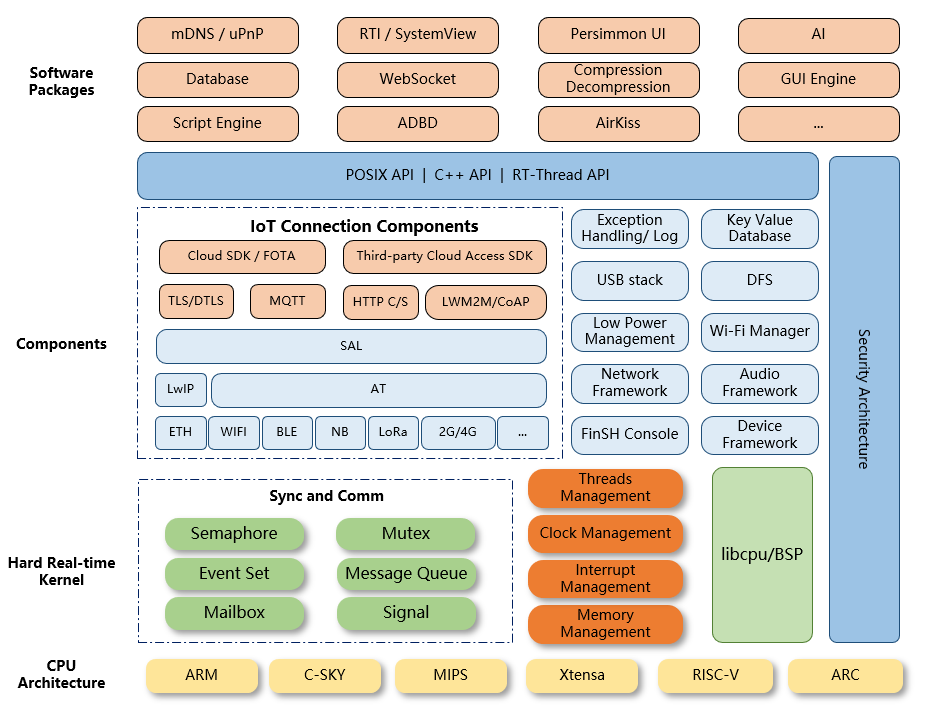
RT-Thread is an open source, community-based real-time operating system (RTOS) for embedded and IoT devices, mainly written in C.Is this a full OS or just a kernel library?It is a full RTOS with a real-time kernel plus a rich components and service layer (filesystem, network stack, device framework) and an online software package ecosystem of 450+ packages.
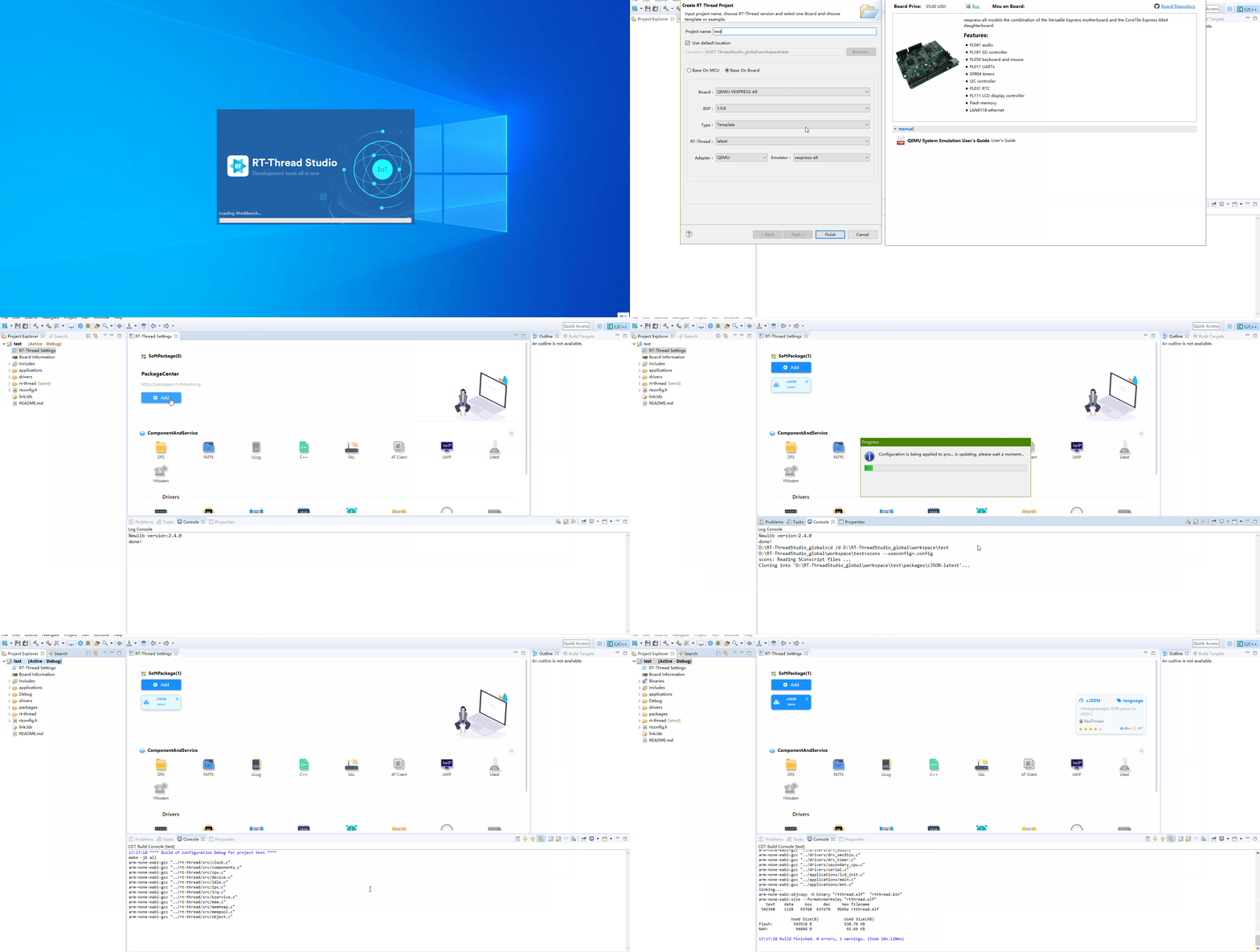
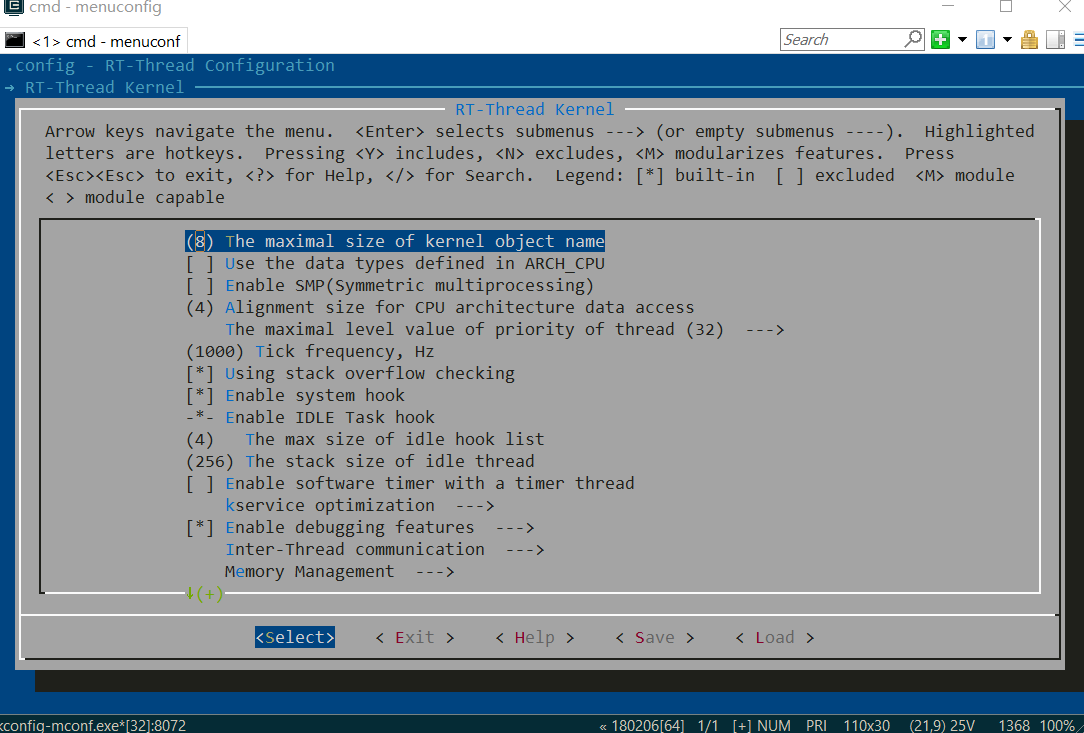
It is a full RTOS with a real-time kernel plus a rich components and service layer (filesystem, network stack, device framework) and an online software package ecosystem of 450+ packages.How do I get started building and running RT-Thread?You can flash a BSP directly to a supported development board, or use the RT-Thread Studio IDE or the Env TUI tool to configure and generate GCC/Keil MDK/IAR projects; there's also a qemu-vexpress-a9 BSP to try it without hardware.
You can flash a BSP directly to a supported development board, or use the RT-Thread Studio IDE or the Env TUI tool to configure and generate GCC/Keil MDK/IAR projects; there's also a qemu-vexpress-a9 BSP to try it without hardware.Which compilers and architectures does it support?It supports mainstream toolchains GCC, Keil MDK and IAR, and has been ported to ARM Cortex-M/A, ARM7/9/11, MIPS32, RISC-V, ARC, DSP, C-Sky and x86 across ~200 development boards.
It supports mainstream toolchains GCC, Keil MDK and IAR, and has been ported to ARM Cortex-M/A, ARM7/9/11, MIPS32, RISC-V, ARC, DSP, C-Sky and x86 across ~200 development boards.How small can it be squeezed down for a tiny microcontroller?The Nano version needs only about 3KB Flash and 1.2KB RAM, so it can run even on very resource-constrained MCUs, while the Standard version supports richer package-based functionality for IoT devices.
The Nano version needs only about 3KB Flash and 1.2KB RAM, so it can run even on very resource-constrained MCUs, while the Standard version supports richer package-based functionality for IoT devices.Who is this aimed at — hobbyists or production embedded developers?It targets embedded/IoT firmware developers building on MCUs and SoCs for both resource-constrained devices and richer IoT products, from hobbyist boards like Raspberry Pi Pico to commercial chip platforms.
It targets embedded/IoT firmware developers building on MCUs and SoCs for both resource-constrained devices and richer IoT products, from hobbyist boards like Raspberry Pi Pico to commercial chip platforms.Can I use this commercially without releasing my source code?Yes, RT-Thread is licensed under Apache License 2.0, which is fully open source, free for commercial use, and does not require disclosing your code.
Yes, RT-Thread is licensed under Apache License 2.0, which is fully open source, free for commercial use, and does not require disclosing your code.What does the package ecosystem actually give me?Through an online software package management tool you can pull in reusable modules for things like graphical interfaces similar to Android, touch sliding effects, and smart voice interaction, letting you build complex IoT features quickly instead of writing them from scratch.
Through an online software package management tool you can pull in reusable modules for things like graphical interfaces similar to Android, touch sliding effects, and smart voice interaction, letting you build complex IoT features quickly instead of writing them from scratch.Does RT-Thread support object-oriented design in C?Yes, it applies object-oriented programming methods to its real-time system design, which keeps the kernel code structured, modular, and easy to tailor despite being written in plain C.
Yes, it applies object-oriented programming methods to its real-time system design, which keeps the kernel code structured, modular, and easy to tailor despite being written in plain C.Are there standard API interfaces like POSIX?Yes, RT-Thread offers a variety of standard interfaces including POSIX, CMSIS, and a C++ application environment, making it easier to port existing code or developer skills onto it.
Yes, RT-Thread offers a variety of standard interfaces including POSIX, CMSIS, and a C++ application environment, making it easier to port existing code or developer skills onto it.How is the source code organized?The repository splits into folders like bsp (board support packages), components (shell, filesystem, protocol stacks), libcpu (CPU porting for ARM/MIPS/RISC-V), include (kernel headers), src (kernel source), and tools (build scripts).
The repository splits into folders like bsp (board support packages), components (shell, filesystem, protocol stacks), libcpu (CPU porting for ARM/MIPS/RISC-V), include (kernel headers), src (kernel source), and tools (build scripts).What are similar projects?zephyr, linux, mu300-linux, micropython, muse-gadget-sdk, openwrt, tinygo, arduino-esp32
zephyr, linux, mu300-linux, micropython, muse-gadget-sdk, openwrt, tinygo, arduino-esp32Which topics is it in?rtos, microkernel, risc-v, driver, arm, microcontroller, embedded-systems, operating-system, kernel, iot, embedded, hardware
rtos, microkernel, risc-v, driver, arm, microcontroller, embedded-systems, operating-system, kernel, iot, embedded, hardware