SenseNova-Skills
English | 简体中文
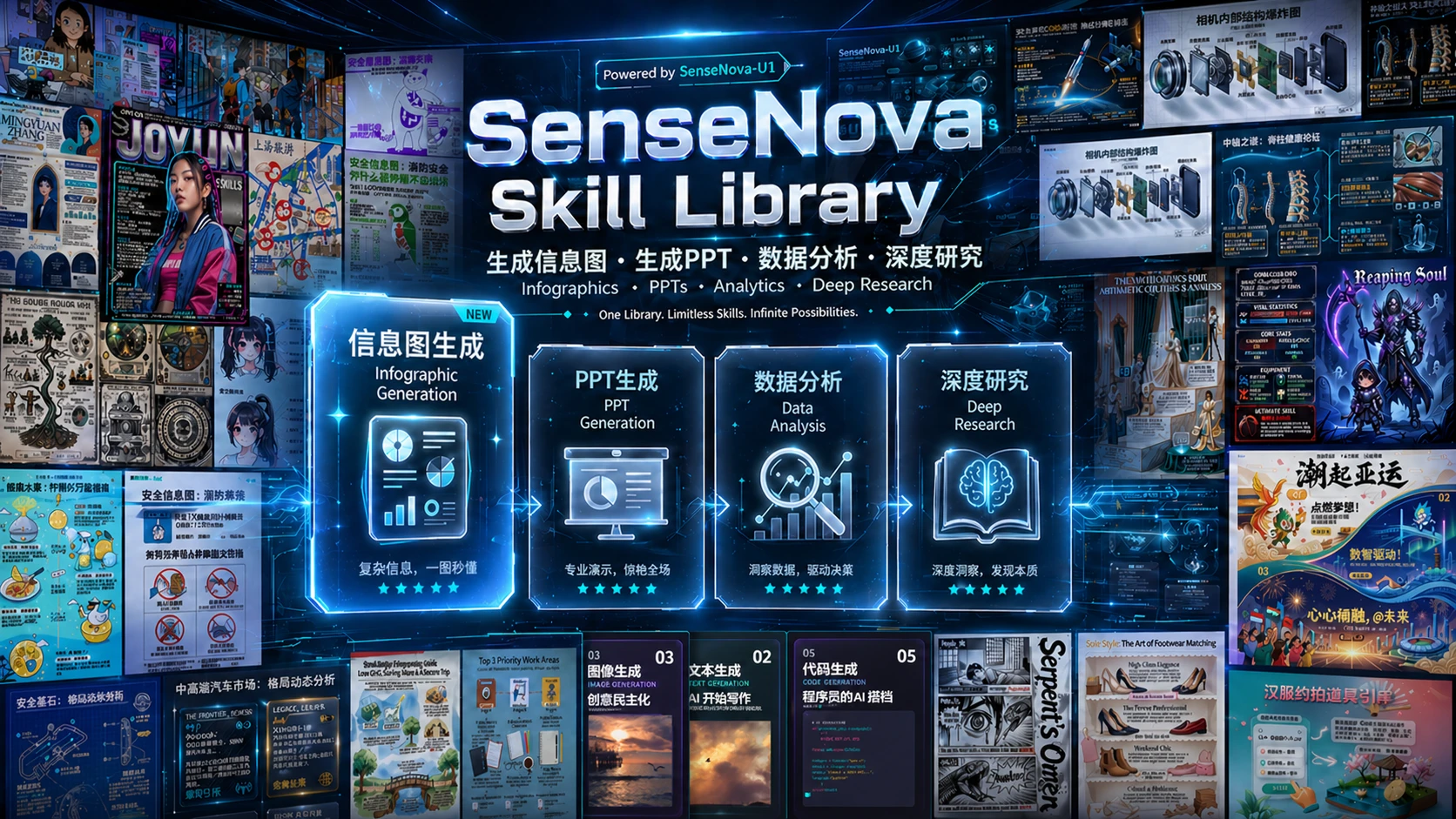





The SenseNova model family plugs directly into agent runtimes such as OpenClaw and hermes-agent, with the skills in this repository extending the models with concrete, end-to-end office capabilities.
In this repository each skill lives in its own directory and declares triggers, capabilities, and execution flow through a SKILL.md file, following the Agent Skills convention.
The skills cover image generation & visualization, slide-deck (PPT) generation, Excel data analysis, and deep research — usable standalone or composed into end-to-end workflows.
🎨 Want to see what it can do? Check out our sn-infographic Gallery to explore nearly 100 stunning generation cases and steal their prompt designs !
🦝 Available out-of-the-box in Raccoon
The latest SenseNova models and the full Cowork-Skill suite in this repo are bundled into Raccoon, with enterprise-grade security and a zero-setup experience — if you'd rather not provision env, API keys, and runtimes yourself, you can use these capabilities directly through Raccoon. Free trial available — no payment required to get started.
Raccoon now ships a full upgrade across product capability and client experience:
- Three core office capabilities, strengthened: powered by SenseNova 6.7 Flash + Cowork-Skill, data analysis, PPT generation, and task planning each take a step up — covering the full loop from multi-file cleaning/analysis to formal report decks, industry/competitive research, and investment memos.
- New: infographic generation: built on the SenseNova U1 model, compresses complex data, long reports, and business insights into dense, structured, visual infographics that are easier to digest and share.
- New client + local Agent OS: the cloud model handles heavy reasoning and multimodal understanding; the local Agent OS sits next to your files, work context, and personal habits — delivering a more personalized, local, and secure AI-native office experience.
- Proven at scale: chosen by 15M+ individual users and thousands of enterprise customers.
👉 Try it: xiaohuanxiong.com
How to Use
These skills are designed to run inside an Agent Skills-compatible agent.
This repo documents both the international and mainland China SenseNova API flows. Make sure the docs page, API key, base URL, and model name all come from the same region.
Recommended: let the agent install the skills for you. Hand it the repo URL and ask it to clone and drop the skills into the right directory — for example:
"Please install SenseNova-Skills from https://github.com/OpenSenseNova/SenseNova-Skills into your skills directory."
After it finishes, you may need to manually restart the agent service before the new skills are picked up.
Prefer to install manually?
Clone this repository, then copy the subdirectories under skills/ into the target directory yourself:
git clone https://github.com/OpenSenseNova/SenseNova-Skills.git --depth=1
mkdir -p ~/.openclaw/skills
cp -r SenseNova-Skills/skills/* ~/.openclaw/skills/
For Hermes, swap the target to ~/.hermes/skills/.
Per-category Python dependencies, API keys, and invocation examples are documented in the 📖 Full guide for each section.
Skills List
🎨 Image & Visualization
📖 Full guide: docs/sn-image-generate_en.md (prerequisites, Quick Start, API config, and invocation samples).
| Name |
Label |
Description |
sn-image-doctor |
Environment Doctor |
Validates the SenseNova-Skills environment — checks sn-image-base install, Python deps, and required env vars; interactively fills missing values into .env. |
sn-image-base |
Image Base Layer (Tier 0) |
Low-level tools — text-to-image (sn-image-generate), image editing (sn-image-edit), image recognition (sn-image-recognize), and text optimization (sn-text-optimize) — exposed through a unified sn_agent_runner.py, designed to be called by upper-layer skills. |
sn-infographic |
Infographic Generation (Tier 1) |
Auto prompt-quality scoring, layout/style selection (87 layouts / 66 styles), multi-round generation with VLM review and quality ranking, producing publication-ready infographics. |
sn-image-imitate |
Image Imitation (Tier 1) |
Given one reference image and a target content prompt, generates a new image that imitates the reference. |
sn-image-resume |
Resume Image Generation (Tier 1) |
Given resume information, generates a resume image. |
📊 Presentations (PPT)
📖 Full guide: docs/sn-ppt-generate.md (prerequisites, Quick Start, API config, and invocation samples).
| Name |
Label |
Description |
sn-ppt-entry |
PPT Entry Point |
Unified entry point for PPT generation. Asks the user to choose fast, standard, or creative mode, then collects role / audience / scenario / page count. For standard mode, also asks about image sourcing (AI, web search, or none) and chart rendering (U1 infographics or ECharts). Parses uploaded pdf / docx / md / txt, emits task_pack.json + info_pack.json, and dispatches to the chosen mode. |
sn-ppt-doctor |
PPT Environment Doctor |
Environment check for the PPT pipeline — validates sn-image-base, API keys, the Node runtime, and optional deps; writes missing required vars into .env. |
sn-ppt-creative |
PPT Creative Mode |
One full-page 16:9 PNG per slide, generated via sn-image-generate with a per-page composed prompt. Falls back to web image search when T2I generation fails. |
sn-ppt-standard |
PPT Standard & Fast |
style_spec → outline → asset plan + per-slot images + VLM QC → per-page HTML → per-page review → PPTX export. Fast mode builds a complete draft immediately with autonomous decisions, then provides structured refinement suggestions. Supports AI-generated infographics (U1) for diagrams and web image search (Serper) for real photos. |
📈 Data Analysis (DA)
📖 Full guide: docs/sn-data-analysis.md (prerequisites, Quick Start, API config, and invocation samples).
| Name |
Label |
Description |
sn-da-excel-workflow |
Excel Analysis Orchestration |
End-to-end Excel pipeline — multi-sheet read, large-file detection (≥10k rows triggers Parquet), cleaning, conditional filtering, cross-sheet aggregation, and Excel/CSV export. |
sn-da-image-caption |
Image Understanding & Data Extraction |
For image-first inputs — table OCR, chart understanding, screenshot/UI description; parses captions into DataFrames, recreates visualizations, exports Excel/CSV. |
sn-da-large-file-analysis |
High-Performance Large-File Analysis |
Streaming reads for ≥10k-row Excel datasets (openpyxl read_only + iter_rows), Parquet conversion, memory optimization, chunked processing, large-file writes. |
🔬 Deep Research
📖 Full guide: docs/sn-deep-research.md (prerequisites, web_search precheck, Quick Start, and per-stage invocation).
| Name |
Label |
Description |
sn-deep-research |
Deep Research Entry Point |
Mode-aware deep-research orchestrator with parallel research work packages, one-pass quick/normal synthesis, and an auditable heavy workflow, producing final report.md. |
sn-research-report |
Final Report Writing & Editing |
Renders the judgment layer into the final report.md; also handles targeted rewrites — restructuring, polishing, table-augmentation — for an existing draft. |
sn-report-format-discovery |
Presentation-Format Discovery |
Optional standalone format recommendation; sn-deep-research uses a single request-level format string instead of format artifacts. |
sn-prepare-citations |
Citation Rendering |
Post-processes [^source_id] footnotes into numbered citations and appends references from evidence sources. |
sn-md-to-html-report |
Markdown → HTML Report |
Converts the research report.md (or any Markdown doc) into a clean, single-file HTML reading view that opens offline — embedded images, side-panel TOC, responsive tables, and table-delimiter repair. |
🔍 Search
📖 Search skills are documented together with deep research: docs/sn-deep-research.md (includes per-platform API keys, invocation, and unified JSON output).
| Name |
Label |
Description |
sn-search-academic |
Academic Search |
ArXiv (with section-level HTML reading) / Semantic Scholar (with citation counts) / PubMed (with PMC open-access full text) / Wikipedia, in one aggregated interface. |
sn-search-code |
Developer Search |
GitHub (repo / code / issue) / Stack Overflow / Hacker News / HuggingFace (models / datasets / spaces), aggregated. |
sn-search-social-cn |
Chinese Social Search |
Bilibili / Zhihu / Douyin search; some platforms require cookie auth. |
sn-search-social-en |
English Social Search |
Reddit / Twitter (X) / YouTube search. |
Sample Outputs
🎨 Infographic (sn-infographic)
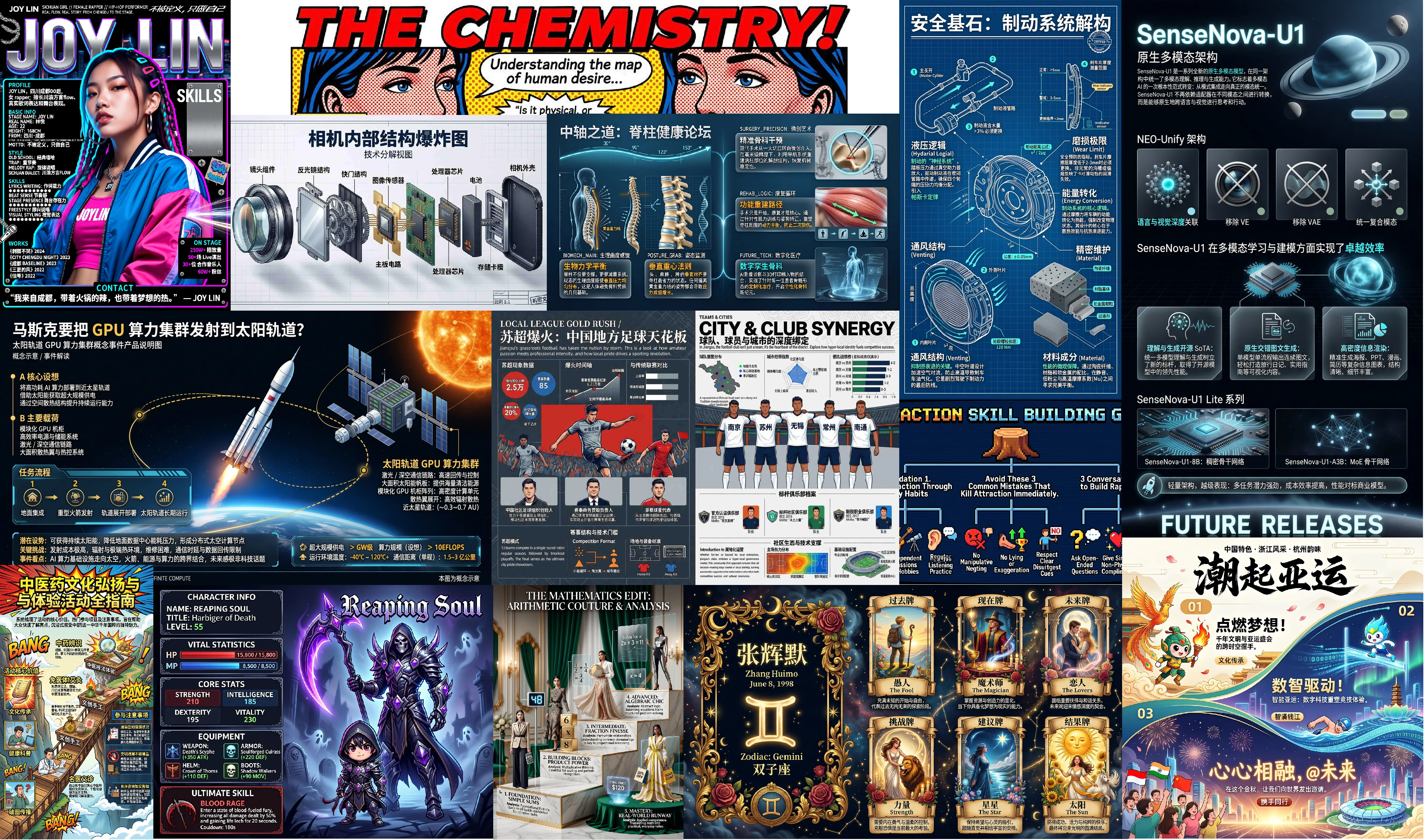
A few sn-infographic outputs (more in docs/sn-infographic-examples.md).
🧩 Memory price analysis — insight → analysis → presentation → end-to-end workflow
examples/memory-price-end2end-analysis. Starting from a raw quote CSV, the agent profiles fields, normalizes categories and timestamps, then attacks the rally from three angles — overall trend, top movers per category, and the gap between server-grade and consumer-grade SKUs — locating a late-February inflection along the way. Treating those findings as the research question, it switches to deep research: planning per-dimension web searches over supply contraction, AI-server demand, and vendor output discipline, then triaging and cross-checking evidence across sources before committing it to the report. The data and research conclusions are then handed to PPT generation, which lays out a 16-page outline, plans per-slot imagery, renders per-page HTML, runs VLM review, and finally composites screenshots into the PPTX. The result is a clear three-step storyline: prices are rising → here is why → here is what to do. This is the only example that exercises the full data analysis → deep research → PPT chain end-to-end.
examples/employee-performance-analysis. The agent reads 10 separate monthly review xlsx files, aligns column schemas across months and joins them into one longitudinal table. From that table it produces aggregate views — monthly average trend, score-distribution boxplots, grade mix change, and a 38-role ranking — and individual views — top performers, needs-attention, and consistently-improving cohorts plus per-employee year trends. The findings are written up with explicit improvement suggestions tied to specific roles and individuals, backed by 8 supporting charts. The same content is delivered as a Word doc (for distribution) and a visualized HTML report (for browsing). The example shows how sn-da-excel-workflow handles "many small spreadsheets that should be one analysis" rather than a single big file.
🔬 Embodied AI industry research — deep research
examples/embodied-ai-deep-research. Given only an industry name, the agent first commits to a research plan — market size, vendor share, financing, cost structure, development roadmap — instead of jumping straight into search. For each dimension it runs targeted web searches, fetches and reads source pages, and extracts both numeric and qualitative evidence; conflicting figures across sources are explicitly reconciled before being trusted. A synthesis stage organizes per-dimension evidence into a traceable, reader-oriented information structure rather than a stack of disconnected bullets. The output is an illustrated report (Markdown + visualized HTML) with 5 dimension-specific charts. The example shows how sn-deep-research turns "go research X" into a structured plan-then-execute loop with traceable evidence.
🎯 Property fee pricing — PPT generation
examples/property-fee-pricing-ppt. The agent takes a free-form brief — topic (property fee pricing), audience (property staff + committee), 26 pages, black-and-white warm style — and first commits to an outline plus a per-page asset plan that conforms to the style spec. Each slide is then built as semantic per-page HTML rather than free-form image generation: copy, layout, illustrations, icons, and any data charts are reasoned about per slot. Imagery is produced or selected per slot and VLM-checked against the page's intent; each rendered page goes through a review pass with optional rewrite for coherence and copy quality. Final pages are screenshotted and composited into the PPTX, with the per-page HTML kept alongside for direct browser preview or re-editing. The example demonstrates sn-ppt-standard style consistency on a long, prose-heavy deck where every slide must obey the same audience and palette constraints.
FAQ
Common setup and runtime questions (400/401 errors, rate limits, PPT timeouts, infographic quality, model names) are answered in docs/faq.md.
Contribut

 一个面向 SenseNova 模型系列的模块化 Agent Skills 库,为办公助手类智能体提供具体的端到端能力:图像生成与信息图、PPT/幻灯片生成、Excel 数据分析和深度研究。既可以单独使用,也可以串联成工作流。