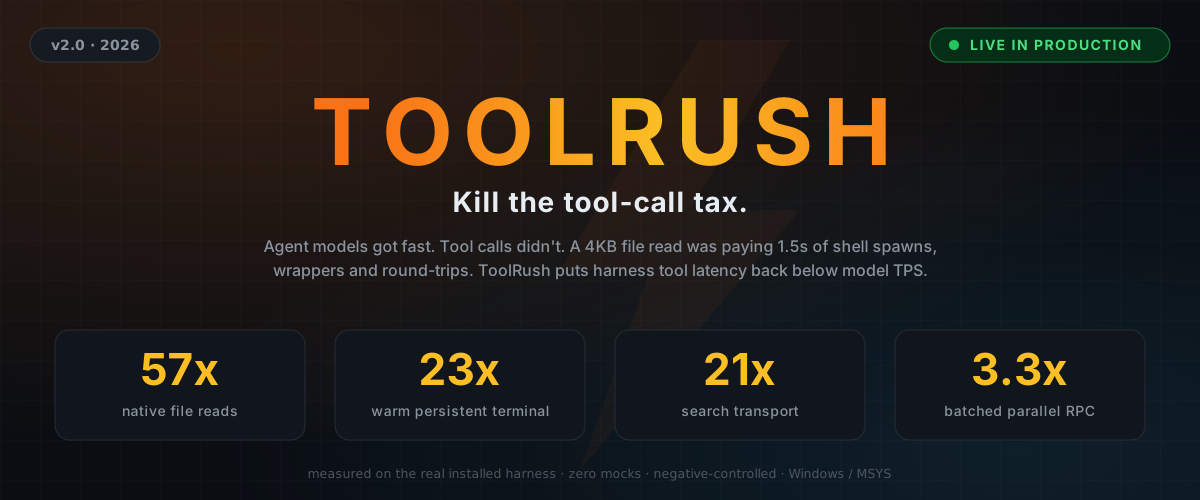




Modern agent models stream tokens faster than their harness can read a file. The bottleneck stopped being tokens/sec — it became the tool-call tax: every read_file, search_files, and terminal call paying process spawns, shell round-trips, wrapper layers, and full re-dispatch for work that costs microseconds.
ToolRush kills the tax. It is a low-overhead execution layer for Hermes Agent: same tools, same output envelopes, same safety gates — radically cheaper transport, plus real batched parallelism and survival across harness updates.
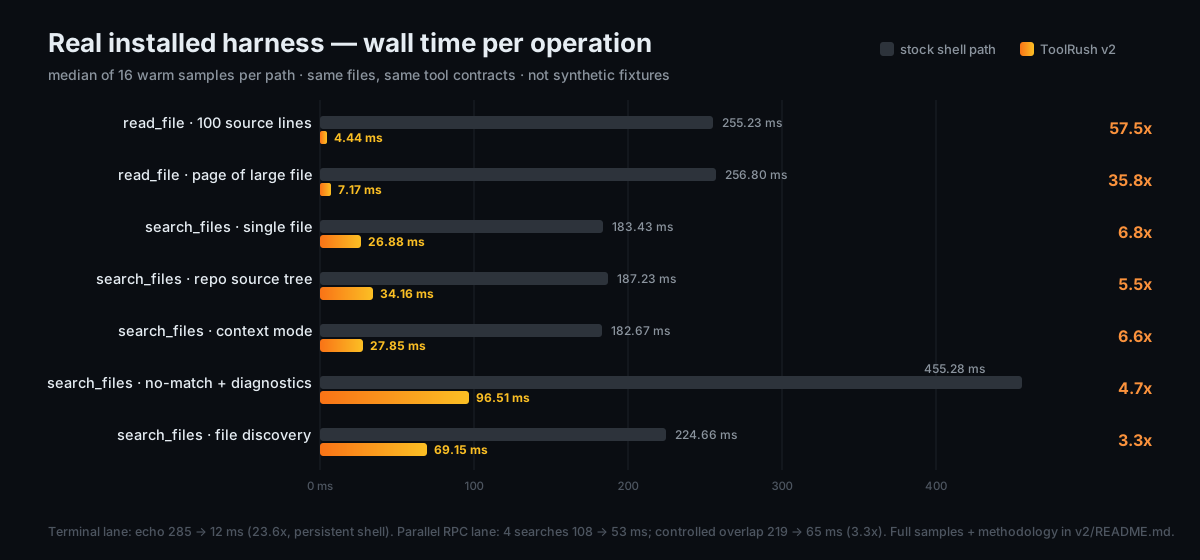
Results (measured on the real installed harness — no mocks, no fixtures)
| Lane |
Before |
After |
Win |
| Native file reads |
255.23 ms |
4.44 ms |
57.5x |
| Warm terminal (persistent shell) |
285 ms |
12.1 ms |
23.6x |
Search transport (direct rg) |
183–455 ms |
27–97 ms |
4.7–6.8x |
| Batched parallel RPC |
108 ms seq |
53 ms batched |
2.1x (3.3x controlled overlap) |
These are tool-operation wall times, not model-inclusive turn speed — the honest framing: tool-heavy turns get dramatically faster, chat-heavy turns barely move. Full samples, p95s, methodology, and one disclosed regression (trivial native reads don't benefit from threading) in v2/README.md.
Architecture
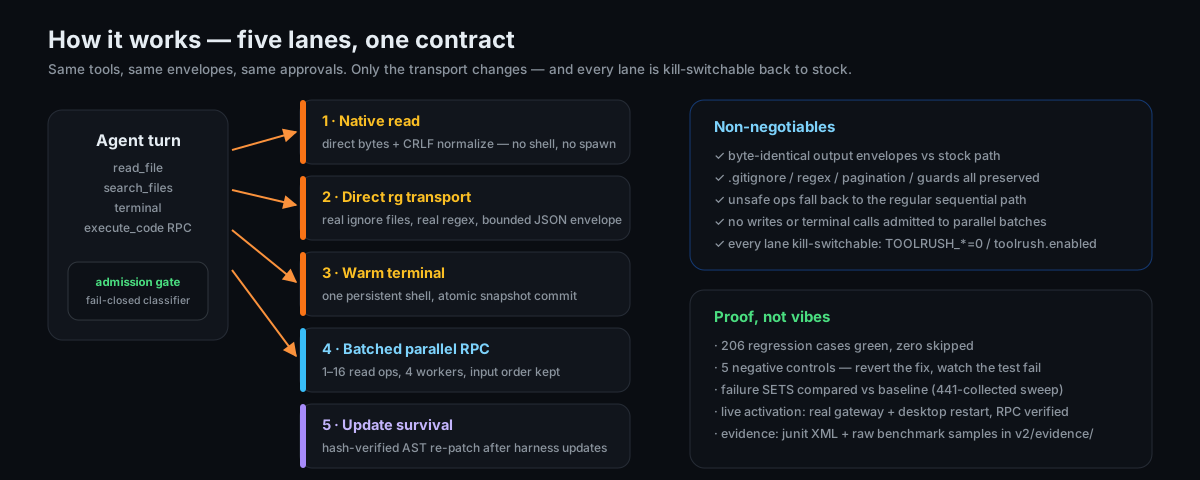
- One search engine, accelerated transport. No second, less-correct reimplementation. Direct
rg.exe execution preserves real ignore files, regex grammar, context flags, and configuration; native Windows reads reuse the upstream bounded reader, access guards, binary/document routing, and output assembler.
- Correctness before speed. Fixed JSON-breaking trailing text in search results; pagination now has stable content order and a more-results sentinel; regex backslashes and leading hyphens stay literal; CRLF and unterminated final lines handled consistently.
- Real programmatic parallelism.
from hermes_tools import parallel — a batch of 1–16 read operations runs on up to 4 workers through one RPC, returns input order, and keeps authentication, tool allowlists, call budgets, and cell retirement fully enforced. Whole invalid batches are rejected before dispatch. No writes, no terminal.
- Correct warm-shell transport. One persistent bash, streaming through an OS pipe with bounded parser memory, a filtered atomic snapshot commit, preserved exit status/cwd/exports, and command-tree kill on cancellation. Never retries a submitted command.
- Hardened scheduler admission. Fail-closed classifier refuses hidden writes (
wget, curl -o, sed w, branch creation, env-wrapped scripts, shared cwd mutations). Admission is not approval: anything refused still runs — just sequentially, the regular way.
- Update survival. Hash-verified helper sources and 25 function-scoped compatibility patches live outside the upstream checkout; after a harness update the plugin restores them in memory, preserving imported references. Unknown upstream drift degrades loudly instead of overwriting new code.
- Diagnostics and rollback.
doctor.py --smoke, per-lane kill-switches (TOOLRUSH_*=0), a master toolrush.enabled: false, source preimages, payload hashes, and a documented runbook.
Verification



- 206 unique regression cases passed, zero failed, zero skipped (deduplicated across three suites).
- Five negative controls each fail for the intended reason when the fix is reverted — native read off, native search off, parallel workers serialized, unsafe admission restored, snapshot commit removed. A test that can't fail proves nothing.
- Failure SETS, not counts, compared against a 441-collected baseline sweep: identical failing IDs before and after.
- Live end-to-end activation: gateway and desktop restarted clean;
parallel RPC exercised inside the real running execute_code kernel; config and provider files verified byte-identical (SHA-256) across the restart.
- Contract verdicts, evidence XMLs, raw benchmark samples, reviewer reports:
v2/evidence/.
Repo layout
| Path |
What |
v2/ |
The shipped implementation — full report, intent recovery, design, MANIFEST (sha256), plugin, installed-source snapshot, evidence |
toolrush.py |
v1 lab runtime (fast_read / batch_read, persistent pool, session cache) |
toolrush_search.py · toolrush_exec.py |
wave-3 in-process search · wave-2 persistent-shell executor |
bench_*.py, dissect_*.py |
the profiling and benchmarking that named the tax |
validation-contract*.md |
VAL- contracts, one per wave (contract-first) |
results.md, *.json |
measured evidence — no invented numbers anywhere |
The origin story: lab waves
Before v2 shipped into the live tree, the tax was found and killed one wave at a time in this repo. Kept for the receipts:
| Wave |
Target |
Result |
| 1 |
read_file dispatch |
1460 ms → 1.18 ms (1237x) — root cause: up to 5 shell commands per read (stat + head|base64 + sed|cut + wc -l + tail); the bytes cost 0.25 ms, the wrapping cost 1460 ms |
| 2 |
terminal spawn tax |
echo 285 ms → 12.1 ms (23.6x) via one persistent bash; win decomposed by negative control into ~8x wrap-trim + ~3x shell persistence |
| 3 |
content search |
900 ms → 42 ms (21.3x) in-process walk + memoized real-guard verdicts; match sets identical 40/40 |
| 4 |
dispatch pipeline |
measured, then STOP — registry 0.005 ms, full path 4.44 ms; the remaining "tax" is load-bearing safety rails. No theater. |
Wave 4's verdict is the project's favorite line: know when to stop. v2 then rebuilt the lab wins as production code — one engine, correct semantics, hardened admission, update survival — because a 21x search that drops .gitignore semantics is a bug with a speedup.
Laws
- Contract before code. Negative control or it didn't happen.
- Live harness trees are never touched from the lab — prototype wins first, then ports behind a kill-switch.
- Byte-identical output vs the stock path, or the lane doesn't ship.
- Fail-closed everywhere: refused acceleration still executes, just the safe sequential way.
- Measured evidence in-repo; no invented numbers, ever.
Built for Hermes Agent by Nous Research · shipped and running live since 2026-09-05.

 ToolRush 是 Hermes Agent(Nous Research 的智能体框架)的低开销执行层插件,能消除文件读取、搜索和终端命令等工具调用的延迟开销,同时保持相同的工具、输出和安全闸门。