












What is this?
 Taro is an open cross-platform, cross-framework solution: write one codebase with React, Vue or Nerv and it runs as WeChat/JD/Baidu/Alipay/ByteDance/QQ mini-programs, H5 web apps, or React Native apps for iOS and Android.
Taro is an open cross-platform, cross-framework solution: write one codebase with React, Vue or Nerv and it runs as WeChat/JD/Baidu/Alipay/ByteDance/QQ mini-programs, H5 web apps, or React Native apps for iOS and Android.Is this a framework I add to a project, or something else?A full framework with its own build toolchain, not a single library: a TypeScript monorepo that compiles one source tree to each target platform, with parts of the compiler written in Rust.
A full framework with its own build toolchain, not a single library: a TypeScript monorepo that compiles one source tree to each target platform, with parts of the compiler written in Rust.How do I start building with it?Follow the 'get started in 5 minutes' quickstart linked in the README: install the Taro CLI globally via npm, scaffold a project, and build for the platform you need; docs are at docs.taro.zone.
Follow the 'get started in 5 minutes' quickstart linked in the README: install the Taro CLI globally via npm, scaffold a project, and build for the platform you need; docs are at docs.taro.zone.What do I need to have before using it?A Node.js environment plus working knowledge of React, Vue or Nerv — a Taro app is ordinary components from those frameworks compiled to each target.
A Node.js environment plus working knowledge of React, Vue or Nerv — a Taro app is ordinary components from those frameworks compiled to each target.What's the catch — anything painful about versions or upgrades?Major upgrades are the main gotcha: there's an official guide for migrating Taro 1/2 projects to Taro 3, and parts of the ecosystem already target Taro 4, so match UI kit versions to your Taro version.
Major upgrades are the main gotcha: there's an official guide for migrating Taro 1/2 projects to Taro 3, and parts of the ecosystem already target Taro 4, so match UI kit versions to your Taro version.Who is this actually for?Front-end teams that need the same product across several mini-program platforms, the web and native mobile — the README notes Taro already runs in production there and across the industry.
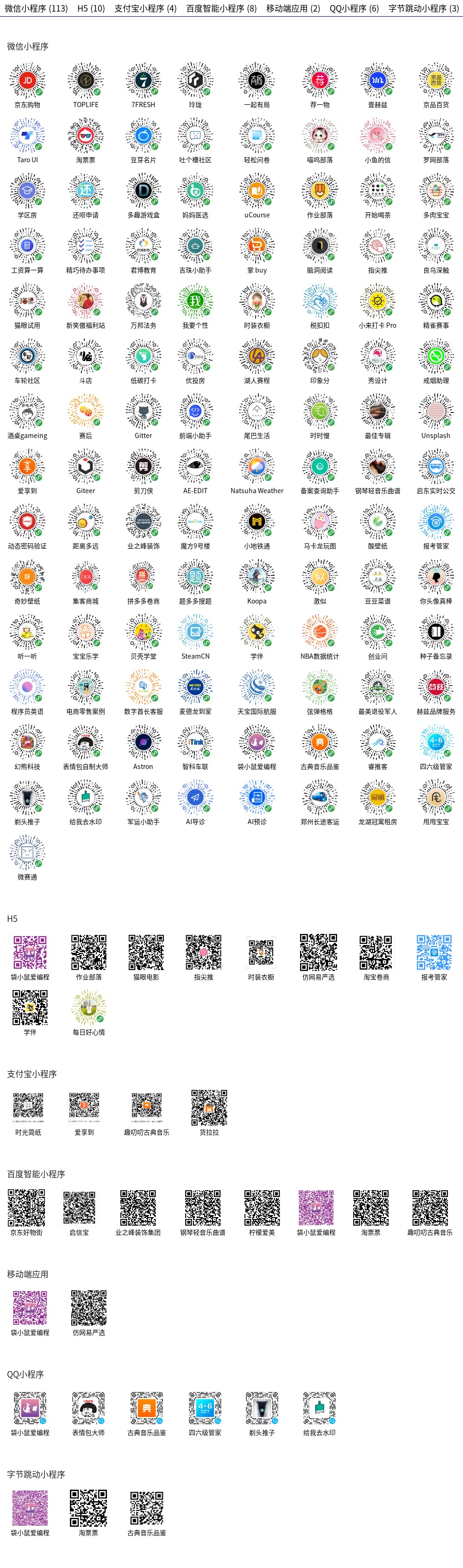
Front-end teams that need the same product across several mini-program platforms, the web and native mobile — the README notes Taro already runs in production there and across the industry.Are there ready-made UI component libraries for Taro?Yes — the README's community table lists taro-ui (React, Taro 1/2/3), NutUI (JD-style, Vue 3), taroify (a Taro port of Vant), @antmjs/vantui, Tard and duxui, covering React and Vue 3 across Taro versions.
Yes — the README's community table lists taro-ui (React, Taro 1/2/3), NutUI (JD-style, Vue 3), taroify (a Taro port of Vant), @antmjs/vantui, Tard and duxui, covering React and Vue 3 across Taro versions.Why write one Taro codebase instead of a separate app per platform?Because maintaining a separate codebase for every end is expensive. The README's pitch: when a business must appear on many ends, a single codebase that adapts to all of them is what's really needed — that's the problem Taro solves.
Because maintaining a separate codebase for every end is expensive. The README's pitch: when a business must appear on many ends, a single codebase that adapts to all of them is what's really needed — that's the problem Taro solves.What is Nerv, one of the supported frameworks?A lightweight React-compatible component library from NervJS, the same organization behind Taro — the README lists it alongside React and Vue as a framework you can write your app in.
A lightweight React-compatible component library from NervJS, the same organization behind Taro — the README lists it alongside React and Vue as a framework you can write your app in.Why is it called Taro?After Ultraman Taro: the README introduces the project with a joke that Taro is the chief instructor of the Universe Guard and the strongest of the Ultramen, pronounced ['tɑ:roʊ].
After Ultraman Taro: the README introduces the project with a joke that Taro is the chief instructor of the Universe Guard and the strongest of the Ultramen, pronounced ['tɑ:roʊ].What are similar projects?formily, CopilotKit, umi, react-navigation, expo, uni-app, moveable, styled-components
formily, CopilotKit, umi, react-navigation, expo, uni-app, moveable, styled-components