Ears for coding agents: let AI hear, review and make sound. CPU-only, open source.
earshot (Leonxlnx/earshot)
Searching Database…
The project's README from github.com/Leonxlnx/earshot. As one markdown file: README.md.
Ears for coding agents.
Watch the 22 s launch film - every sound in it was made
in code by earshot forge; no recordings, no music track.
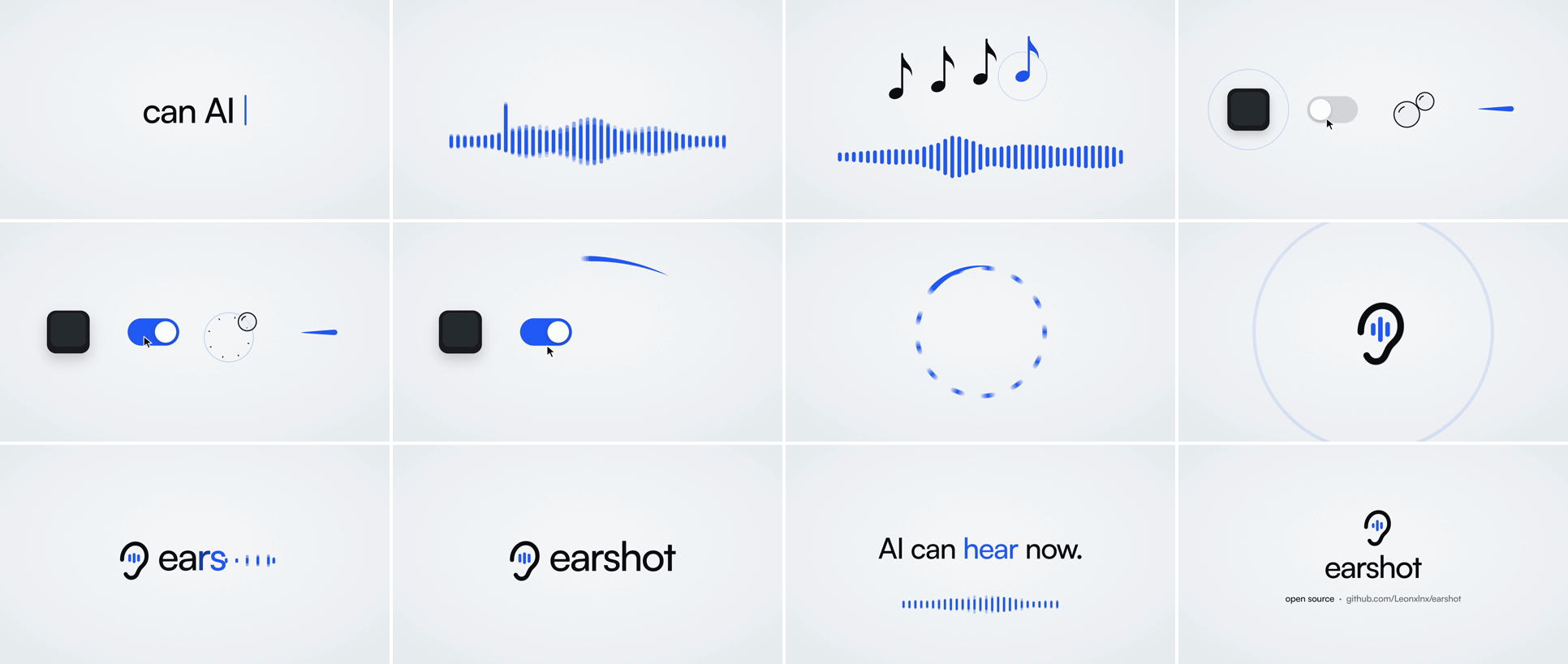
AI coding agents can now write the code that renders a film, a product demo or a game. They still cannot hear what they made. They cannot tell a premium key press from a cheap one, notice that a hit lands 80 ms after the cut, or hear that the music swells in the wrong place.
earshot turns sound into evidence an agent can reason about: what a file sounds like in words, how well it fits a description, the best moment inside a long recording, whether it is a real recording or code-synthesized, a second-by-second listening transcript of a whole film, an annotated picture of it, and a scorecard against professional launch films. It runs locally on CPU, as a CLI, a Python API and an MCP server.
With ears, an agent can also make its own sounds in code and improve them by listening (earshot forge), and
translate a recording into code it can vary (earshot fit). Both below.
$ earshot describe enter.ogg
  0.56 s short transient (attack 3 ms, decays in 190 ms). Sounds most like: a single mechanical keyboard key press
  (z +5.4), a soft key release click (z +3.6) ... [clear reading]. peak -0.1 dBFS, brightness 1.5 kHz ...

$ earshot match key.ogg "a deep thocky mechanical keyboard press" --alts "a clicky blue switch keyboard" "a mouse click"
  -> strong (z +3.7; would rank #2 among 322 vocabulary descriptions) ...

$ earshot find keys.ogg "a single mechanical key press" --top 4
  0:03.94-0:04.19 (0.24 s stroke, z +4.1 strong); 0:10.60-0:10.86 ...

$ earshot critique film.mp4
  VERDICT: close - 21 of 23 scored metrics in range ... FIX FIRST: 1. [major] nothing reaches body level until 0:01.01 ...
| command | what an agent gets |
|---|---|
describe FILE |
what it sounds like: calibrated tags (z) with the closest alternative readings, AudioSet labels, measurements |
match FILE QUERY [--alts ...] |
how well a description fits: cosine, z among the vocabulary, a verdict (strong / plausible / weak / no match) with held-out evidence |
rank QUERY PATHS... |
many candidate files sorted by a description (pick the best download) |
find FILE QUERY |
the best moments inside a long recording, as sample trims (start / end seconds) |
compare FILE --refs DIR / ab A B |
nearest reference recordings and typicality; A/B two sounds or two trims, the differences in words |
realness FILE... |
real recording / pro-produced vs code-synthesized, with evidence and per-window scores |
timeline FILE [--video V] [--cues C] |
the listening transcript: events (time, level, tag), sections, loudness, beat grid, sync of sound to picture cuts and cue frames |
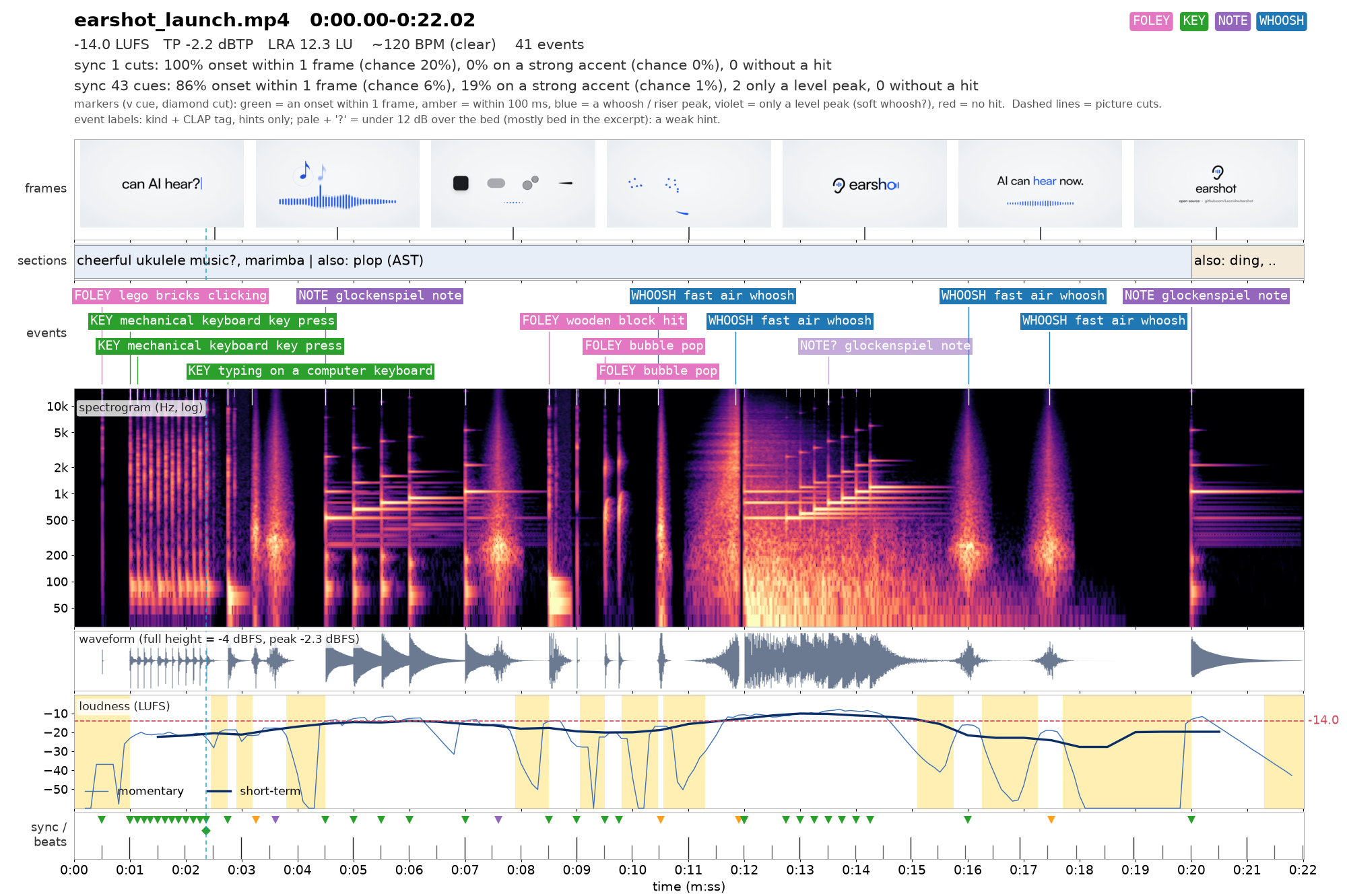
sheet FILE -o out.png |
an annotated PNG (video frames, sections, labelled events, spectrogram, waveform, loudness, sync markers) for agents that read images |
critique FILE [--video V] |
a launch-video scorecard against a profile of 7 professional launch films, with timestamped fixes |
profile REFS... -o p.json |
build your own reference profile from films you admire |
measure FILE |
objective measurements only (no models): LUFS, true peak, LRA, envelope, spectrum, tempo / key |
forge RECIPE --refset CAT |
make a sound in code and improve it by listening (see below) |
fit FILE -o recipe.py |
translate a recording into a forge recipe module that re-renders it, with knobs and morphs (see below) |
gallery DIR -o page.html |
one static HTML listening page of forge outputs: players, spectrograms, numbers |
llm FILE --yes-upload |
optional audio-LLM critique (Gemini), only with your own key and explicit consent |
mcp |
the same tools as an MCP server for Claude Code and other agents |
doctor [--load] |
check the install, models, data files and CPU settings |
Every command prints a plain-language summary first; --json gives the full result, --out f.json saves it. Errors
are one line on stderr (earshot <command>: error: ..., exit 1). Each CLI call is a new process and loads the models
(~20-40 s) before it answers: for more than a few calls use the MCP server (models stay loaded) or one Python script
with from earshot import api.
What an agent sees when it listens to that film with earshot sheet (frames, labelled sound events, spectrogram,
loudness, sync to the beat):
Listening makes iteration possible. The agent writes a sound as code: a recipe of physical synthesis (modal resonators, contact excitations, filtered noise, a computed room and a microphone; no recorded audio inside). The forge renders candidates from the recipe's parameters, and a critic built from earshot scores each one: description match against named confusions, realness, closeness to real reference recordings and measured shape, then model-free penalties against the references: 1/3-octave tonal balance, the spectro-temporal envelope (a tail that dies too fast shows here), artifacts (clicks, aliasing, DC / infrasound, harsh resonances, comb ring, cut tails, clipping) and polish (attack, onset snap, tail smoothness). A cheap model-free pre-screen ranks many renders with the same measurements, so the models only hear the best; an evolutionary search keeps the best and mutates them. Then the agent reads the critic's words ("sounds like: a cork pop, a glass ting", "decay +2.4 outside the refs", "bumpy tail"), looks at spectrograms next to the references, rewrites the recipe, and runs it again.
earshot forge --list                             # the recipes (click, impact, keypress, pop, whoosh, ...) + refsets
earshot forge keypress --refs path/to/real/keypresses/ --budget 144 --variants 4 --dir made/keypress
earshot forge whoosh --refset whoosh_fast --budget 96 --dir made/whoosh      # a reference set's 'forge' split
earshot forge whoosh --target "a fast crisp air whoosh" --alts "a wind gust" "a sword swing" \
  --refs path/to/real/whooshes/ --mode real --dir made/whoosh
earshot forge --render keypress --params made/keypress/report.json --seeds 1 2 3 --dir made/again
Output (--dir): the best diverse sounds as WAVs; report.md (what was asked, the search per generation, each pick in
the critic's words, the measured gap to the references); compare.png (each pick's spectrogram, envelope and
1/3-octave balance next to its nearest reference); audition.wav (made, ref, made, ref ... to listen in pairs);
report.json with every candidate's parameters and scores, the same critic's scores of the real references
(leave-one-out) and held-out AudioSet tags. Picks are re-rendered on new seeds (--robust, default 3) and must differ
in parameters and in sound. Reference sets (earshot/forge/refsets.py) are split by source into a 'forge' side the
search may use and a 'bench' side only the fixed benchmark (eval/forge/bench.py) hears. The DSP toolkit for recipes:
earshot/forge/dsp.py (sources: modal, noise, air, sweeps, Shepard risers, sub drops, bells, FM; layering) and
earshot/forge/fx.py (reverb, saturation, transient shaping, limiter, EQ match, Doppler, filters, glitch, granular).
In Python: from earshot.forge import forge.
forge v2 (0.2.0). Recipes come as families of named characters: 34 motion-design categories (whooshes, swishes,
swipes, risers, downlifters, zips, impacts, sub drops, logo stings, clicks, taps, toggles, hover ticks, pops,
notification dings, shimmers, glitches, key presses), 16 of them modelled on the designed effects of professional
launch films (docs/motion-sfx-study.md), 4-6 variants each. A fixed benchmark scores them
against held-out recordings the forge never heard. Against v1 on it: variants are no longer near copies (CLAP cosine
between variants 0.89-0.97 -> 0.71-0.85 in the five categories v1 had; real sets 0.52-0.77), tails that died too fast
now reach the real length (click t40 0.56 -> 1.44 x the bench median, fast whoosh 0.51 -> 0.88), and the tonal
balance is closer in 3 of those 5 (key press 8.2 -> 7.4 dB, fast whoosh 8.6 -> 6.2, impact 6.7 -> 4.4). Across all
34, the made balance is at least as close to the held-out recordings as a second set of real recordings in 18 of the
21 categories that have a number, and every final re-renders from its report.json (earshot forge --check). The
model checks that v1 had saturated fell. A clean blind-test kit for the v2 sounds is eval/forge/blind_v2.py; no v2
score is published yet. What changed, every number, and what is still weak: docs/FORGE_V2.md.
The reference recordings are licensed and not in this repo, so --refset needs a local registry: bring your own refs
with --refs DIR, or lay them out as described in earshot/forge/refsets.py. Without refs the critic runs in
designed mode (realness reported, not required). The CLI defaults changed in 0.2.0 (pre-screen, seed bank, robust
re-renders, the recipe's reference set); the Python forge() defaults still reproduce v1. See
CHANGELOG.md.
Blind test (v1 recipes). A key press, a UI click, a pop, a fast whoosh and an impact were made from scratch in code and played blind next to real recordings of the same kind of sound. The author picked the made one correctly 8 times out of 15: a coin flip. Only the made impact was spotted (its tail dies too fast). One listener and 15 trials is a small test, not a proof; it says the made sounds are no longer easy to tell from real ones.
Honest limits (Goodhart). The search optimises earshot's own models, and those can be pleased without the sound getting better. After a search the made sounds pass every model check, held-out ones included, so the model checks stop telling made from real; the 1/3-octave measurement still can. The realness model is easy to fool (a modal resonator plus a room and a noise floor reads "real"). Judge a made sound by the model-free measurements, spectrograms next to the references, robust re-renders, and a human blind test.
earshot fit translates a recording into code by analysis by synthesis. It fits a small synthesis model with readable
parameters (ringing modes, tracked partials, a time-varying noise gesture, or a layered hybrid of them) until its
render matches the recording, then writes the model as a forge recipe module whose render() makes the sound. The
module stores the structure of the sound, not its samples, so it can make new takes, variations (size, damping,
pitch, brightness, decay, ...) and morphs between two recordings.
earshot fit click.wav -o made/click_fit.py --report    # recipe + its render + side-by-side spectrogram + metrics
python made/click_fit.py 3 take3.wav                   # the module renders on its own (seed 3)
earshot fit --morph a.wav b.wav --amount 0.5 -o made/ab_morph.py
earshot fit --forge made/click_fit.py --budget 96 --dir made/click_variations   # critic-searched variations
Measured on 12 real recordings (2 each of click, key press, pop, impact, fast whoosh, notification): median CLAP
cosine 0.945 between each recording and the render of its generated code (minimum 0.881), and the same top
earshot describe tag in 10 of 12. In our 12-trial blind test (recording vs render, loudness-matched, random order)
the listener could not tell which clip was the recording. One listener is a small test, not a proof. The renders are
close, not identical: onsets, tone balance and noise texture still differ measurably; the selection weights were set
on the same 12 recordings; risers, zips and long designed sounds are untested. A fit is a derivative of its recording,
so keep the source's licence with the recipe. Limits: docs/FIT.md.
earshot gallery turns forge outputs into one static HTML page for people with ears: no server, no network, no
external scripts, inline CSS. One card per category, grouped by family (whooshes, sweeps, impacts, UI, tonal,
digital); per sound a player, a spectrogram thumbnail (log frequency, one time span per card so lengths compare),
duration, peak and momentary-max LUFS, the critic's total / pass, and the recipe parameters of every variant in a
collapsible table. The repo holds no audio, so point it at your own forge runs (out/forge_v2 below is one folder
per category).
earshot gallery out/forge_v2 -o out/gallery/gallery.html                  # <category>/final/*.wav (+ report.json)
earshot gallery out/forge_v2 -o g.html --results eval/forge/results_v2r6.json   # + held-out benchmark numbers
earshot gallery out/forge_v2 -o g.html --refs forge                        # + A/B row: each sound's nearest forge ref
earshot gallery --compare "r2:out/forge_v2/*/final_r2" "r3:out/forge_v2/*/final" -o compare.html \
  --results r2:eval/forge/results_v2r2.json                                # before / after, variant under variant
earshot gallery out/forge_v2 -o portable.html --embed                      # audio (FLAC) + images inside the file
earshot gallery out/forge_v2 -o share.html --embed-compressed              # one small file: MP3 previews, plays anywhere
earshot gallery --compare "v1:old/*/final" "v2:out/forge_v2/*/final" --alias keypress=typing_key -o v1_v2.html
Audio is referenced by relative path (or embedded with --embed); thumbnails go to <page>_files/ next to the page
and are cached by content. --embed-compressed makes one self-contained page to send or open on a phone: each sound
encoded by ffmpeg (MP3 192 kbps by default; --embed-codec opus or vorbis for Ogg, --kbps for the rate), JPEG
thumbnails, no links to local files; 183 sounds come to about 9 MB. The numbers on it are still measured on the WAVs.
--alias OLD=NEW puts a folder under another category's card (an older recipe's keypress under typing_key).
A "match loudness" switch (on by default) turns louder players down so a riser does not blast after a click; it
changes the player volume only, never the files. Benchmark numbers are shown only for files the benchmark actually
measured: a file newer than the results JSON, or with another length / peak, gets none (renamed files are matched by
length and peak, and the page lists every such case). In --compare, files identical to an earlier version are marked
= r2. Bench references never go on a page: --refs bench is refused, every reference passes refsets.held_out(),
and only the benchmark's numbers are shown, never its file names. Forge references are licensed recordings: keep a
page that plays them private. In Python: from earshot.gallery import gallery.
Python 3.10+ and ffmpeg / ffprobe on PATH. CPU only; no GPU is used.
git clone https://github.com/Leonxlnx/earshot && cd earshot
python -m venv .venv
.venv/bin/python -m pip install torch --index-url https://download.pytorch.org/whl/cpu   # Windows: .venv/Scripts/python
.venv/bin/python -m pip install -e ".[mcp,llm,dev]"
.venv/bin/python -m earshot doctor --load
The first model use downloads two open models (~1.4 GB) into .cache/hf inside the repo (or EARSHOT_HOME): CLAP
laion/larger_clap_general (text-audio embeddings) and the AudioSet tagger MIT/ast-finetuned-audioset-10-10-0.4593.
After that earshot works offline.
Settings (environment variables): EARSHOT_THREADS (torch CPU threads, default min(4, cores/2)), EARSHOT_HOME
(cache root), EARSHOT_PRECISION (bf16 by default, used only on CPUs with native bf16 such as AVX512-BF16 / AMX,
fp32 everywhere else; fp32 forces fp32), EARSHOT_OFFLINE=1. earshot doctor --load reports what is in use.
claude mcp add earshot --scope user -e EARSHOT_THREADS=3 -- /path/to/earshot/.venv/bin/python -m earshot mcp
Or in any client's .mcp.json:
{"mcpServers": {"earshot": {"command": "/path/to/earshot/.venv/bin/python", "args": ["-m", "earshot", "mcp"],
  "env": {"EARSHOT_THREADS": "3"}}}}
Models load on the first call and stay warm. On a slow machine start Claude Code with MCP_TIMEOUT=60000. The
optional llm_critique tool reads GEMINI_API_KEY from the environment; never write a literal key into a file.
import earshot
earshot.describe('whoosh.wav')
earshot.find('typing.ogg', 'a single isolated key press')
earshot.timeline('soundtrack.wav', video='film.mp4')
from earshot import api   # everything in one namespace: api.rank, api.critique, api.realness_many, ...
Two skills ship in skills/. Copy or symlink them into ~/.claude/skills/ (or a project's .claude/skills/).
skills/earshot: how an agent should listen with earshot: which command answers which question, how to read
the verdicts, when not to trust them.skills/real-sound: a full process for premium, realistic soundtracks for code-made films from real licensed
recordings: sourcing with licence checks, a music edit, a JSON sound design, a deterministic mixer, measured QA, a
multi-lens critique, mastering, credits and mux. earshot chooses, trims and verifies the sounds.Every number below comes with the command that measured it in docs/VALIDATION.md. What earshot cannot judge is in docs/LIMITS.md.
earshot hears through two open models and a set of measurements. Trustworthy: loudness, timing and sync to picture, "is this the kind of sound I asked for" on single exposed sounds, picking among candidates, obvious code-synthesized sources. Hints only: tags of events inside a busy mix, music genre and mood. It cannot judge taste or emotion, provenance or licences, speech content, or anything above 14 kHz from the models. The launch scorecard describes the style of the 7 films behind it, not every good film. Details in docs/LIMITS.md.
earshot/            the package: CLI, Python API, MCP server, CPU model wrappers
  forge/            make sounds in code: DSP building blocks, critic, model-free tone checks, search, recipes/
    fit/            recording -> code: modal / sines / spectral fitters, quality metrics, recipe codegen
  gallery.py        the static listening page
  data/             vocabulary + calibration stats, realness model weights, launch profile (numbers only, no media)
skills/earshot/     agent skill: how to listen with earshot
skills/real-sound/  agent skill: real-recordings soundtracks (scripts, templates, prompts, references)
docs/               VALIDATION, LIMITS, FORGE_V2, FIT, the motion-SFX study, launch-video playbook, design notes
eval/               evaluation scripts and results per area (see eval/README.md)
tests/              pytest (fast by default; --slow loads the models)
No audio or video is stored in this repo. The evaluation data (licensed recordings and third-party films) is not redistributed; only derived numbers are committed.
MIT for the code (see LICENSE). The models are downloaded from their authors under their own licences:
CLAP (laion/larger_clap_general) Apache-2.0, AST (MIT/ast-finetuned-audioset-10-10-0.4593) BSD-3-Clause.
skills/real-sound/scripts/master.py is vendored from the Cinetic skill by the same author.
Ears for coding agents: let AI hear, review and make sound. CPU-only, open source.