System Overview & Human Intent
Software codebases are living artifacts of human intellect designed to express domain logic, structural design, and operational intent. Traditional static analysis frameworks—such as pointer-heavy Code Property Graphs or lowered compiler IRs—strip away this high-level context, introducing massive memory inflation and pointer-chasing latency that isolate static analysis from real-time developer workflows.
Designed, created, and maintained solely by Ahmad Hassan (B-Ted), OpenHeart introduces the Succinct Compositional Program Graph (SCPG)—a formal 7-tuple graph representation:
$$\mathcal{G} = (V, E, \nu, \varepsilon, \tau, \rho, \Sigma_\Phi)$$
By combining Succinct Balanced Parentheses (BP) trees, Compressed Sparse Row (CSR) control flow graphs, Static Single-Assignment (SSA) data flow representations, and Reduced Ordered Binary Decision Diagram (ROBDD) path summaries, OpenHeart achieves up to 128× memory compression while maintaining $O(1)$ bidirectional source-to-diagram traceability.
Key Technical Features
- 128× Memory Compression: Replaces pointer-heavy AST nodes with Succinct Balanced Parentheses (BP) bitstrings and $O(1)$ Jacobson Rank/Select indexes.
- $O(1)$ Universal Traceability: Monotonic 32-bit
token_id anchors link raw source positions directly to IR graph nodes and derived UML elements.
- 19 Universal Diagram Projections: Generates all 14 standard OMG UML 2.5 diagrams + 5 deep compiler pipeline IRs directly from binary graph layers.
- Zero-Backend In-Browser GitHub Ingestion: 100% free-forever client-side cloning and AST parsing running directly on GitHub Pages.
- Declarative Manifest Architecture: Centralized
manifest.json controlling categories, diagrams, 16 relationship terminologies, and 24 classifier node schemas with zero hardcoding.
- Zero-Copy Memory Mapping: All 10 compilation pipeline phases serialize into CRC-64 verified binary artifacts mapped directly into OS page memory.
- Multi-Repo Convergence: Validated with $F_1 = 1.0000$ precision across Java, Kotlin, Python, Rust, TypeScript, and C++ codebases.
📊 Complete 19-Diagram Suite Specification
OpenHeart deterministically derives 19 specialized graph projections organized into 3 distinct categories:
1. UML 2.5 Structural Projections (7 Diagrams)
- 01 · Class Diagram (
package_tree engine): Complete class taxonomy, inheritance hierarchies, interfaces, fields, methods, and member visibility.
- 02 · Package Diagram (
hierarchical engine): Multi-tier domain namespaces, package containment hierarchy, and inter-package dependencies.
- 03 · Component Diagram (
hierarchical engine): Modular subsystems, provided/required interfaces, and runtime service wiring.
- 04 · Composite Structure Diagram (
hierarchical engine): Internal parts, ports, and assembly connectors within composite classifiers.
- 05 · Object Diagram (
hierarchical engine): Runtime heap instances, object identities, and reference linkages.
- 06 · Deployment Diagram (
hierarchical engine): Execution environment nodes, devices, and artifact distribution topologies.
- 07 · Profile Diagram (
hierarchical engine): Metamodels, stereotypes, tagged values, and <<extend>> arrows.
2. UML 2.5 Behavioral Projections (7 Diagrams)
- 08 · Sequence Diagram (
sequence engine): Lifeline message traces, synchronous/asynchronous dispatches, and activation bars.
- 09 · State Machine Diagram (
hierarchical engine): Finite states, initial/final pseudostates, transition triggers, and entry/do/exit activities.
- 10 · Activity Diagram (
hierarchical engine): Business logic workflows, control nodes, decision branches, and swimlanes.
- 11 · Use Case Diagram (
usecase engine): Actor boundaries, goal-driven use cases, <<include>>, and <<extend>> dependencies.
- 12 · Communication Diagram (
hierarchical engine): Object collaboration topology with sequenced message ordering numbers.
- 13 · Interaction Overview Diagram (
hierarchical engine): High-level control flow between nested sequence reference frames (ref sd).
- 14 · Timing Diagram (
timing engine): Multi-track temporal waveforms, clock events, and state change transitions over time.
3. Compiler Pipeline IRs (5 Diagrams)
- 15 · Control Flow Graph (CFG) (
hierarchical engine): Basic block partitioning, branching conditions, and loop back-edges.
- 16 · Data Flow Graph (DFG) (
hierarchical engine): SSA def-use value lineage chains and operand dependencies.
- 17 · Control Dependence Graph (CDG) (
hierarchical engine): Reversed post-dominator control conditions governing basic block execution.
- 18 · Call Graph (CG) (
hierarchical engine): Interprocedural call sites, CHA virtual method dispatch resolution, and recursion SCCs.
- 19 · ROBDD Saturation (
hierarchical engine): Canonical Reduced Ordered Binary Decision Diagram path summaries and exact #SAT path counting.
Master 10-Phase SCPG Compilation Pipeline
Phase 1 (COMPLETED) ──► Phase 2 (COMPLETED) ──► Phase 3 (COMPLETED) ──► Phase 4 (COMPLETED) ──► Phase 5 (COMPLETED)
Lexical Ingestion       BP AST & Succinct      Symbol Table &         CFG CSR & Dominator    SSA Conversion, CDG
& Token Corpus (.tca)   Reduction (.bpa)       Hierarchy (.sta)       Tree (.cfa)            & IFDS Solver (.ssa)

        │
        ▼
Phase 6 (COMPLETED) ──► Phase 7 (COMPLETED) ──► Phase 8 (COMPLETED) ──► Phase 9 (COMPLETED) ──► Phase 10 (COMPLETED)
Inter-procedural        Traceability Index     ROBDD Path             UML Semantic           SCPG Binary (.scpg)
Call Graph (.cga)       Forward/Backward       Summaries (.psa)       Metadata (.uma)        & Query Engine
Binary Artifact Specifications
| Phase |
Artifact Extension |
Magic Header |
Core Storage Strategy & Data Structures |
| Phase 1 |
.tca |
TCA\0 |
SourceFileRecord[], 16-byte TokenRecord[], FNV-1a StringInterner |
| Phase 2 |
.bpa |
BPA\0 |
Balanced Parentheses bitstrings (u64[]), JumpTable, RankSelectIndex, SparseTableRMQ |
| Phase 3 |
.sta |
STA\0 |
SymbolRecord[], ScopeNode[], TypeHierarchyEdge[], StdLibManager |
| Phase 4 |
.cfa |
CFA\0 |
SuccessorCSR, PredecessorCSR, idom[], DominanceFrontierCSR |
| Phase 5 |
.ssa |
SSA\0 |
SSARecord[], PhiRecord[], DefUseCSR, CDGCSR, IFDS Solvers |
| Phase 6 |
.cga |
CGA\0 |
CallSiteRecord[], CallEdgeCSR, Andersen Points-To Allocation Sets |
| Phase 7 |
.tra |
TRA\0 |
Forward Map, Backward Map, Bijective UMLLinkRecord[] |
| Phase 8 |
.psa |
PSA\0 |
FunctionPSAHeader[], 12-byte Compact ROBDDNodeTable |
| Phase 9 |
.uma |
UMA\0 |
ClassRecord[], ObjectRecord[], SequenceDiagramRecord[], GoF Pattern Matches |
| Phase 10 |
.scpg |
SCPG |
Unified Memory-Mapped SCPG Header, Layer Maps, Cross-Layer Indexes |
Repository Structure
OpenHeart/
├── src/                          # Native Rust Engine Implementation (10 Compilation Phases)
│   ├── adapters/                 # HTTP REST API Server & Git Clone Ingestion Adapter
│   ├── ast/                      # Phase 2: Balanced Parentheses (BP) AST & Rank/Select LCA Engine
│   ├── cfg/                      # Phase 4: Control Flow Graph (CSR) & Cooper Dominators
│   ├── cg/                       # Phase 6: Call Graph & Andersen Points-To Analysis
│   ├── core/                     # Core Types, Binary Serialization Primitives & Logger
│   ├── ingestion/                # Phase 1: Tree-sitter Lexical Ingestion & Token Corpus (.tca)
│   ├── psa/                      # Phase 8: ROBDD Path Summaries & #SAT Path Counting (.psa)
│   ├── scpg/                     # Phase 10: SCPG Binary Serializer, Query Engine, & Diagram Exporters
│   │   ├── diagram/              # Multi-Format Abstract Factory (JSON, PlantUML, Mermaid, XMI)
│   ├── ssa/                      # Phase 5: SSA Form, CDG, & IFDS Data Flow Solvers (.ssa)
│   ├── symbol/                   # Phase 3: Symbol Table & Scope Graph Engine (.sta)
│   ├── tra/                      # Phase 7: Universal Traceability Index (.tra) & UMLLinks
│   ├── uma/                      # Phase 9: UML Semantic Metadata Artifact (.uma) & Pattern Detectors
│   ├── lib.rs                    # Library Crate Root
│   └── main.rs                   # Engine CLI Entrypoint
│
├── web/                          # OpenHeart Web Studio Portal (100% Free Zero-Backend on GitHub Pages)
│   ├── diagrams/                 # Declarative manifest.json + 19 JSON & PUML Projections
│   ├── js/                       # Modular ES6 Web Engine (Layout, Renderer, Canvas, Editor, File Tree)
│   │   ├── themes/               # Theme Manager & Dynamic Cytoscape Stylesheet Compiler
│   │   ├── uml-card-renderer.js  # Vector SVG Card Generators
│   │   ├── uml-layout.js         # Deterministic Spatial Layout Engines
│   │   ├── puml-parser.js        # Generic PlantUML / Mermaid Parser
│   │   ├── graph-canvas.js       # Interactive Cytoscape Canvas Controller
│   │   ├── editor.js             # Monaco Precision Code Synchronizer
│   │   ├── file-tree.js          # Deterministic File Tree Explorer
│   │   └── github-engine.js      # Zero-Backend In-Browser GitHub Repo Analyzer
│   ├── index.html                # Single-Page Web Studio Application
│   └── style.css                 # Premium Swiss Design System & Dark/Light Themes
│
├── examples/                     # Standard Example & Benchmark Codebases (GoF Patterns, Enterprise Sample)
├── tests/                        # Unit & Integration Test Suite (47 Unit + 22 Integration Tests)
├── scripts/                      # Autonomous Diagram Generators, CI Checkers & Benchmark Harnesses
├── docs/                         # Formal Specifications, Research Papers, & Developer Guides
├── Cargo.toml / Cargo.lock       # Rust Package Dependencies & Build Configuration
└── Makefile                      # Convenient Targets for Build, Test, & Server Launch
🛠️ Quickstart & Local Execution
1. Launch Live Web Studio (No Installation Required)
Access the live studio directly in your browser:
OpenHeart Web Studio on GitHub Pages
2. Build Engine
cargo build --release
3. Run Single Codebase Analysis
target/release/openheart analyze ./my_project ./output_dir
4. Launch Web Server & Interactive Web Studio
target/release/openheart server 8080
Then visit http://localhost:8080 in your web browser.
5. Run Integration Test Suite
cargo test --all-targets
Documentation Index
- System Overview: Formal mathematical definitions, comparative analysis, and succinct data structures.
- System Architecture: 10-Phase pipeline design and 19 diagram mappings.
- Codebase Guide: Repository layout, module structure, and internal developer reference.
- Getting Started: Workspace setup, Web Studio usage, and command-line execution.
- Succinct Structures: BP ASTs, CSR CFGs, Wavelet Trees & ROBDD proof specs.
- UML Derivation: Derivation rules for structural, behavioral, and compiler IR diagrams.
- Architectural Roadmap: Complete 10-phase SCPG compilation pipeline overview.
License & Author
Authored, created, and maintained solely by Ahmad Hassan (B-Ted) under the MIT License.






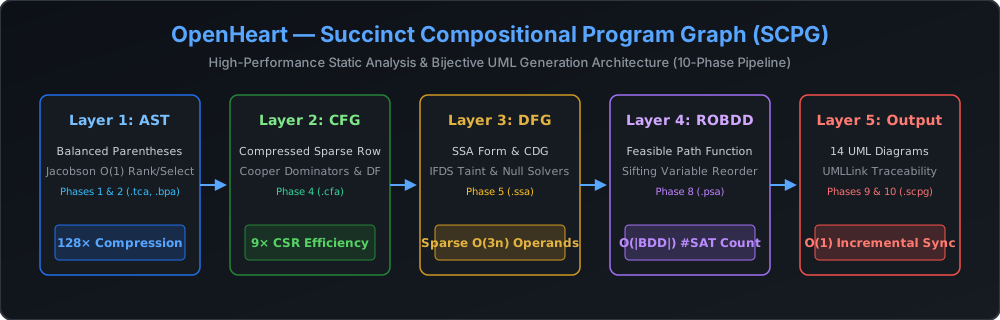

 OpenHeart is a static analysis compiler written in Rust that parses source code into a formal graph representation called SCPG (Succinct Compositional Program Graph) and projects it into 19 different diagrams: 14 standard UML 2.5 views plus 5 compiler pipeline IRs.