2.8K ·GitHub
What is this?
 pstack is a port of Lauren Tan's (Poteto's) opinionated Cursor skill stack that improves coding-agent outcomes, adapted to run on Claude Code, Codex, Pi, Copilot, OpenCode, Gemini CLI, and Prime Agent.
pstack is a port of Lauren Tan's (Poteto's) opinionated Cursor skill stack that improves coding-agent outcomes, adapted to run on Claude Code, Codex, Pi, Copilot, OpenCode, Gemini CLI, and Prime Agent.Is this a standalone app or a plugin for my coding agent?It is a skill/plugin pack that installs into an existing coding-agent harness rather than a standalone application; it adds skills, slash commands, subagent/question/wake-up tools, and a routing hook to whichever harness you already use.
It is a skill/plugin pack that installs into an existing coding-agent harness rather than a standalone application; it adds skills, slash commands, subagent/question/wake-up tools, and a routing hook to whichever harness you already use.How do I install pstack into my coding agent?You run the plugin install command inside Claude Code, or an equivalent terminal command for Codex or Pi; shared installation docs cover Prime Agent, OpenCode, Gemini CLI, and skills-only installs for any harness.
You run the plugin install command inside Claude Code, or an equivalent terminal command for Codex or Pi; shared installation docs cover Prime Agent, OpenCode, Gemini CLI, and skills-only installs for any harness.Which coding agents does pstack support?Claude Code, Codex, Copilot, Pi, OpenCode, Gemini CLI, and Prime Agent.
Claude Code, Codex, Copilot, Pi, OpenCode, Gemini CLI, and Prime Agent.Any install pitfalls I should know about?The routing hook is installed automatically only on Claude Code and Codex, and on Codex you must explicitly approve it through /hooks before it runs; on Pi the extension injects the same routing instruction instead of a hook.
The routing hook is installed automatically only on Claude Code and Codex, and on Codex you must explicitly approve it through /hooks before it runs; on Pi the extension injects the same routing instruction instead of a hook.Does pstack send my code or session data anywhere?pstack itself has no server or telemetry; anything its skills ask your agent to read, including session transcripts, is sent to your model provider as part of normal agent use, and PR-related tools use your local GitHub CLI login.
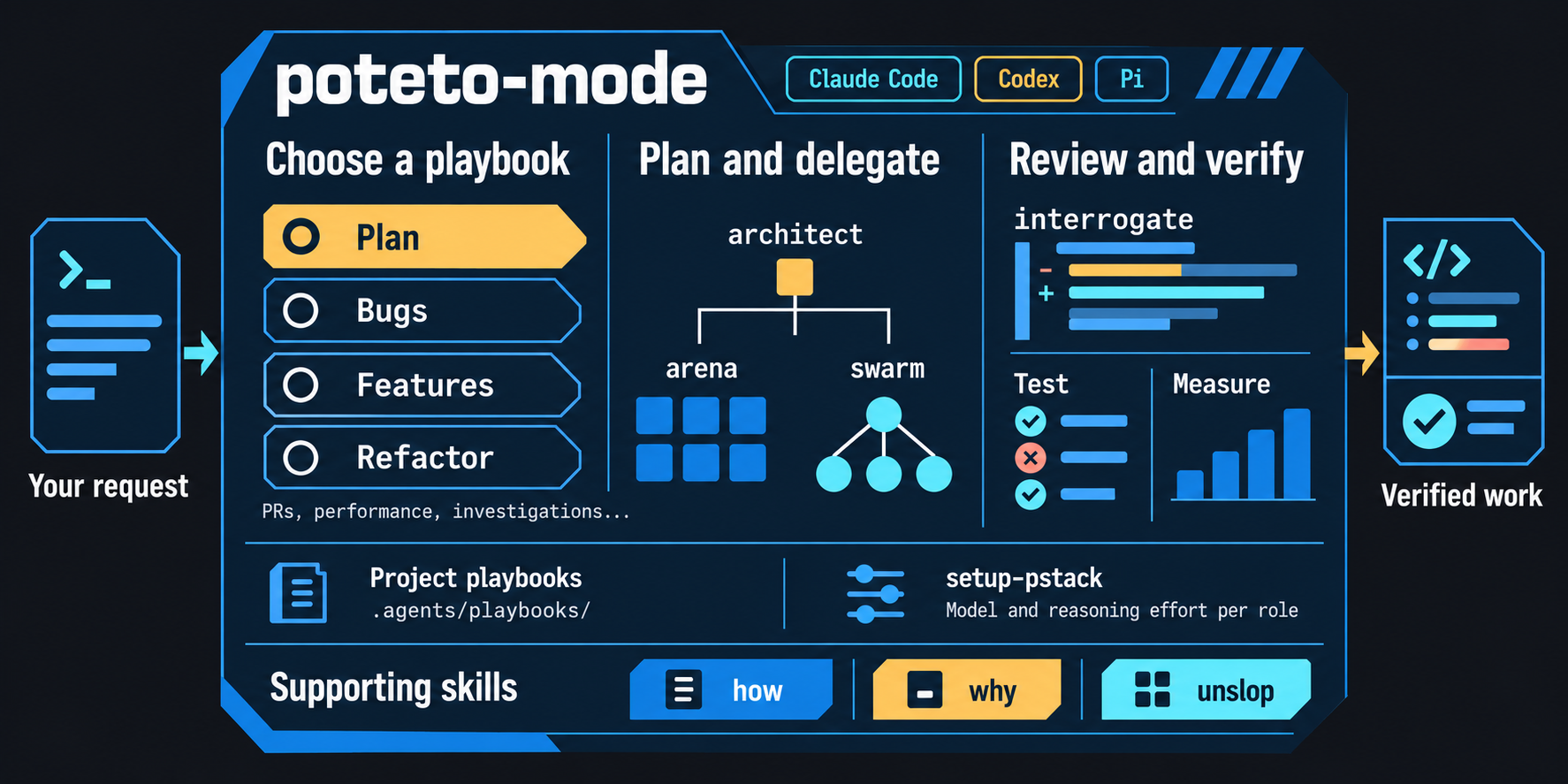
pstack itself has no server or telemetry; anything its skills ask your agent to read, including session transcripts, is sent to your model provider as part of normal agent use, and PR-related tools use your local GitHub CLI login.What is poteto-mode?poteto-mode is the router you tell your goal to; it then invokes the correct pstack playbook (bug fix, feature, refactor, planning, etc.) for the task.
poteto-mode is the router you tell your goal to; it then invokes the correct pstack playbook (bug fix, feature, refactor, planning, etc.) for the task.What does the separate agent-formal-verify plugin add?It handles concurrency bugs and invariants that tests can't reach, adding TLA+ model checking and Lean proofs on top of the pstack workflows.
It handles concurrency bugs and invariants that tests can't reach, adding TLA+ model checking and Lean proofs on top of the pstack workflows.How does pstack approach a typical bug fix?It reproduces the failure, investigates the how and why, delegates the fix, and reruns the failing case; if the fix crosses a function boundary it brings in an architect role first, and you get the fix with failing and passing evidence.
It reproduces the failure, investigates the how and why, delegates the fix, and reruns the failing case; if the fix crosses a function boundary it brings in an architect role first, and you get the fix with failing and passing evidence.What is tools/forks.json used for?pstack tracks the upstream Cursor skill stack while also carrying named policy forks, each declared in tools/forks.json, so alternate behavior sets can be applied.
pstack tracks the upstream Cursor skill stack while also carrying named policy forks, each declared in tools/forks.json, so alternate behavior sets can be applied.What are similar projects?agents, pstack, open-steps, superpowers-zh, open-pstack, Orbital, orca, claude-plugins-official
agents, pstack, open-steps, superpowers-zh, open-pstack, Orbital, orca, claude-plugins-officialWhich topics is it in?codex-plugin, claude-plugin, codex-skills, claude-code-skills, subagents, codex-cli, claude-code-plugin, gemini-cli, code-review, harness, opencode, coding-agents
codex-plugin, claude-plugin, codex-skills, claude-code-skills, subagents, codex-cli, claude-code-plugin, gemini-cli, code-review, harness, opencode, coding-agents