Macro is the all-in-one workspace for you and your team. It unifies email + messages + docs + tasks + agents + CRM into a single fast interface with shared team-level memory. Everything in your workspace is @linked and searchable so your team (and your agents) never have to switch tools.
Why Macro
We built Macro because we wanted a single operating system for our startup. There are many good software products, and we used them all — Slack, Linear, Notion, HubSpot, and Superhuman — but they don't work together as one system. As we scaled our last venture to ~20 people things started to break: every team got their own tools and the company was held together by MCP and Zapier. The company was not computable. It was chaotic.
Macro is a complete redesign of work software from the ground up as a single system.
Designed by us in NYC and Toronto, dogfooded by our team of ~15 for two years. Built in SolidJS and Rust for speed and reliability. We're focused on building something that any small company or team at a larger company can use as their "operating system".
Features
Macro is composed of 'blocks' designed to be modular, extensible, and work together like Lego. For each block, we studied the best prior art and tried to make it even better.
Each surface is purpose-built for its job rather than composed from a generic block primitive — but every one of them shares the same backend; cross-references between a doc and a task, or a channel message and an email, are natively stored as a bidirectional graph.
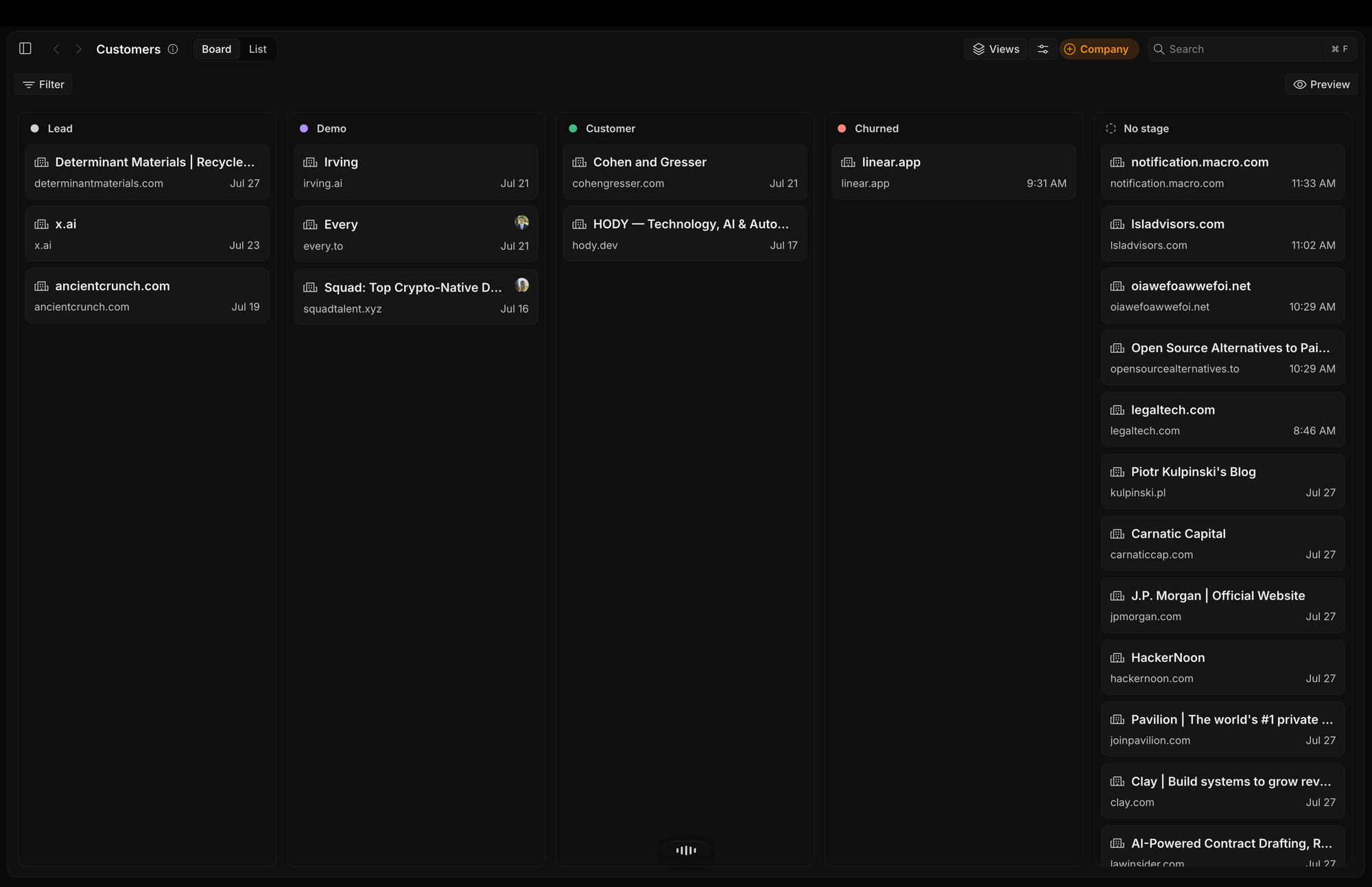
Customer and contact objects, custom properties, email sync, enrichment.
Multiple email inboxes w/ good AI tools, integrated CRM
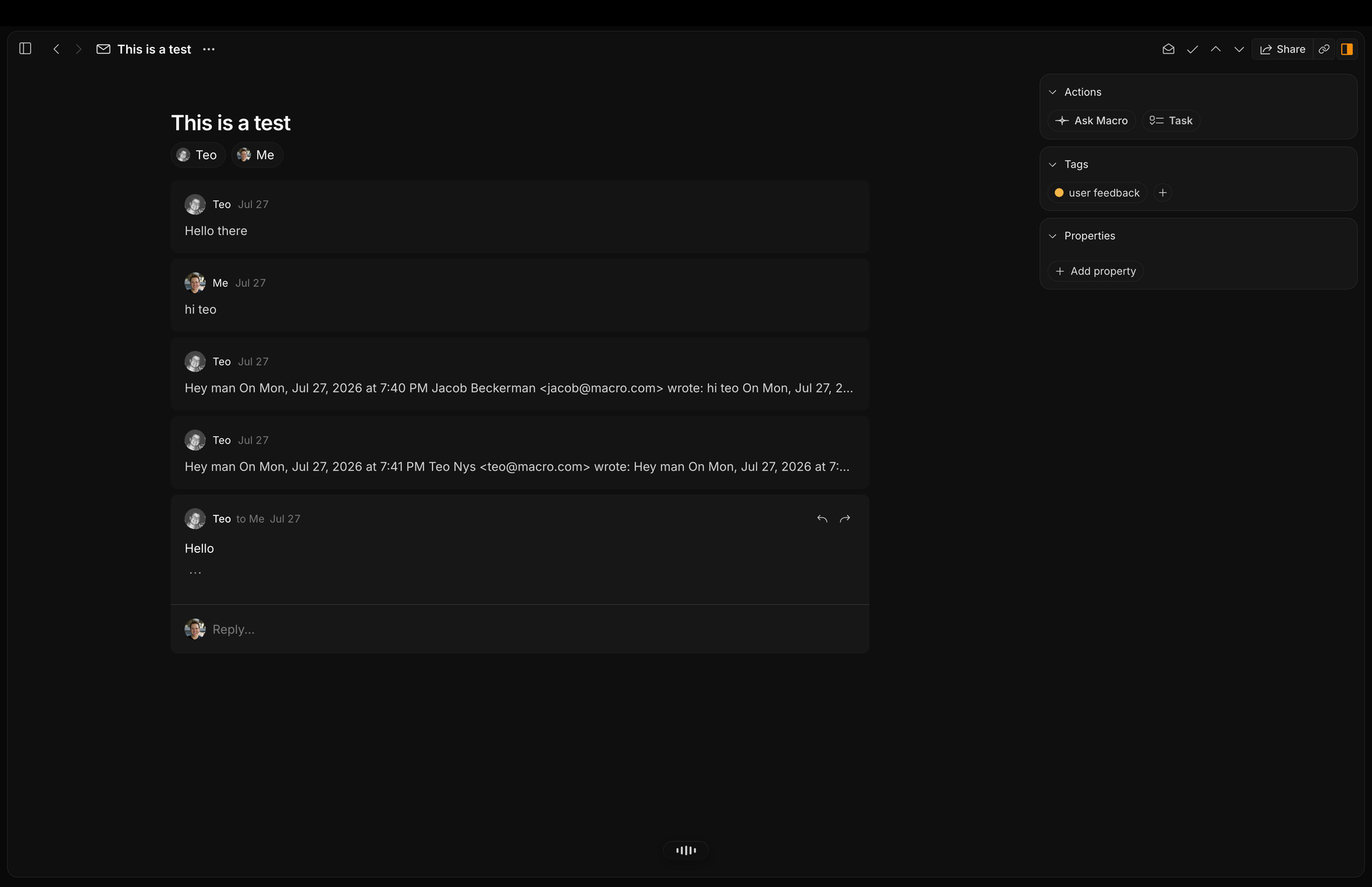
Macro Mail is inspired by Superhuman's keyboard-first interface with a few key additions:
Multi-account. Triage all your Google accounts in a single inbox, with the same tagging and sharing system. Or triage individually.
Unified inbox: emails, messages, @mentions, and tasks to complete, all in the same list. Use jk and e to navigate everything.
Better AI, with a tools/MCP surface designed to work across inboxes and to help your agents more accurately retrieve information. For example, we expose a unified search tool that allows agents to search all file attachment PDFs (parsed out of email) directly, rather than pulling email threads then attachments. You can also draft, edit and send emails right from AI chats, without opening your email.
Multitasking ability — Macro has a built-in window manager that lets you create 3+ splits (scales with monitor size) so you can draft emails while reviewing prior threads.
Company/Contact objects. Macro has native CRM capability so you can cmd+k to a contact, like [email protected] to see all emails between you and that person, or companies, to see all emails and files between everyone on your team and everyone at that company, e.g. @acme.com. All of this right from your email without having to open a heavyweight CRM like HubSpot or Salesforce. Email aggregation by contact or company is also available to your agents so they can better assist with CRM-type queries and actions.
Macro Mail lives in the same interface as channels, docs, tasks, and code. From any email, hit "task" to create a linked task, e.g. a ticket for an engineer from a customer support email. @mention emails in documents, e.g. @Re: Contract Signature.eml inside of Todos.md. In Macro, your email is brought into the fold with all of your tools, and your team, in the same permissions system: just hit Share to share an email to any DM or channel — no need to screenshot.
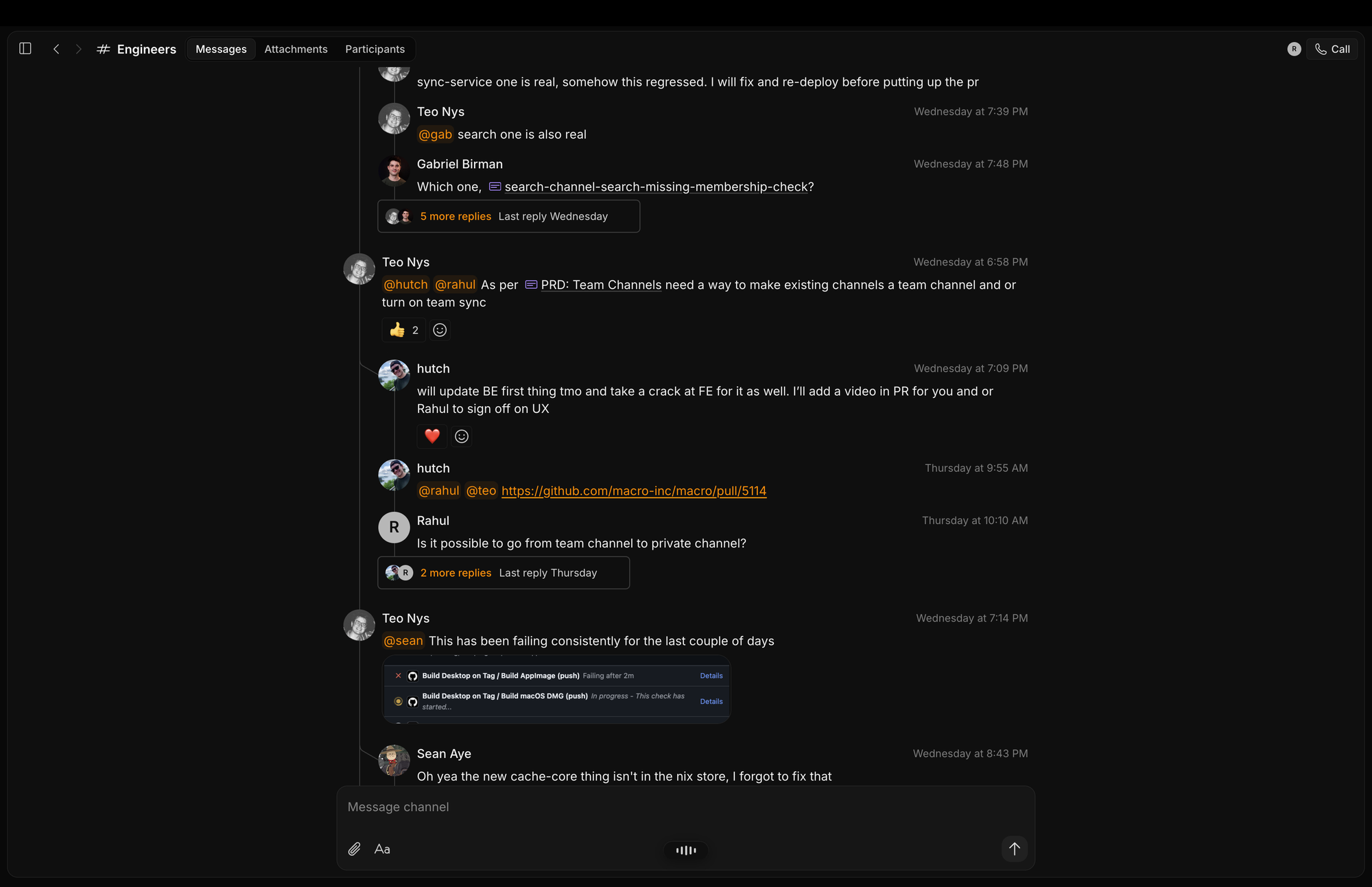
Macro Chat is designed to be more focused than Slack. The first couple of replies show inline and the rest collapse into a thread, so a busy channel stays readable. Threads are permissioned severally so you can share threads across channels by copying links. Everything is stored in a bidirectional graph, so tasks @link to messages that created them, customer support emails tie into support channels, CRM records get updated when they're discussed in messages, etc. The core idea is that (i) messaging should be the centerpiece around which tasks, mail, docs, and content management are built, all in a lightweight way, and agents should be first-class citizens like human users and (ii) messaging needs to be more focused and readable for technical conversations, and not turn into battles where context is lost and progress is indistinguishable from noise.
Linear recently published a report that issue tracking is dead. We agree with that, but the stronger form is that issue tracking never really worked, at least for us. We really tried and we blamed ourselves, but as we talked to other companies, it turns out that nobody was using their issue tracker "correctly". And if that's the case, the problem is the design of the tool, not the companies that use it.
The core problem with traditional issue trackers or project management tools is that they get out of date. The reason they get out of date is that (i) they're a separate system from where the conversation really happens in team chat (e.g. Slack, Macro, Discord, etc.) and (ii) they don't add much benefit beyond tracking the work. They're a chore with near-term costs and only the promise of long-term benefit. They're too rigid compared to a 2D canvas, too opinionated, and don't match how your project actually functions.
The solution isn't to forgo tracking entirely. We tried that and it was a different form of chaos. The solution we've found is lightweight issues tightly coupled to your channels and DMs, so that issue tracking naturally occurs where the conversation itself happens.
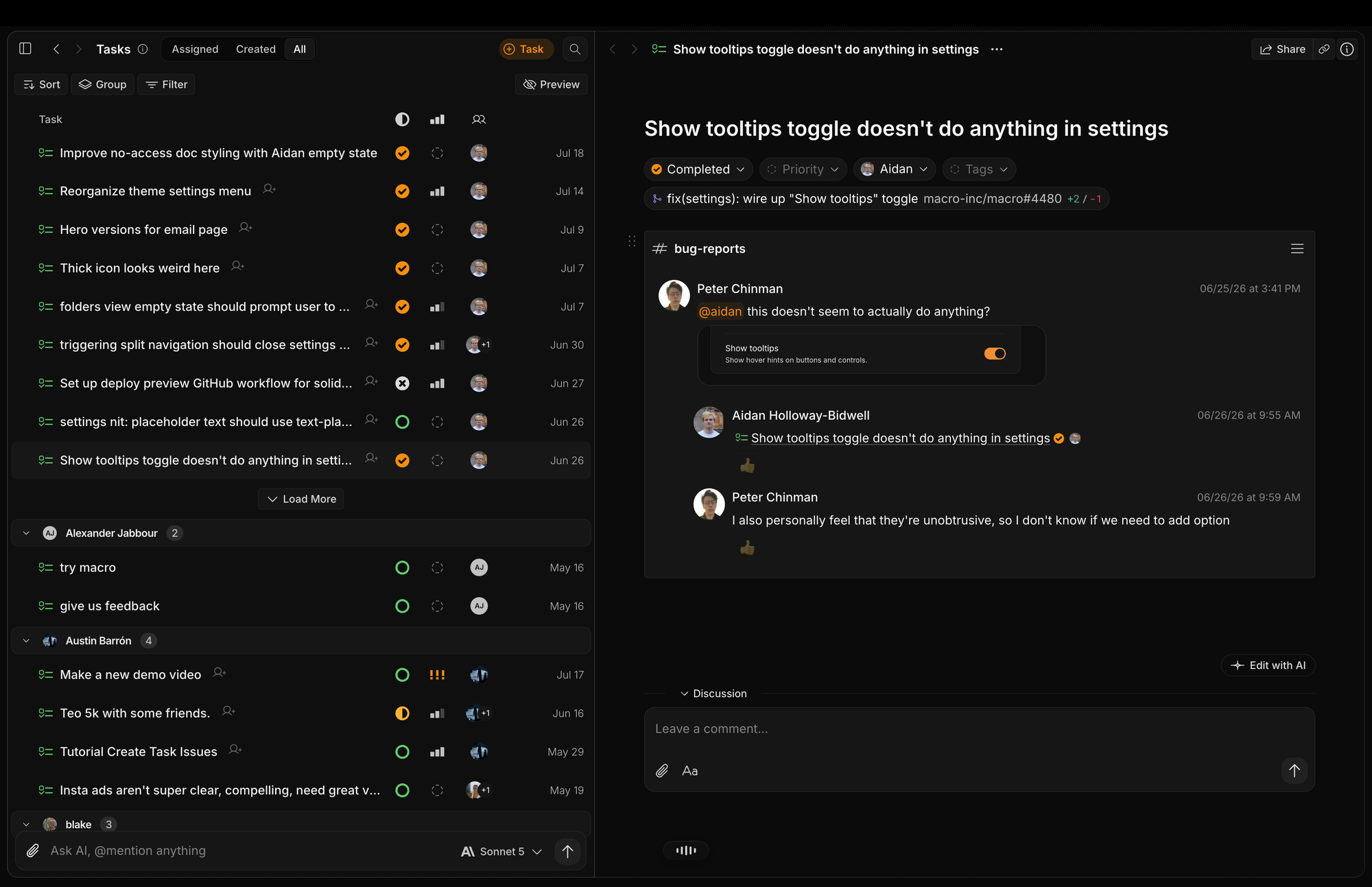
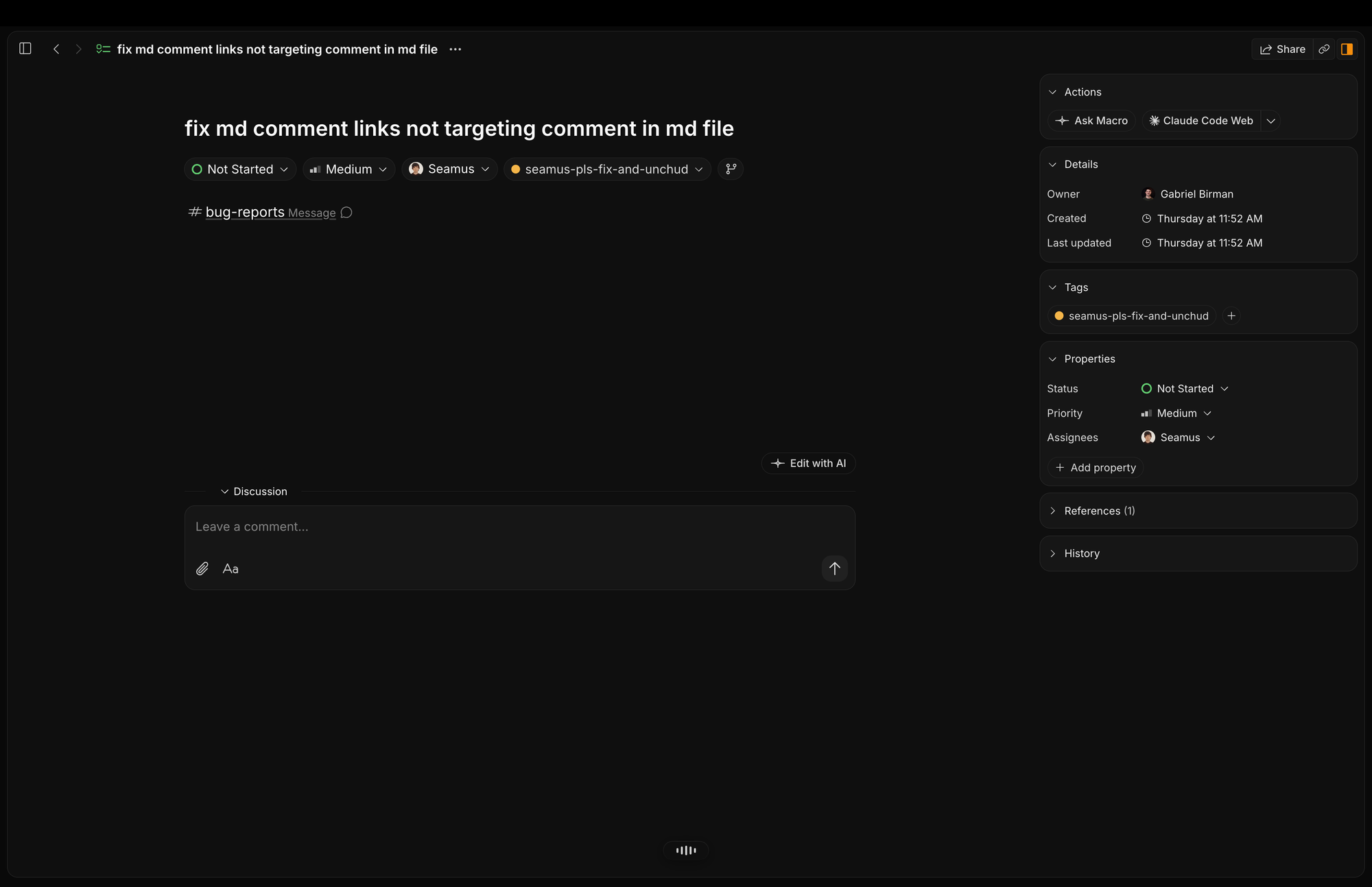
Creating tasks in Macro is easy. Where possible, tasks created are bidirectionally linked to the creating context (e.g. a customer email) so the full chain is auditable from "why are we doing this" → task → agent → pull request, all in one system.
Create a task from an email
From anywhere via ct
From a markdown doc with /task
From any - [ ] bullet by highlighting and clicking "Task"
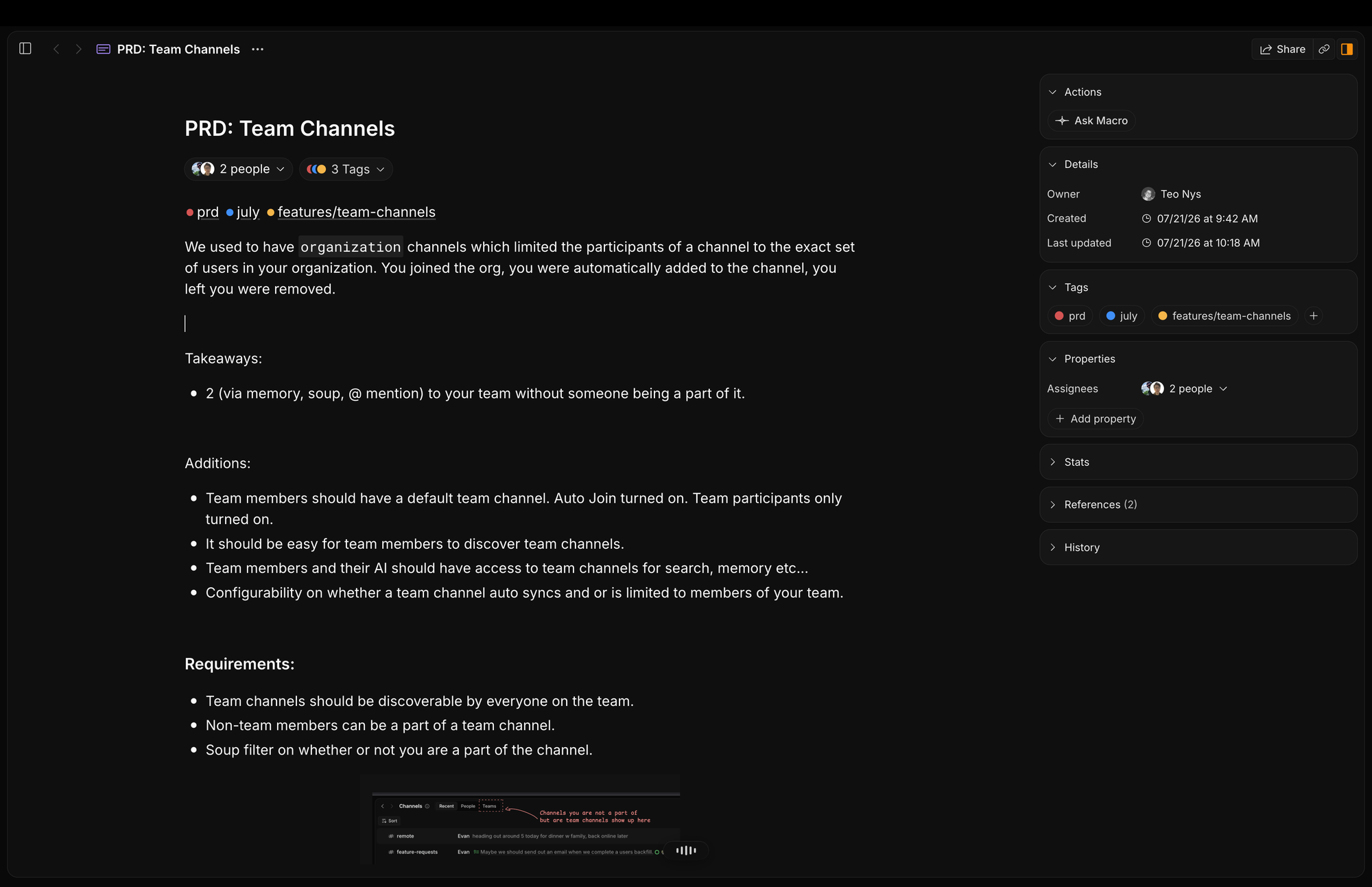
We wanted everything in a single markdown editor without switching tools.
Native markdown compatibility and bulk/import export (see "file over app" paradigm)
Live collaboration with CRDTs and Cloudflare durable objects make it feel like you're editing on the same computer. Edits come in ~instantly instead of ka-chunking like Google Docs
Version control: history and forking, with a neat UI for scrubbing history. This is still in v1, there's a lot to do to get it closer to git, or we may eventually add git compatibility.
Offline editing and reconciliation.
@-linked to everything in your workspace: email, docs, tasks, messages, channels, companies, contacts, etc. Like Notion but multi-modal
Mobile-friendly, in our iOS app or on the web (Android app coming soon)
Agent native editing, powered by swarms of agents operating as peers in the CRDT collaboration system like human collaborators. See Wolf's tech blog on this. Use via MCP or internal agent.
Agents can edit documents that are open or closed. One interesting use case for agentic editing is to maintain team-context. For example we have a Macro Automation that runs daily to update our in-office Pool Games markdown doc. It scans through all of the channels to see if anyone has one and then updates the doc. If somebody has already edited the doc, it can know that and forgo the update. Conflicts are handled natively by the CRDT collaboration system.
The problem with standalone CRM is the same as with task trackers: it's not up to date. The CRM only partially reflects reality, so if you want to know what the latest status on a deal is you still have to message the AE/SDR and ask for context. CRMs are also too rigid and closed-source, while DIY CRMs in Airtable/Notion don't provide email aggregation by Company/Contact/Deal that is the core feature of CRM. We went through all the CRMs, including the new AI-native ones, and while they're well-designed they're just structurally set up to fail over time.
Macro fixes this by colocating your CRM with your team chat and email, instead of having a separate system. When you @mention a company record in a message, your team can click that record to see the latest — it's much faster than navigating to your CRM to find the record, going back to Slack and pasting it in, and this speed difference makes all the difference. Secondly, @mentioning a Company/Contact creates a bidirectional link between that message and the record, so from the record later you can trace the conversations that happened. This fixes the core issue we had with Attio/HubSpot/Salesforce: the actual important conversation about a deal happens not in the CRM but over messages. Macro makes this a feature rather than making you feel disorganized about it. It's not your fault, it was the CRM's fault!
We haven't innovated on the core idea of CRM other than what you read in the above paragraph. None of this should be that interesting:
Kanban board and customizable deal stages, list view, saved views, shareable views, personal and team views, etc.
"Notes" on the company actually use the same system as channels/DMs, so you can @mention and do all of the things you expect in a channel. Basically, every deal gets its own channel, automatically, that's pinned right to the deal record
@mention the company or contact from any note, message, task, pull request, etc., to create a bidirectional link between the record and that thing. For example, @mention a company from an engineering task to note their request. It all ties together.
Since Macro has the team context in a single database, it is uniquely positioned to offer team-level memory with full context of all of the operations of the business. We do this every day via a cron job. Your memory is updated from team conversations, your DMs, your sent and received emails, tasks created and completed, etc. All of this is synthesized together in one pass, rather than severally, and combined with your previous memory to form the new memory output. The net result:
Macro has the best memory on what you're working on and what you care about vs. chatbots that only build memory from prior chats
This memory is available to external agents via MCP, or any AI model (OpenAI, Google, Anthropic, etc.) through the model picker for maximum portability
The memory is plainly stored in markdown so you can export it as you please. To manually update it, just ask the AI to remember something/update your memory
Team memory comes in quite handy. For example, I took a screenshot of some features I'd written in a paper notepad and asked the agent to create tickets and assign to the appropriate engineer which it did perfectly without any runtime tool use.
Memory isn't supposed to encompass everything. Macro also has a tool/MCP surface with near 100% coverage of the things you can do in Macro's UI, so that your agents aren't limited in what they can do like they are in most SaaS. There are also no rate limits on MCP.
As we've discussed above, each of the blocks is designed to be best-in-class. We have thoughtfully designed each of Chat, Docs, Email, Agents, etc., to improve on your status quo individually. But where it all comes together is how it's more than the sum of its modules; it's how they work together.
Bidirectional @linking. @mention a doc in a message and both know about each other. Your workspace becomes a web of context you can navigate in either direction.
Channel-based permissions. Anything you @mention in a channel is automatically shared with its members. Join a channel, gain access; leave, lose it. No permission-request dance.
Unified memory. Agents remember what your whole team is doing across email, messages, tasks, docs, and calls, not just your own chat history. Refreshed nightly.
One inbox. Emails, channel messages, task assignments, @mentions, and agent responses all land in one place, split into Signal and Noise. Keyboard-first throughout.
Deeper reading: key concepts covers blocks, mentions, properties, and permissions; the FAQ covers comparisons, licensing, and self-hosting.
Using the hosted app
Sign up and connect your Gmail or Google Workspace account. Macro runs in any modern browser, with an iOS app for your phone. The getting started guide takes you from a fresh account to a working setup in about 15 minutes. Coming from Notion, Slack, Superhuman, or Linear? See Switch to Macro.
Running it locally
To run the frontend against hosted services, or to run the local stack, follow Running locally.
macro/
├── apps/
│   ├── web/       SolidJS client — browser, Tauri desktop, mobile
│   └── docs/      docs.macro.com
├── services/      42 deployable services, workers, and Lambda handlers
├── crates/        167 Rust libraries — domain logic, models, db clients
├── packages/      shared TypeScript — collaboration, lexical-core, loro-mirror
├── infra/         Pulumi definitions
├── docker/        local Compose stack
├── nix/           pinned dev shell and build inputs
└── tooling/       repo scripts and code generators
Services follow a hexagonal layout: inbound adapters, a domain core with ports, outbound adapters. docs/STYLE_GUIDE.md has the conventions and CONTRIBUTING.md covers the PR process.
Security
Enterprise-grade security. Zero data retention with model providers, including no training on customer data. SOC 2 Type II certified. We welcome responsible security reports and pay bounties in accordance with severity and impact. Send reports to [email protected].
License
Macro is fully open source — not "open core" — under the GNU Affero General Public License v3.0. See LICENSE.txt for details.
You can self-host Macro under the terms of the AGPLv3; the FAQ covers what that involves. If you want to build on top of Macro under a different license, contact [email protected]. For managed hosting or commercial arrangements, contact [email protected].
Community
Have an idea, want to contribute, or want to work on Macro?
If Macro is interesting/useful to you, please scroll up and give the repo a star (scroll to the top of this page -> click Star in top right). Stars are how most users hear about Macro because they move us up GitHub's search and trending pages.
What is this?Macro is an all-in-one workspace for teams that unifies email, chat, docs, tasks, agents, calls, and CRM into a single fast interface with shared team-level AI memory, instead of juggling separate tools like Slack, Linear, Notion, HubSpot, and Superhuman.
Is this one app or a bunch of integrated tools glued together?It is a single application made of modular 'blocks' (Email, Messages, Tasks, Docs, Canvas, Agents, Calls, CRM, etc.) that all share one backend, with every cross-reference between a doc, task, email, or message natively stored as a bidirectional graph.
How do I actually get on Macro — is there a web app, a desktop app, mobile?Macro is available as a web app and an iOS app today, with Android coming soon; the codebase is a monorepo with the web client in apps/web, built with Bun and TypeScript tooling (Biome, tsc).
Do I need a Gmail account or specific AI provider keys to use it?Email features connect to Google accounts for unified-inbox triage, and AI features work through a model picker that supports OpenAI, Google, and Anthropic models rather than locking you into one provider.
What's still rough or missing right now?Document version control is still v1 — basic history and forking, not full git-level tracking — and the Android app hasn't shipped yet (web and iOS are available).
Where does my data actually live — synced to a server, or can I work offline?Docs sync live through CRDTs backed by Cloudflare durable objects for near-instant collaboration, and also support offline editing with automatic reconciliation when you're back online.
What makes Macro's CRM different from HubSpot or Salesforce?It's colocated with team chat and email rather than being a separate system, so @mentioning a Company or Contact creates a live bidirectional link to that conversation and every deal automatically gets its own pinned channel.
How do AI agents actually interact with Macro?Agents are treated as first-class collaborators: they can edit CRDT documents directly (even open ones), create tasks, draft and send emails, and pull from unified team memory via MCP using any connected model (OpenAI, Google, Anthropic).
Why build a whole new system instead of combining Slack, Linear, and Notion?After scaling a previous startup to ~20 people, the founders found that stitching together best-in-class tools with MCP and Zapier made the company 'not computable' and chaotic, so they rebuilt everything as one system on a shared bidirectional-graph backend.
How does the shared team memory get built?A daily cron job synthesizes team conversations, DMs, sent and received emails, and completed tasks into one markdown memory file combined with the previous memory, which is then accessible to agents and any AI model via MCP.


 Macro is an all-in-one workspace for teams that unifies email, chat, docs, tasks, agents, calls, and CRM into a single fast interface with shared team-level AI memory, instead of juggling separate tools like Slack, Linear, Notion, HubSpot, and Superhuman.