
29.1K ·GitHub
What is this?
 Swift Algorithm Club is a community-maintained collection of implementations of popular algorithms and data structures written in Swift, each paired with a detailed explanation of how it works.
Is this a library I can drop into my app, or more of a learning reference?It's primarily a learning reference: the project explicitly prioritizes clear, readable code over building a reusable library, though most snippets can work in production with some tweaking.
It's primarily a learning reference: the project explicitly prioritizes clear, readable code over building a reusable library, though most snippets can work in production with some tweaking.How is the list organized, and where should a beginner start?Entries are grouped by topic — Searching, String Search, Sorting, Compression, Mathematics, Machine Learning, and Data Structures (arrays, queues, lists, trees, hashing, sets, graphs) — plus a Puzzles section of interview-style problems. For beginners it recommends starting with Stack, Queue, Insertion Sort, Binary Search/Binary Search Tree, Merge Sort, and Boyer-Moore string search.
Entries are grouped by topic — Searching, String Search, Sorting, Compression, Mathematics, Machine Learning, and Data Structures (arrays, queues, lists, trees, hashing, sets, graphs) — plus a Puzzles section of interview-style problems. For beginners it recommends starting with Stack, Queue, Insertion Sort, Binary Search/Binary Search Tree, Merge Sort, and Boyer-Moore string search.Which Xcode and Swift version does the code target?The code is written for Xcode 10 and Swift 4.2, and the maintainers say they intend to keep it updated with newer Swift releases.
The code is written for Xcode 10 and Swift 4.2, and the maintainers say they intend to keep it updated with newer Swift releases.Is the code here production-ready as-is?Mostly yes, but not guaranteed out of the box — the authors say you may need to adapt a snippet to fit your own codebase since clarity, not reusability, was the design priority.
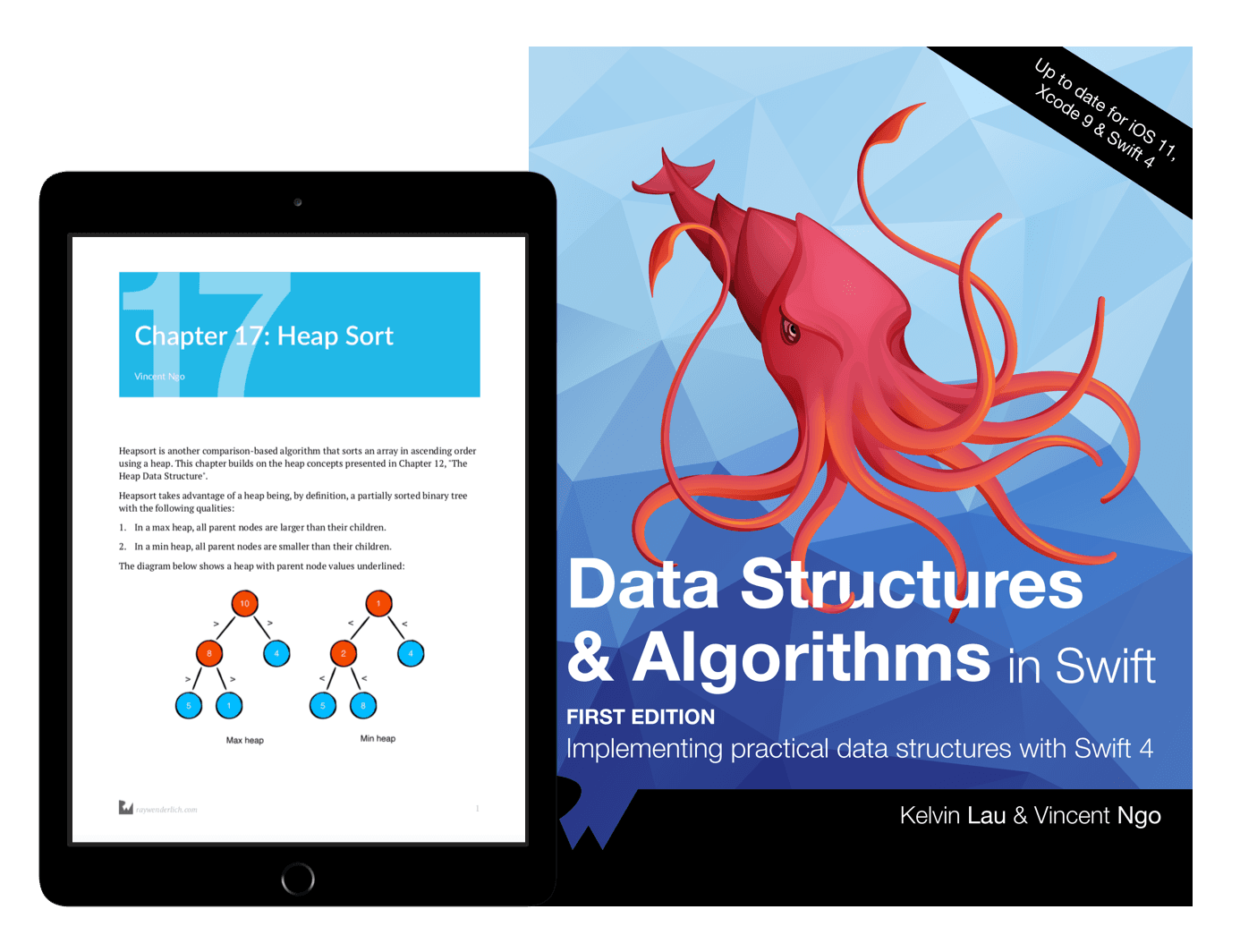
Mostly yes, but not guaranteed out of the box — the authors say you may need to adapt a snippet to fit your own codebase since clarity, not reusability, was the design priority.What is the companion book 'Data Structures & Algorithms in Swift'?It's an official paid book by the Swift Algorithm Club team, covering the same linked lists, trees, sorts, and graph algorithms with hands-on Swift implementations, available on the raywenderlich.com store.
It's an official paid book by the Swift Algorithm Club team, covering the same linked lists, trees, sorts, and graph algorithms with hands-on Swift implementations, available on the raywenderlich.com store.Does it cover machine learning algorithms too?Yes, a dedicated Machine Learning section includes k-Means clustering, k-Nearest Neighbors, linear and logistic regression, neural networks, PageRank, Naive Bayes, and simulated annealing.
Yes, a dedicated Machine Learning section includes k-Means clustering, k-Nearest Neighbors, linear and logistic regression, neural networks, PageRank, Naive Bayes, and simulated annealing.Are there interview-style practice problems?Yes, the Puzzles section covers classic coding-interview questions like Two-Sum, FizzBuzz, the Monty Hall Problem, Egg Drop, and the Dining Philosophers problem.
Yes, the Puzzles section covers classic coding-interview questions like Two-Sum, FizzBuzz, the Monty Hall Problem, Egg Drop, and the Dining Philosophers problem.What are similar projects?hello-algorithm, leetcode, interview, leetcode, Go, apachecn-algo-zh, algorithm-base, awesome-algorithms
hello-algorithm, leetcode, interview, leetcode, Go, apachecn-algo-zh, algorithm-base, awesome-algorithmsWhich topics is it in?coding-interview, interview-questions, data-structures, interview, interview-preparation, algorithms, programming, computer-science, book, swift, beginner-friendly, learning-resources
coding-interview, interview-questions, data-structures, interview, interview-preparation, algorithms, programming, computer-science, book, swift, beginner-friendly, learning-resources