









 Apache MXNet on Twitter
 Contributor and user blogs about MXNet
 Discuss MXNet on r/mxnet
 Apache MXNet YouTube channel
 Apache MXNet on LinkedIn
What is this?
 Apache MXNet is a deep learning framework designed for both efficiency and flexibility: it lets you mix symbolic and imperative programming, and a dynamic dependency scheduler automatically parallelizes operations on the fly.
Is it a Python library or something bigger?It's a full framework, not a thin library: a NumPy-like interface and the easy-to-use Gluon 2.0 API sit on top of a fast, memory-efficient engine. The README also frames it as a community with blueprints and guidelines for building deep learning systems.
It's a full framework, not a thin library: a NumPy-like interface and the easy-to-use Gluon 2.0 API sit on top of a fast, memory-efficient engine. The README also frames it as a community with blueprints and guidelines for building deep learning systems.How do I get it installed?The README's Contents section links to an Installation guide, alongside tutorials, API documentation and examples.
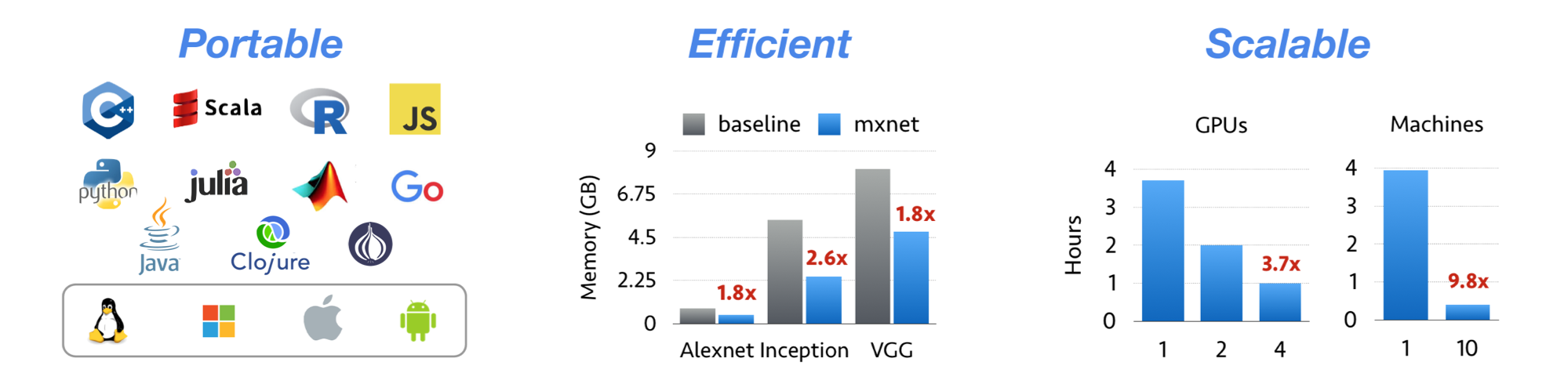
The README's Contents section links to an Installation guide, alongside tutorials, API documentation and examples.Which languages can I use it from?Python, Java, C++, R, Scala, Clojure, Go, JavaScript, Perl, and Julia are supported — ten languages in all.
Python, Java, C++, R, Scala, Clojure, Go, JavaScript, Perl, and Julia are supported — ten languages in all.Is MXNet still an actively developed project?No — the GitHub repository is archived and read-only, so it no longer receives updates; the newest release listed in the README is 1.9.1.
No — the GitHub repository is archived and read-only, so it no longer receives updates; the newest release listed in the README is 1.9.1.Does it run on phones or other small devices?Yes — it's lightweight and memory-efficient, portable to smart devices through native cross-compilation support on ARM and via ecosystem projects such as TVM, TensorRT, and OpenVINO.
Yes — it's lightweight and memory-efficient, portable to smart devices through native cross-compilation support on ARM and via ecosystem projects such as TVM, TensorRT, and OpenVINO.Can it use multiple GPUs or several machines at once?Yes — it scales to multi-GPU and distributed training with auto parallelism through ps-lite, Horovod, and BytePS, and it's cloud-friendly with direct AWS and Azure compatibility.
Yes — it scales to multi-GPU and distributed training with auto parallelism through ps-lite, Horovod, and BytePS, and it's cloud-friendly with direct AWS and Azure compatibility.I already know NumPy — how steep is the learning curve?Gentle — the README says NumPy users can easily adopt MXNet and start in deep learning. Automatic hybridization additionally gives imperative code the performance of traditional symbolic programming.
Gentle — the README says NumPy users can easily adopt MXNet and start in deep learning. Automatic hybridization additionally gives imperative code the performance of traditional symbolic programming.Can I plug in my own accelerator hardware?Yes — the backend supports full customization, so custom accelerator libraries or in-house hardware can be integrated without maintaining a fork of MXNet.
Yes — the backend supports full customization, so custom accelerator libraries or in-house hardware can be integrated without maintaining a fork of MXNet.Can it run models in the browser?Yes — the ecosystem includes MXNet.js, a JavaScript package for deep learning in the browser without a server.
Yes — the ecosystem includes MXNet.js, a JavaScript package for deep learning in the browser without a server.Where did MXNet come from?It emerged from a collaboration by the authors of cxxnet, minerva, and purine2, combining aspects of each for flexibility, speed, and memory efficiency, and later became an Apache project.
It emerged from a collaboration by the authors of cxxnet, minerva, and purine2, combining aspects of each for flexibility, speed, and memory efficiency, and later became an Apache project.