

18.3K ·GitHub
What is this?
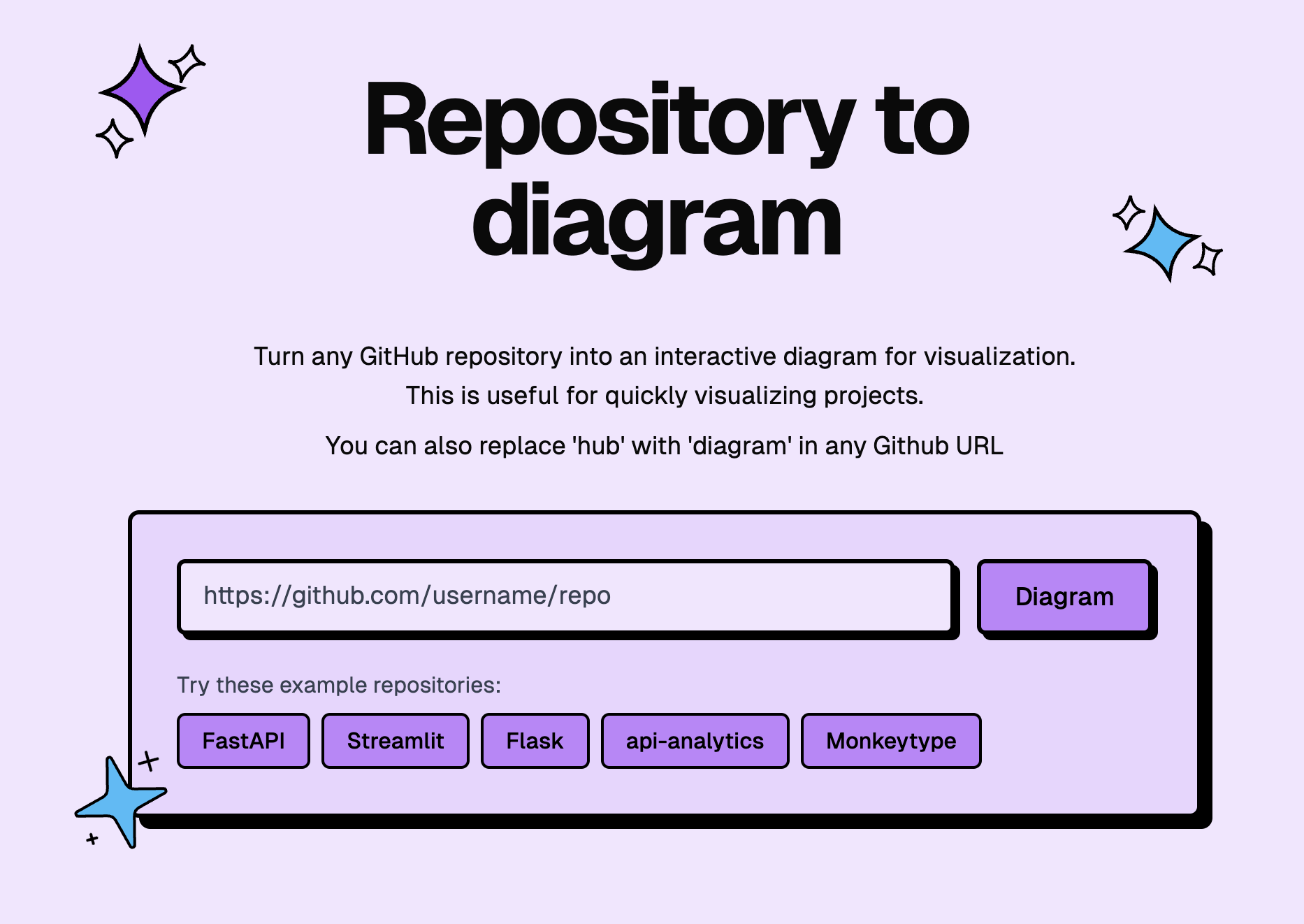
 GitDiagram turns any public or private GitHub repository into an interactive architecture diagram in seconds. You can also replace 'hub' with 'diagram' in any GitHub URL to open its diagram.
GitDiagram turns any public or private GitHub repository into an interactive architecture diagram in seconds. You can also replace 'hub' with 'diagram' in any GitHub URL to open its diagram.Is this a website I visit, or something I have to install?It's a web app — nothing to install. It converts the repository tree and README into a system-level graph of components and edges rather than drawn folders, and every node links to its real source on GitHub.
It's a web app — nothing to install. It converts the repository tree and README into a system-level graph of components and edges rather than drawn folders, and every node links to its real source on GitHub.How do I get a diagram for a repository, and what happens under the hood?Swap 'hub' for 'diagram' in any GitHub URL. It fetches the repo tree and README via the GitHub API, streams a plain-English architecture explanation, then renders a validated interactive Mermaid graph.
Swap 'hub' for 'diagram' in any GitHub URL. It fetches the repo tree and README via the GitHub API, streams a plain-English architecture explanation, then renders a validated interactive Mermaid graph.Do I need my own OpenAI API key to use it?Not on the hosted site: OpenAI is used by default (OpenRouter for self-hosted) and a complimentary quota is included. Local development needs more — at minimum R2, Upstash, and one AI provider in .env.
Not on the hosted site: OpenAI is used by default (OpenRouter for self-hosted) and a complimentary quota is included. Local development needs more — at minimum R2, Upstash, and one AI provider in .env.Does it work on every repository, or are there limits?Yes: truncated trees and oversized inputs are rejected before model work begins, and generation must fit a 300-second Vercel function budget.
Yes: truncated trees and oversized inputs are rejected before model work begins, and generation must fit a 300-second Vercel function budget.Can I run GitDiagram on my own server instead of the hosted site?Vercel is the only live runtime, but the repo keeps a recovery recipe: the same Next.js app builds into a minimal non-root Docker image for Railway via the checked-in Dockerfile and railway.json.
Vercel is the only live runtime, but the repo keeps a recovery recipe: the same Next.js app builds into a minimal non-root Docker image for Railway via the checked-in Dockerfile and railway.json.Can it diagram private repositories, and what happens to my GitHub token?Yes — pick Private Repos and provide a fine-grained GitHub personal access token. It travels only with the same-origin request, is never embedded in public links, and private artifacts get a separate R2 namespace.
Yes — pick Private Repos and provide a fine-grained GitHub personal access token. It travels only with the same-origin request, is never embedded in public links, and private artifacts get a separate R2 namespace.How does it stop the AI from producing broken or wrong diagrams?Model output is validated before you see it: the server checks identifiers, graph connectivity, limits and every linked path against the actual repository, retrying invalid output with focused feedback, and the browser renders sanitized Mermaid in strict security mode.
Model output is validated before you see it: the server checks identifiers, graph connectivity, limits and every linked path against the actual repository, retrying invalid output with focused feedback, and the browser renders sanitized Mermaid in strict security mode.Do I trigger a fresh AI run every time I reopen a diagram?No. Successful artifacts are persisted to Cloudflare R2 — keyed by repository, with private ones in a separate namespace — so later visits reopen the saved diagram without another model call.
No. Successful artifacts are persisted to Cloudflare R2 — keyed by repository, with private ones in a separate namespace — so later visits reopen the saved diagram without another model call.What can I actually do with the finished diagram?Click any component to open its real file or directory on GitHub, copy the Mermaid source, or download the rendered diagram as a PNG.
Click any component to open its real file or directory on GitHub, copy the Mermaid source, or download the rendered diagram as a PNG.What is GitDiagram built with?Next.js 16 App Router, React 19, TypeScript, Tailwind CSS and Radix UI, with generation endpoints on Vercel's Bun runtime. Cloudflare R2 stores artifacts, Upstash Redis handles quotas and locks, and the AI provider is OpenAI or OpenRouter.
Next.js 16 App Router, React 19, TypeScript, Tailwind CSS and Radix UI, with generation endpoints on Vercel's Bun runtime. Cloudflare R2 stores artifacts, Upstash Redis handles quotas and locks, and the AI provider is OpenAI or OpenRouter.What are similar projects?next-ai-draw-io, archify, oh-my-mermaid, deepwiki-open, whirl, chatbot, crm, svg-diagram
next-ai-draw-io, archify, oh-my-mermaid, deepwiki-open, whirl, chatbot, crm, svg-diagramWhich topics is it in?gemini-cli-extension, architecture-diagram, mermaid, code, software-architecture, diagrams, system-design, openrouter, vercel, architecture, visualization, tailwindcss
gemini-cli-extension, architecture-diagram, mermaid, code, software-architecture, diagrams, system-design, openrouter, vercel, architecture, visualization, tailwindcss