

What is this?
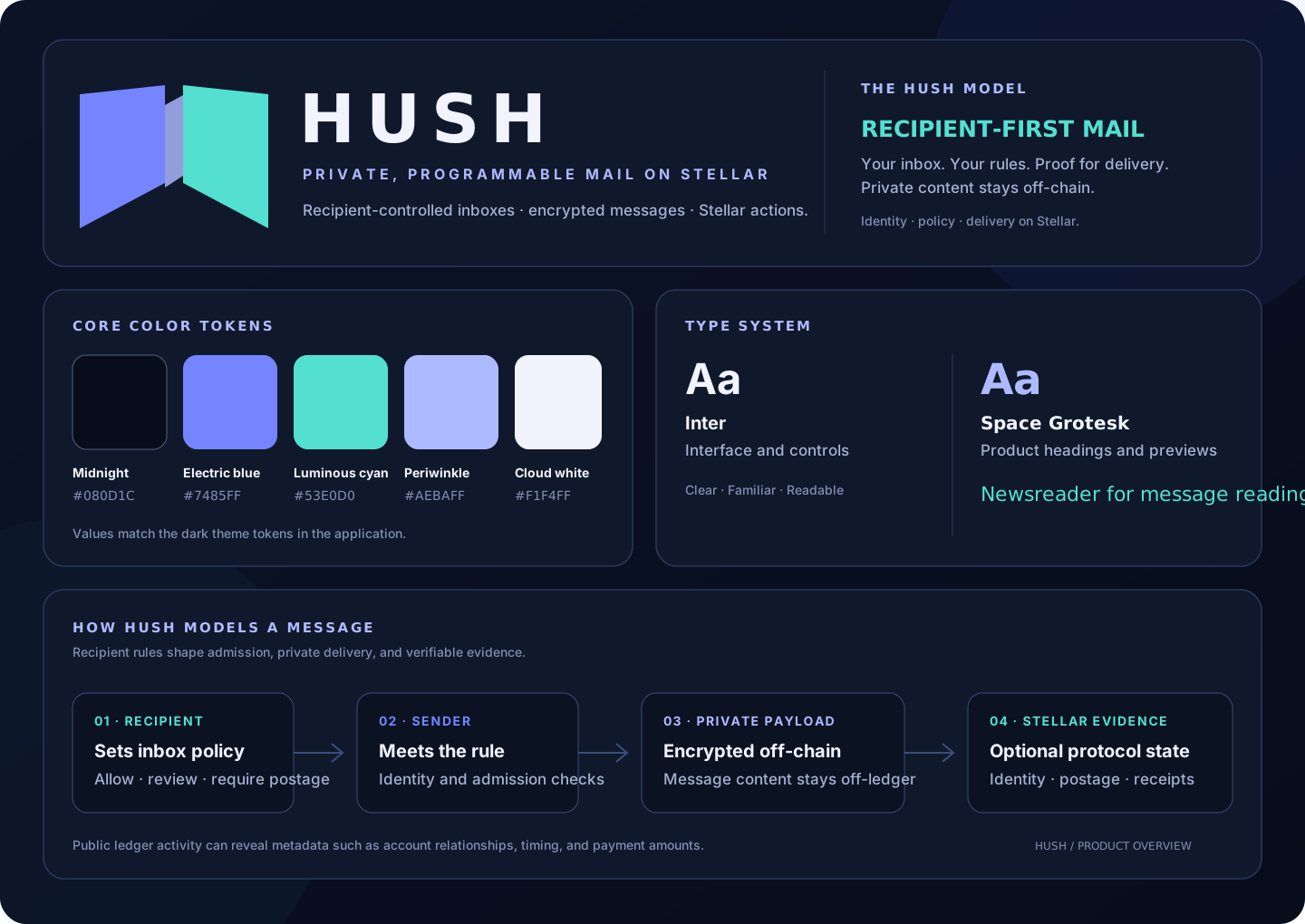
 Hush is an open-source beta for private, programmable email built on Stellar identity. Senders must satisfy a recipient-chosen policy (trusted access, verification, explicit approval, or postage) before a message is delivered, and the system produces verifiable delivery receipts.
Hush is an open-source beta for private, programmable email built on Stellar identity. Senders must satisfy a recipient-chosen policy (trusted access, verification, explicit approval, or postage) before a message is delivered, and the system produces verifiable delivery receipts.Is this a hosted email service I sign up for, or something I run myself?It is a self-run stack, not a signup service: the client, API, relay, protocol and Soroban smart contracts all live in this repo, and there is currently no verified public hosted demo.
It is a self-run stack, not a signup service: the client, API, relay, protocol and Soroban smart contracts all live in this repo, and there is currently no verified public hosted demo.How do I get it running locally?Install Node.js 24+ and Bun 1.3.14, then start the Vite dev server, which prints the local URL. Building or testing the Soroban contracts separately requires Rust at the version pinned in rust-toolchain.toml.
Install Node.js 24+ and Bun 1.3.14, then start the Vite dev server, which prints the local URL. Building or testing the Soroban contracts separately requires Rust at the version pinned in rust-toolchain.toml.Do I need a real Stellar wallet or production credentials to test it?No — the default local profile uses test accounts and synthetic messages against testnet; you're explicitly told not to use real wallet seeds, production tokens, or private keys.
No — the default local profile uses test accounts and synthetic messages against testnet; you're explicitly told not to use real wallet seeds, production tokens, or private keys.Is there a live, production-ready version I can send real email through today?No. Hush is explicitly beta software, and a testnet deployment is not production availability, deliverability, or a financial guarantee; some federation domains and identifiers are also still legacy pending migration.
No. Hush is explicitly beta software, and a testnet deployment is not production availability, deliverability, or a financial guarantee; some federation domains and identifiers are also still legacy pending migration.Does putting message delivery on Stellar make my emails public?No — message bodies and attachments stay off the ledger, carried by relays and encrypted object storage; only identity, policy, postage and receipt evidence touch Stellar, and that metadata (account relationships, payment amounts, timing) is still visible on-chain.
No — message bodies and attachments stay off the ledger, carried by relays and encrypted object storage; only identity, policy, postage and receipt evidence touch Stellar, and that metadata (account relationships, payment amounts, timing) is still visible on-chain.How does the sender-approval system actually work?It depends on the recipient's configured policy: a sender can be let through via a trusted or verified identity, required to wait for explicit approval, asked to pay postage, or blocked outright, with the client showing sender provenance and delivery state for every message.
It depends on the recipient's configured policy: a sender can be let through via a trusted or verified identity, required to wait for explicit approval, asked to pay postage, or blocked outright, with the client showing sender provenance and delivery state for every message.Why build this on Stellar instead of a normal mail server?Stellar is used purely as a programmable identity and protocol-evidence layer — Soroban contracts enforce sender policy, postage, and receipts — so admission rules and delivery proofs can be independently verified instead of trusted to a single operator.
Stellar is used purely as a programmable identity and protocol-evidence layer — Soroban contracts enforce sender policy, postage, and receipts — so admission rules and delivery proofs can be independently verified instead of trusted to a single operator.What's actually inside the repo besides the inbox UI?It bundles Stellar identity/federation resolution, message-envelope and key-derivation encryption code, a relay plus encrypted object storage service, a proof-inspector UI/API, and the Soroban contracts for policy, postage and receipts.
It bundles Stellar identity/federation resolution, message-envelope and key-derivation encryption code, a relay plus encrypted object storage service, a proof-inspector UI/API, and the Soroban contracts for policy, postage and receipts.What are similar projects?stellar-trade, clearledger, nuvex, clearledger-contracts, TrustMint, sphere-sdk, stellar-pathfinder, solana-classic
stellar-trade, clearledger, nuvex, clearledger-contracts, TrustMint, sphere-sdk, stellar-pathfinder, solana-classicWhich topics is it in?soroban, stellar, beta, end-to-end-encryption, smart-contracts, decentralized, cryptography, web3, messaging, privacy-first, blockchain, email
soroban, stellar, beta, end-to-end-encryption, smart-contracts, decentralized, cryptography, web3, messaging, privacy-first, blockchain, email